Health insurance is complicated... who knew?
In the bass guitar world technology has been pushing the limits with lighter weight, smaller cabinets, massive power, and more low end extension. My 6 pound head can run rings around the 65 pound heads of my youth and my 34 pound cab puts out more low end than the refrigerator sized (and weight) cabs of that same time period. Still, common wisdom is that you cannot have cheap, light, loud, and low all in one package. The laws of physics still apply along with basic economics.
In order to fix our medical care system, we must first acknowledge that the rules of math apply. It is not possible to have everyone covered with good comprehensive coverage at lower prices that are affordable to everyone without government funding and government interference. Lower priced plans with reduced coverage are only helpful until they are not. Cutting payment to physicians or other providers can only go so far before the math no longer works. A for profit entity has a bottom line commitment to the bottom line... and something eventually has to give in order for the company to make its profits. All that adds up to one inescapable conclusion.: before the ACA, the system was broken. Too many people were not insured. Too many people went bankrupt because of medical bills. Too many died because of lack of care. Treatment plans were often chosen by bean counters rather than because of efficacy. The training of physicians is expensive and favors some specialties over others regardless of actual social needs. The nature of healthcare makes it impossible for it to respond to market pressures in the same way that other industries do.
The ACA attempted to fix some of the presenting problems without addressing underlying issues. It succeeded in that small way and would have been more successful had the Republican Party not worked so hard to obstruct it. (We hear how the CBO's numbers were so off... but that ignores the fact that their numbers were based on the plan actually being adopted while 29 states refused the Medicare expansion part of the program). Because the ACA sought to work within the then, current system of for profit private insurance companies, etc., it could never deliver the product it promised of affordable, comprehensive coverage for all.
To get the product that a civilized country deserves requires a complete overhaul from top to bottom including training of physicians, funding of medical research, decisions regarding what care is provided (and not provided), how funding is allocated and what fee structures look like. It will take years to accomplish... possibly decades... but if we do not begin the process, we will see our broken system continue to deteriorate and all but the very rich will suffer.
Thursday, April 06, 2017


Thursday, February 09, 2017
Sermons now on YouTube
The church I serve has begun to put videos of the sermon up
on youtube each week. The program has
raised some interesting issues.
First, there are the aesthetic questions. We’re using an inexpensive camera (Zoom Q4n)
and trying to be as unobtrusive as possible so there is one camera angle with a
bit of fisheye to the image. The camera
allows an AB or XY microphone arrangement so we tried both to see what would
give us better sound. I also quickly
learned that a dark jacket works better against the background of the
sanctuary. Watching myself also has me thinking about how I move when I'm preaching, what I do with my hands, etc. etc.
The more important questions have had to do with the shaping
of the sermon itself. I preach from the
lectionary. For those unfamiliar with a
lectionary, it is a list of 4 scripture readings for each Sunday of the church
year in a three year cycle. The readings include an historic passage (usually from the Old Testament), a Psalm, a
gospel passage, and a reading from the letters in the New Testament. The passages are chosen to fit together (in
the eyes of those who put the lectionary together) and are intended to go
through all of the major themes of the Bible over the three year cycle. More liturgical churches read all four
lections each Sunday. Because we’re in
the free church tradition, we have no such expectation. Indeed, using the lectionary at all is a choice I make. From the 4 readings, I choose two passages for each Sunday and
preach on the second one. It seems
important to me that we, who call ourselves Biblical Christians, read at least
two passages each Sunday. (many more conservative churches don't really read any passages from the Bible, instead just proof-texting during the sermon to prove whatever preconceptions they already hold). Again, being
in the Free Church tradition, I am not compelled to use the lectionary and
indeed, there are times when I stray from it.
Still, for me, it is a discipline that forces me to preach on passages
that I might not choose otherwise and to wrestle with themes that are uncomfortable for me. Of
course, I do still pick from among the four readings.
All of that said, I try to choose passages that I think
relate to the context of Cambridge Drive Community Church. And I try to construct a sermon that speaks
to the issues with which we’re living at the moment. A sermon out there in the ether is divorced
from that context and may or may not speak in the same way to someone watching
in a very different setting. While
Cambridge Drive is by no means homogeneous theologically or otherwise, I can
reasonably expect that someone might watch one of these sermons who comes from
a very different place culturally or theologically than those sitting in the
sanctuary. And the folk in the chairs in our sanctuary know me well enough to know how to take things, when I'm joking, what struggles the passage imposes on me... To what degree do I try to
generalize my sermon for those outside?
Should I avoid context specific remarks, knowing that doing so might
make the sermon less effective for those in the congregation while making it
more effective for some hypothetical watcher from elsewhere? Do I downplay the relationships I have with my congregation to make a sermon more general or do I just allow the outside to overhear what is going on here?
I spoke with a friend this morning about those questions and she asked whether my sermons have changed since we began videoing them. I responded that I'm not sure... but I am certainly being more thoughtful about what I say and how I say it.
In any case... the sermons are now up there for any to see... Here's the link to the channel
And here's the sermon from February 5 for an easier look...
Let me know what you think...
Wednesday, January 18, 2017
Tiny Desk
Many of you know that back in the late 90's I performed in a duo with my daughter under her name, Alexis d, mostly around the Hudson & Pioneer Valleys in upstate NY & Massachusetts. It was one of the most musically satisfying times of my life.
Life goes on and things change but Alexis and I still perform occasionally and still write every now and then. This year, we have submitted a song to the NPR Tiny Desk Contest.
Check it out...
Here are the lyrics...
Chorus
Life goes on and things change but Alexis and I still perform occasionally and still write every now and then. This year, we have submitted a song to the NPR Tiny Desk Contest.
Check it out...
Here are the lyrics...
V.
Don't know where I'm going
Not sure where I've been
It's the biggest hot mess
This thing I'm in
I call up experience
My blessings and my sins
But I still don't know,
The next step or when.
Chorus
We can talk about the future,
We can wish about the past
But all I want
Is the gift I know'll last
V2
I've traveled around the
world
I've sure seen a lot
I've been granted riches
So others envy what i've got.
But all I know,
Is when I look at you,
That's got to be the best
thing
I could ever choose.
Chorus
Bridge
Let's spend a little time
Just us two
That's the present,
I'll give to you.
V3
I might be lost
I might get found,
I may be up
I've certainly been down,
Truth be told,
Only one way to be,
Only one place,
That's where you're with me.
Chorus
Bridge
Tag
Wednesday, January 11, 2017
Trump, Streep, and what happened
Most of us have heard at least exerpts from Meryl Streep's Golden Globe speech where she reamed the president elect for mocking a disabled reporter.
Here's the referenced video from Trump...
Here's the referenced video from Trump...
So, here's the argument we're hearing from the right wing... "Trump makes these same movements when he is making fun of people who are not disable, like Ted Cruz. Therefore, he is not mocking the disabled reporter." They often go on to acknowledge that Trump is rude, but state emphatically he is not guilty of mocking a disability.
I find that one of the most ridiculous defenses I have ever heard. Let me give a parallel example. If I called someone a "retard" who did not have a mental deficiency and then turned around and called someone who was intellectually challenged a "retard" would that mean I wasn't making fun of their disability? No. Indeed it would be worse because in the first instance, where I used that slur against someone without a disability, I was holding up the disabled person's condition as a slur. The intellectually challenged person becomes the living embodiment of the slur.
That is precisely what Trump was doing when he used the same movements in mocking Cruz. He was saying "Cruz is comparable to one of those people who are worthy of disdain and mockery." That he used the same movements when mocking someone who actually has a disability does not make it less offensive. Indeed, it is more offensive.
There are no excuses. That behavior clearly sets an example for others and normalizes behaviors that are despicable.
Tuesday, December 20, 2016
Failing presidents & hypocrisy
I've heard the word "hypocrite" a lot lately, referring to Democrats who complained about Republicans who pledged to obstruct Obama at every opportunity and yet seem determined to do exactly the same thing with Donald Trump. It isn't the same and here is why.
1. In spite of what we heard on Right Wing Talk Radio & TV, Obama is not and never was a communist out to destroy our country. He is a centrist, committed to working across the isle, many of whose ideas actually reflected Republican ideas. Take the ACA. It was a program very similar in its most important details to a health care proposal put forward by the right wing Heritage Foundation. It was centered around the private sector and enfranchised the insurance industry. Had he truly been a leftist, Obama would have argued for Medicare for all as Bernie Sanders has done.
Trump, on the other hand, seems to be poised to blow up the entire government. He has already skirted many of the common practices of the past such as releasing his tax returns so we can all see whether his interests conflict with those of the American people. He has chosen to avoid intelligence briefings, either because he truly believes there is nothing he needs to learn or because he doesn't trust the intelligence agencies. His cabinet appointees so far seem almost all to fall into one of two categories... either they have no experience and no knowledge of the area they will be heading or they are committed to destroying the role of the very agency they will head.
2. Obama clearly fell in line with the general trajectory of history. Whether we like what he dd or not, he didn't do anything that made people go, "What?"
Even before he is inaugurated, Trump is already breaking with policies and ideas that are foundational to our security both nationally and internationally. His thoughtless actions regarding our treaties have already begun to push Asian allies towards China and he has unnecessarily provoked China by skirting the one China doctrine. His relationship to Russia is troubling at best. His calls for the US military to commit war crimes and his commitment to sidestepping accepted rules that have to do with nepotism and conflicts of interest are equally troubling.
On the national level, he is either allowing or directing the dismantling of many of the social safety nets upon which many people depend.
3. Obama knew what government is and what its role is. Trump doesn't seem to understand that government is not a business and the rules by which it operates are not the same. If his business fails, it can declare bankruptcy and at least Donald walks away unscathed. It has happened multiple times. If government fails... that is something altogether different.
4. Obama knows that when the president speaks, things happen, so he is careful about what he says. Trump has no such wisdom or he enjoys the chaos that happens when he says something unwise. In either case... it is not good.
5. Obama has a heart to leave the world a better place. You may not agree with his vision of that, but you cannot argue the point. Nothing that Trump has ever done in his entire life would indicate that he has any concerns beyond himself. There is nothing beyond his skin that he seems to truly care about beyond the way that it impacts him.
6. The best you could say about the Republican obstructionists might be that some were acting consistently with their values - that they hate the federal government and literally want it to fail so by obstructing a president as thoughtful and charismatic as Obama who began his presidency with a real mandate, they were working to that end. And now they find a kindred soul in Trump, who wants to see government curtailed not out of some political ideology but because it constrains his personal behavior.
Democratic obstructionists will be working to preserve the rights and safety nets, some of which have been in place for decades and upon which many people depend. Without those safety nets, people will die.
So... are there areas where Dems should support Trump? Say, like if he proposes working on infrastructure? I have mixed feelings. I should say that I believe he will only propose improving the infrastructure if he will personally benefit from it. Still there clearly are areas where he may see his self-interests and those of the nations align... so yes, I would argue that we work on those issues with him. But we must never allow those issues to cause us to lose sight of the other things he is doing or allowing to not be done.
If Trump and the Republicans in office work to tear apart Social Security, Medicare, and the ACA (all of which they propose to do), I will do what I can to obstruct them and call upon my representatives to do the same. I want them to fail there. If they want to tear up treaties and alliances with other nations and put the entire world at risk, I will work to obstruct them and call upon my representatives to do the same. I want them to fail. If they continue to enfranchise hate groups and normalize the kind of behavior I would punish my grandson for, I will do what I can to obstruct them and call upon my representatives to do the same. I want them to fail. If the Republicans continue their march to destroy our government by undermining trust in all facets of it, I will do what I can to obstruct them and call upon my representatives to do the same. I want them to fail. If the Trump administration actually becomes the kleptocracy I expect it will be, I will do what I can to obstruct them and call upon my representatives to do the same. I want them to fail.
1. In spite of what we heard on Right Wing Talk Radio & TV, Obama is not and never was a communist out to destroy our country. He is a centrist, committed to working across the isle, many of whose ideas actually reflected Republican ideas. Take the ACA. It was a program very similar in its most important details to a health care proposal put forward by the right wing Heritage Foundation. It was centered around the private sector and enfranchised the insurance industry. Had he truly been a leftist, Obama would have argued for Medicare for all as Bernie Sanders has done.
Trump, on the other hand, seems to be poised to blow up the entire government. He has already skirted many of the common practices of the past such as releasing his tax returns so we can all see whether his interests conflict with those of the American people. He has chosen to avoid intelligence briefings, either because he truly believes there is nothing he needs to learn or because he doesn't trust the intelligence agencies. His cabinet appointees so far seem almost all to fall into one of two categories... either they have no experience and no knowledge of the area they will be heading or they are committed to destroying the role of the very agency they will head.
2. Obama clearly fell in line with the general trajectory of history. Whether we like what he dd or not, he didn't do anything that made people go, "What?"
Even before he is inaugurated, Trump is already breaking with policies and ideas that are foundational to our security both nationally and internationally. His thoughtless actions regarding our treaties have already begun to push Asian allies towards China and he has unnecessarily provoked China by skirting the one China doctrine. His relationship to Russia is troubling at best. His calls for the US military to commit war crimes and his commitment to sidestepping accepted rules that have to do with nepotism and conflicts of interest are equally troubling.
On the national level, he is either allowing or directing the dismantling of many of the social safety nets upon which many people depend.
3. Obama knew what government is and what its role is. Trump doesn't seem to understand that government is not a business and the rules by which it operates are not the same. If his business fails, it can declare bankruptcy and at least Donald walks away unscathed. It has happened multiple times. If government fails... that is something altogether different.
4. Obama knows that when the president speaks, things happen, so he is careful about what he says. Trump has no such wisdom or he enjoys the chaos that happens when he says something unwise. In either case... it is not good.
5. Obama has a heart to leave the world a better place. You may not agree with his vision of that, but you cannot argue the point. Nothing that Trump has ever done in his entire life would indicate that he has any concerns beyond himself. There is nothing beyond his skin that he seems to truly care about beyond the way that it impacts him.
6. The best you could say about the Republican obstructionists might be that some were acting consistently with their values - that they hate the federal government and literally want it to fail so by obstructing a president as thoughtful and charismatic as Obama who began his presidency with a real mandate, they were working to that end. And now they find a kindred soul in Trump, who wants to see government curtailed not out of some political ideology but because it constrains his personal behavior.
Democratic obstructionists will be working to preserve the rights and safety nets, some of which have been in place for decades and upon which many people depend. Without those safety nets, people will die.
So... are there areas where Dems should support Trump? Say, like if he proposes working on infrastructure? I have mixed feelings. I should say that I believe he will only propose improving the infrastructure if he will personally benefit from it. Still there clearly are areas where he may see his self-interests and those of the nations align... so yes, I would argue that we work on those issues with him. But we must never allow those issues to cause us to lose sight of the other things he is doing or allowing to not be done.
If Trump and the Republicans in office work to tear apart Social Security, Medicare, and the ACA (all of which they propose to do), I will do what I can to obstruct them and call upon my representatives to do the same. I want them to fail there. If they want to tear up treaties and alliances with other nations and put the entire world at risk, I will work to obstruct them and call upon my representatives to do the same. I want them to fail. If they continue to enfranchise hate groups and normalize the kind of behavior I would punish my grandson for, I will do what I can to obstruct them and call upon my representatives to do the same. I want them to fail. If the Republicans continue their march to destroy our government by undermining trust in all facets of it, I will do what I can to obstruct them and call upon my representatives to do the same. I want them to fail. If the Trump administration actually becomes the kleptocracy I expect it will be, I will do what I can to obstruct them and call upon my representatives to do the same. I want them to fail.
Tuesday, December 13, 2016
Russia
I don't know whether Russia interfered with the election in any substantive way. I don't know whether anyone in the Trump organization colluded (if Russia did). I don't know why Russia might have preferred Trump to win (although I can infer). I don't know what might have happened had Russia not interfered (if they did) or whether the outcome would have been different.
I do know that information was released that likely damaged Hillary Clinton's campaign both by the FBI and via other avenues. I know that information was not released on the Trump campaign including from the CIA who believed that Russia was helping out the Trump campaign...
Sooooo... an investigation seems critical. If a foreign government is interfering in our elections, we need to know and it needs to be addressed. As one former CIA chief has said, this is "the political equivalent of 9/11."
To those Republicans who investigated Bengazi 7 times, each time hoping for a different result but each time claiming that the American people deserve to know and who are now saying that an investigation into possible interference by Russia into the presidential election is not necessary... once again, you are showing that you have no real interest in the truth or in justice, but only in power. Your hypocrisy is astounding and blatantly obvious.
I do know that information was released that likely damaged Hillary Clinton's campaign both by the FBI and via other avenues. I know that information was not released on the Trump campaign including from the CIA who believed that Russia was helping out the Trump campaign...
Sooooo... an investigation seems critical. If a foreign government is interfering in our elections, we need to know and it needs to be addressed. As one former CIA chief has said, this is "the political equivalent of 9/11."
To those Republicans who investigated Bengazi 7 times, each time hoping for a different result but each time claiming that the American people deserve to know and who are now saying that an investigation into possible interference by Russia into the presidential election is not necessary... once again, you are showing that you have no real interest in the truth or in justice, but only in power. Your hypocrisy is astounding and blatantly obvious.
Tuesday, December 06, 2016
Jurisdiction
I've been reading Father Gregory Boyle's wonderful book Tattoos on the Heart. It is a collection of inspiring and heart-breaking stories from his years of ministry with gang members in LA. A story from chapter six (and Father Boyle's interpretation of it) particularly resonated with me today and related to things I've been thinking about.
In the aftermath of the election I've been thinking a lot about community and about the way we relate to other folk, near and far. One morning as he arrived at his office for work, Junior called out from his second story apartment window, "Love you G dog!"
Father Boyle answered back, "Thank you Junior. That was a very nice thing to say."
Boyle goes on, "He waves me on as if papally blessing me on my day. 'O come on now G, you know. You're in my jurisdiction.'"
In the interpretation of the story, Boyle observes that the gang members have very limited jurisdictions, areas and communities they know and for which they care. He doesn't outright say but implies that the barriers at the edge of those jurisdictions are as solid as they can be. He goes on that our call as Christians is to widen our jurisdictions.
As I've been watching the aftermath of the election both in the larger world and in my heart this call speaks loudly. We all have a variety of concentric jurisdictions, with each further one getting a little less commitment and caring. The primary jurisdiction is always the one that gets our deepest commitment. Sometimes the barriers are porous. Sometimes they are as solid as they can be. We all have a point at which the jurisdictions end.
Personally, before the election I would have felt that my primary jurisdiction was pretty big... or at least my second one was. Afterwards, I see it was not nearly as large as I thought, but that the barrier between it and the next level was extremely porous. After the election, everything in my heart, which had been deeply hurt and disappointed, wanted to shore up that barrier and close up any openings shutting out those beyond my closest jurisdictions.
It is frightening to open those barriers and it is dangerous. The more open you are, the more vulnerable you feel. It could be argued that that fear is exactly what fueled the election... fear of the one outside of my jurisdiction taking something that is rightfully mine. And so the walls go up both literal and figurative. Our role is to risk... to tear down the walls and to see whoever is standing on the other side as "in my jurisdiction."
An observation... we would hope that our elected leaders are people who have wide jurisdictions that at the very least include everyone in the nation along with the ecosystem. It is better yet when the barrier to their next level is porous and yearns for the very best not only for the US but the rest of the world.
Sometimes we have had leaders like that. More often they fall short. Unfortunately there is something about the role of elected leader that calls to the narcissist. The narcissist's jurisdiction is as narrow as it can possibly be... it ends at their own skin. The only time they care about anyone or anything else is when it impacts them. A talented narcissist can be charming and even effective... but it is all about ME... ALWAYS.
In the aftermath of the election I've been thinking a lot about community and about the way we relate to other folk, near and far. One morning as he arrived at his office for work, Junior called out from his second story apartment window, "Love you G dog!"
Father Boyle answered back, "Thank you Junior. That was a very nice thing to say."
Boyle goes on, "He waves me on as if papally blessing me on my day. 'O come on now G, you know. You're in my jurisdiction.'"
In the interpretation of the story, Boyle observes that the gang members have very limited jurisdictions, areas and communities they know and for which they care. He doesn't outright say but implies that the barriers at the edge of those jurisdictions are as solid as they can be. He goes on that our call as Christians is to widen our jurisdictions.
As I've been watching the aftermath of the election both in the larger world and in my heart this call speaks loudly. We all have a variety of concentric jurisdictions, with each further one getting a little less commitment and caring. The primary jurisdiction is always the one that gets our deepest commitment. Sometimes the barriers are porous. Sometimes they are as solid as they can be. We all have a point at which the jurisdictions end.
Personally, before the election I would have felt that my primary jurisdiction was pretty big... or at least my second one was. Afterwards, I see it was not nearly as large as I thought, but that the barrier between it and the next level was extremely porous. After the election, everything in my heart, which had been deeply hurt and disappointed, wanted to shore up that barrier and close up any openings shutting out those beyond my closest jurisdictions.
It is frightening to open those barriers and it is dangerous. The more open you are, the more vulnerable you feel. It could be argued that that fear is exactly what fueled the election... fear of the one outside of my jurisdiction taking something that is rightfully mine. And so the walls go up both literal and figurative. Our role is to risk... to tear down the walls and to see whoever is standing on the other side as "in my jurisdiction."
An observation... we would hope that our elected leaders are people who have wide jurisdictions that at the very least include everyone in the nation along with the ecosystem. It is better yet when the barrier to their next level is porous and yearns for the very best not only for the US but the rest of the world.
Sometimes we have had leaders like that. More often they fall short. Unfortunately there is something about the role of elected leader that calls to the narcissist. The narcissist's jurisdiction is as narrow as it can possibly be... it ends at their own skin. The only time they care about anyone or anything else is when it impacts them. A talented narcissist can be charming and even effective... but it is all about ME... ALWAYS.
Wednesday, November 16, 2016
Election 2016 #6 - my fantasy
From everything I can see, I do not believe that Donald Trump ever actually wanted or expected to be president. I truly think he was just screwing with us all. Now that he has won and we see the amazing disarray and ineptitude of his transition team, I have to wonder whether he is looking for a way out.

OK, this is a fantasy and I have zero expectation that it will happen... but it could happen. Indeed, I believe there are really good reasons to make it happen. So, maybe we should float this idea out there in hopes it gets Trump's ear. If it catches your imagination, share it far and wide.
So... first some factual observations.
Trump's presidency will be a failure. He cannot possibly meet the expectations of those who voted for him and they will come after him with pitchforks and torches in 2 and then 4 years. His brand will be destroyed. History will dismiss him. As a narcissist, this is the worst possible outcome for Trump.
The electors of the electoral college can vote for whoever they want. Even in states where they are legally required to vote for the winner of their state, the penalty for not doing so is very small.
If Trump were to become president and then resign, that would make Pence president... and from everything I can see, Trump does not share any ideological beliefs with Pence so Trump would not want that outcome. Plus resigning would be embarrassing.
Here's the fantasy... Trump could send his minions to privately see the electors and encourage them to switch their votes and put Hillary in. We're still not sure how many electors he actually has but likely a switch of about 25 would do the trick, maybe a few more. They could justify their switch as trying both to fulfill the original intent of the electoral college to keep unfit candidates from winning AND as honoring the will of the majority. As of this writing, HRC has won the popular vote by over 1 million votes. Alexander Hamilton saw the role of the electors to ensure that “the office of President will never fall to the lot of any man who is not in an eminent degree endowed with the requisite qualifications.” Duh!
So what does Trump get in my fantasy? He doesn't have to fail at president. He can yell all he wants that the election was rigged against him and become not only the leader of his base but also a martyr for their cause. His dream of a media empire will take off like wildfire. He could become the true leader of a new political movement and perhaps even a new political party. None of his shady dealings with foreign governments need ever come out. If, and I do mean if, he has any degree of patriotism in him, he gets to save the US from a disaster he has to know is coming if he becomes president.
So, Donald, are you up for this?
OK, this is a fantasy and I have zero expectation that it will happen... but it could happen. Indeed, I believe there are really good reasons to make it happen. So, maybe we should float this idea out there in hopes it gets Trump's ear. If it catches your imagination, share it far and wide.
So... first some factual observations.
Trump's presidency will be a failure. He cannot possibly meet the expectations of those who voted for him and they will come after him with pitchforks and torches in 2 and then 4 years. His brand will be destroyed. History will dismiss him. As a narcissist, this is the worst possible outcome for Trump.
The electors of the electoral college can vote for whoever they want. Even in states where they are legally required to vote for the winner of their state, the penalty for not doing so is very small.
If Trump were to become president and then resign, that would make Pence president... and from everything I can see, Trump does not share any ideological beliefs with Pence so Trump would not want that outcome. Plus resigning would be embarrassing.
Here's the fantasy... Trump could send his minions to privately see the electors and encourage them to switch their votes and put Hillary in. We're still not sure how many electors he actually has but likely a switch of about 25 would do the trick, maybe a few more. They could justify their switch as trying both to fulfill the original intent of the electoral college to keep unfit candidates from winning AND as honoring the will of the majority. As of this writing, HRC has won the popular vote by over 1 million votes. Alexander Hamilton saw the role of the electors to ensure that “the office of President will never fall to the lot of any man who is not in an eminent degree endowed with the requisite qualifications.” Duh!
So what does Trump get in my fantasy? He doesn't have to fail at president. He can yell all he wants that the election was rigged against him and become not only the leader of his base but also a martyr for their cause. His dream of a media empire will take off like wildfire. He could become the true leader of a new political movement and perhaps even a new political party. None of his shady dealings with foreign governments need ever come out. If, and I do mean if, he has any degree of patriotism in him, he gets to save the US from a disaster he has to know is coming if he becomes president.
So, Donald, are you up for this?
Tuesday, November 15, 2016
Election 2016 #5 - now what?
Like many other folk, I found myself reeling at the results of the presidential election. I had difficulty understanding why anyone would vote for Donald Trump. I was (and am) afraid of what the future might bring. I posted a statement on Facebook - "I wonder whether this is a country in can live in." By that I meant that I was considering emigrating somewhere. I did play some of those scenarios out and indeed, depending on what happens with medical insurance, I may have to. Since last Wednesday I've thought differently... it most definitely is not a country in which I want to live, so I am committing myself to work harder to make it the country in which I do want to live. OK, now what? What do we do?
None of these thoughts are original. I've listened a lot to Van Jones recently. Some of what he has said is reflected here. I also found an article by Masha Gessen on how to live under an autocratic ruler that I found extremely helpful.
There is a phrase that's going around (from Salena Zito?) in a number of slightly different variations, "Trump's supporters take him seriously but not literally while his detractors take him literally but not seriously." I will take him seriously now and I will continue to take him literally. Gessen's first rule is to believe what the autocrat says. When Trump says he wants to make Muslims register, believe him. When Trump says he will repeal the ACA, believe him. When he says he wants to deport 11 million people, believe him. When he says that women who have abortions should be prosecuted, believe him. Now it is possible that he didn't mean what he said in at least a few instances but I would rather be prepared for the worst than be surprised when he follows up. It is possible that even the Republicans will stand against some of his excesses (although I doubt that) and he won't be able to accomplish some of his plans. Be vigilant and be ready.
Be aware of what he actually said but also how he has followed up in action. He spoke out against racists (rather softly) but then turned around and hired Steve Bannon.
Watch those behind the scenes. Trump does not seem to have any real ideology. Those behind him do.
Work to build relationships and community so we can stand against the damages his administrations wants to do. Be a part of a religious body that takes seriously the calls of faith. If you can't do religion, get together with a bunch of other people regularly an build something that is working towards being the Blessed Community. You can't change the world alone but together...
And be persistent. Wilburforce took 13 years to get his anti-slavery bill passed. As Hillary quoted in her concession speech, "So let us not grow weary in doing what is right, for we will reap at harvest time if we do not give up. (Gal. 6:9, NRSV)
Listen to those who voted for Trump and keep the truth in front of them. I truly believe we have a lot in common. I was not happy with the direction of the nation either and felt disappointed that Obama did not push more aggressively. I think we have at least some common goals. Let's find them and hold them up. Then, remind them when Trump fails to meet their expectations, as he will, and continue to point out the evils there. Most importantly, build relationships across lines.
Be outraged. It is tempting to look for ways to find the good in Trump. There may indeed be some areas where he does some good things. Do not allow that to dim your vision. See what is outrageous and call it out.
In two years we have the midterm elections. Throw the Republicans out. OK, I know it isn't that simple but those of us standing against the goals of this administration must organize and work to turn things around. A Democratic House and Senate would make things soooooo much easier. More Democratic legislatures and executives at the state level would make standing for what is right and good so much easier. Let us put everything we can into making that happen.
Work hard on the issues that are critical. We must stand with our Muslim friends. If they do try to register Muslims, be registered as a Muslim. I commit to do so. Work with Democratic legislators to guard the SCOTUS. Work to do all we can to meet the challenges of climate change.
Work to provide a safe place for those communities most threatened by this political change.
Finally, remember that time is on our side. The arc of history is long but it always bends towards justice. The fears that motivated the alt-right in this election are based in reality. The nation is becoming more diverse in every way. That cannot be stopped. Millenials didn't show up nearly as much as they needed to, but the election map of those under 25 is almost completely blue. Yes, the map that went around immediately following the election was not accurate and reflected polling from a few weeks before the election but the real one still looks like this
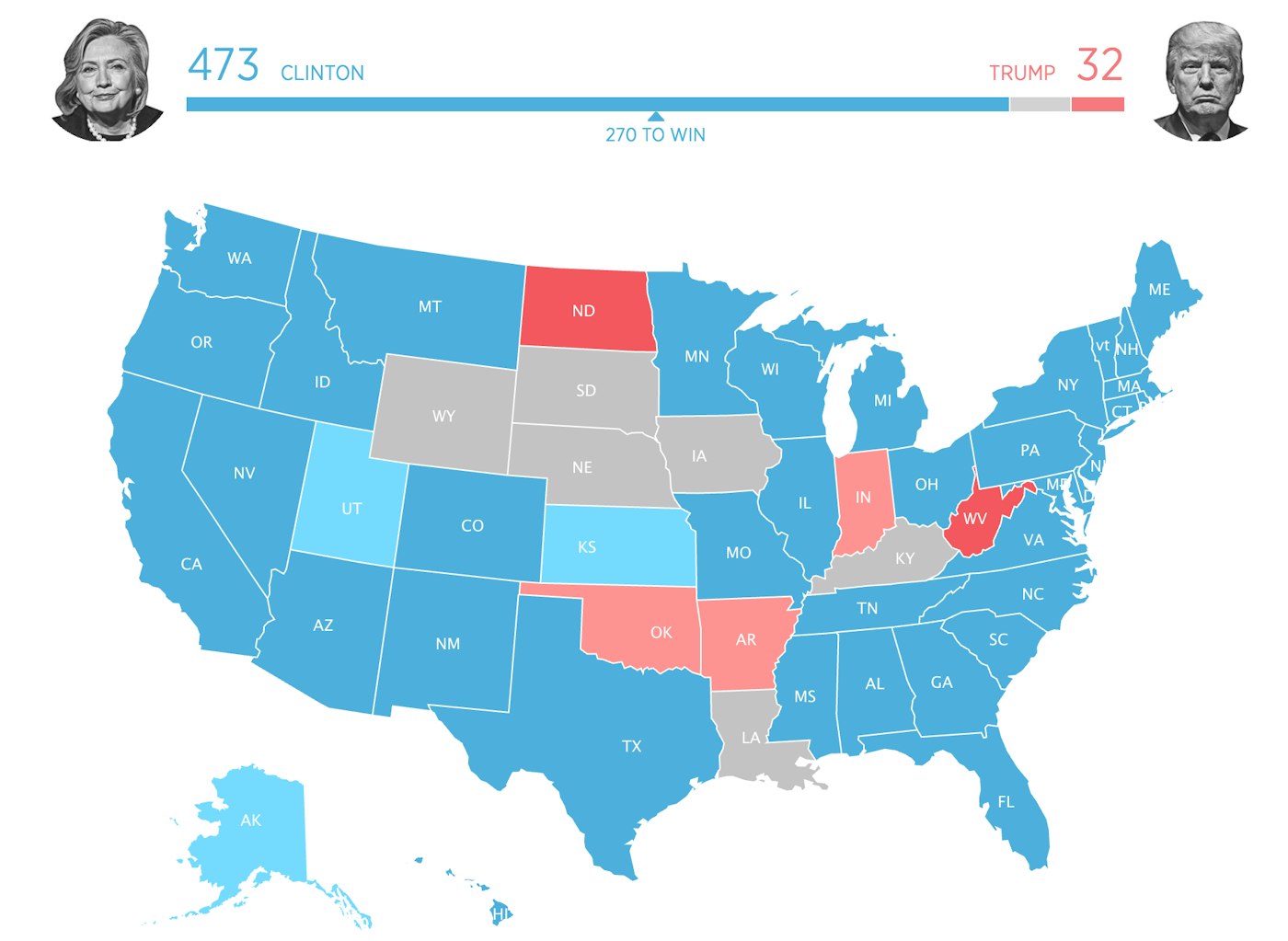 Time is on our side.
None of these thoughts are original. I've listened a lot to Van Jones recently. Some of what he has said is reflected here. I also found an article by Masha Gessen on how to live under an autocratic ruler that I found extremely helpful.
There is a phrase that's going around (from Salena Zito?) in a number of slightly different variations, "Trump's supporters take him seriously but not literally while his detractors take him literally but not seriously." I will take him seriously now and I will continue to take him literally. Gessen's first rule is to believe what the autocrat says. When Trump says he wants to make Muslims register, believe him. When Trump says he will repeal the ACA, believe him. When he says he wants to deport 11 million people, believe him. When he says that women who have abortions should be prosecuted, believe him. Now it is possible that he didn't mean what he said in at least a few instances but I would rather be prepared for the worst than be surprised when he follows up. It is possible that even the Republicans will stand against some of his excesses (although I doubt that) and he won't be able to accomplish some of his plans. Be vigilant and be ready.
Be aware of what he actually said but also how he has followed up in action. He spoke out against racists (rather softly) but then turned around and hired Steve Bannon.
Watch those behind the scenes. Trump does not seem to have any real ideology. Those behind him do.
Work to build relationships and community so we can stand against the damages his administrations wants to do. Be a part of a religious body that takes seriously the calls of faith. If you can't do religion, get together with a bunch of other people regularly an build something that is working towards being the Blessed Community. You can't change the world alone but together...
And be persistent. Wilburforce took 13 years to get his anti-slavery bill passed. As Hillary quoted in her concession speech, "So let us not grow weary in doing what is right, for we will reap at harvest time if we do not give up. (Gal. 6:9, NRSV)
Listen to those who voted for Trump and keep the truth in front of them. I truly believe we have a lot in common. I was not happy with the direction of the nation either and felt disappointed that Obama did not push more aggressively. I think we have at least some common goals. Let's find them and hold them up. Then, remind them when Trump fails to meet their expectations, as he will, and continue to point out the evils there. Most importantly, build relationships across lines.
Be outraged. It is tempting to look for ways to find the good in Trump. There may indeed be some areas where he does some good things. Do not allow that to dim your vision. See what is outrageous and call it out.
In two years we have the midterm elections. Throw the Republicans out. OK, I know it isn't that simple but those of us standing against the goals of this administration must organize and work to turn things around. A Democratic House and Senate would make things soooooo much easier. More Democratic legislatures and executives at the state level would make standing for what is right and good so much easier. Let us put everything we can into making that happen.
Work hard on the issues that are critical. We must stand with our Muslim friends. If they do try to register Muslims, be registered as a Muslim. I commit to do so. Work with Democratic legislators to guard the SCOTUS. Work to do all we can to meet the challenges of climate change.
Work to provide a safe place for those communities most threatened by this political change.
Finally, remember that time is on our side. The arc of history is long but it always bends towards justice. The fears that motivated the alt-right in this election are based in reality. The nation is becoming more diverse in every way. That cannot be stopped. Millenials didn't show up nearly as much as they needed to, but the election map of those under 25 is almost completely blue. Yes, the map that went around immediately following the election was not accurate and reflected polling from a few weeks before the election but the real one still looks like this
Friday, November 11, 2016
Election 2016 #4 more personal
I thought this was one of the most important comments on Tuesday evening as election results came in. It is a real and deeply important question - what does the elction of Donald Trump say to our children and grandchildren? In electing him we have legitimized his behavior - after all we chose him to be the leader of the USA. We have legitimized bullying. We have legitimized sexual predation. We have legitimized bigotry. We have legitimized racism. Racism, bigotry, predation, and bullying were a part of the American experience but before Tuesday we worked against them all. People were embarrassed to be bigoted and careful to express those kinds of thoughts. Now even those who previously called themselves "morals voters" have put their stamp of approval on all of the above.
I do not want my grandson to see Donald Trump as a man whose behavior he is to emulate. I don't want him to see a world where a man like that is rewarded with the highest office in the land. I don't want him to believe that any of those things are OK. Ever.
I do not want my granddaughter to grow up in a country where the leader brags about committing sexual battery and churches lift him up as their choice. I don't want her to ever experience being touched by any man without first giving her consent.
I don't want my Muslim, immigrant, gay friends to live in a nation where they must live in fear.
Yet, we are already seeing a multitude of reports of all of these kinds of behaviors on the rise.
On Tuesday I posted a comment on Facebook - I wonder whether this is a country in which I can live... I was pondering the possibility of moving somewhere else... Today, my answer is still "no," but my path is not to leave. I was too complacent before. No longer. I will work harder and harder to make this the country in which I want to live.
Thursday, November 10, 2016
Election Results 2016 - let's get personal #1
OK... one of the issues we hear about most regarding the Obama years is the ACA and more than once I heard people say that "Hillary will double down on Obamacare." Trump has said that on day 1 he will repeal the ACA. I'm not sure how that is possible but... From what I can see the closest that the GOP has come to a proposed alternative is Paul Ryans 37 pages of talking points (it lists goals but doesn't really say how we get to any of them... and as the ACA has shown, the proof really is in the implimentation) or Trump's promise of something better with no details and as far as anyone from the outside can see, no work having been done on what would be a tremendously complex issue. Of course, the option of just repealing the ACA without replacing it with any legislative alternative is a real possibility... with all of the attendant chaos that would bring.
This one is very personal for me. I have an hereditary condition called heterozygous familial hyperlipidemia. What that means is that my liver doesn't fully function with regards to processing cholesterol and I end up with crazy high numbers of the bad kind (when I was first tested, my overall cholesterol was 613). That results in severe artery disease. Most of the men in my biological family died of heart attacks in their thirties (my father at 31). That means that on the private market I am simply uninsurable.
When it was discovered that I have this condition, my arteries were in very bad shape to the point that surgical intervention would do no good. I had not had a heart attack though. The medications (expensive) work very well for me and my cholesterol has been under control for nearly 30 years. I still have not had a heart attack and some of the arterial damage has healed itself.
Under the old system, health insurance differed dramatically from one state to another. In New York, I got excellent insurance at a reasonable price through the local council of churches which acted as a group. In California, I had to get it either through the denomination or as private insurance. Private was not available to me. Period. The broker literally laughed when he saw the medical history portion of my application. So we got it through the denomination which, because everyone who could get insurance cheaper had moved to another source, became a group of older individuals with more medical issues. I got insurance... but the year prior to the ACA, it cost nearly $4000 a month for my spouse and I. Yes. That is the correct number of zeros. When the ACA was implemented, that program disappeared because nobody was able for it to continue. Even under the ACA, our insurance started at $2000 a month... but that still was a savings of over $24000 a year.
Long story short... if the ACA is repealed without a replacement that provides insurance to people like me at a reasonable cost, I will likely die. I'm not trying to be dramatic here... only stating a reasonable understanding of what will happen.
Before the ACA, 45,000 died each year from the results of lack of insurance. 20 million people who had been uninsured got health insurance under the ACA. That number dropped significantly. If the ACA is repealed without a suitable replacement, we'll be looking at those numbers again... and I will likely be one of them.
This one is very personal for me. I have an hereditary condition called heterozygous familial hyperlipidemia. What that means is that my liver doesn't fully function with regards to processing cholesterol and I end up with crazy high numbers of the bad kind (when I was first tested, my overall cholesterol was 613). That results in severe artery disease. Most of the men in my biological family died of heart attacks in their thirties (my father at 31). That means that on the private market I am simply uninsurable.
When it was discovered that I have this condition, my arteries were in very bad shape to the point that surgical intervention would do no good. I had not had a heart attack though. The medications (expensive) work very well for me and my cholesterol has been under control for nearly 30 years. I still have not had a heart attack and some of the arterial damage has healed itself.
Under the old system, health insurance differed dramatically from one state to another. In New York, I got excellent insurance at a reasonable price through the local council of churches which acted as a group. In California, I had to get it either through the denomination or as private insurance. Private was not available to me. Period. The broker literally laughed when he saw the medical history portion of my application. So we got it through the denomination which, because everyone who could get insurance cheaper had moved to another source, became a group of older individuals with more medical issues. I got insurance... but the year prior to the ACA, it cost nearly $4000 a month for my spouse and I. Yes. That is the correct number of zeros. When the ACA was implemented, that program disappeared because nobody was able for it to continue. Even under the ACA, our insurance started at $2000 a month... but that still was a savings of over $24000 a year.
Long story short... if the ACA is repealed without a replacement that provides insurance to people like me at a reasonable cost, I will likely die. I'm not trying to be dramatic here... only stating a reasonable understanding of what will happen.
Before the ACA, 45,000 died each year from the results of lack of insurance. 20 million people who had been uninsured got health insurance under the ACA. That number dropped significantly. If the ACA is repealed without a suitable replacement, we'll be looking at those numbers again... and I will likely be one of them.
Wednesday, November 09, 2016
Election 2016 Results #2
A newspaper writer in Pittsburgh commented a few weeks ago that those who opposed Trump took him literally but not seriously while those who supported his candidacy took him seriously but not literally.
Today we see they were both wrong. Trump is as serious as a heart attack (I choose that metaphor purposefully) and that is precisely because of his plans... plans that will likely be unimpeded since he'll have a Republican congress and, at least theoretically, a partisan judiciary.
11 million people deported... imagine what that does to our economy. And then imagine what that does to the places to which they are sent.
The ACA repealed... Perhaps as many as 20 million people who had been uninsured, who got insurance under the ACA, now uninsured again. 45,000 annual deaths in the US due to lack of insurance before the ACA and we'll be back there again. I have a very good chance of being one of them... more in a later post.
Fundamental threats to the freedom of the press and to the civilized transfer of the political process ("lock her up," or worse, "execute her").
Trade agreements torn up.
Social safety net shredded and replaced with privatized schemes.
Bigotry being enshrined under the cloak of religious freedom
Any desire to address the biggest issue we face today - climate change - in a substantive way is simply discarded.
People of color and LGBTQ folk being completely disenfranchised.
No checks or balances.
Today we see they were both wrong. Trump is as serious as a heart attack (I choose that metaphor purposefully) and that is precisely because of his plans... plans that will likely be unimpeded since he'll have a Republican congress and, at least theoretically, a partisan judiciary.
11 million people deported... imagine what that does to our economy. And then imagine what that does to the places to which they are sent.
The ACA repealed... Perhaps as many as 20 million people who had been uninsured, who got insurance under the ACA, now uninsured again. 45,000 annual deaths in the US due to lack of insurance before the ACA and we'll be back there again. I have a very good chance of being one of them... more in a later post.
Fundamental threats to the freedom of the press and to the civilized transfer of the political process ("lock her up," or worse, "execute her").
Trade agreements torn up.
Social safety net shredded and replaced with privatized schemes.
Bigotry being enshrined under the cloak of religious freedom
Any desire to address the biggest issue we face today - climate change - in a substantive way is simply discarded.
People of color and LGBTQ folk being completely disenfranchised.
No checks or balances.
election 2016 results #1
I believed the polls. I did expect that there would be some folk who came out and voted for Trump who were ashamed to tell anyone that was their plan, but I expected that number to be relatively small. So I believed the polls. I expected a Hillary win yesterday, perhaps even a landslide.
Here's why... I believed in the general goodness of the American people. I believed that as a nation we are moving beyond sexism, racism, xenophobia, homophobia, and toward a new community. Yes, I knew all of those things are still very real but I also believe they are fundamentally at odds with who and what we claim to be as a people. I believe in generosity, in community, in compassion... I simply could not believe that a person like Donald Trump could be elected to the presidency of the USA.
I am in shock now. I don't know what to do next but I am sure that the task before us is harder than I ever imagined and the work more urgent. But today... I just can't
Here's why... I believed in the general goodness of the American people. I believed that as a nation we are moving beyond sexism, racism, xenophobia, homophobia, and toward a new community. Yes, I knew all of those things are still very real but I also believe they are fundamentally at odds with who and what we claim to be as a people. I believe in generosity, in community, in compassion... I simply could not believe that a person like Donald Trump could be elected to the presidency of the USA.
I am in shock now. I don't know what to do next but I am sure that the task before us is harder than I ever imagined and the work more urgent. But today... I just can't
Thursday, October 06, 2016
Politics and the Problem of Truth
A clergy friend of mine recently posted a question on Facebook regarding the minefield of clergy or churches making political endorsements. I responded that I have no respect (or fear) of the law that says that churches, like other 501 C 3's risk losing their tax exempt status if they make an endorsement. I would argue that the 1st amendment says that churches can do what they feel they need to do without fear of reprisal from government agencies... but that is another discussion. I went on to say that churches still should not make endorsements. Here's why.
First off, even the most homogeneous of congregations still have some diversity of thought. To endorse a candidate will certainly disenfranchise anyone who supports another candidate or even those who are questioning.
Most importantly though, every candidate will at times make stands or statements that fly in the face of commitments that we must make as followers of Jesus. If we have endorsed a candidate, it can be very difficult to stand against those actions. That will damage any claims of credibility we have in the world.
I was particularly struck by this in the recent VP debate. Mike Pence calls himself an evangelical Christian and is the darling of the conservative Christian political movement, often being touted as a future presidential candidate. Again and again, he responded to challenges from Kaine with "that isn't true" or "we never said that" when there evidence is right there on the web for all to see.
We expect politicians to exaggerate and even to make promises that they have little intention of keeping... but to flat out deny reality, to lie bold faced, is another matter. For people who call themselves followers of the one who is The Truth to so readily abandon that commitment to truth telling only tells us that they are not really so committed to The Truth as they claim.
We can argue whether one candidate is less truthful than another. There are websites that track such things, as biased as they may be. In any case, that only supports my argument that churches need to avoid endorsements. If facing the truth makes us squirm at our chosen candidate... then maybe we need a different one.
First off, even the most homogeneous of congregations still have some diversity of thought. To endorse a candidate will certainly disenfranchise anyone who supports another candidate or even those who are questioning.
Most importantly though, every candidate will at times make stands or statements that fly in the face of commitments that we must make as followers of Jesus. If we have endorsed a candidate, it can be very difficult to stand against those actions. That will damage any claims of credibility we have in the world.
I was particularly struck by this in the recent VP debate. Mike Pence calls himself an evangelical Christian and is the darling of the conservative Christian political movement, often being touted as a future presidential candidate. Again and again, he responded to challenges from Kaine with "that isn't true" or "we never said that" when there evidence is right there on the web for all to see.
We expect politicians to exaggerate and even to make promises that they have little intention of keeping... but to flat out deny reality, to lie bold faced, is another matter. For people who call themselves followers of the one who is The Truth to so readily abandon that commitment to truth telling only tells us that they are not really so committed to The Truth as they claim.
We can argue whether one candidate is less truthful than another. There are websites that track such things, as biased as they may be. In any case, that only supports my argument that churches need to avoid endorsements. If facing the truth makes us squirm at our chosen candidate... then maybe we need a different one.
Wednesday, August 10, 2016
mini book review The Sex Lives of Cannibals

Tuesday, August 09, 2016
Book Review - Live Like you Give a Damn
I listen to books in my car as I commute back and forth to work. I had just started through This Changes Everything by Naomi Klein for the second time when I received notice about Tom Sine's book Live Like You Give a Damn. I was really excited. Klein in her book tells us that the current economic system is not sustainable without destroying the earth (rightly I think) and talks a lot about what a new system might look like if we abandoned the kind of capitalist system we currently have. The spiritual implications where everywhere. I listened and kept thinking that her message fits so well with the demands of the gospel. This Changes Everything is, I think, one of the most important books I've read in a long time. I hoped that Sine would do a similar exegesis of the problems we face while providing that faith based understanding of what new directions we as followers of Jesus might pursue. I was disappointed.
If I was to try to give you a condensed version of Live Like You Give a Damn, it would be this: "The world needs to change. We older folk in the church have stunted imaginations. Millenials want to make a difference. Millenials have good ideas if we listen. We should follow their lead. Here are some examples of churches and/or millenials who are making a difference." All well and good but what I was hoping to read was a diagnoses of those problems from a faith standpoint and some idea of what the big picture changes might be that we see manifested in those various examples. I didn't get what I hoped and as I read Sine's book, I wasn't able to divorce myself from Klein's excellent analysis... and I was left wanting more... a lot more.
I don't want to be unfair to Sine. He does provide some challenging analysis... but I wanted more. He does call us to question the values of our culture in a personal way but I wanted that plus the corporate questioning as well. He calls us to use our imaginations as foundations for faith as we devise a new narrative that leads us to our best tomorrows. He does remind us that the gospel is always contextual but I still wonder whether there must be a larger narrative under which, those contextual ones fit. It felt to me though as if he wanted the church to become a city on the hill kind of Anabaptist example for all to see while I wanted the Mustard Seed conspiracy that invades and changes everything. Perhaps if I had read Sines first and then Klein, the book would have sat better for me and Klein would have helped to fill in the blanks. Should you chose to read it, I'd recommend you do that. If you only have time/energy for one or the other, I'd recommend Klein's book given the caveat that while I think the implications of her work have a lot to say for people of faith, she does not frame any of her challenges in spiritual terms. In either case, you'll need to do some work... and that I guess, is a good thing.
Disclosure of Material Connection: I received this book free from the author and/or publisher through the Speakeasy blogging book review network. I was not required to write a positive review. The opinions I have expressed are my own. I am disclosing this in accordance with the Federal Trade Commission’s 16 CFR,Part 255.
If I was to try to give you a condensed version of Live Like You Give a Damn, it would be this: "The world needs to change. We older folk in the church have stunted imaginations. Millenials want to make a difference. Millenials have good ideas if we listen. We should follow their lead. Here are some examples of churches and/or millenials who are making a difference." All well and good but what I was hoping to read was a diagnoses of those problems from a faith standpoint and some idea of what the big picture changes might be that we see manifested in those various examples. I didn't get what I hoped and as I read Sine's book, I wasn't able to divorce myself from Klein's excellent analysis... and I was left wanting more... a lot more.
I don't want to be unfair to Sine. He does provide some challenging analysis... but I wanted more. He does call us to question the values of our culture in a personal way but I wanted that plus the corporate questioning as well. He calls us to use our imaginations as foundations for faith as we devise a new narrative that leads us to our best tomorrows. He does remind us that the gospel is always contextual but I still wonder whether there must be a larger narrative under which, those contextual ones fit. It felt to me though as if he wanted the church to become a city on the hill kind of Anabaptist example for all to see while I wanted the Mustard Seed conspiracy that invades and changes everything. Perhaps if I had read Sines first and then Klein, the book would have sat better for me and Klein would have helped to fill in the blanks. Should you chose to read it, I'd recommend you do that. If you only have time/energy for one or the other, I'd recommend Klein's book given the caveat that while I think the implications of her work have a lot to say for people of faith, she does not frame any of her challenges in spiritual terms. In either case, you'll need to do some work... and that I guess, is a good thing.
Disclosure of Material Connection: I received this book free from the author and/or publisher through the Speakeasy blogging book review network. I was not required to write a positive review. The opinions I have expressed are my own. I am disclosing this in accordance with the Federal Trade Commission’s 16 CFR,Part 255.
Thursday, August 04, 2016
The Destruction of the Evangelical Witness
I wouldn't call myself an Evangelical these days... at least not in the conventional sense of that term but that movement plays a significant role in my background. There was a long time when I would have identified myself as such. My tradition - the Baptist movement - and my denomination - The American Baptist churches, USA - both include significant proportions of folk who would call themselves "evangelical." I know the theology and have good friends who are evangelicals. While it is a branch of the Christian Church that I no longer call home, I do have deep appreciation for the best parts of that movement and often tell my church and my more liberal friends that I and we have much to learn from our evangelical brothers and sisters.
All that said, I am very worried that the evangelical church is in serious danger of destroying its witness and damaging the Church perhaps permanently. At the very least, they are convincing a lot of unchurched folk that they do not really believe what they say they believe and that they are more concerned about cultural influence and power than about following Jesus. How so? By endorsing Donald Trump and clothing it their faith.
I have no right to judge Donald Trump's faith or lack thereof, but if, as many evangelicals are saying, he has recently had a conversion experience, then somebody out to be helping him figure out what following Jesus looks like. All of these big name evangelical preachers like Jerry Falwell Jr. ought to be sitting him down and telling him that a follower of Jesus ought not be making fun of differently abled folk, ought not to be lying almost as often as he opens his mouth, ought to think more carefully before denigrating women and/or treating them as sex objects, should not be inciting his followers to violence... the list goes on and on. Of course, there is the problem of his past which seems to fly in the face of every value these evangelical leaders claim to hold... bad enough in itself, but he hasn't said a single word that shows any repentance from any of it. Indeed, he said that he does not need any forgiveness. These folk should be coaching him at the least or calling him out. For years they questioned Barack Obama's faith and are doing the same to Hillary Clinton when both of them were/are good members of local congregations and speak squarely from the Christian tradition. It is true that both Obama and Clinton are pro-choice... but as more than one person has argued, they both present policies that are more effective at lowering the rate of abortion than any recent Republican candidate. See here and here.
Instead of calling him out, some very visable prominent evangelicals have doubled down arguing that voting Trump is the only moral option, that his behavior regarding the Khan family was appropriate, and even comparisons between Trump and Ronald Reagan (as close as conservatives have to a saint). It is true that many evangelical leaders have spoken out in opposition to these leaders, it is these who have gotten the most press and the polls seem to indicate that white evangelicals are among the most faithful supporters of Donald Trump.
So... to my evangelical friends, distance yourself from Trump and from those evangelical leaders who are supporting him or at least call him on his behavior or forever be resigned to the fact that you have abandoned your values and sullied the cause of Christ.
All that said, I am very worried that the evangelical church is in serious danger of destroying its witness and damaging the Church perhaps permanently. At the very least, they are convincing a lot of unchurched folk that they do not really believe what they say they believe and that they are more concerned about cultural influence and power than about following Jesus. How so? By endorsing Donald Trump and clothing it their faith.
I have no right to judge Donald Trump's faith or lack thereof, but if, as many evangelicals are saying, he has recently had a conversion experience, then somebody out to be helping him figure out what following Jesus looks like. All of these big name evangelical preachers like Jerry Falwell Jr. ought to be sitting him down and telling him that a follower of Jesus ought not be making fun of differently abled folk, ought not to be lying almost as often as he opens his mouth, ought to think more carefully before denigrating women and/or treating them as sex objects, should not be inciting his followers to violence... the list goes on and on. Of course, there is the problem of his past which seems to fly in the face of every value these evangelical leaders claim to hold... bad enough in itself, but he hasn't said a single word that shows any repentance from any of it. Indeed, he said that he does not need any forgiveness. These folk should be coaching him at the least or calling him out. For years they questioned Barack Obama's faith and are doing the same to Hillary Clinton when both of them were/are good members of local congregations and speak squarely from the Christian tradition. It is true that both Obama and Clinton are pro-choice... but as more than one person has argued, they both present policies that are more effective at lowering the rate of abortion than any recent Republican candidate. See here and here.
Instead of calling him out, some very visable prominent evangelicals have doubled down arguing that voting Trump is the only moral option, that his behavior regarding the Khan family was appropriate, and even comparisons between Trump and Ronald Reagan (as close as conservatives have to a saint). It is true that many evangelical leaders have spoken out in opposition to these leaders, it is these who have gotten the most press and the polls seem to indicate that white evangelicals are among the most faithful supporters of Donald Trump.
So... to my evangelical friends, distance yourself from Trump and from those evangelical leaders who are supporting him or at least call him on his behavior or forever be resigned to the fact that you have abandoned your values and sullied the cause of Christ.
Sunday, July 31, 2016
Jill Stein and Gary Johnson Are Trying to Make Donald Trump President
Ok... the title is click bait... but it is pretty close to accurate.
Here's the deal, in order to win the presidency, a candidate must get 51% of the electoral votes, i.e. 270 electoral votes. The presidency does not go to the candidate with the most electoral votes if none get to that threshold. The House of Representatives chooses the next president. Let me say that one more time... in caps... so that everyone gets it. IF NO CANDIDATE GETS 270 ELECTORAL VOTES THE HOUSE DECIDES THE NEXT PRESIDENT. They have to choose from among the top three of electoral college vote receivers but they make the decision with each state delegation getting one vote. This has happened twice in the history of the US - 1800 & 1824. AND FWIW, no 3rd party candidate has ever won the presidency.
Now, if you believe that Gary Johnson or Jill Stein can get 270 electoral votes... then... don't bother reading this because there is no way to get through your bubble.
If you believe that voting your conscience regardless of any possible outcomes is morally superior, again don't bother reading this because one can't reason with fundamentalists (and that simply is what you are).
Let's play out some scenarios... Here's a ridiculous one but say Gary Johnson unbelievably gets 49% of the electoral votes, Hillary gets 20%, Trump gets 25% and Jill Stein gets the last 6%... Trump likely wins. The House won't give the presidency to a Democrat and that means they'll need to come together. They'd never get all of their states to vote for a libertarian or a Green which leaves Trump. Oh, and by the way, if they can't make a decision, the current Vice President acts as President... giving the office to a Democrat.
Second scenario... Hillary gets 49%, Trump gets 45% and Johnson & Stein split the additional 6... Trump wins for the above reasons. 2/3's of Stein's 3% would have given the election to HRC. It only takes a very small percentage for the third party candidates to be spoilers while at the same time, it is virtually impossible for them to actually win.
You might say, "But the Democrats will get a majority in the House and it is safe then even if the election goes to the House." Well... maybe. Maybe not. Remember, it isn't the membership of the House that votes, it is the delegations and each state gets one vote. So... if the majority of states send a Republican delegation, regardless of the overall balance of the House members, Trump wins. There is no way that a Republican House will elect anyone from another party as president and they have shown they have neither the ability or the patience to thoughtfully compromise. Add that while they're deliberating, Joe Biden is acting president and they will want to put Trump in as quickly as possible.
Just a fun side piece... the Senate chooses the Vice President... so they don't even have to be from the same party.
You might also say, "I live in a safe state so I can vote my conscience without worrying." Again... maybe... maybe not. This is a crazy election. NPR recently had a show where they interviewed a bunch of blue collar Democrats from Monessen, PA who said they were voting for Trump even though they didn't expect he can do any of the things he is promising. Frankly, I don't know what to expect. Hillary could win in a landslide... or Trump might beat her outright. Or the 3rd party spoilers might do just that and the election goes to the House and Donald Trump becomes president. I don't know what will happen and no state feels safe to me at this point. Voting for a third party candidate anywhere just seems too risky to me.
So here's the question... if no third party candidate has a snowball's chance in Phoenix of winning what in the world are Gary Johnson and Jill Stein doing? They have zero influence in the two major parties regardless of how many votes they get. (The people who will have influence in the parties are the ones who do the hard work of organizing within the parties. That is why the Tea Party was so effective in the Republican Party.) They cannot win. They'll never get 270 electoral votes and would never be chosen by the House as it is or will be in 2017. In Jill Stein's case, is she just trying to punish the Democrats for not being pure enough? Is this just some narcissistic game where they can demonstrate their purity and encourage others to do the same, damn the consequences? Or do they really not understand how the process works? Or are they really just plants working for Donald Trump to make him president? Regardless of their intent, if they get enough votes, that is exactly the result of their campaigns.
And of course, this is all just the electoral college stuff... there is the closer to the bone results like Florida in 2000 where if just 30% of those who voted for Ralph Nader had voted for Gore, there would have been no questions regarding who won the state, the SCOTUS mess would never have happened and W would not have been president. You play out the results of that. It is more likely that a third party candidate will simply influence who wins a given state. Remember, every state but two is winner take all in the electoral college so Johnson or Stein could receive 30% of the popular vote and get no electoral votes... but they would influence who wins the various states as per Nader in 2000.
So what does all of this add up to? A vote for anyone other than Hillary is a vote for Trump. He doesn't need to get a majority of the popular vote or even a majority of the electoral college to be the next president. All he needs is to keep Hillary from getting 270 electoral votes... and Jill Stein, Gary Johnson, and all those who vote for either are trying to help him accomplish just that.
Here's the deal, in order to win the presidency, a candidate must get 51% of the electoral votes, i.e. 270 electoral votes. The presidency does not go to the candidate with the most electoral votes if none get to that threshold. The House of Representatives chooses the next president. Let me say that one more time... in caps... so that everyone gets it. IF NO CANDIDATE GETS 270 ELECTORAL VOTES THE HOUSE DECIDES THE NEXT PRESIDENT. They have to choose from among the top three of electoral college vote receivers but they make the decision with each state delegation getting one vote. This has happened twice in the history of the US - 1800 & 1824. AND FWIW, no 3rd party candidate has ever won the presidency.
Now, if you believe that Gary Johnson or Jill Stein can get 270 electoral votes... then... don't bother reading this because there is no way to get through your bubble.
If you believe that voting your conscience regardless of any possible outcomes is morally superior, again don't bother reading this because one can't reason with fundamentalists (and that simply is what you are).
Let's play out some scenarios... Here's a ridiculous one but say Gary Johnson unbelievably gets 49% of the electoral votes, Hillary gets 20%, Trump gets 25% and Jill Stein gets the last 6%... Trump likely wins. The House won't give the presidency to a Democrat and that means they'll need to come together. They'd never get all of their states to vote for a libertarian or a Green which leaves Trump. Oh, and by the way, if they can't make a decision, the current Vice President acts as President... giving the office to a Democrat.
Second scenario... Hillary gets 49%, Trump gets 45% and Johnson & Stein split the additional 6... Trump wins for the above reasons. 2/3's of Stein's 3% would have given the election to HRC. It only takes a very small percentage for the third party candidates to be spoilers while at the same time, it is virtually impossible for them to actually win.
You might say, "But the Democrats will get a majority in the House and it is safe then even if the election goes to the House." Well... maybe. Maybe not. Remember, it isn't the membership of the House that votes, it is the delegations and each state gets one vote. So... if the majority of states send a Republican delegation, regardless of the overall balance of the House members, Trump wins. There is no way that a Republican House will elect anyone from another party as president and they have shown they have neither the ability or the patience to thoughtfully compromise. Add that while they're deliberating, Joe Biden is acting president and they will want to put Trump in as quickly as possible.
Just a fun side piece... the Senate chooses the Vice President... so they don't even have to be from the same party.
You might also say, "I live in a safe state so I can vote my conscience without worrying." Again... maybe... maybe not. This is a crazy election. NPR recently had a show where they interviewed a bunch of blue collar Democrats from Monessen, PA who said they were voting for Trump even though they didn't expect he can do any of the things he is promising. Frankly, I don't know what to expect. Hillary could win in a landslide... or Trump might beat her outright. Or the 3rd party spoilers might do just that and the election goes to the House and Donald Trump becomes president. I don't know what will happen and no state feels safe to me at this point. Voting for a third party candidate anywhere just seems too risky to me.
So here's the question... if no third party candidate has a snowball's chance in Phoenix of winning what in the world are Gary Johnson and Jill Stein doing? They have zero influence in the two major parties regardless of how many votes they get. (The people who will have influence in the parties are the ones who do the hard work of organizing within the parties. That is why the Tea Party was so effective in the Republican Party.) They cannot win. They'll never get 270 electoral votes and would never be chosen by the House as it is or will be in 2017. In Jill Stein's case, is she just trying to punish the Democrats for not being pure enough? Is this just some narcissistic game where they can demonstrate their purity and encourage others to do the same, damn the consequences? Or do they really not understand how the process works? Or are they really just plants working for Donald Trump to make him president? Regardless of their intent, if they get enough votes, that is exactly the result of their campaigns.
And of course, this is all just the electoral college stuff... there is the closer to the bone results like Florida in 2000 where if just 30% of those who voted for Ralph Nader had voted for Gore, there would have been no questions regarding who won the state, the SCOTUS mess would never have happened and W would not have been president. You play out the results of that. It is more likely that a third party candidate will simply influence who wins a given state. Remember, every state but two is winner take all in the electoral college so Johnson or Stein could receive 30% of the popular vote and get no electoral votes... but they would influence who wins the various states as per Nader in 2000.
So what does all of this add up to? A vote for anyone other than Hillary is a vote for Trump. He doesn't need to get a majority of the popular vote or even a majority of the electoral college to be the next president. All he needs is to keep Hillary from getting 270 electoral votes... and Jill Stein, Gary Johnson, and all those who vote for either are trying to help him accomplish just that.
Wednesday, July 20, 2016
fundamentalism and the voting booth
I know about fundamentalists. I'm a Baptist pastor and if any groups is known for harboring fundamentalists it is us. (It isn't fair or accurate to label all Baptists as fundamentalists... duh look at me... but there is something about this movement that at least allows room for them to develop).
This post is not about religious fundamentalists and their politics (though it may be). Instead it is about a new brand of political fundamentalists.
Back when Gore vs. Bush happened and Ralph Nader stuck his head into the fray, he spoke at my church in upstate NY. As I remember it, one of the things Nader said was that voters should choose a candidate purely from their ideas. If the candidate had no chance of winning... irrelevant. Idealogical purity was/is the only criteria. When pressed whether his candidacy might cause Bush to win, Nader refused to even consider any culpability. Indeed, when after the election Nader was presented with the numbers... if only 30% of those who had voted for him in Florida had gone for Gore, the questions that eventually took the election to the SCOTUS would never have materialized and Gore would have been the clear winner, Nader basically responded that had the Dems presented a better candidate, that would not have been an issue. Of course, if everyone voted simply on ideological purity, nobody would ever get enough votes to be elected. Had the Dems presented Nader, Bush still would have won and likely by a much, much wider margin.
This year, we're presented with an interesting political quandary. Neither of the major candidates is generating a lot of love from their prospective parties. I can't tell you how many leftist folk I've encountered who have said that it doesn't matter that HRC and Bernie come out the same on about 93% of the issues... it is the other 7% that they cannot abide by and so will never vote for HRC. (OK the percentages were pulled out of thin air, but HRC and Bernie aren't very far apart on most issues.) It is easier for me to understand a real conservative saying that he/she would never vote for Trump as at best he has been amazingly inconsistent regarding his stand on just about everything other than the size of his... hands. On that side of the isle I'm fascinated at the number of folk who are willing to overlook basically everything about him in order to vote Republican.
So the question is at what point does one step away from fundamentalism... and ideological purity? Anyone who knows me knows that I was a Bernie supporter although he was not my perfect candidate. I've long ago abandoned any semblance of political fundamentalism as my perfect candidate wouldn't have a snowball's chance in Phoenix of ever getting elected so I have long wrestled with the questions of incremental change and the possibility of winning vs. losing because I backed a horse without a chance and getting nothing I hope for.
This post is not about religious fundamentalists and their politics (though it may be). Instead it is about a new brand of political fundamentalists.
Back when Gore vs. Bush happened and Ralph Nader stuck his head into the fray, he spoke at my church in upstate NY. As I remember it, one of the things Nader said was that voters should choose a candidate purely from their ideas. If the candidate had no chance of winning... irrelevant. Idealogical purity was/is the only criteria. When pressed whether his candidacy might cause Bush to win, Nader refused to even consider any culpability. Indeed, when after the election Nader was presented with the numbers... if only 30% of those who had voted for him in Florida had gone for Gore, the questions that eventually took the election to the SCOTUS would never have materialized and Gore would have been the clear winner, Nader basically responded that had the Dems presented a better candidate, that would not have been an issue. Of course, if everyone voted simply on ideological purity, nobody would ever get enough votes to be elected. Had the Dems presented Nader, Bush still would have won and likely by a much, much wider margin.
This year, we're presented with an interesting political quandary. Neither of the major candidates is generating a lot of love from their prospective parties. I can't tell you how many leftist folk I've encountered who have said that it doesn't matter that HRC and Bernie come out the same on about 93% of the issues... it is the other 7% that they cannot abide by and so will never vote for HRC. (OK the percentages were pulled out of thin air, but HRC and Bernie aren't very far apart on most issues.) It is easier for me to understand a real conservative saying that he/she would never vote for Trump as at best he has been amazingly inconsistent regarding his stand on just about everything other than the size of his... hands. On that side of the isle I'm fascinated at the number of folk who are willing to overlook basically everything about him in order to vote Republican.
So the question is at what point does one step away from fundamentalism... and ideological purity? Anyone who knows me knows that I was a Bernie supporter although he was not my perfect candidate. I've long ago abandoned any semblance of political fundamentalism as my perfect candidate wouldn't have a snowball's chance in Phoenix of ever getting elected so I have long wrestled with the questions of incremental change and the possibility of winning vs. losing because I backed a horse without a chance and getting nothing I hope for.
Tuesday, June 14, 2016
More Guns?
 In the aftermath of the horrors of Orlando, the chorus has begun. "We need more guns." "If only someone in that nightclub had had a gun..." "The only thing that can stop a bad guy with a gun is a good guy with a gun." And on it goes.
The cynic in me wants to completely dismiss all of those speakers but I know there are some folk, probably even most, who say those things actually believe they are offering a real solution. We have a cultural myth that violence can actually solve problems and that responding with violence is the strong, manly, and usually appropriate response to serious problems.
I don't want to address that myth here although it is central to the discussion and challenging it is key to real solutions to the violence in our society. Instead, I want to look at the practicality of more guns and imagine just what that might have looked like at Pulse.
First, for mass shooters, the possibility of being killed is not a deterrent. Most end up dead anyway and go into the situation planning exactly that. In the case of religious crazies, there is often an overlay of martyrdom. The fear of death simply is irrelevant in those situations or may even be a motivation of the shooter.
So let's play this out in our imaginations - more guns. The nightclub is going full bore. There is loud music, flashing lights, and lots of people dancing. The room is tightly packed and the crowd is moving. Multiple people present have guns... They have been drinking and dancing and enjoying themselves. Suddenly people hear gunshots. The first reaction is confusion. Is it the music? What is going on? Then the crowd panics and is running in every direction. Joe Smith pulls his gun and in the craziness shoots at what he thinks is the shooter. Across the club, Bob Doe pulls his gun. Through the crowd, he sees two people shooting. He can guess the one with the AR15 is the person who started shooting first but is the 2nd one an accomplice or a good guy with a gun? He starts shooting as well just as the crowd closes in front of him... and the crowd is panicking even more, running in every direction. The first person to draw their gun hears shots coming from another direction and turns. Is that person another good guy or an accomplice? At whom do I shoot? Third, fourth, fifth guns are drawn and more people are shooting. None are trained to use a weapon under the stress of a situation like that. All are making life and death decisions in seconds. Most have been drinking. All the while the crowd is panicking and people are moving in and out of the lines of fire. someone hits the mass shooter and he goes down... but the bullets continue to fly. Multiple people have been shot... by whom? Ten minutes after the first shot, the police arrive at a scene that looks like the OK Corral. They see guns drawn, bodies on the floor, and people still shooting. How are they to know who is a good guy and who is not? Do they respond by shooting as well?
Were lives saved in this scenario? It certainly doesn't sound that way to me. Even in a situation where the people are trained for that kind of situation and someone is in charge, mistakes still happen. Soldiers talk about the fog of war where reason and training go out the window to be taken over by random instinct. Indeed, part of the design of assault weapons is meant to compensate for the lessened ability to aim, choose targets, and be completely intentional in battle. The weapon is designed to spray large numbers of bullets in a general direction in the hopes of hitting as many people as possible. They have a term for soldiers killed by their own in such circumstances - "friendly fire." We've also seen recent videos of police shootings where multiple trained police officers shoot scores of bullets at a suspect and at least a significant number of the bullets miss the target. In a setting like Pulse, where would those bullets end up?
No... I can't see a situation where having more guns would lead to a better outcome. I can come up with scores of situations where it would make things worse.
Subscribe to:
Posts (Atom)


