I've been reading Father Gregory Boyle's wonderful book Tattoos on the Heart. It is a collection of inspiring and heart-breaking stories from his years of ministry with gang members in LA. A story from chapter six (and Father Boyle's interpretation of it) particularly resonated with me today and related to things I've been thinking about.
In the aftermath of the election I've been thinking a lot about community and about the way we relate to other folk, near and far. One morning as he arrived at his office for work, Junior called out from his second story apartment window, "Love you G dog!"
Father Boyle answered back, "Thank you Junior. That was a very nice thing to say."
Boyle goes on, "He waves me on as if papally blessing me on my day. 'O come on now G, you know. You're in my jurisdiction.'"
In the interpretation of the story, Boyle observes that the gang members have very limited jurisdictions, areas and communities they know and for which they care. He doesn't outright say but implies that the barriers at the edge of those jurisdictions are as solid as they can be. He goes on that our call as Christians is to widen our jurisdictions.
As I've been watching the aftermath of the election both in the larger world and in my heart this call speaks loudly. We all have a variety of concentric jurisdictions, with each further one getting a little less commitment and caring. The primary jurisdiction is always the one that gets our deepest commitment. Sometimes the barriers are porous. Sometimes they are as solid as they can be. We all have a point at which the jurisdictions end.
Personally, before the election I would have felt that my primary jurisdiction was pretty big... or at least my second one was. Afterwards, I see it was not nearly as large as I thought, but that the barrier between it and the next level was extremely porous. After the election, everything in my heart, which had been deeply hurt and disappointed, wanted to shore up that barrier and close up any openings shutting out those beyond my closest jurisdictions.
It is frightening to open those barriers and it is dangerous. The more open you are, the more vulnerable you feel. It could be argued that that fear is exactly what fueled the election... fear of the one outside of my jurisdiction taking something that is rightfully mine. And so the walls go up both literal and figurative. Our role is to risk... to tear down the walls and to see whoever is standing on the other side as "in my jurisdiction."
An observation... we would hope that our elected leaders are people who have wide jurisdictions that at the very least include everyone in the nation along with the ecosystem. It is better yet when the barrier to their next level is porous and yearns for the very best not only for the US but the rest of the world.
Sometimes we have had leaders like that. More often they fall short. Unfortunately there is something about the role of elected leader that calls to the narcissist. The narcissist's jurisdiction is as narrow as it can possibly be... it ends at their own skin. The only time they care about anyone or anything else is when it impacts them. A talented narcissist can be charming and even effective... but it is all about ME... ALWAYS.
Showing posts with label community. Show all posts
Showing posts with label community. Show all posts
Tuesday, December 06, 2016


Tuesday, November 15, 2016
Election 2016 #5 - now what?
Like many other folk, I found myself reeling at the results of the presidential election. I had difficulty understanding why anyone would vote for Donald Trump. I was (and am) afraid of what the future might bring. I posted a statement on Facebook - "I wonder whether this is a country in can live in." By that I meant that I was considering emigrating somewhere. I did play some of those scenarios out and indeed, depending on what happens with medical insurance, I may have to. Since last Wednesday I've thought differently... it most definitely is not a country in which I want to live, so I am committing myself to work harder to make it the country in which I do want to live. OK, now what? What do we do?
None of these thoughts are original. I've listened a lot to Van Jones recently. Some of what he has said is reflected here. I also found an article by Masha Gessen on how to live under an autocratic ruler that I found extremely helpful.
There is a phrase that's going around (from Salena Zito?) in a number of slightly different variations, "Trump's supporters take him seriously but not literally while his detractors take him literally but not seriously." I will take him seriously now and I will continue to take him literally. Gessen's first rule is to believe what the autocrat says. When Trump says he wants to make Muslims register, believe him. When Trump says he will repeal the ACA, believe him. When he says he wants to deport 11 million people, believe him. When he says that women who have abortions should be prosecuted, believe him. Now it is possible that he didn't mean what he said in at least a few instances but I would rather be prepared for the worst than be surprised when he follows up. It is possible that even the Republicans will stand against some of his excesses (although I doubt that) and he won't be able to accomplish some of his plans. Be vigilant and be ready.
Be aware of what he actually said but also how he has followed up in action. He spoke out against racists (rather softly) but then turned around and hired Steve Bannon.
Watch those behind the scenes. Trump does not seem to have any real ideology. Those behind him do.
Work to build relationships and community so we can stand against the damages his administrations wants to do. Be a part of a religious body that takes seriously the calls of faith. If you can't do religion, get together with a bunch of other people regularly an build something that is working towards being the Blessed Community. You can't change the world alone but together...
And be persistent. Wilburforce took 13 years to get his anti-slavery bill passed. As Hillary quoted in her concession speech, "So let us not grow weary in doing what is right, for we will reap at harvest time if we do not give up. (Gal. 6:9, NRSV)
Listen to those who voted for Trump and keep the truth in front of them. I truly believe we have a lot in common. I was not happy with the direction of the nation either and felt disappointed that Obama did not push more aggressively. I think we have at least some common goals. Let's find them and hold them up. Then, remind them when Trump fails to meet their expectations, as he will, and continue to point out the evils there. Most importantly, build relationships across lines.
Be outraged. It is tempting to look for ways to find the good in Trump. There may indeed be some areas where he does some good things. Do not allow that to dim your vision. See what is outrageous and call it out.
In two years we have the midterm elections. Throw the Republicans out. OK, I know it isn't that simple but those of us standing against the goals of this administration must organize and work to turn things around. A Democratic House and Senate would make things soooooo much easier. More Democratic legislatures and executives at the state level would make standing for what is right and good so much easier. Let us put everything we can into making that happen.
Work hard on the issues that are critical. We must stand with our Muslim friends. If they do try to register Muslims, be registered as a Muslim. I commit to do so. Work with Democratic legislators to guard the SCOTUS. Work to do all we can to meet the challenges of climate change.
Work to provide a safe place for those communities most threatened by this political change.
Finally, remember that time is on our side. The arc of history is long but it always bends towards justice. The fears that motivated the alt-right in this election are based in reality. The nation is becoming more diverse in every way. That cannot be stopped. Millenials didn't show up nearly as much as they needed to, but the election map of those under 25 is almost completely blue. Yes, the map that went around immediately following the election was not accurate and reflected polling from a few weeks before the election but the real one still looks like this
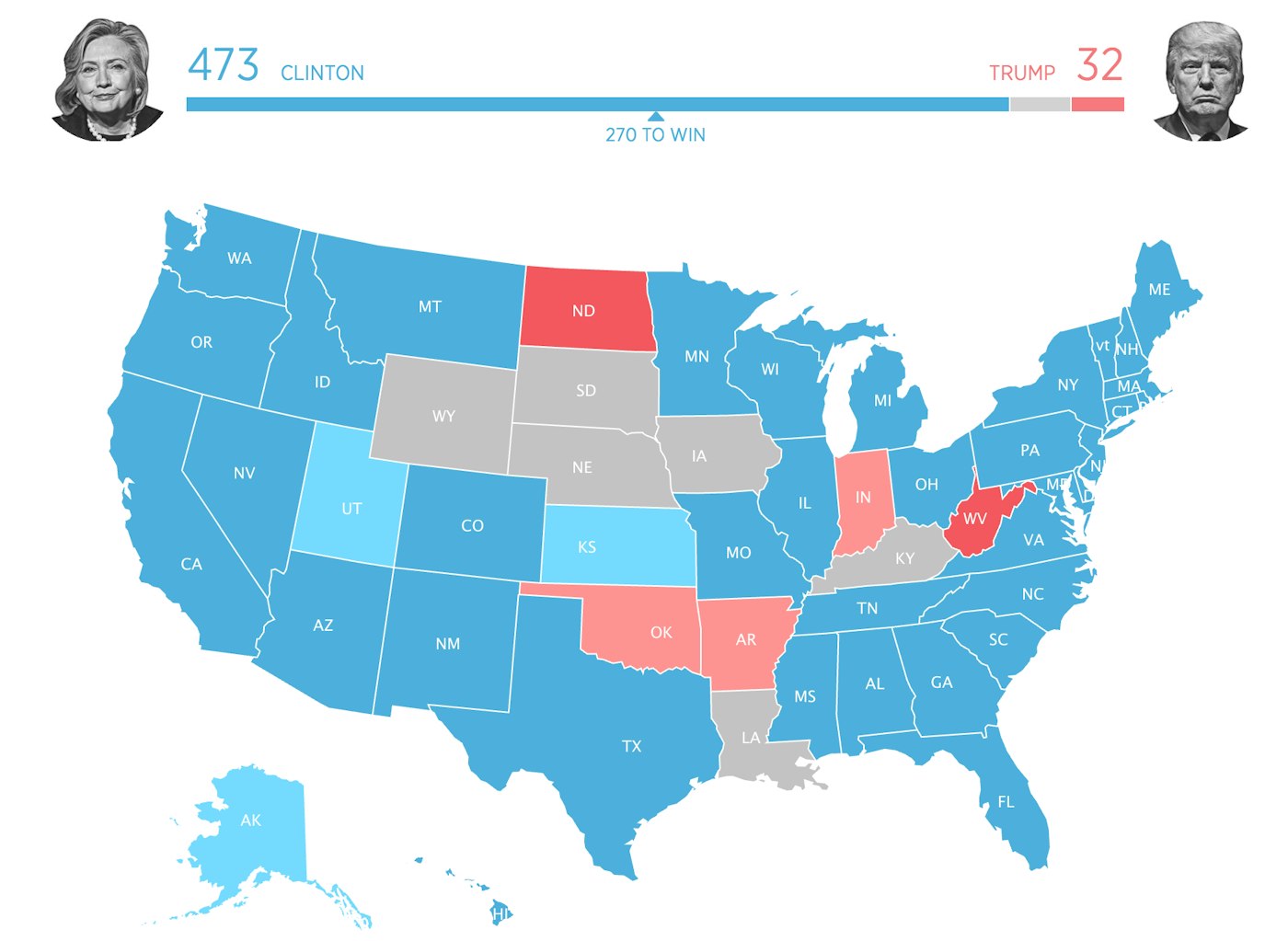 Time is on our side.
None of these thoughts are original. I've listened a lot to Van Jones recently. Some of what he has said is reflected here. I also found an article by Masha Gessen on how to live under an autocratic ruler that I found extremely helpful.
There is a phrase that's going around (from Salena Zito?) in a number of slightly different variations, "Trump's supporters take him seriously but not literally while his detractors take him literally but not seriously." I will take him seriously now and I will continue to take him literally. Gessen's first rule is to believe what the autocrat says. When Trump says he wants to make Muslims register, believe him. When Trump says he will repeal the ACA, believe him. When he says he wants to deport 11 million people, believe him. When he says that women who have abortions should be prosecuted, believe him. Now it is possible that he didn't mean what he said in at least a few instances but I would rather be prepared for the worst than be surprised when he follows up. It is possible that even the Republicans will stand against some of his excesses (although I doubt that) and he won't be able to accomplish some of his plans. Be vigilant and be ready.
Be aware of what he actually said but also how he has followed up in action. He spoke out against racists (rather softly) but then turned around and hired Steve Bannon.
Watch those behind the scenes. Trump does not seem to have any real ideology. Those behind him do.
Work to build relationships and community so we can stand against the damages his administrations wants to do. Be a part of a religious body that takes seriously the calls of faith. If you can't do religion, get together with a bunch of other people regularly an build something that is working towards being the Blessed Community. You can't change the world alone but together...
And be persistent. Wilburforce took 13 years to get his anti-slavery bill passed. As Hillary quoted in her concession speech, "So let us not grow weary in doing what is right, for we will reap at harvest time if we do not give up. (Gal. 6:9, NRSV)
Listen to those who voted for Trump and keep the truth in front of them. I truly believe we have a lot in common. I was not happy with the direction of the nation either and felt disappointed that Obama did not push more aggressively. I think we have at least some common goals. Let's find them and hold them up. Then, remind them when Trump fails to meet their expectations, as he will, and continue to point out the evils there. Most importantly, build relationships across lines.
Be outraged. It is tempting to look for ways to find the good in Trump. There may indeed be some areas where he does some good things. Do not allow that to dim your vision. See what is outrageous and call it out.
In two years we have the midterm elections. Throw the Republicans out. OK, I know it isn't that simple but those of us standing against the goals of this administration must organize and work to turn things around. A Democratic House and Senate would make things soooooo much easier. More Democratic legislatures and executives at the state level would make standing for what is right and good so much easier. Let us put everything we can into making that happen.
Work hard on the issues that are critical. We must stand with our Muslim friends. If they do try to register Muslims, be registered as a Muslim. I commit to do so. Work with Democratic legislators to guard the SCOTUS. Work to do all we can to meet the challenges of climate change.
Work to provide a safe place for those communities most threatened by this political change.
Finally, remember that time is on our side. The arc of history is long but it always bends towards justice. The fears that motivated the alt-right in this election are based in reality. The nation is becoming more diverse in every way. That cannot be stopped. Millenials didn't show up nearly as much as they needed to, but the election map of those under 25 is almost completely blue. Yes, the map that went around immediately following the election was not accurate and reflected polling from a few weeks before the election but the real one still looks like this
Tuesday, July 28, 2015
Choosing Faith for your child
The other Sunday we had a baby dedication at Cambridge Drive. The reality is that we don't dedicate babies... we dedicate the adults in their lives to providing a community of caring, nurture, and education so that they may come to their own profession of faith. That leads me to think about a statement that I hear fairly often, "We don't want to force our children into any faith tradition. They can make their own decision when they get older."
To an uncritical thinker, the two paths may sound very similar. They are not. let me give a metaphor.
 "We believe that playing a musical instrument is very important. Indeed, all of the studies show that it is one of the very best exercises for the entire brain. At the same time, we know that playing a musical instrument is a big commitment. It involves time to practice, money for lessons, money for instruments, and in some ways it even determines the child's friends - if for example they play in the band. A young child may think she knows what instrument is best but she is too immature to really think that through. Because it is so important, we'll wait until our son or daughter has graduated from high school so they can make their own decision about playing an instrument and which one."
It is of course, ridiculous. Anyone who has tried to learn an instrument as an adult knows how much more difficult it is than learning as a child. We also know how that brain exercise impacts the brains of young children in positive ways. Finally, learning an instrument is like learning a language and significant bits of that learning are transferable to other languages learned later on. It is fairly obvious that to wait until the child is old enough to "make their own choice" will simply remove the possibilities from them. If they learn no instruments as a child, they likely will never learn an instrument. On the other hand, if they learn an instrument and decide later on to learn a different one, they will already have many of the skills needed to make that transition.
I believe the same thing is true with regards to faith. Without a foundation in a religious tradition it will be very difficult for a young person to make good choices regarding a path for themselves. They won't have a language with which to describe religious inclinations and they won't have a vocabulary to enable them to make judgements regarding the value of one tradition or even one faith community over another. If religious faith has any value, children must be exposed from their youngest days.
And there is that question too... does religious faith have any value? There are scores of evangelical atheists out there these days telling us that religion is at its foundation a negative force. They point to he word "faith" and smirk that it requires commitment to something for which there can be no proof. Then they go on to list the history of religious violence.
There is no argument. Violence has been and still is perpetrated in the name of religion. Still, I think it would be difficult or impossible to parse out the parts of that violence that are religious in nature and which are political, economic, or cultural. Then there have been a few cultures that called themselves atheist. All of which I'm aware were significantly unenlightened.
As for being unverifiable... well, I do not agree that all things of value must be verifiable. I love my wife, my children, and my grandchildren. Is that verifiable? Is it quantifiable? I think not... but it is simply one of the most important commitments in my life.
Are there reasons to believe that a religious commitment, and even more important, a religious community is important? I think so. I would argue that while there are clearly instances of religious violence, that most of the positive movements forward in history have had significant if not exclusively religious components.
All of the blue zone studies have indicated that there is a very positive correlation between longevity and being part of a religious community which gives shape and purpose to life. That is quantifiable.
The unquantifiable part is that of my personal experience. It has been in that larger community of faith that I have found support and challenge that has helped me to be the person I am. Now, I know that one need not have a religious community to have community, but I see very, very few examples of the kinds of connections and support I see in a good church among my atheist friends. They may have small connective groups but they tend to be homogenous in every way and they tend to be much more laissez-faire in their connectedness. The churches in which I've been a part certainly have a degree of homogeneity but they have also had bits that were clearly not. They have all included folk with different political and cultural backgrounds, ages, economic strata, educational attainments... Were I choosing them as friends, many of them would have lain outside those lines. Because the church in effect forced me to be a part of their lives, I found myself enriched in ways that under other circumstances never would have happened.
Finally, religious folk are more generous (again quantifiable) and I would argue that is a very important trait to encourage. Religious faith requires one to look outside of themselves and to think of the welfare of others. Again, it is not difficult to find toxic examples, but even then, there is often a hint of a positive side to it.
So... I would argue that providing a positive foundation for a faith commitment is an important task for a parent and for the larger religious community. Raise a child within a tradition. Then, when they are ready they will choose, but they will have a foundation upon which to make a good decision.
To an uncritical thinker, the two paths may sound very similar. They are not. let me give a metaphor.

It is of course, ridiculous. Anyone who has tried to learn an instrument as an adult knows how much more difficult it is than learning as a child. We also know how that brain exercise impacts the brains of young children in positive ways. Finally, learning an instrument is like learning a language and significant bits of that learning are transferable to other languages learned later on. It is fairly obvious that to wait until the child is old enough to "make their own choice" will simply remove the possibilities from them. If they learn no instruments as a child, they likely will never learn an instrument. On the other hand, if they learn an instrument and decide later on to learn a different one, they will already have many of the skills needed to make that transition.
I believe the same thing is true with regards to faith. Without a foundation in a religious tradition it will be very difficult for a young person to make good choices regarding a path for themselves. They won't have a language with which to describe religious inclinations and they won't have a vocabulary to enable them to make judgements regarding the value of one tradition or even one faith community over another. If religious faith has any value, children must be exposed from their youngest days.
And there is that question too... does religious faith have any value? There are scores of evangelical atheists out there these days telling us that religion is at its foundation a negative force. They point to he word "faith" and smirk that it requires commitment to something for which there can be no proof. Then they go on to list the history of religious violence.
There is no argument. Violence has been and still is perpetrated in the name of religion. Still, I think it would be difficult or impossible to parse out the parts of that violence that are religious in nature and which are political, economic, or cultural. Then there have been a few cultures that called themselves atheist. All of which I'm aware were significantly unenlightened.
As for being unverifiable... well, I do not agree that all things of value must be verifiable. I love my wife, my children, and my grandchildren. Is that verifiable? Is it quantifiable? I think not... but it is simply one of the most important commitments in my life.
Are there reasons to believe that a religious commitment, and even more important, a religious community is important? I think so. I would argue that while there are clearly instances of religious violence, that most of the positive movements forward in history have had significant if not exclusively religious components.
All of the blue zone studies have indicated that there is a very positive correlation between longevity and being part of a religious community which gives shape and purpose to life. That is quantifiable.
The unquantifiable part is that of my personal experience. It has been in that larger community of faith that I have found support and challenge that has helped me to be the person I am. Now, I know that one need not have a religious community to have community, but I see very, very few examples of the kinds of connections and support I see in a good church among my atheist friends. They may have small connective groups but they tend to be homogenous in every way and they tend to be much more laissez-faire in their connectedness. The churches in which I've been a part certainly have a degree of homogeneity but they have also had bits that were clearly not. They have all included folk with different political and cultural backgrounds, ages, economic strata, educational attainments... Were I choosing them as friends, many of them would have lain outside those lines. Because the church in effect forced me to be a part of their lives, I found myself enriched in ways that under other circumstances never would have happened.
Finally, religious folk are more generous (again quantifiable) and I would argue that is a very important trait to encourage. Religious faith requires one to look outside of themselves and to think of the welfare of others. Again, it is not difficult to find toxic examples, but even then, there is often a hint of a positive side to it.
So... I would argue that providing a positive foundation for a faith commitment is an important task for a parent and for the larger religious community. Raise a child within a tradition. Then, when they are ready they will choose, but they will have a foundation upon which to make a good decision.
Tuesday, July 08, 2014
Which America
A few years ago I was on a flight and got talking with a woman who was an orthodox Calvinist. Before we left the plane she remarked that we worshiped a different Jesus. She was probably correct. There are more than one important areas of life where such a distinction is possible.
 I've been thinking a lot about patriotism since a few days before the
4th. I walk around my neighborhood and see lots of American flags. I hear the arguments about the flood of child immigrants and what should be done about them. I read questions about the on-going mess in Iraq, Syria, Israel, Palestine, Ukraine, and more other places than I can name and wonder what we can do, should do in the wider world. I hear folk of various political stripes claiming patriotism and often accusing
other folk of not having any... I think that we are often talking about a different America.
Now I realize this is a caricature and an over-simplification, but there are those for whom America is a white, middle class, Protestant country whose actions in the world are always righteous and good and for whom the free market is the answer to any and all problems. When one of these folk says that Obama is not a "true American," they are being literally accurate. When one questions or worse yet, condemns, the actions of the US in the world, they really are being traitorous to this understanding of America. Likewise when someone who holds this view of the US looks at me and says that I am not patriotic, they are absolutely correct. Indeed, I have always been wary of calling myself patriotic for fear that I would be seen as ascribing to this understanding of the US.
It is not the only picture of America though. There is another way to see America, forgive again the caricature. That vision says that America is a nation of immigrants - all colors, all cultures, all religions - coming together to build a new kind of society. It is a nation that speaks of justice and mercy and welcome first and foremost and which truly believes the inscription on the Statue of Liberty. It is a nation where the government is by and for the people, which while imperfect, really does seek the good and is necessary for society to be its best. To this second vision, I proudly affirm I am patriotic.
Friday, December 24, 2010
so who's better?
There is a common assumption that government is inefficient at providing anything. A comment on an earlier post included a link to a paper arguing that a completely privatized road system would be better than the system we currently have and would even lower the rate of automobile related deaths. It is rare that the argument goes that far, but there we are.
I would argue that for many areas of life, government is not only the logical but also the better provider of services. Let's look at a specific example, privatized fire protection. It might be cheaper (although we won't address the ways that is accomplished). A community has two companies providing fire departments. Taxes dropped significantly when the public department was abolished. Property owners purchase subscriptions for their service. Both companies do what they do well and the price is competitive between them and lower than the attendant taxes were. They truly are competitors in all of the best and worst senses of the term. A fire breaks out at a house with nobody home. The neighbors call a fire company and the dispatcher looks up the address, only to tell the caller that the homeowner does not have a subscription with them. Then the dispatcher tells the caller that the next door neighbor does have a subscription and they will be there to keep the fire from spreading. They arrive quickly, set up, and begin hosing down the neighbors home to keep the fire from spreading... while watching the first house burn. In the meantime, the caller has contacted the second company who send a truck. When they arrive, the first company is in their way and they cannot get close enough to efficiently address the fire. Plus, the additional call cost them abut 5-10 minutes, during which time the fire got a lot worse. And it is discovered that the neighbor on the other side, trying to save money, has neglected to purchase a subscription from either company. That house catches fire and the entire neighborhood is threatened. A third house, also without a subscription, begins to catch and the second company, which has a lot of subscriptions in the area, decides to address that house to keep things from spreading further. After the incident, they send a bill to the final home and the owner responds, "I didn't ask you to put out the fire." Those who have purchased subscriptions wonder whether they should drop theirs... look at the results - one house with a subscription is gone and one without was saved.
Would it not have been more efficient had there been one department, paid for by public funds, with the responsibility of keeping the entire community safe?
Here's the basic issue for me. A for profit company has as its primary responsibility, making a profit. Indeed, it has a legal and fiduciary responsibility to make money. If a given service cannot be done profitably, it will not be done. Decisions are made based on the bottom line, and usually with short term goals in mind. Many companies provide excellent services or products and rightly pride themselves on excellence but they must be able to make a profit or they do not provide that service or product. Government, on the other hand, has as its primary responsibility, the welfare of the citizenry. There are times when that welfare will not easily translate to a dollars and cents bottom line and other times when it clearly will not be profitable, especially in the short term.
Let's look at another example - medical care (which I believe should be provided by the government). When the Obama plan (which I'm not happy with) was being discussed two big scary terms thrown out by the opponents were "death panels" and "rationing" as if either was a new thing. There already are both. Panels decide what care will be provided. I have an insurance policy with scores of exclusions. Somebody sat down and said, "we will not cover this. no exceptions." About 5 years ago, we paid nearly $60K for a surgery that our daughter needed because our company never paid for that surgery. Without it, she would have gone deaf in one ear, had difficulty chewing, and likely would have had her jaw lock periodically, requiring visits to the emergency room to have it broken. "Sorry. Not covered. Ever." As for rationing, we were able to come up with the money. It really hit our finances hard but we did it. Had we not been able to, rationing would have come into play... no money = no surgery and she would likely be deaf now and facing the other issues. For those without insurance, every medical decision is a similar one. Questions are not always asked regarding the value of a procedure, the prognosis for the patient, or even if it is good science. Long term questions are not asked regarding the way that decision will impact the larger society. Instead, a bean counter asks who will pay and how much? I would much rather have a panel of scientists asking whether the procedure is likely to be successful than a panel of bean counters asking whether it will be profitable.
And finally, if a service is being provided for profit, every dollar that is shunted off into profits is a dollar not spent on meeting the need.
There is no question that government is not always efficient and that the services it provides could be improved. Often those with the loudest voices get their needs addressed while those with less power are ignored. Often government responds to misinformation and acts in ways that clearly go against the common good... that is what we have elections for. It is the responsibility of the whole of the citizenry to stand up and change those in power. Still, that basic difference of primary goal is critical. For profit businesses are there to make money. Meeting needs is only the way they make money. Government is there to meet needs.
Saturday, September 18, 2010
A Tea Party World
I understand the allure of "small government" - indeed, there are areas, specifically around military expenditures where I'd like it to get a lot smaller - but in general, it is not a world where I want to live.
The arguments for small government come from two general directions. First, that people should be responsible for their own lives. What they earn, they keep. Where they stumble, that is their problem. They make their choices and live with them. This argument, in its best incarnation, assumes that everyone has equal access. This is, blatantly untrue. Some people are recipients of the hard work, good luck, or unlawful activity of their ancestors while others suffer because of mistakes made in previous generations or as the result of injustices suffered in years before. And of course, there are cultural differences, often related to the above issues, that come into play as well. Some people run the entire marathon with no training and no shoes while others start 10 feet from the end and could crawl across the line and still win. In its worst incarnation, the argument doesn't care that things aren't equal. "I got mine, so screw you."
The second direction is tied to the first, that people should not be forced to help others. Some would argue that they will do it on their own without the government interfering. In the case of businesses, the free market will push them to ethical behavior. In the case of individuals, compassion for others will push them to build a more just society. Beyond the fact that history shows otherwise, this argument requires a belief that human beings are by nature altruistic, compassionate, far sighted, and interested in the needs of others. There is no doubt that we see hints of this and that there are individuals who exhibit those traits, but as a species... I wouldn't count on it. The Christian tradition has a theological concept that applies here - original sin. I do not believe that people are by nature depraved or evil, but I do believe that when push comes to shove, most people put their own needs first and most people are predisposed to ignore the needs and pains of others. How many times have we heard someone ho has returned from a trip to Haiti or India or Africa or even some of the US inner cities or the Gulf Coast and remark, "I never imagined such poverty." Well, if you never imagined it, it was only because you closed your eyes. It has always been there. And of course, there is the second thread in this argument... people should not be forced to help others because they are where they deserve to be.
So what do we hear from the Tea Party, the bastion of small government thinking? I have heard arguments that we should terminate unemployment benefits, social security, welfare, and Medicare. There is no question that these kinds of programs cost significant money. Terminating them would shrink government significantly. Imagine our nation without them. Picture a time without social security. I know many elderly folk who live off of that small income alone. Without it, they literally would have no income. And if you take away their Medicare, many would face astronomical medical bills. And, given their health issues and age, no other insurance would ever take them. That would be a stupid business decision. So what happens to them? They would die miserable deaths in abject poverty. So the argument might go, "that is their fault. They should have saved for retirement." All well and good unless during your working years you live so close to the edge that you must make choices between food and heat.
Imagine if we did away with unemployment, as meager as it is, for that 9+% of people who are not able to find a job? What would happen to them and their families? Our current economic structure requires that somebody be out of work... what should happen to those people?
Imagine an infrastructure that has completely disintegrated as government spending on roads, bridges, public transportation, etc. disappeared completely.
Imagine nobody ever checking food or drugs for safety. Every trip to the grocery store might be a game of Russian Roulette. Think of cars without any safety features. Imagine no public utilities. Picture businesses polluting communities and poisoning workers with no constraints because no government agency is looking over their shoulders.
Imagine no public higher education and perhaps even no public schools at all.
Those are all scenarios that Tea Party candidates have endorsed.
Yes... taxes would be much lower... but it is not a world where I want to live.
Thursday, January 03, 2008
Fragility of Community, the scrolls #3
As we listened to the story of the Qumran community, I was struck with a sadness at the fragility of community. I know they lasted for a long time but they didn't last forever. Were it not for a shepherd throwing rocks into a cave and hearing clay jars break, we would know next to nothing about them. Their work would still be in a cave. The ruins would still be unexplored. (Almost all of the excavation at Qumran has taken place since and because of the discovery of the Dead Sea Scrolls.)
The reality is that we still don't know a lot about the folk who lived there. Scholars disagree whether or not they were Essene or some other religious group or some other type of settlement altogether. The Wikipedia article on Qumran gives a good summary of some of the arguments.
Still, it seems pretty clear to me that they were a community gathered for religious purposes and that they took those purposes very seriously. And now they are gone.
As we drove home and came through Ventura, I thought of the Bridge Community there. It was a church community that deeply impressed me... They took their faith very seriously and tried to live it in concrete ways in that small city. They took their relationships with one another seriously and tried to truly be a community of faith together. After the death of one of the leaders, difficulties with landlords, struggles with how to spend time and resources, they dissolved. While I never was able to participate in the community and only got to know a few of the participants, I mourn the loss. It was nice to know that they were there and that they were doing church in a way that I would like to try.
All of that got me thinking... community is fragile. It is hard work to keep the relationships going and the struggles of relationship are never easy. It exists in a context and either disappears or changes when the context changes. It relies on a mix of personalities and gifts and circumstances that do not last forever. And then it is gone. And that is OK because it fulfilled its place in the universe and then made space for something new. If it did its job well, it leaves behind influences that live on for years to come. Qumran did. The Bridge did. Hopefully the communities that I am a part of do so as well.
Subscribe to:
Posts (Atom)


