Showing posts with label book review. Show all posts

Friday, June 02, 2017

Rules for Revolutionaries: How Big Organizing Can Change Everything - book review

If by some chance you haven't read anything I've posted in the past, I am a leftist.  I half joked that Bernie Sanders was not liberal enough for me... and it was only half a joke.  I am a child of the 60's.  The Civil Rights Movement and the Anti-War Movement were important parts of my formation.  I am also a Christian and a pastor of a Christian church.  I believe in radical transformation.   I believe we are on the cusp of significant change as a culture, as a world, and in the Church. 

When this title by Becky Bond & Zack Exley, Rules for Revolutionaries: How Big Organizing Can Change Everything,  presented itself as a possibility for a book review,  I envisioned 5 Easy Steps to Changing the World... or maybe even 5 Really Hard Steps to Changing the World.  I was hoping that the book would pick up where Naomi Klein's This Changes Everything left off and do a better job of providing direction than Tom Sine's, Live Like You Give a Damn did.  As a parenthesis, if you haven't read Klein's book, it is a must read for anybody concerned about the direction our world is going.  I was hoping for some insights that might apply to the Church and to churches as we seek to navigate this turbulent time.

I got what I wanted... sort of... and didn't get what I wanted... sort of...  The book claims to not just be a re-hashing of what happened in the Bernie Sanders presidential campaign and then proceeds to be exactly that. For those who are interested in understanding how the Sanders campaign worked and why it was as successful as it was, this book is a must read.  For whoever decides to run for the Democrats in 2020, it is likewise a must read.  For change smaller that a presidential campaign, the book requires a bit more work to make relevant.  Still, there are some key ideas that speak to anyone involved in working for significant change whether on the macro level or the more local one.  A couple that jumped out at me are:

  • The first is that change can happen... but if we want to see real change we have to embrace something big that includes all of the issues AND we must envision radical change rather than incremental change.  People are willing to work if they are inspired.  Incremental change doesn't inspire folk. 
  • Personal contact is central to everything
  • Institutions and practices that used to work just get in the way now.
  • Let volunteers run with their gifts.
  • Be willing to make mistakes.
  • Expect pushback even from folk you expected would be on your side.
 So... a good read to learn about the Sanders campaign with a number of serious ah ha's for anyone concerned with leading social change.

Disclosure of Material Connection: I received this book free from the author and/or publisher through the Speakeasy blogging book review network. I was not required to write a positive review. The opinions I have expressed are my own. I am disclosing this in accordance with the Federal Trade Commission’s 16 CFR,Part 255.


Wednesday, August 10, 2016

mini book review The Sex Lives of Cannibals

I listen to books in my car as I commute back and forth to work and have listened to some wonderful books.  Today I finished The Sex Lives of Cannibals by J. Maarten Troost, read by Simon Vance.  It is a wonderful book that I highly recommend.  It is hilarious but also plants some questions underneath your skin that you'll think seriously about.  And Simon Vance does an astoundingly good job of reading the book.  I'm sure it would be wonderful as a book book, but as an audio book it is really, really worth your time.  I highly recommend it.

Tuesday, August 09, 2016

Book Review - Live Like you Give a Damn

I listen to books in my car as I commute back and forth to work.  I had just started through This Changes Everything by Naomi Klein for the second time when I received notice about Tom Sine's book Live Like You Give a Damn.  I was really excited.  Klein in her book tells us that the current economic system is not sustainable without destroying the earth (rightly I think) and talks a lot about what a new system might look like if we abandoned the kind of capitalist system we currently have.  The spiritual implications where everywhere.  I listened and kept thinking that her message fits so well with the demands of the gospel.  This Changes Everything is, I think, one of the most important books I've read in a long time.  I hoped that Sine would do a similar exegesis of the problems we face while providing that faith based understanding of what new directions we as followers of Jesus might pursue.  I was disappointed.

If I was to try to give you a condensed version of Live Like You Give a Damn, it would be this: "The world needs to change. We older folk in the church have stunted imaginations. Millenials want to make a difference.  Millenials have good ideas if we listen.  We should follow their lead.  Here are some examples of churches and/or millenials who are making a difference."  All well and good but what I was hoping to read was a diagnoses of those problems from a faith standpoint and some idea of what the big picture changes might be that we see manifested in those various examples.  I didn't get what I hoped and as I read Sine's book, I wasn't able to divorce myself from Klein's excellent analysis... and I was left wanting more... a lot more.

I don't want to be unfair to Sine.  He does provide some challenging analysis... but I wanted more.  He does call us to question the values of our culture in a personal way but I wanted that plus the corporate questioning as well.  He calls us to use our imaginations as foundations for faith as we devise a new narrative that leads us to our best tomorrows.  He does remind us that the gospel is always contextual but I still wonder whether there must be a larger narrative under which, those contextual ones fit.  It felt to me though as if he wanted the church to become a city on the hill kind of Anabaptist example for all to see while I wanted the Mustard Seed conspiracy that invades and changes everything.  Perhaps if I had read Sines first and then Klein, the book would have sat better for me and Klein would have helped to fill in the blanks.  Should you chose to read it, I'd recommend you do that.  If you only have time/energy for one or the other, I'd recommend Klein's book given the caveat that while I think the implications of her work have a lot to say for people of faith, she does not frame any of her challenges in spiritual terms.  In either case, you'll need to do some work... and that I guess, is a good thing.

Disclosure of Material Connection: I received this book free from the author and/or publisher through the Speakeasy blogging book review network. I was not required to write a positive review. The opinions I have expressed are my own. I am disclosing this in accordance with the Federal Trade Commission’s 16 CFR,Part 255.

Friday, April 08, 2016

An Imagined Reality


Folk who know me know that I'm feelin' the Bern.  I've had some good conversations with friends who definitely don't feel the same and some have raised interesting critiques of Bernie Sanders.  One friend said that Bernie should not be president because he simply doesn't understand how the world works.  I disagreed and responded that perhaps it is not that he doesn't understand how the world works but instead he is offering a different paradigm as to how it should or could work.

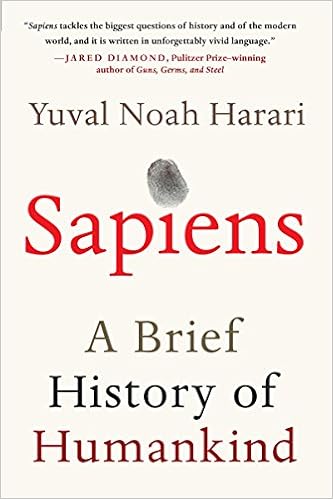
Recently I read a really fascinating book called Sapiens: A Brief History of Humankind.  Of all of the ideas in the book, the one that really caught my imagination is that everything works because of our unique ability to imagine a paradigm and then agree upon it.  Those imagined realities enable large groups of humans to work together, to trade with one another, to form societies.  Basically the author, Yuval Noah Harari, says that there is nothing in human society that does not depend upon those imagined realities upon which we have agreed to agree.  And those imagined realities can be changed.

I was thinking about one of those imagined realities the other day when an editorial in our local paper complained that the problems with the dollar began when its value was cut off from anything real - i.e. gold.  But, the value of gold is also tied to nothing "real."  The book uses gold as an illustration of imagined realities.  While the metal does have some iteresting properties, there is no reason beyond a cultural agreement that it should hold any more value than some other metal, many of which are significantly more useful.  Ineed, when the Spaniards arrived in the new world, searching for gold,  the native people were confused.  Gold is pretty, they thought, but too soft for any important uses.  They imagined much lower value for that soft yellow metal.

Back to Bernie... there is no reason beyond the fact that we have all imagined the world as it is that it should remain that way.  We have decided that some people should be incredibly wealthy while others struggle and even die from want.  We have decided that a freakishly tall, athletic man should make tons of money for entertaining us with incredible feats that we cannot accomplish while the one who picks our food, bent over in the hot sun in a field day after day, struggles.  Why?  The list could go on.

Now Bernie is not calling for crazy changes.  Indeed, many of the changes he envisioned are already part of the imagined reality in much of the world but it is a different reality than the one we've adopted together in the US at this point.  That is why he is revolutionary.  That is why he challenges the powers that be.  That is why I'm feelin' the Bern.  I want to see a new paradigm and the one he is offering is a lot more like the one I believe that God imagines for us than the one we currently have.

Wednesday, April 23, 2014

Keeping the Feast: Metaphors for the Meal

Back in October '13, I reviewed  Keeping the Feast: Metaphors for the Meal by Milton Brasher-Cunningham.   I picked up the book the other day and have been thinking about it again...

One of my favorite stories in the scripture is the post resurrection story in John 21.  Most of the sermons we hear from this chapter center on the questions of Jesus to Peter - "Do you love me more than these?"  but for me the most important piece of the story comes earlier were Jesus cooks breakfast for the disciples.  It seems to me that the meal is central to who we are as Christians beginning, of course, with communion but also including the other intentional meals of our lives.  There is deep truth in the old joke -
A teacher once asked her 3rd graders to each bring something to their class that represented their religious background.  A Roman Catholic child brought a crucifix.  A Jewish child brought a menorah.  A Sikh boy showed his kara.  The Baptist girl brought a covered dish..."
The book shares a strategy that I want with all my heart to try.  Every Thursday evening the author hosted a communal meal.  Whenever someone would attend, a place card with their name would be made which also served as a permanent invitation to attend every Thursday forever.  All one would need do is call by Thursday noon to RSVP so there will be enough food prepared.  They laughed, cried, told stories, challenged one another, and simply were together.  It isn't clear to me whether the meal continues but what a wonderful way to spend Thursday evening!   If it does still take place, I wish I lived close enough to get my own place card for the meal at his home...  Barring that, I look forward to a time when I can shape my life in such a way as to make this possible.

In these days of fast food when families all too often do not take the time to eat together and food is seen more as fuel for the body than as nourishment for the soul, Brasher-Cunningham reminds us of the holy time we spend with each other around the table.  I only wish the book was longer and shared a few more recipes.


One more story... about 15 years ago we did an exchange with a pastor in Leicester, England and spent a month in each other's homes, serving each other's churches.  We did a lot of day trips around central England and one day arrived back in Leicester too tired to cook dinner so we went to a restaurant.  We arrived about 6:00 and every table was empty.  One of the wait staff greeted us and asked whether we had a reservation.  She looked very troubled when I said "no" and ran off to consult with the rest of the staff.  A few moments later she returned and said, "Well, we can seat you but you need to be finished by 9:00 as we will need that table for another party at that time."  She expected us to sit, talk, and linger over the meal.  This little book reminded me again how important that is to do.

Tuesday, April 15, 2014

book review - Theology from Exile: The Year of Matthew, Commentary on the Revised Comon Lectionary for an Emerging Christianity

I've got a number of promised book reviews to get up here on my blog... and here is one.

Theology in Exile: The Year of Matthew is volume 2 of a series of commentaries on the lectionary readings.  Let me make a few disclaimers.  I preach from the Revised Common Lectionary almost every week.  For those who are unfamiliar with the lectionary, it is a selection of scripture readings including a gospel reading, epistle, psalm, and history (usually but not always from the Hebrew Scriptures) for every Sunday in the church year over a three year cycle.  The idea is that through that three year cycle all of the major themes of the Bible are lifted up.  The downside of using a lectionary is that there are some passages that are never read in worship.  The upside is that the lectionary pushes the preacher to consider passages which may be ignored because they are difficult or challenging to the preacher's theology.  It also does push the preaching in a certain arc.

some of my commentaries
I also love commentaries.  I understand that the books in the Bible were written centuries ago in situations radically different from the world in which I live.  I need to understand that setting to address those scriptures in a meaningful way.  I also know that men and women of great wisdom and deep commitment have spent centuries wrestling with the meaning of those words and applying them to their lives.  A wise preacher tries to listen for their experiences and advise.  So, I have lots of commentaries.  Some are on individual books, others are series, and I have one series that addresses the weekly lectionary readings.  Some of aimed at scholarly work while others are directed at preaching.  I am always looking for another to add to my collection.  When this one became available for free for review.  I jumped on it.

The author, Sea Raven, is an associate at the Westar Institute (home of the Jesus Seminar) and is part of the Unitarian Universalist tradition.  Her blog is found at  http://www.gaiarising.org

I was looking forward to getting a more liberal perspective as the vast majority of my commentaries reflect a mainline view.  That you get and it is very helpful.  She poses 4 questions that permeate the series and which I find very helpful...
  1. 1)  What is the nature of God? Violent or non-violent?
  2. 2)  What is the nature of Jesus’s message? Inclusive or exclusive?
  3. 3)  What is faith? Literal belief, or trust in God’s realm of distributive justice-
    compassion?
  4. 4)  What is deliverance? Salvation from hell or liberation from injustice?
She does choose a format that I find less than helpful though.  Rather than address the 4 lections for the week individually as is done in the excellent series Feasting on the Word, she treats the readings together, focusing on the common themes which presumably underscore the choices made by those picking the passages.  She does focus more on the gospel readings but I wish she had either just excluded any reference to the other passages or addressed them all separately.

All in all, I found the volume a helpful addition and it will be used when I come around to year two of the lectionary (beginning in Advent of  2014).

Disclosure of material connection:  I received this book for free from the author or publisher through the Speakeasy blogging book review network.  I was not required to write a positive review and the views expressed are my own. I am disclosing this in accordance with the FTC 16CFR part 255.


Thursday, October 31, 2013

Keeping the Feast

About a year ago, I received Keeping the Feast: Metaphors for the Meal by Milton Brasher-Cunningham in return for a promise to read and review it within 30 days.  Well, it got into the pile and I never got to it.  The other day I got an e-mail reminder (thanks Mike) and found the book and read it.  Here's my review.

This book is about meals... primarily communion but it also reminds us of the sacredness of being at table with one another and the place that meals hold in building community and reinforcing "who we are and to whom we belong." It shares a few recipes (we're going to try them), some poems, and lots of metaphors illustrating the role of communion in our lives.

I like this book.  A lot.  I wanted to like it even more, but I read it too fast for that.  It is a short book and easily read in two or three sittings, which is what I did.  That was a mistake.  It reads more like a series of free flowing discussions over the kitchen table rather than a linear argument or treatise on the theology of the Eucharist and each little bit requires some time to properly digest.  The book made me think of the Slow Food movement, a reaction to fast food eating that envisions food as something we ingest quickly and without thought, as a means of getting a little quick physical nutrition as if eating is the same as refueling a car at the gas station.  Slow Food says that eating together can be a time of meaning, of community, of re-membering and it can be sacred time that makes us whole rather than just full.  I read Keeping the Feast like fast food and that was a mistake.  I'll read it again... slowly, digesting each metaphor and wrestling with the challenges.  (I love the idea of the Thursday Night Dinner).

The secondary theme of the sacredness of eating together will be most meaningful in my life.  My wife and I do eat dinner together every evening but too often it is perfunctory as we grab something and park in front of the television.  Recently my daughter, son-in-law, and grandson moved in with us which has changed our eating pattern and pushed us back to the table together.  It takes more time and a lot more energy, but it might just be a wonderful opportunity for re-membering.  I'm hopeful.  I dare not implement a Thursday Night Dinner without permission but the idea holds a lot of attraction for me.  At the very least, it will push me to open our door more than we do in our isolated American life.

So... I recommend this book.  Read it slowly and take time to digest the ideas.

In the meantime, check out Milton Brasher-Cunningham's blogs - http://donteatalonerecipes.blogspot.com for recipes and http://donteatalone.com  for reflections.

Wednesday, October 10, 2012

Mutiny! Why We Love Pirates and How They Can Save Us

first two disclaimers and an apology...

I received this book for free in return for writing this review.  Second, I have met the author.  A few years ago we met at an event called Soliton and had a few beers together.  I found Kester to be delightful and very bright.  Neither issue will impact any opinions I have regarding the book.   And the apology, I promised to write this review by September 30.  I didn't.  I'm sorry.  Here it is.

The other day I was sitting in front of the television watching a rented movie.  Before the film began there was the typical announcement that "piracy is not a victimless crime."  Of course it is not... we've all imagined the violence of Somali pirates taking hostages of the coast of Africa, families terrified, life disrupted, and on rare occasions, people dying.   But how is that the same as copying a DVD or CD?  And is the situation in Somalia really what we've imagined?

I knew next to nothing about pirates before reading Mutiny.  I do have a friend who is doing her doctoral dissertation on pirates so I've heard a little bit about the way that they were used by the powers that were in the political machinations of the 1600's.  Still, I knew very little more than the cartoonish pictures so prevalent in pop culture.

Brewin has two themes that are central to his argument, the benefits of the commons are being confiscated by those with power and resources, leaving the common people without, and whenever the commons are blocked, pirates emerge to unblock things.  Indeed, his definition of pirate is "one who emerges to defend the commons wherever homes, cultures or economies become ‘blocked’ by the rich." (Kindle Locations 783-784).   He does push the argument a bit further into metaphor as well and talks about the unblocking of the self as a psychological act of piracy necessary for maturation.

The short review of the book is that I loved it.  Go buy it.  The longer review is a little more nuanced.  Brewin clearly says again and again that the pirates are not out to change the game, they have just refused to play.  At the same time, there is more than a bit of romaticization of the pirates, turning them into counter-culture heroes and heroines.  I asked my dissertation friend about Brewin's picture of freedom and equality loving pirates and she reminded me not to forget that they killed people... lots of people.  Evidently piracy was not a victimless crime... but neither were the situations that led to piracy victimless.  That is the message of the book.

In a world where labor and its rewards are more and more separate, where the commons of creative thought and traditions of music and writing, where the power of religion is used to bind people rather than free them, piracy becomes a naturally occurring response.  The questions are many and the answers not simple, but Brewin argues the spirit of the pirate is needed to fix the problems of the world.  What do I say to that?  Argh!

Saturday, July 28, 2012

Confessions of a Bible Thumper - review

We all have times in our lives that are critical to our formation... times that really are foundational to the people that we become, but are not good places to be stuck.  Being a teenager is a good thing, but only for 7 years.  Beyond that, it becomes problematic.  There is an old saying that everyone should live for a time in New York City, but not until they become too hard and everyone should live in Southern California, but not until they become too soft.  The implication is that both are good places to be from.  You can make your own list of developmental stages or experiences that played an important role in your formation.  In my list, I would add that evangelicalism is a good place to be from.


That is the story I was hoping to find in Confessions of a Bible Thumper by Michael Camp.  In part it was there as the story is his journey out of the evangelical church but he never really acknowledges any positive results from his time in evangelicalism.  He obviously has faith now, a faith that was birthed in an evangelical church.  He has a deep respect for the Bible, again birthed in an evangelical tradition even if he does understand the Bible in a very different way now.  Clearly, much of his experience with evangelicalism was toxic, but it still was an important place for him to begin.

Camp's book takes place in a brew pub as he and a small group of evangelical friends discuss his fictional manuscript and his journey from evangelicalism.  They go through a number of issues which he sees as important to the evangelical community and shows where they got the Bible wrong.  The issues include inerrancy of the Bible, freedom, the shape of the church, sexuality, eschatology, sexuality, and creationism vs. evolution.  As someone who lives outside of the evangelical community, none of his arguments were new to me (with the exception of his discussion of punctuated equilibrium in the chapter having to do with evolution) and the issues are not ones that particularly catch my imagination.  Still I can see that for many in the evangelical community, his arguments would be completely new ideas and may encourage new considerations or defensiveness. 

There are three themes which run through the book that I found really disconcerting.  Again and again he speaks of the church and includes only the evangelical tradition in that word.  He does throw a glance at other protestant traditions as when he answers the question of why he did not attend a more liberal church when he found himself in theological disagreement with the evangelical churches he was attending but a glance is all mainline or liberal protestantism gets.  He doesn't even mention Orthodox and Catholic traditions.  All the while, he rails against the legalism of the church.  He certainly could find the failings of any of those traditions, but they would not be the same as the ones he lived in evangelicalism.  By completely dismissing those other traditions, I think he also shuts them off as possible landing places for his future audience.

The second theme is related to the first.  He dismisses the institutional church as being a construct of the Roman empire which he says has no basis in scripture.  Rather than argue the point, let me just say that I think he neglects his own commitment to follow the truth wherever it leads and instead allows his own distaste for the evangelical church as he experienced it to color his conclusions.  He endorses the house church movement as some sort of return to the Biblical model for Christians and ignores the fact that having a house church still requires some sort of structure and so is an institution.  Someone has to pick the time for the meetings, get them started, and ride heard over the agenda. 

Finally,  he rails against spiritual practices such as tithing, praying, attending church as legalistic commands not based in scripture.  While that may be true that none of them are commandments which followers of Jesus are obligated to observe, it neglects the truth that spiritual practices are important for formation and ritual helps to shape us in important ways.  Those practices may not be helpful in his spiritual life but for others they can be extremely important, not as commandments but as disciplines that give shape to a life of faithfulness.  I would guess that he wouldn't disagree with what I said, but his tone seems to reflect an authoritarianism that feels a bit too much like the evangelicalism he is escaping.

All in all, I hope Confessions from a Bible Thumper is just the first volume of Camp's story.   I hope to read a bit more generosity to those of us who choose to stay in the institutional church and find there, in the midst of all of its failings, a significant opportunity to be the body of Christ in this time and place.  In the meantime, I think this volume could be a good read for folk struggling to find a new way to read the Bible and understand their own faith.