Ok... the title is click bait... but it is pretty close to accurate.
Here's the deal, in order to win the presidency, a candidate must get 51% of the electoral votes, i.e. 270 electoral votes. The presidency does not go to the candidate with the most electoral votes if none get to that threshold. The House of Representatives chooses the next president. Let me say that one more time... in caps... so that everyone gets it. IF NO CANDIDATE GETS 270 ELECTORAL VOTES THE HOUSE DECIDES THE NEXT PRESIDENT. They have to choose from among the top three of electoral college vote receivers but they make the decision with each state delegation getting one vote. This has happened twice in the history of the US - 1800 & 1824. AND FWIW, no 3rd party candidate has ever won the presidency.
Now, if you believe that Gary Johnson or Jill Stein can get 270 electoral votes... then... don't bother reading this because there is no way to get through your bubble.
If you believe that voting your conscience regardless of any possible outcomes is morally superior, again don't bother reading this because one can't reason with fundamentalists (and that simply is what you are).
Let's play out some scenarios... Here's a ridiculous one but say Gary Johnson unbelievably gets 49% of the electoral votes, Hillary gets 20%, Trump gets 25% and Jill Stein gets the last 6%... Trump likely wins. The House won't give the presidency to a Democrat and that means they'll need to come together. They'd never get all of their states to vote for a libertarian or a Green which leaves Trump. Oh, and by the way, if they can't make a decision, the current Vice President acts as President... giving the office to a Democrat.
Second scenario... Hillary gets 49%, Trump gets 45% and Johnson & Stein split the additional 6... Trump wins for the above reasons. 2/3's of Stein's 3% would have given the election to HRC. It only takes a very small percentage for the third party candidates to be spoilers while at the same time, it is virtually impossible for them to actually win.
You might say, "But the Democrats will get a majority in the House and it is safe then even if the election goes to the House." Well... maybe. Maybe not. Remember, it isn't the membership of the House that votes, it is the delegations and each state gets one vote. So... if the majority of states send a Republican delegation, regardless of the overall balance of the House members, Trump wins. There is no way that a Republican House will elect anyone from another party as president and they have shown they have neither the ability or the patience to thoughtfully compromise. Add that while they're deliberating, Joe Biden is acting president and they will want to put Trump in as quickly as possible.
Just a fun side piece... the Senate chooses the Vice President... so they don't even have to be from the same party.
You might also say, "I live in a safe state so I can vote my conscience without worrying." Again... maybe... maybe not. This is a crazy election. NPR recently had a show where they interviewed a bunch of blue collar Democrats from Monessen, PA who said they were voting for Trump even though they didn't expect he can do any of the things he is promising. Frankly, I don't know what to expect. Hillary could win in a landslide... or Trump might beat her outright. Or the 3rd party spoilers might do just that and the election goes to the House and Donald Trump becomes president. I don't know what will happen and no state feels safe to me at this point. Voting for a third party candidate anywhere just seems too risky to me.
So here's the question... if no third party candidate has a snowball's chance in Phoenix of winning what in the world are Gary Johnson and Jill Stein doing? They have zero influence in the two major parties regardless of how many votes they get. (The people who will have influence in the parties are the ones who do the hard work of organizing within the parties. That is why the Tea Party was so effective in the Republican Party.) They cannot win. They'll never get 270 electoral votes and would never be chosen by the House as it is or will be in 2017. In Jill Stein's case, is she just trying to punish the Democrats for not being pure enough? Is this just some narcissistic game where they can demonstrate their purity and encourage others to do the same, damn the consequences? Or do they really not understand how the process works? Or are they really just plants working for Donald Trump to make him president? Regardless of their intent, if they get enough votes, that is exactly the result of their campaigns.
And of course, this is all just the electoral college stuff... there is the closer to the bone results like Florida in 2000 where if just 30% of those who voted for Ralph Nader had voted for Gore, there would have been no questions regarding who won the state, the SCOTUS mess would never have happened and W would not have been president. You play out the results of that. It is more likely that a third party candidate will simply influence who wins a given state. Remember, every state but two is winner take all in the electoral college so Johnson or Stein could receive 30% of the popular vote and get no electoral votes... but they would influence who wins the various states as per Nader in 2000.
So what does all of this add up to? A vote for anyone other than Hillary is a vote for Trump. He doesn't need to get a majority of the popular vote or even a majority of the electoral college to be the next president. All he needs is to keep Hillary from getting 270 electoral votes... and Jill Stein, Gary Johnson, and all those who vote for either are trying to help him accomplish just that.
Sunday, July 31, 2016


Wednesday, July 20, 2016
fundamentalism and the voting booth
I know about fundamentalists. I'm a Baptist pastor and if any groups is known for harboring fundamentalists it is us. (It isn't fair or accurate to label all Baptists as fundamentalists... duh look at me... but there is something about this movement that at least allows room for them to develop).
This post is not about religious fundamentalists and their politics (though it may be). Instead it is about a new brand of political fundamentalists.
Back when Gore vs. Bush happened and Ralph Nader stuck his head into the fray, he spoke at my church in upstate NY. As I remember it, one of the things Nader said was that voters should choose a candidate purely from their ideas. If the candidate had no chance of winning... irrelevant. Idealogical purity was/is the only criteria. When pressed whether his candidacy might cause Bush to win, Nader refused to even consider any culpability. Indeed, when after the election Nader was presented with the numbers... if only 30% of those who had voted for him in Florida had gone for Gore, the questions that eventually took the election to the SCOTUS would never have materialized and Gore would have been the clear winner, Nader basically responded that had the Dems presented a better candidate, that would not have been an issue. Of course, if everyone voted simply on ideological purity, nobody would ever get enough votes to be elected. Had the Dems presented Nader, Bush still would have won and likely by a much, much wider margin.
This year, we're presented with an interesting political quandary. Neither of the major candidates is generating a lot of love from their prospective parties. I can't tell you how many leftist folk I've encountered who have said that it doesn't matter that HRC and Bernie come out the same on about 93% of the issues... it is the other 7% that they cannot abide by and so will never vote for HRC. (OK the percentages were pulled out of thin air, but HRC and Bernie aren't very far apart on most issues.) It is easier for me to understand a real conservative saying that he/she would never vote for Trump as at best he has been amazingly inconsistent regarding his stand on just about everything other than the size of his... hands. On that side of the isle I'm fascinated at the number of folk who are willing to overlook basically everything about him in order to vote Republican.
So the question is at what point does one step away from fundamentalism... and ideological purity? Anyone who knows me knows that I was a Bernie supporter although he was not my perfect candidate. I've long ago abandoned any semblance of political fundamentalism as my perfect candidate wouldn't have a snowball's chance in Phoenix of ever getting elected so I have long wrestled with the questions of incremental change and the possibility of winning vs. losing because I backed a horse without a chance and getting nothing I hope for.
This post is not about religious fundamentalists and their politics (though it may be). Instead it is about a new brand of political fundamentalists.
Back when Gore vs. Bush happened and Ralph Nader stuck his head into the fray, he spoke at my church in upstate NY. As I remember it, one of the things Nader said was that voters should choose a candidate purely from their ideas. If the candidate had no chance of winning... irrelevant. Idealogical purity was/is the only criteria. When pressed whether his candidacy might cause Bush to win, Nader refused to even consider any culpability. Indeed, when after the election Nader was presented with the numbers... if only 30% of those who had voted for him in Florida had gone for Gore, the questions that eventually took the election to the SCOTUS would never have materialized and Gore would have been the clear winner, Nader basically responded that had the Dems presented a better candidate, that would not have been an issue. Of course, if everyone voted simply on ideological purity, nobody would ever get enough votes to be elected. Had the Dems presented Nader, Bush still would have won and likely by a much, much wider margin.
This year, we're presented with an interesting political quandary. Neither of the major candidates is generating a lot of love from their prospective parties. I can't tell you how many leftist folk I've encountered who have said that it doesn't matter that HRC and Bernie come out the same on about 93% of the issues... it is the other 7% that they cannot abide by and so will never vote for HRC. (OK the percentages were pulled out of thin air, but HRC and Bernie aren't very far apart on most issues.) It is easier for me to understand a real conservative saying that he/she would never vote for Trump as at best he has been amazingly inconsistent regarding his stand on just about everything other than the size of his... hands. On that side of the isle I'm fascinated at the number of folk who are willing to overlook basically everything about him in order to vote Republican.
So the question is at what point does one step away from fundamentalism... and ideological purity? Anyone who knows me knows that I was a Bernie supporter although he was not my perfect candidate. I've long ago abandoned any semblance of political fundamentalism as my perfect candidate wouldn't have a snowball's chance in Phoenix of ever getting elected so I have long wrestled with the questions of incremental change and the possibility of winning vs. losing because I backed a horse without a chance and getting nothing I hope for.
Tuesday, June 14, 2016
More Guns?
 In the aftermath of the horrors of Orlando, the chorus has begun. "We need more guns." "If only someone in that nightclub had had a gun..." "The only thing that can stop a bad guy with a gun is a good guy with a gun." And on it goes.
The cynic in me wants to completely dismiss all of those speakers but I know there are some folk, probably even most, who say those things actually believe they are offering a real solution. We have a cultural myth that violence can actually solve problems and that responding with violence is the strong, manly, and usually appropriate response to serious problems.
I don't want to address that myth here although it is central to the discussion and challenging it is key to real solutions to the violence in our society. Instead, I want to look at the practicality of more guns and imagine just what that might have looked like at Pulse.
First, for mass shooters, the possibility of being killed is not a deterrent. Most end up dead anyway and go into the situation planning exactly that. In the case of religious crazies, there is often an overlay of martyrdom. The fear of death simply is irrelevant in those situations or may even be a motivation of the shooter.
So let's play this out in our imaginations - more guns. The nightclub is going full bore. There is loud music, flashing lights, and lots of people dancing. The room is tightly packed and the crowd is moving. Multiple people present have guns... They have been drinking and dancing and enjoying themselves. Suddenly people hear gunshots. The first reaction is confusion. Is it the music? What is going on? Then the crowd panics and is running in every direction. Joe Smith pulls his gun and in the craziness shoots at what he thinks is the shooter. Across the club, Bob Doe pulls his gun. Through the crowd, he sees two people shooting. He can guess the one with the AR15 is the person who started shooting first but is the 2nd one an accomplice or a good guy with a gun? He starts shooting as well just as the crowd closes in front of him... and the crowd is panicking even more, running in every direction. The first person to draw their gun hears shots coming from another direction and turns. Is that person another good guy or an accomplice? At whom do I shoot? Third, fourth, fifth guns are drawn and more people are shooting. None are trained to use a weapon under the stress of a situation like that. All are making life and death decisions in seconds. Most have been drinking. All the while the crowd is panicking and people are moving in and out of the lines of fire. someone hits the mass shooter and he goes down... but the bullets continue to fly. Multiple people have been shot... by whom? Ten minutes after the first shot, the police arrive at a scene that looks like the OK Corral. They see guns drawn, bodies on the floor, and people still shooting. How are they to know who is a good guy and who is not? Do they respond by shooting as well?
Were lives saved in this scenario? It certainly doesn't sound that way to me. Even in a situation where the people are trained for that kind of situation and someone is in charge, mistakes still happen. Soldiers talk about the fog of war where reason and training go out the window to be taken over by random instinct. Indeed, part of the design of assault weapons is meant to compensate for the lessened ability to aim, choose targets, and be completely intentional in battle. The weapon is designed to spray large numbers of bullets in a general direction in the hopes of hitting as many people as possible. They have a term for soldiers killed by their own in such circumstances - "friendly fire." We've also seen recent videos of police shootings where multiple trained police officers shoot scores of bullets at a suspect and at least a significant number of the bullets miss the target. In a setting like Pulse, where would those bullets end up?
No... I can't see a situation where having more guns would lead to a better outcome. I can come up with scores of situations where it would make things worse.
Tuesday, June 07, 2016
a suspension of disbelief & Donald redux redux
Twice before I've blogged about the folk who attend our local megachurches yet tell me that they do not believe what they believe in those churches... here and here. I wrote about folk who walk into a church and suspend their disbelief... that is they basically acted as if they believed what was being said for that hour in church and then wrote it off as they walked out the door. Or perhaps they simply don't listen to what is being said.
I've been thinking about this in regards to the Donald Trump phenomenon. I think that is going on there as well... the folk who are endorsing him are not really listening to what he is saying. It does go further than that - and perhaps this is true in those church folk as well. Not only are they not hearing what is said, they are projecting what they want to hear. For example, Donald has made "Make America Great Again" his slogan. Not once has he given even the slightest idea how he would do that and even more important, he has not defined what that means. What are the characteristics that we have lost? When was the time that we were great? Those listening can fill in whatever answers work for them... and they do.
That "morals" voters would choose Donald Trump over anyone except Hugh Hefner is almost unbelievable. That neo-cons would back his economic policies makes me scratch my head. I guess some folk find his bull in the china shop persona attractive after Obama's measured, cautious, and thoughtful presentation on the world stage but for the life of me, I can't figure out why. I'm sure there are some who feel so disenfranchised that they want to blow up this entire project called American democracy and replace it with... who knows what... and they aren't presenting a picture any more well formed than Somalia. And finally there are those Republicans who have decided that since Trump will get the nomination, he must be a real Republican and is therefore worthy of their vote over any Democrat... even one whose policies are well to his right in almost every single way. And those same Republicans continue to ignore... here is the list from that liberal bastion the Washington Post. I get that there are folk who really don't like Hillary, the Dems likely nominee and hope that by electing Donald, they'll at least retain control over the SCOTUS and the legislative branches. That, of course presupposes that anyone can predict what Donald would do with judicial nominees and that there are enough folk out there drinking the Kool Aid to provide shirt tails for Republican candidates down the ballot.
And the rest of the world looks on in wonder as we Americans continue to suspend our disbelief, project our hopes and dreams, and ignore what is blatantly in front of us. And they are realistically afraid.
I've been thinking about this in regards to the Donald Trump phenomenon. I think that is going on there as well... the folk who are endorsing him are not really listening to what he is saying. It does go further than that - and perhaps this is true in those church folk as well. Not only are they not hearing what is said, they are projecting what they want to hear. For example, Donald has made "Make America Great Again" his slogan. Not once has he given even the slightest idea how he would do that and even more important, he has not defined what that means. What are the characteristics that we have lost? When was the time that we were great? Those listening can fill in whatever answers work for them... and they do.
That "morals" voters would choose Donald Trump over anyone except Hugh Hefner is almost unbelievable. That neo-cons would back his economic policies makes me scratch my head. I guess some folk find his bull in the china shop persona attractive after Obama's measured, cautious, and thoughtful presentation on the world stage but for the life of me, I can't figure out why. I'm sure there are some who feel so disenfranchised that they want to blow up this entire project called American democracy and replace it with... who knows what... and they aren't presenting a picture any more well formed than Somalia. And finally there are those Republicans who have decided that since Trump will get the nomination, he must be a real Republican and is therefore worthy of their vote over any Democrat... even one whose policies are well to his right in almost every single way. And those same Republicans continue to ignore... here is the list from that liberal bastion the Washington Post. I get that there are folk who really don't like Hillary, the Dems likely nominee and hope that by electing Donald, they'll at least retain control over the SCOTUS and the legislative branches. That, of course presupposes that anyone can predict what Donald would do with judicial nominees and that there are enough folk out there drinking the Kool Aid to provide shirt tails for Republican candidates down the ballot.
And the rest of the world looks on in wonder as we Americans continue to suspend our disbelief, project our hopes and dreams, and ignore what is blatantly in front of us. And they are realistically afraid.
Wednesday, May 04, 2016
Feelin' the Bern... now what?
Once again... I'm feelin' the Bern. Bernie Sanders is the first truly progressive Democratic candidate for president in memory (Obama, the Clintons, etc. are essentially center/right politicians - look at their policies). His views fit with mine more than any other candidate I've had the opportunity to vote for. And come the California primary, I will vote for him assuming he is still in the race. And I'm not willing to concede there is no hoe for him to get the nomination at this point.
But... it does seem pretty likely that Hillary will get the nomination. Hillary is not my candidate. She is too cozy with the monied elite for me. She is too hawkish. Her economic policies are too far to the right for me. There are areas where we agree or at least she is much closer to my hopes than not and even on those areas where we are far apart, she is still closer to my dreams than any of the Republican possible choices. So... if she is the Democratic nominee I will vote for her. There re two basic arguments why...
First, I think Bernie has begun something important within the Democratic party. He has re-energized a real progressive movement there that has the seeds of real change in the party. Since Carter, the Dems have been turning away from working people, worrying more about practicality than what is right, and far too willing to play the role of military strongman in the world. I felt some hope with the Occupy movement but all too quickly it fizzled out. This movement has challenged the seat of power in the Democratic party. Over the next few years, the demographics have shown that the Republicans will have virtually no chance of national offices. Given that they have doubled down o racism and xenophobia with Donald Trump, this is even more true. This election will be the last gasp for the Republicans on a national level, we have the opportunity to reshape the only party that will have a chance of electing presidents. If we pull out of the party, we will lose our leverage.
At the same time, if we remain faithful to the party, Bernie will go into the convention with significant power. He has already changed the conversation... at the convention and afterwards, he will have power to impact the platform and the agenda the Democrats set for the next few years. If we stay involved and engaged, which means supporting the Democratic candidate, we have the opportunity to begin significant change in the institution. If we step back, then like children who've taken their ball and left the playground because we didn't get our way, what happens on the playground will be completely out of our control and we will have squandered the influence this movement has built.
There is a second argument that is equally important: the possibility of a Trump presidency along with a Republican legislative branch and consequently a "conservative" judiciary for another generation. Trump has built his campaign on racism, xenophobia, sexism, and jingoism. That is attractive to too large a swath of the American electorate and has energized a group of folk who have been sitting out elections for some time. If we progressives sit out because we're unhappy with Hillary, Trump just might win. Let me say that again... if we progressives sit out because we're unhappy with Hillary, Trump just might win. The same is likely true if we write in Bernie.
Now, I don't think that Trump was the worst Republican possibility... but I still don't think we could characterize a Trump presidency as anything other than a disaster for our country and for the world. On a personal level, I was embarrassed that George Bush was my president. I will be mortified if Donald Trump is. He personifies all of the worst things in our culture and I honestly do not see anything of value that he would bring to the job. Nothing. Zero. Nada.
I have heard progressives argue that a Donald Trump is just what we need to push things over the edge and bring about the real revolution. I find that the most cynical and offensive argument I have heard. Indeed, it is only an argument that could be made by someone who has life too easy and won't have to endure either the direct fallout of a terrible presidency or the real pains of a revolution. It is an argument made by a secure middle class white person... not someone whose family is split apart by a president who sends the parents back to El Salvador, a Korean family who are sent off to interment camps because of something done by North Korea, a poor family whose children no longer have school lunches, a woman who cannot make decisions about her own body, a military person sent off to one more unnecessary war only to return home (if he/she returns home) to find inadequate supports provided for their long term needs brought about by participating in war, an individual with a pre-existing condition who suddenly finds themselves without medical insurance, a retired person who loses medicare AND social security... you get the point.
Like Bernie, I am a Democratic Socialist. He is my candidate as long as he is a real choice. If Hillary gets the nomination, I will support her. I will vote for her. I will argue for her election. This election is simply too important to waste with a protest vote or to sit out and allow the Republicans to tear part the social fabric progressives have worked so hard to weave.
But... it does seem pretty likely that Hillary will get the nomination. Hillary is not my candidate. She is too cozy with the monied elite for me. She is too hawkish. Her economic policies are too far to the right for me. There are areas where we agree or at least she is much closer to my hopes than not and even on those areas where we are far apart, she is still closer to my dreams than any of the Republican possible choices. So... if she is the Democratic nominee I will vote for her. There re two basic arguments why...
First, I think Bernie has begun something important within the Democratic party. He has re-energized a real progressive movement there that has the seeds of real change in the party. Since Carter, the Dems have been turning away from working people, worrying more about practicality than what is right, and far too willing to play the role of military strongman in the world. I felt some hope with the Occupy movement but all too quickly it fizzled out. This movement has challenged the seat of power in the Democratic party. Over the next few years, the demographics have shown that the Republicans will have virtually no chance of national offices. Given that they have doubled down o racism and xenophobia with Donald Trump, this is even more true. This election will be the last gasp for the Republicans on a national level, we have the opportunity to reshape the only party that will have a chance of electing presidents. If we pull out of the party, we will lose our leverage.
At the same time, if we remain faithful to the party, Bernie will go into the convention with significant power. He has already changed the conversation... at the convention and afterwards, he will have power to impact the platform and the agenda the Democrats set for the next few years. If we stay involved and engaged, which means supporting the Democratic candidate, we have the opportunity to begin significant change in the institution. If we step back, then like children who've taken their ball and left the playground because we didn't get our way, what happens on the playground will be completely out of our control and we will have squandered the influence this movement has built.
There is a second argument that is equally important: the possibility of a Trump presidency along with a Republican legislative branch and consequently a "conservative" judiciary for another generation. Trump has built his campaign on racism, xenophobia, sexism, and jingoism. That is attractive to too large a swath of the American electorate and has energized a group of folk who have been sitting out elections for some time. If we progressives sit out because we're unhappy with Hillary, Trump just might win. Let me say that again... if we progressives sit out because we're unhappy with Hillary, Trump just might win. The same is likely true if we write in Bernie.
Now, I don't think that Trump was the worst Republican possibility... but I still don't think we could characterize a Trump presidency as anything other than a disaster for our country and for the world. On a personal level, I was embarrassed that George Bush was my president. I will be mortified if Donald Trump is. He personifies all of the worst things in our culture and I honestly do not see anything of value that he would bring to the job. Nothing. Zero. Nada.
I have heard progressives argue that a Donald Trump is just what we need to push things over the edge and bring about the real revolution. I find that the most cynical and offensive argument I have heard. Indeed, it is only an argument that could be made by someone who has life too easy and won't have to endure either the direct fallout of a terrible presidency or the real pains of a revolution. It is an argument made by a secure middle class white person... not someone whose family is split apart by a president who sends the parents back to El Salvador, a Korean family who are sent off to interment camps because of something done by North Korea, a poor family whose children no longer have school lunches, a woman who cannot make decisions about her own body, a military person sent off to one more unnecessary war only to return home (if he/she returns home) to find inadequate supports provided for their long term needs brought about by participating in war, an individual with a pre-existing condition who suddenly finds themselves without medical insurance, a retired person who loses medicare AND social security... you get the point.
Like Bernie, I am a Democratic Socialist. He is my candidate as long as he is a real choice. If Hillary gets the nomination, I will support her. I will vote for her. I will argue for her election. This election is simply too important to waste with a protest vote or to sit out and allow the Republicans to tear part the social fabric progressives have worked so hard to weave.
Wednesday, April 27, 2016
Israel & Foreign Aid
Let me begin by saying that I believe in foreign aid. I think properly used, foreign aid can be a significant tool in our national security in addition to making the world a generally better place.
We give a significant amount to Israel each year - $3 Billion. It is the largest recipient of US government aid. That equals a little more than 1% of their entire GDP and almost 4% of the government budget. It essentially goes there with no strings attached. A group of legislators have proposed that we raise that amount to about $3.7 Billion and Israel is hoping to see it raised to between $4 & $4.5 Billion.
To put those numbers in context. The population of Israel is roughly the same as either New Jersey or Virginia. New Jersey is the state with the lowest return on its federal tax dollars in the US and actually ends up with roughly a negative $23 Million each year. That is, NJ sends $23 million more to the federal government than comes back to the state. Virgnia is the state with the highest amount of return from the federal government. It receives about $97 million more than it sends in in federal taxes. Look at those numbers for a second and realize that the state with the highest return on its federal tax dollars gets back less than 1/3 of what we sent to Israel this year... and there are obviously strings on much or most of that money. Israel, on the other hand, continues to break international law with the building of settlements. Additionally, 1 of 3 Israeli families receive some kind of government welfare including large numbers of ultra-orthodox Jews who live on state subsidies for religious study. Some studies show that 65% of ultra-orthodox men do not work but instead spend their time being paid by the government to study torah and scripture. The ultra-orthodox are also the fastest growing Jewish segment of the Israeli population.
Some economists are arguing that the Israeli economy will collapse under the weight of its welfare system. It is no wonder that they are hoping for a significant increase in our aid... On top of those who are paid to not work, Israeli citizens receive other benefits that US citizens do not. All universities are subsidized by the state and students pay only a small percentage of the actual costs. Health insurance is universal and looks to me roughly like Medicare for All. One could easily argue that we subsidize all of these benefits.
So what do I think we should do? I think that aid should be tied to real actions that reflect our values. Should we dictate to Israel how they should live? No. But neither should we subsidize their choices when they conflict with our own. Here are two examples. We refuse welfare to criminals in the US... tie our aid to the dismantling of settlements and to better treatment of the Palestinians. We hold as one of our deepest values separation of church and state... tie some aid to the removal of special perks for ultra-orthodox sects.
We give a significant amount to Israel each year - $3 Billion. It is the largest recipient of US government aid. That equals a little more than 1% of their entire GDP and almost 4% of the government budget. It essentially goes there with no strings attached. A group of legislators have proposed that we raise that amount to about $3.7 Billion and Israel is hoping to see it raised to between $4 & $4.5 Billion.
To put those numbers in context. The population of Israel is roughly the same as either New Jersey or Virginia. New Jersey is the state with the lowest return on its federal tax dollars in the US and actually ends up with roughly a negative $23 Million each year. That is, NJ sends $23 million more to the federal government than comes back to the state. Virgnia is the state with the highest amount of return from the federal government. It receives about $97 million more than it sends in in federal taxes. Look at those numbers for a second and realize that the state with the highest return on its federal tax dollars gets back less than 1/3 of what we sent to Israel this year... and there are obviously strings on much or most of that money. Israel, on the other hand, continues to break international law with the building of settlements. Additionally, 1 of 3 Israeli families receive some kind of government welfare including large numbers of ultra-orthodox Jews who live on state subsidies for religious study. Some studies show that 65% of ultra-orthodox men do not work but instead spend their time being paid by the government to study torah and scripture. The ultra-orthodox are also the fastest growing Jewish segment of the Israeli population.
Some economists are arguing that the Israeli economy will collapse under the weight of its welfare system. It is no wonder that they are hoping for a significant increase in our aid... On top of those who are paid to not work, Israeli citizens receive other benefits that US citizens do not. All universities are subsidized by the state and students pay only a small percentage of the actual costs. Health insurance is universal and looks to me roughly like Medicare for All. One could easily argue that we subsidize all of these benefits.
So what do I think we should do? I think that aid should be tied to real actions that reflect our values. Should we dictate to Israel how they should live? No. But neither should we subsidize their choices when they conflict with our own. Here are two examples. We refuse welfare to criminals in the US... tie our aid to the dismantling of settlements and to better treatment of the Palestinians. We hold as one of our deepest values separation of church and state... tie some aid to the removal of special perks for ultra-orthodox sects.
Friday, April 08, 2016
An Imagined Reality
Folk who know me know that I'm feelin' the Bern. I've had some good conversations with friends who definitely don't feel the same and some have raised interesting critiques of Bernie Sanders. One friend said that Bernie should not be president because he simply doesn't understand how the world works. I disagreed and responded that perhaps it is not that he doesn't understand how the world works but instead he is offering a different paradigm as to how it should or could work.
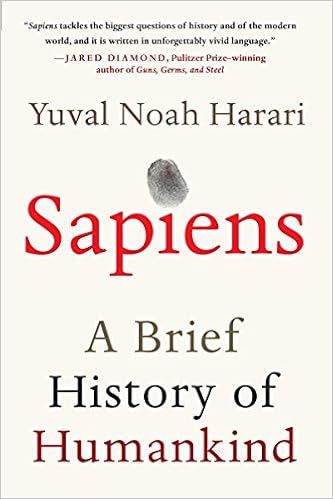 Recently I read a really fascinating book called Sapiens: A Brief History of Humankind. Of all of the ideas in the book, the one that really caught my imagination is that everything works because of our unique ability to imagine a paradigm and then agree upon it. Those imagined realities enable large groups of humans to work together, to trade with one another, to form societies. Basically the author, says that there is nothing in human society that does not depend upon those imagined realities upon which we have agreed to agree. And those imagined realities can be changed.
I was thinking about one of those imagined realities the other day when an editorial in our local paper complained that the problems with the dollar began when its value was cut off from anything real - i.e. gold. But, the value of gold is also tied to nothing "real." The book uses gold as an illustration of imagined realities. While the metal does have some iteresting properties, there is no reason beyond a cultural agreement that it should hold any more value than some other metal, many of which are significantly more useful. Ineed, when the Spaniards arrived in the new world, searching for gold, the native people were confused. Gold is pretty, they thought, but too soft for any important uses. They imagined much lower value for that soft yellow metal.
Back to Bernie... there is no reason beyond the fact that we have all imagined the world as it is that it should remain that way. We have decided that some people should be incredibly wealthy while others struggle and even die from want. We have decided that a freakishly tall, athletic man should make tons of money for entertaining us with incredible feats that we cannot accomplish while the one who picks our food, bent over in the hot sun in a field day after day, struggles. Why? The list could go on.
Now Bernie is not calling for crazy changes. Indeed, many of the changes he envisioned are already part of the imagined reality in much of the world but it is a different reality than the one we've adopted together in the US at this point. That is why he is revolutionary. That is why he challenges the powers that be. That is why I'm feelin' the Bern. I want to see a new paradigm and the one he is offering is a lot more like the one I believe that God imagines for us than the one we currently have.
Tuesday, April 05, 2016
Medicare
My spouse becomes eligible for Medicare this year so we've been paying attention. We've had to pay attention to insurance for a number of years as I have a genetic condition that causes a chronic disease. It has been under control for me since 1987 but that is irrelevant. On the open market, I was not insurable at any price. I had medical insurance available through our denomination but it was nearly $4K a month and was no longer affordable by my employer or my family. The ACA saved us... me... literally. (This is not about the ACA and I see serious problems there which I have addressed before a number of times). So paying attention to Medicare didn't feel unusual.
I noticed quickly that while some folk have complaints, few of them are the elderly folk on Medicare... and the complaints that population does have are no different than the general population dealing with any insurance company - costs, restricted access, complexity... I do hear younger folk who say that Medicare is proof that the government can't run a healthcare insurance system. They say it is nearly bankrupt and doesn't work anyway.
So, with those thoughts in mind, we went to a two hour seminar yesterday to get a basic understanding of Medicare presented by a non-profit that advocates for the elderly and helps them with issues around Medicare. I came away with some impressions... Medicare is too complicated. Negotiating part D and supplemental plans is difficult and clearly a lot to ask of some seniors. $300-400 a month for a newly retired person in California for part B, a reasonable part D, and an F class supplemental plan is a lot of money, especially for someone on a fixed income... and it will only go up. The "free market" alternative - Medicare Advantage - may work somewhere, but it requires a population density that we don't have where we live so the choices here are thinning rapidly (there are only three plans available in Santa Barbara county now and only one that covers the entire county) as the companies can't make the level of profits they desire. Even where it might work, it still has the significant limitations commonly associated with HMO's. The donut hole is scary for someone with a chronic condition but the way that the ACA is filling in the hole is at least a little heartening.
It seems that making Medicare a single payer system, eliminating the need for Part D and supplemental plans would go a long way to simplifying the system. Both pieces feel to me like compromises made with the private sector so they can continue to get some portion of income from this group of high consumers of medical care. We are worried about the realities of paying that much money a month for insurance after having employer provided insurance our entire lives but I am more than glad to know that I will at least have coverage. I anticipate that at least one of my meds (which is stupidly expensive) may not be covered but that will be what it is. I have 3+ more years until I become eligible and another year beyond that until retirement so some of those worries are meaningless. A Republican president and congress could make the entire program go away. A Democratic one of each might strengthen the programs... time will tell there.
Of course there are the big public policy questions that continue... Is healthcare a right that everyone should be provided regardless of their economic condition? For me as a theologian, what are the theological implications of that question? How do we control costs while at the same time insuring good care? And for me a central question, what role should the profit motive have in healthcare? (I would argue none)
I noticed quickly that while some folk have complaints, few of them are the elderly folk on Medicare... and the complaints that population does have are no different than the general population dealing with any insurance company - costs, restricted access, complexity... I do hear younger folk who say that Medicare is proof that the government can't run a healthcare insurance system. They say it is nearly bankrupt and doesn't work anyway.
So, with those thoughts in mind, we went to a two hour seminar yesterday to get a basic understanding of Medicare presented by a non-profit that advocates for the elderly and helps them with issues around Medicare. I came away with some impressions... Medicare is too complicated. Negotiating part D and supplemental plans is difficult and clearly a lot to ask of some seniors. $300-400 a month for a newly retired person in California for part B, a reasonable part D, and an F class supplemental plan is a lot of money, especially for someone on a fixed income... and it will only go up. The "free market" alternative - Medicare Advantage - may work somewhere, but it requires a population density that we don't have where we live so the choices here are thinning rapidly (there are only three plans available in Santa Barbara county now and only one that covers the entire county) as the companies can't make the level of profits they desire. Even where it might work, it still has the significant limitations commonly associated with HMO's. The donut hole is scary for someone with a chronic condition but the way that the ACA is filling in the hole is at least a little heartening.
It seems that making Medicare a single payer system, eliminating the need for Part D and supplemental plans would go a long way to simplifying the system. Both pieces feel to me like compromises made with the private sector so they can continue to get some portion of income from this group of high consumers of medical care. We are worried about the realities of paying that much money a month for insurance after having employer provided insurance our entire lives but I am more than glad to know that I will at least have coverage. I anticipate that at least one of my meds (which is stupidly expensive) may not be covered but that will be what it is. I have 3+ more years until I become eligible and another year beyond that until retirement so some of those worries are meaningless. A Republican president and congress could make the entire program go away. A Democratic one of each might strengthen the programs... time will tell there.
Of course there are the big public policy questions that continue... Is healthcare a right that everyone should be provided regardless of their economic condition? For me as a theologian, what are the theological implications of that question? How do we control costs while at the same time insuring good care? And for me a central question, what role should the profit motive have in healthcare? (I would argue none)
Wednesday, March 30, 2016
End of Life Choices
Last October, after my state passed a law allowing physician assisted suicide, I posted a blog about the issue. I struggled and continue to struggle with the question. Here's a paragraph from that post.
The other side of my equation is that my spouse is a hospice chaplain. During Cheryl's years of work in that challenging setting, I have learned that those final days can truly be holy time and that in spite of (perhaps sometimes because of) the pain, relationships are healed, grace is poured out, and that life is enriched in ways that could not be imagined under normal circumstances. In his book, The Four Things that Matter Most, Ira Byock tells story after story of families who look back at the last days with a loved one as some of the most positive time they shared together. I also know that sometimes even the most dire prognosis can be wrong and that individuals who really should die, simply don't. Cheryl has had more than one client who was supposed to have a prognosis of 6 months or less but instead lived for years.
All of that is to say that I fear by making it easy to avoid the difficult times, we will also see many families missing out on the wonderful times that are enabled by the nearness of death. I also fear insurance companies pushing "a good death" because it costs much less than the protracted experience of dying well.
I really do understand the reason why some folk may want to end their own lives as a way of avoiding terrible suffering and I do think the law is probably a good thing. Still, I hope that we find a way to open other options that truly can be filled with grace.
I saw images on 9/11 that made me think differently.My thinking was prodded forward by the situation of Brittany Maynard, who suffered with a terrible form of brain cancer and chose to move to Oregon so that she could take her own life rather than go through the process of the cancer. I watched a friend die of that same cancer so I knew a bit of what she was facing...
We also saw people jump from the towers to their deaths, knowing that they were committing suicide. At the same time, death was imminent as the flames came towards them. The choice was clearly between dying a painful death of burning or a quick one from the impact of a fall from the towers. I don't know what I would have done if faced with that choice but I do know how I feel about burning and it is not a way that I would choose to die. So, I asked myself, was the decision to jump an immoral one? Did I have the right to condemn those who would choose one way to die over another, knowing that death was clearly coming?
The other side of my equation is that my spouse is a hospice chaplain. During Cheryl's years of work in that challenging setting, I have learned that those final days can truly be holy time and that in spite of (perhaps sometimes because of) the pain, relationships are healed, grace is poured out, and that life is enriched in ways that could not be imagined under normal circumstances. In his book, The Four Things that Matter Most, Ira Byock tells story after story of families who look back at the last days with a loved one as some of the most positive time they shared together. I also know that sometimes even the most dire prognosis can be wrong and that individuals who really should die, simply don't. Cheryl has had more than one client who was supposed to have a prognosis of 6 months or less but instead lived for years.
All of that is to say that I fear by making it easy to avoid the difficult times, we will also see many families missing out on the wonderful times that are enabled by the nearness of death. I also fear insurance companies pushing "a good death" because it costs much less than the protracted experience of dying well.
I really do understand the reason why some folk may want to end their own lives as a way of avoiding terrible suffering and I do think the law is probably a good thing. Still, I hope that we find a way to open other options that truly can be filled with grace.
Tuesday, March 08, 2016
Free College?

I pay taxes to support education because I want to live in a society wherein the citizens are educated at least enough to be contributing members of society. We provide education for our children because we require at least a minimally educated population or things get very ugly very fast. So why through age 18? I would argue that education has historically been provided in the amount required for an individual to be a productive member of society. For a long time - during the agricultural age, 8th grade was enough. That meant an individual could read and do enough math to be sure they weren't getting cheated when they sold a cow at market and that they could make reasonably informed decisions at the ballot box after making judgments regarding the claims of politicians. We provided that for every child in every family and the broader society absorbed the costs. An individual family that wanted to send their child further could do so on their own dime but the minimum was provided "free." A child with an 8th grade education could become a fully functional and contributing member of society. He or she could have a family, a home, and make a contribution.
When the industrial age took hold and life became more and more technical, 8th grade was no longer enough. More complicated math was often required. The world was becoming smaller so citizens needed to be able to reason a bit more to understand international issues. One needed to read better to be able to understand manuals for complicated machinery. As a society we added 4 years to what was provided "free." It was clear that 8 grades was not enough but 12 seemed to meet the requirements. A high school diploma was enough. Again, a family that wanted to send their children to college or technical school could do so, but society both required and funded through high school. An individual with a high school diploma could make a good living, raise a family, be a part of society...
A high school diploma is no longer enough. The vast majority of jobs available to an individual with only a high school diploma could just as easily be done by a machine and it takes more training than just high school to run those machines. We also live in a world that is becoming more and more complicated and ignorant populations do not make wise decisions. Either college or technical education after high school is required for an individual to become a fully functional member of society. If we as a nation do not provide those educational requirements, we run the risk of having a larger and larger underclass without any ability or hope of ever becoming a fully functioning member of the society. That is a recipe for disaster.
So... Bernie Sander's call for "free" public education is not a pie in the sky dream. It is a requirement for a healthy society. "But it is so expensive. Where will we get the money to pay for it?" We get the money to pay for the things we think are important. When the government decided we needed to go to war in Iraq & Afghanistan, almost nobody asked how we would pay for it. When my county decided they needed a new county jail, questions of money came up but almost nobody seriously said, "let's leave the criminals on the streets." So where do we get the money? Raise taxes? Perhaps. Cut the military? Perhaps. Make it happen one way or another? Absolutely.
Now how about the folk who incurred huge debts at exorbitant interest rates in order to become fully functioning members of society - taking on costs that the broader society took on in the past? I would argue that at the very least, the government should take over the private loans and convert all student loans to 0% interest. They aren't charging that much more than that to big banks that borrow money from the government... why not free a generation of young adults from that burden, allowing them to truly become fully functioning?
Thursday, March 03, 2016
Church Values
Two pieces came together this week to have me thinking about church values. First, I listened to an interview with the pastor of a megachurch in the south who talked about the core values of his congregation. While the wording might get under my skin a bit, I found myself more or less agreeing with the values he stated. The part that hooked me was the clarity with which they were spoken. The church has five very clear, short (the longest is 5 words) statements that give shape to their ministry. The second piece is a blog post written by my daughter, "What are you doing?" In it she raises the question of whether or not one's actions are furthering their primary path or taking them down rabbit holes.
So I was thinking about the churches I've been a part of... I've been blessed to have been part of great churches doing significant ministry in their various settings. While the values of those congregations have often been implied by their actions, none of them have been nearly so clear as to have 5 short clear statements which could be recited by anyone in the congregation or used as yardsticks to evaluate the direction of their ministries. Of course, articulating values doesn't mean a specific church really holds them. Nor does a list necessarily include all or even the most deeply held values of any given church. For example, few churches would say they value the status quo above all else but many clearly do. And while many churches might put evangelism as a core value - perhaps even their top one - few really live as if that is the case. Still, at least trying to articulate them can only be a good thing.
So what are the values of Cambridge Drive Community Church where I currently serve? To what degree are they reflected in the shape of our ministries and our life together? Are our resources allocated to support the things we value most or are institutional needs draining them more than the values would indicate? We haven't clarified those issues as well as we could and should. For example, I would say that one of our core values is that our buildings and land should serve the community. In a typical month we have between 500 and 1000 individual people who use our property who are not directly affiliated with the church via concerts, recitals, 12 step programs, educational programs, and just enjoying the grounds. Many of them are on the property multiple times in a month, some more often than even our most committed members. While we charge for many of the uses, none are market rate and for many the church is essentially subsidizing the use. We often wrestle with those costs and struggle with the difficulties of other folk using our "stuff." If we had more clarity around those uses as a core value, the questions may be easier to address...
All of that gives me and us something to work on...
So I was thinking about the churches I've been a part of... I've been blessed to have been part of great churches doing significant ministry in their various settings. While the values of those congregations have often been implied by their actions, none of them have been nearly so clear as to have 5 short clear statements which could be recited by anyone in the congregation or used as yardsticks to evaluate the direction of their ministries. Of course, articulating values doesn't mean a specific church really holds them. Nor does a list necessarily include all or even the most deeply held values of any given church. For example, few churches would say they value the status quo above all else but many clearly do. And while many churches might put evangelism as a core value - perhaps even their top one - few really live as if that is the case. Still, at least trying to articulate them can only be a good thing.
So what are the values of Cambridge Drive Community Church where I currently serve? To what degree are they reflected in the shape of our ministries and our life together? Are our resources allocated to support the things we value most or are institutional needs draining them more than the values would indicate? We haven't clarified those issues as well as we could and should. For example, I would say that one of our core values is that our buildings and land should serve the community. In a typical month we have between 500 and 1000 individual people who use our property who are not directly affiliated with the church via concerts, recitals, 12 step programs, educational programs, and just enjoying the grounds. Many of them are on the property multiple times in a month, some more often than even our most committed members. While we charge for many of the uses, none are market rate and for many the church is essentially subsidizing the use. We often wrestle with those costs and struggle with the difficulties of other folk using our "stuff." If we had more clarity around those uses as a core value, the questions may be easier to address...
All of that gives me and us something to work on...
Saturday, February 20, 2016
Better Living through Chemistry
When I was younger, Dupont Chemicals used the tagline - "Better living through chemistry." I'm a case study that indeed, at least sometimes it is true.
I have an hereditary condition called heterozygous familial hyperlipidemia. Basically there are two genes that regulate the way the body deals with cholesterol. In my disorder, one of those genes does not work correctly. This results in extremely high cholesterol numbers - my total count when it was first diagnosed was 613 (normal is under 200). There are some folk in whom neither gene works correctly - homozygous familial hyperlipidemia - whose total cholesterol counts are often above 1000.
You are probably aware that elevated cholesterol is associated with coronary artery disease. These crazy high numbers result in severe disease at earlier ages. My biological farther died at age 31 from the artery disease associated with his hyperlipidemia. An autopsy after his death revealed major blockages in every coronary artery.
Due to dysfunctional family issues, I was not aware of my problem until I had chest pains in my mid 30's. By the time my disorder was discovered, there were a number of drugs available to treat my cholesterol problem - niacin in large quantities, bile acid sequestrants, and statins - the first of which was released to the market about 1 month before my diagnosis. I began a regimen of all three classes of drugs. My blockages were too numerous and too severe to do stents or bypass so even with the lower cholesterol, my prognosis was unclear. Animal studies had shown that if the cholesterol could be brought to normal levels, the blockages may recede. The cardiologist told me that he didn't know whether the drugs would drop my cholesterol enough and that even if they did, the blockages may remain unchanged. He advised me to get my affairs in order just in case.
The drugs worked well and my cholesterol dropped more than anyone ever expected. The side effects were/are manageable. That hoped for result that hadn't really been observed in humans took place - my blockages began to recede. Still, some of my numbers never really got to "normal." My HDL's were still lower than they should be and my LDL's were still higher. I had a friend who was diagnosed with the same disorder as me about the same time. The drugs did not work for him and he died less than a year later.
Recently another new class of drugs have made their way to the market - PCSK9 inhibitors. They are aimed at folk like me with genetic causes for their high cholesterol. They are crazy expensive (about $14K per year). My cardiologist started me on one (Repatha) about 3 months ago in addition to my current regimen. The company - Amgen - is subsidizing some folk in using the drug and I fall into that category. For the first time in my life, my HDL's are crazy low, my HDL's are normal, and my overall cholesterol is insanely low - 97!!! If my blockages receded some before, they could recede even more now.
Assuming there are no terrible side effects, this bodes really well for me and for other folk like me... except... the price. What about the folk who will be excluded because they cannot afford the drug? I think of my friend for whom the earlier drugs did not work. Perhaps these new drugs would have been the miracle that saved his life... if his insurance would cover them with a copay he could afford or if he fell into the proper category to be subsidized. If not...
Again we see the reality in our culture with regards to medical care. Those with resources will live and those without... will die.
I have an hereditary condition called heterozygous familial hyperlipidemia. Basically there are two genes that regulate the way the body deals with cholesterol. In my disorder, one of those genes does not work correctly. This results in extremely high cholesterol numbers - my total count when it was first diagnosed was 613 (normal is under 200). There are some folk in whom neither gene works correctly - homozygous familial hyperlipidemia - whose total cholesterol counts are often above 1000.
You are probably aware that elevated cholesterol is associated with coronary artery disease. These crazy high numbers result in severe disease at earlier ages. My biological farther died at age 31 from the artery disease associated with his hyperlipidemia. An autopsy after his death revealed major blockages in every coronary artery.
Due to dysfunctional family issues, I was not aware of my problem until I had chest pains in my mid 30's. By the time my disorder was discovered, there were a number of drugs available to treat my cholesterol problem - niacin in large quantities, bile acid sequestrants, and statins - the first of which was released to the market about 1 month before my diagnosis. I began a regimen of all three classes of drugs. My blockages were too numerous and too severe to do stents or bypass so even with the lower cholesterol, my prognosis was unclear. Animal studies had shown that if the cholesterol could be brought to normal levels, the blockages may recede. The cardiologist told me that he didn't know whether the drugs would drop my cholesterol enough and that even if they did, the blockages may remain unchanged. He advised me to get my affairs in order just in case.
The drugs worked well and my cholesterol dropped more than anyone ever expected. The side effects were/are manageable. That hoped for result that hadn't really been observed in humans took place - my blockages began to recede. Still, some of my numbers never really got to "normal." My HDL's were still lower than they should be and my LDL's were still higher. I had a friend who was diagnosed with the same disorder as me about the same time. The drugs did not work for him and he died less than a year later.
Recently another new class of drugs have made their way to the market - PCSK9 inhibitors. They are aimed at folk like me with genetic causes for their high cholesterol. They are crazy expensive (about $14K per year). My cardiologist started me on one (Repatha) about 3 months ago in addition to my current regimen. The company - Amgen - is subsidizing some folk in using the drug and I fall into that category. For the first time in my life, my HDL's are crazy low, my HDL's are normal, and my overall cholesterol is insanely low - 97!!! If my blockages receded some before, they could recede even more now.
Assuming there are no terrible side effects, this bodes really well for me and for other folk like me... except... the price. What about the folk who will be excluded because they cannot afford the drug? I think of my friend for whom the earlier drugs did not work. Perhaps these new drugs would have been the miracle that saved his life... if his insurance would cover them with a copay he could afford or if he fell into the proper category to be subsidized. If not...
Again we see the reality in our culture with regards to medical care. Those with resources will live and those without... will die.
Tuesday, February 02, 2016
Courageous Conservative?
Yesterday was the Iowa Caucuses and Ted Cruz won the Republican nod. In his speech, he referred
 to a win for courageous conservatives all across the nation and implied that he is the last best hope for true conservatives. I guess I see where some of his support comes from as he massages the fears of folk who feel as if "their country" is melting away or already has.
I don't like him and would never vote for him under any circumstances... but for those who are considering him, let me make a few observations.
Ted Cruz is not a conservative. The root of the word comes from "conserve." There is nothing that Ted Cruz wants to conserve. He has shown again and again that he does not believe in government (except when it interferes in individuals' lives around the "hot" sins he rails against) and his sole agenda is to destroy not conserve. The values upon which this nation was founded seem to hold little attraction to him - equal justice for all, opportunity for all, the right to have the government stay out of one's personal life, true freedom of religion, etc. etc.
He is no brand of Christian that I recognize as following Jesus. He comes from a strain called dominionism where "the Church" is called to take over the institutions of society and establish what can only be seen as the Christian equivalent of the radical Muslim vision of the Caliphate. The movement (and Ted Cruz) obviously has either not read or not understood John 18:36 "Jesus said, 'My kingdom is not of this world. If it were, my servants would fight to prevent my arrest by the Jewish leaders. But now my kingdom is from another place.'" While Ted Cruz has been careful not to say these kinds of things directly, his father is a prominent preacher of this theology and a number of other prominent dominionist preachers have said that God is advancing Ted Cruz as part of the plan to take over the seven mountains of society. Terry Gross has a wonderful interview regarding this brand of theology.
While Ted Cruz is certainly not a traditional political insider... he is Princeton and Harvard educated. His wife is a Managing Director at Goldman Sachs and is a member of the Council on Foreign Relations. His career includes stints on the Federal Trade Commission, as an assistant deputy attorney general of the Department of Justice, Solicitor General of the state of Texas, and of course, the junior senator from Texas. You can't get much closer to the center of power than that.
I don't like him and would never vote for him under any circumstances... but for those who are considering him, let me make a few observations.
Ted Cruz is not a conservative. The root of the word comes from "conserve." There is nothing that Ted Cruz wants to conserve. He has shown again and again that he does not believe in government (except when it interferes in individuals' lives around the "hot" sins he rails against) and his sole agenda is to destroy not conserve. The values upon which this nation was founded seem to hold little attraction to him - equal justice for all, opportunity for all, the right to have the government stay out of one's personal life, true freedom of religion, etc. etc.
He is no brand of Christian that I recognize as following Jesus. He comes from a strain called dominionism where "the Church" is called to take over the institutions of society and establish what can only be seen as the Christian equivalent of the radical Muslim vision of the Caliphate. The movement (and Ted Cruz) obviously has either not read or not understood John 18:36 "Jesus said, 'My kingdom is not of this world. If it were, my servants would fight to prevent my arrest by the Jewish leaders. But now my kingdom is from another place.'" While Ted Cruz has been careful not to say these kinds of things directly, his father is a prominent preacher of this theology and a number of other prominent dominionist preachers have said that God is advancing Ted Cruz as part of the plan to take over the seven mountains of society. Terry Gross has a wonderful interview regarding this brand of theology.
While Ted Cruz is certainly not a traditional political insider... he is Princeton and Harvard educated. His wife is a Managing Director at Goldman Sachs and is a member of the Council on Foreign Relations. His career includes stints on the Federal Trade Commission, as an assistant deputy attorney general of the Department of Justice, Solicitor General of the state of Texas, and of course, the junior senator from Texas. You can't get much closer to the center of power than that.
Tuesday, January 05, 2016
Insurrectionists? Terrorists? in Oregon
I have to admit that I have really mixed feelings about the mess in South Eastern Oregon... My first reaction was that if a group of heavily armed black folk took over a government building, we'd have the National Guard with armored personnel carriers and there would be blood shed. If it was a group of unarmed Muslims, even if the group was primarily women and children, we'd have the same reaction.
And that is exactly what the folk who took the building want. They have said they want the public lands to be returned to local control - i.e. they want to be able to use public lands for their benefit at no cost and with no restrictions and they'll stay there "as long as it takes." As long as what takes? Do they really believe that federal land use policies will be changed because a group of somewhere between 20 and 150 heavily armed idiots are sitting in a building way out in the middle of nowhere? No, the "what" they're waiting for is for someone at the federal level to get impatient and come in with guns blazing so they can be martyrs for their cause (sound anything like the fundamentalists of Da'esh?).
I have to admit that my gut first said that the government should give them what they want. Treat them the same way a group of black men or Muslims would be treated. Responses that I routinely condemn by the way... No... it seem to me that the government is responding in a reasonable way so far in avoiding violence.
So what do I think they should do from here? First, this group should be defined officially as terrorists. That is what they are. They are using violence and the fear of violence to influence political outcomes. They are clearly seeing themselves as fighting against the federal government as they embrace that crazy reading of the 2nd Amendment that says the reason we have guns is so we can fight against a tyrannical federal government. "Tyrannical" means whenever the federal government does something they don't like. Their intent is to use violence in order to get their way.
Then, all power should be cut off and a perimeter set up around them to keep anything - food, water, information, whatever - from going in or out. Then wait. If some go out to hunt, arrest them, and try them for terrorism. They say they'll stay as long as it takes... let them. Arrest them as it becomes possible. Continually offer a non-violent resolution which results in their arrest. If they begin a violent confrontation, do the best possible to keep it from escalating but do not allow them out except as prisoners.
At the same time, it does seem that our federal government has taken a hands off approach to right wing insurrectionist groups. They cannot be allowed to flout the law without serious consequences. Armed insurrection while threatening to kill law enforcement and military personnel must result in significant prison terms.
What do you think?
And that is exactly what the folk who took the building want. They have said they want the public lands to be returned to local control - i.e. they want to be able to use public lands for their benefit at no cost and with no restrictions and they'll stay there "as long as it takes." As long as what takes? Do they really believe that federal land use policies will be changed because a group of somewhere between 20 and 150 heavily armed idiots are sitting in a building way out in the middle of nowhere? No, the "what" they're waiting for is for someone at the federal level to get impatient and come in with guns blazing so they can be martyrs for their cause (sound anything like the fundamentalists of Da'esh?).
I have to admit that my gut first said that the government should give them what they want. Treat them the same way a group of black men or Muslims would be treated. Responses that I routinely condemn by the way... No... it seem to me that the government is responding in a reasonable way so far in avoiding violence.
So what do I think they should do from here? First, this group should be defined officially as terrorists. That is what they are. They are using violence and the fear of violence to influence political outcomes. They are clearly seeing themselves as fighting against the federal government as they embrace that crazy reading of the 2nd Amendment that says the reason we have guns is so we can fight against a tyrannical federal government. "Tyrannical" means whenever the federal government does something they don't like. Their intent is to use violence in order to get their way.
Then, all power should be cut off and a perimeter set up around them to keep anything - food, water, information, whatever - from going in or out. Then wait. If some go out to hunt, arrest them, and try them for terrorism. They say they'll stay as long as it takes... let them. Arrest them as it becomes possible. Continually offer a non-violent resolution which results in their arrest. If they begin a violent confrontation, do the best possible to keep it from escalating but do not allow them out except as prisoners.
At the same time, it does seem that our federal government has taken a hands off approach to right wing insurrectionist groups. They cannot be allowed to flout the law without serious consequences. Armed insurrection while threatening to kill law enforcement and military personnel must result in significant prison terms.
What do you think?
Tuesday, December 15, 2015
Islam and the Power of the Press
We have a small Muslim community in Santa Barbara. There is a student organization at the University of Santa Barbara and a single mosque that currently does weekly prayers at the Goleta Community Center. They've been trying to build a proper mosque for about 10 years... so goes building in this area of California compounded by the fact that it is a mosque...
It is a wonderful community of people. Because it is the only mosque and the community is relatively small, Shia, Sunni, and any other brand of Muslim worship together. They are comprised of folk from very conservative countries like Saudi Arabia all the way to folk from more "western" cultures like Bosnia, immigrants, students, professors, and folk whose families have been US citizens for generations. That mix certainly has its tensions, but in large degree they work it out. Folk from the mosque have also been very involved in the larger interfaith community, building strong relationships with Jews, Christians, Buddhists, and Hindus. They are both appreciative of and advocates for what more than one of them has called the "genius of America" - freedom of religion. They have also clearly condemned religious violence and spoken strongly against acts of terrorism.
When I think of Muslims, it is these folk who come to mind. When I read statements like, "Why aren't moderate Muslims speaking out?" I shake my head and want to point to my friends.
About a year ago, Muslims in Great Britain have begun a campaign on the web #NotInMyName and the phrase and hashtag is being used all over the world. Yesterday our local mosque organized a march and vigil to speak out against religious violence, particularly in response to the terrorist act in San Bernadino. They invited interfaith partners and all people of good will to be part of the event and representatives from every faith tradition and no faith tradition walked with them and stood in silence in memory of those killed.
I'm not good at estimating crowd sizes (and we all know that pastors tend to exaggerate numbers), but on what Santa Barbarans call a frigid night, I'd guess about 300 people walked, listened to speakers, and stood in silence following the Imam as he and his congregation affirmed that Islam is a religion of peace and tolerance and that above all, they desire to be part of the larger American community.
One of the local televisions stations covered the event. As far as I could see, the others did not. I picked up this morning's paper - The Santa Barbara News Press - and the headline article with a large photo was that a group of students from Westmont College had gone to the Children's Wing of the local hospital to sing Christmas Carols to the ill children. The event was not even mentioned.
Now, I have no idea how many similar events have taken place around the country or the world. I do know that Muslim leaders and Muslim scholars have spoken out again and again against religious extremism and especially against terrorist violence. If the press does not cover these events, how can "moderate" Muslims get their message out? To what degree does the media feed off and support the narrative proposed by fanatics? And in doing just that, are they not complicit?
This message and similar ones are out there...
It is a wonderful community of people. Because it is the only mosque and the community is relatively small, Shia, Sunni, and any other brand of Muslim worship together. They are comprised of folk from very conservative countries like Saudi Arabia all the way to folk from more "western" cultures like Bosnia, immigrants, students, professors, and folk whose families have been US citizens for generations. That mix certainly has its tensions, but in large degree they work it out. Folk from the mosque have also been very involved in the larger interfaith community, building strong relationships with Jews, Christians, Buddhists, and Hindus. They are both appreciative of and advocates for what more than one of them has called the "genius of America" - freedom of religion. They have also clearly condemned religious violence and spoken strongly against acts of terrorism.
When I think of Muslims, it is these folk who come to mind. When I read statements like, "Why aren't moderate Muslims speaking out?" I shake my head and want to point to my friends.
About a year ago, Muslims in Great Britain have begun a campaign on the web #NotInMyName and the phrase and hashtag is being used all over the world. Yesterday our local mosque organized a march and vigil to speak out against religious violence, particularly in response to the terrorist act in San Bernadino. They invited interfaith partners and all people of good will to be part of the event and representatives from every faith tradition and no faith tradition walked with them and stood in silence in memory of those killed.
I'm not good at estimating crowd sizes (and we all know that pastors tend to exaggerate numbers), but on what Santa Barbarans call a frigid night, I'd guess about 300 people walked, listened to speakers, and stood in silence following the Imam as he and his congregation affirmed that Islam is a religion of peace and tolerance and that above all, they desire to be part of the larger American community.
One of the local televisions stations covered the event. As far as I could see, the others did not. I picked up this morning's paper - The Santa Barbara News Press - and the headline article with a large photo was that a group of students from Westmont College had gone to the Children's Wing of the local hospital to sing Christmas Carols to the ill children. The event was not even mentioned.
Now, I have no idea how many similar events have taken place around the country or the world. I do know that Muslim leaders and Muslim scholars have spoken out again and again against religious extremism and especially against terrorist violence. If the press does not cover these events, how can "moderate" Muslims get their message out? To what degree does the media feed off and support the narrative proposed by fanatics? And in doing just that, are they not complicit?
This message and similar ones are out there...
Wednesday, November 25, 2015
A Good Guy with a Gun
Following the events in Paris, I have read multiple right wing commentators who speculated that if only Parisians had had guns, there would have been a very different outcome at the Bataclan. Well, they're probably correct, but I don't know that the different outcome would have been a better one.
I won't argue whether or not a gun ever helps to deter crimes. I understand there is good data that points that way but there is also good data that indicates that the very presence of a gun makes things more dangerous. That is what I expect would have happened at the Bataclan.
 Imagine the scene with me. There is a large crowd of people gathered in a fairly chaotic place when all of a sudden one person pulls out a gun and begins firing. Then a second pulls out a gun. Then a third and a fourth. How would you know who is a "terrorist" and who is not? A fifth person, whom we know to be a "good guy," pulls a gun and begins to fire at one of the previous four, who then fires back. If that fourth shooter was actually not a part of the terrorist group, he or she likely thinks the fifth is. Multiply that by many people pulling guns and beginning to shoot at someone else who is shooting, all the while a number of innocent bystanders have been hit. (After all, none of these shooters are trained to fire at real people in highly stressful situations while others are shooting back at them.) Then the police arrive on the scene only to see multiple shooters with weapons drawn, shooting at others in the panicked crowd. How do they know who is a "good guy" and who is not? So they begin firing as well. Multiply all of that as the number of "good guys with guns" goes up. What began as an horrific event has turned into the shootout at the OK corral.
Recently in less crazy settings we have seen incidents that went horribly wrong. There is the story of the car jacking victim in Houston a few weeks ago who was shot in the head, presumably by a "good guy with a gun" who was trying to help stave off the crime. Instead, the victim was shot, the carjackers escaped, and the "good guy" picked up his shell casings and fled the scene, no doubt worried that he would be arrested.
I'm reminded of the meme that went around a few weeks ago... A small boy was throwing stones at other children in the school yard. The teachers knew that something needed to be done or one of the children would likely be injured so, they handed out more stones to the other children. That makes sense...
Adding more guns to a terrible situation does change things... but not necessarily in a positive way.
I won't argue whether or not a gun ever helps to deter crimes. I understand there is good data that points that way but there is also good data that indicates that the very presence of a gun makes things more dangerous. That is what I expect would have happened at the Bataclan.

Recently in less crazy settings we have seen incidents that went horribly wrong. There is the story of the car jacking victim in Houston a few weeks ago who was shot in the head, presumably by a "good guy with a gun" who was trying to help stave off the crime. Instead, the victim was shot, the carjackers escaped, and the "good guy" picked up his shell casings and fled the scene, no doubt worried that he would be arrested.
I'm reminded of the meme that went around a few weeks ago... A small boy was throwing stones at other children in the school yard. The teachers knew that something needed to be done or one of the children would likely be injured so, they handed out more stones to the other children. That makes sense...
Adding more guns to a terrible situation does change things... but not necessarily in a positive way.
Wednesday, November 18, 2015
Fear and Religious Freedom
You have likely heard freedom of the press referred to as the "first freedom," because it is central to the functioning of a democracy but also because many folk think it is the first freedom listed in the Bill of Rights. While it is part of the first amendment, it is not the first one listed. The first freedom listed is freedom of religion. One might argue that the order is irrelevant but I think it is not. Freedom of religion tells us that the government has no say in the way that we order our values and shape our lives. Freedom of speech and of the press is rendered impotent if the government first has the power to repress or support that most central of individual functions - the way we shape who we are, what we believe, what we value. As with all of the freedoms in the Bill of Rights, religious freedom is aimed primarily at protecting those who fall outside of the centers of power - odd groups, minority groups, those who do not
Like all freedoms, freedom of religion comes with risk. There are religious systems that by their nature are oppressive and destructive. There are religious systems that by their very nature work against human progress. There are even some that promote violence. As a nation we have wrestled with the ways to deal with those issues and have decided - rightly I believe - that before the government can interfere with religious practice, it must show a compelling interest. Fear is not a compelling interest.
Recently, because of the actions of a very small group of jihadists, Muslims have been the object of
 fear and of discrimination. One piece that comes up regularly is the wearing of burqas or niqabs which cover everything except the eyes (and sometimes even the eyes) by Muslim women. The arguments go two ways. One says that such treatment of women is oppressive (that is another post). The second is more prevalent now in these days following the terrorist attacks in Paris. It says that these loose fitting garments allow someone to hide weapons which are then easily used to commit violence and prevent others from being able to identify the person wearing the garments.
The fact that the vast majority of terrorists are men and that loose garments that cover the majority of the body are often worn by folk for very practical reasons (spend any time in northern Minnesota in January without everything being covered?) and that in many states in the US, citizens are allowed to openly carry weapons down the center of the street tells us that this is more about fear of the other than about terrorism.
It is worth understanding Muslim discussions and thoughts regarding hijab - modesty of dress for both men and women - in various Muslim cultures and theological traditions but that is basically irrelevant at this point. Many religious groups including orthodox Jews, the Amish, Sikhs, some groups of evangelical Christians, and some Muslim traditions have proscribed ways of dress for both women and men. The question is whether or not the government has the power to define religious expression in terms of dress. Perhaps a more blunt way to phrase the question is whether or not the government has the power to tell you or me what we must wear? If some Orthodox Jew finds it offensive that my wife's forearms are showing as she walks down the street or some Amish folk think my dress is too colorful should they be allowed to enforce their religious understandings? Should a Sunni from Saudi Arabia be able to make my female readers wear a niqab? We would be up on our hind legs in a second if any of those enforcements were to take place. We should feel the same repulsion at the idea that the government can make a woman who believes that her religious commitment to hijab requires her to be covered to uncover herself.
Like all freedoms, freedom of religion comes with risk. There are religious systems that by their nature are oppressive and destructive. There are religious systems that by their very nature work against human progress. There are even some that promote violence. As a nation we have wrestled with the ways to deal with those issues and have decided - rightly I believe - that before the government can interfere with religious practice, it must show a compelling interest. Fear is not a compelling interest.
Recently, because of the actions of a very small group of jihadists, Muslims have been the object of
The fact that the vast majority of terrorists are men and that loose garments that cover the majority of the body are often worn by folk for very practical reasons (spend any time in northern Minnesota in January without everything being covered?) and that in many states in the US, citizens are allowed to openly carry weapons down the center of the street tells us that this is more about fear of the other than about terrorism.
It is worth understanding Muslim discussions and thoughts regarding hijab - modesty of dress for both men and women - in various Muslim cultures and theological traditions but that is basically irrelevant at this point. Many religious groups including orthodox Jews, the Amish, Sikhs, some groups of evangelical Christians, and some Muslim traditions have proscribed ways of dress for both women and men. The question is whether or not the government has the power to define religious expression in terms of dress. Perhaps a more blunt way to phrase the question is whether or not the government has the power to tell you or me what we must wear? If some Orthodox Jew finds it offensive that my wife's forearms are showing as she walks down the street or some Amish folk think my dress is too colorful should they be allowed to enforce their religious understandings? Should a Sunni from Saudi Arabia be able to make my female readers wear a niqab? We would be up on our hind legs in a second if any of those enforcements were to take place. We should feel the same repulsion at the idea that the government can make a woman who believes that her religious commitment to hijab requires her to be covered to uncover herself.
Wednesday, November 11, 2015
An Economic Problem
I listened to most of the Republican debate last night and I have to wonder what universe they're living in... for that matter, a similar question can be raised with the Dems.

Again and again, I heard how they were going to rebuild a growth economy that would provide good, well paying jobs for Americans. Regardless of how I feel about their tactics, the truth is I don't think that is a possibility right now.
Let's imagine the very best possible outcomes... a bunch of these big multi-national companies decide to come back to the US and build big modern factories... The fact is that those factories will hire some folk, but not nearly the number that a similar factory would have hired 50 years ago. Automation is the word. Robots and computers would be doing the work that Tom, Bill, John, Jean, and Sally did in the 50's. Bob might still have a job making sure things are going well but the productivity of the individual worker is way higher which basically means that fewer flesh and blood employees are needed to produce even more goods. As time goes on, there will likely be fewer of these jobs in the factories with more and more of the work becoming automated. Even if those few workers did get higher pay (which in today's economy they do not), because of increased productivity, the lions share of income goes up the ladder to those who own the capital. Labor doesn't count as capital and besides, there are scores of folk who would love to leave the fast food job for a chance at a position that pays closer to a living wage. Of course we still need folk to design and program the robots... but those aren't blue collar jobs that pay well.
We could use serious work on infrastructure which does require skilled labor and just plain labor... but that requires bigger government and nobody is really talking about the kind of government commitment required to rebuild crumbling roads and bridges all across the country.
Which leaves us service jobs which have grown. The Obama presidency produced significantly more jobs that previous Republican administrations but the observation is correct, many are not jobs that provide a living wage. The reality is that fewer of those service jobs will be needed in the near future. Retail has rapidly shifted to the internet, putting scores of retail clerks out of jobs and moving those tasks to large distribution centers where much of the work can be automated and even that which is not requires radically fewer workers than your local Macys. Think of it, there is no real reason that McDonalds really needs more than one or two people. Virtually everything done at a fast food restaurant could be automated. You could punch your order into a ouch screen, swipe your card, and wait for a series of computerized robots to provide you with a custom made burger without the possibility that someone overlooked your order or put extra pickles on when you had clearly stated none. It won't be long until it is less expensive for a new franchise to do just that vs. hiring real people who make mistakes, get sick, and get weekly paychecks.
So much work can be centralized. More and more Universities are moving to online classes where a video of a professor who died a decade ago can continue to "educate" students while, yes, computers can grade the papers. Surgeons can use robots across the globe to perform surgeries and my insurance is rewarding customers who use online physicians. Multi-site churches use star preachers and show the sermon on a big screen while volunteer musicians lead the worship. One of our local wine tasting rooms has a bank of spigots on a wall with a touch pad, a description of each wine, and a card reader. When you arrive, you receive a card with a computer chip to use at the pouring stations. You then choose the wine you want to taste, slide your card, push the size of the taste, and hold your glass under the spigot where you receive exactly the pour you ordered. At the end of your tastings you hand the card to the one person (not really required) who places the card in another reader that then tells you your bill... which as likely as not, you pay with a debit card swiped through another card reader. The few places where real people are required - wait staff at a high end restaurant, a real pourer at the wine tasting room, artisan crafts, personal care givers for the elderly, etc. - are luxuries. We simply need fewer people to do more work... and as the technology improves, we will need fewer yet. There simply are not and will not be enough jobs out there. And some of the work that does require real people, such as music, art, literature, is becoming devalued by the current means of distribution (digital via the internet) and those folk are less able to make a living at their work.
What all of that adds up to is that the current direction of our economy does not bode well for those without significant capital in the short term and for just about anyone in the long term (owning an automated factory doesn't do much for your bank account if there is no customer base to purchase your goods).
It really does feel to me as if we're headed to a choice between a future that looks like Star Trek The Next Generation where people spend their time doing things that bring meaning to their lives or a world like Blade Runner or The Hunger Games where the vast majority of folk live in dangerous and depressing places, just on the edge while a few reap whatever rewards there might be and live behind walls in gated, protected areas.
Now, I'll get a bit political... those who argue for smaller government push us towards a world like the latter. That is certainly the world their current patron saint - Ayn Rand - would have advocate (think of the places in the world with "small government" like Somalia and tell me you'd really rather live there). Even the more left leaning, worker centered views of some Democrats like Bernie Sanders just holds off that new world for a few short years. As a society we will have to make decisions and a radical rethink of the way our economy needs to be shaped is necessary if we want to avoid that future.

Again and again, I heard how they were going to rebuild a growth economy that would provide good, well paying jobs for Americans. Regardless of how I feel about their tactics, the truth is I don't think that is a possibility right now.
Let's imagine the very best possible outcomes... a bunch of these big multi-national companies decide to come back to the US and build big modern factories... The fact is that those factories will hire some folk, but not nearly the number that a similar factory would have hired 50 years ago. Automation is the word. Robots and computers would be doing the work that Tom, Bill, John, Jean, and Sally did in the 50's. Bob might still have a job making sure things are going well but the productivity of the individual worker is way higher which basically means that fewer flesh and blood employees are needed to produce even more goods. As time goes on, there will likely be fewer of these jobs in the factories with more and more of the work becoming automated. Even if those few workers did get higher pay (which in today's economy they do not), because of increased productivity, the lions share of income goes up the ladder to those who own the capital. Labor doesn't count as capital and besides, there are scores of folk who would love to leave the fast food job for a chance at a position that pays closer to a living wage. Of course we still need folk to design and program the robots... but those aren't blue collar jobs that pay well.
We could use serious work on infrastructure which does require skilled labor and just plain labor... but that requires bigger government and nobody is really talking about the kind of government commitment required to rebuild crumbling roads and bridges all across the country.
Which leaves us service jobs which have grown. The Obama presidency produced significantly more jobs that previous Republican administrations but the observation is correct, many are not jobs that provide a living wage. The reality is that fewer of those service jobs will be needed in the near future. Retail has rapidly shifted to the internet, putting scores of retail clerks out of jobs and moving those tasks to large distribution centers where much of the work can be automated and even that which is not requires radically fewer workers than your local Macys. Think of it, there is no real reason that McDonalds really needs more than one or two people. Virtually everything done at a fast food restaurant could be automated. You could punch your order into a ouch screen, swipe your card, and wait for a series of computerized robots to provide you with a custom made burger without the possibility that someone overlooked your order or put extra pickles on when you had clearly stated none. It won't be long until it is less expensive for a new franchise to do just that vs. hiring real people who make mistakes, get sick, and get weekly paychecks.
So much work can be centralized. More and more Universities are moving to online classes where a video of a professor who died a decade ago can continue to "educate" students while, yes, computers can grade the papers. Surgeons can use robots across the globe to perform surgeries and my insurance is rewarding customers who use online physicians. Multi-site churches use star preachers and show the sermon on a big screen while volunteer musicians lead the worship. One of our local wine tasting rooms has a bank of spigots on a wall with a touch pad, a description of each wine, and a card reader. When you arrive, you receive a card with a computer chip to use at the pouring stations. You then choose the wine you want to taste, slide your card, push the size of the taste, and hold your glass under the spigot where you receive exactly the pour you ordered. At the end of your tastings you hand the card to the one person (not really required) who places the card in another reader that then tells you your bill... which as likely as not, you pay with a debit card swiped through another card reader. The few places where real people are required - wait staff at a high end restaurant, a real pourer at the wine tasting room, artisan crafts, personal care givers for the elderly, etc. - are luxuries. We simply need fewer people to do more work... and as the technology improves, we will need fewer yet. There simply are not and will not be enough jobs out there. And some of the work that does require real people, such as music, art, literature, is becoming devalued by the current means of distribution (digital via the internet) and those folk are less able to make a living at their work.
What all of that adds up to is that the current direction of our economy does not bode well for those without significant capital in the short term and for just about anyone in the long term (owning an automated factory doesn't do much for your bank account if there is no customer base to purchase your goods).
It really does feel to me as if we're headed to a choice between a future that looks like Star Trek The Next Generation where people spend their time doing things that bring meaning to their lives or a world like Blade Runner or The Hunger Games where the vast majority of folk live in dangerous and depressing places, just on the edge while a few reap whatever rewards there might be and live behind walls in gated, protected areas.
Now, I'll get a bit political... those who argue for smaller government push us towards a world like the latter. That is certainly the world their current patron saint - Ayn Rand - would have advocate (think of the places in the world with "small government" like Somalia and tell me you'd really rather live there). Even the more left leaning, worker centered views of some Democrats like Bernie Sanders just holds off that new world for a few short years. As a society we will have to make decisions and a radical rethink of the way our economy needs to be shaped is necessary if we want to avoid that future.
Thursday, October 22, 2015
Musical blessings
It has been a wild and woolly couple of weeks for me - being on vacation and then two conferences.
 The second conference was the regional Folk Alliance conference called FARWest. FARWest is essentially a trade conference for acoustic musicians and bookers. There are workshops aimed at helping touring musicians and venues to do what they do better and lots and lots and lots of music. The performances begin in mid afternoon and run until 2:30 in the morning... followed by an open jam session for those who still don't want to go to bed. Add getting to spend time with old friends and make some new ones.
I have no idea how many performers there were but between the official showcases and coffeehouse and the guerrilla showcases that take place in hotel rooms, I think I saw at least 40-50 different acts. Some literally knocked my socks off and I hope to book them for Cambridge Drive Concerts. Some were really great but didn't seem as if they would be the right acts for Cambridge Drive. Others... didn't click for me... which is not a swipe at the quality of the performer's art, only a statement that it wasn't my cup of tea for a variety of reasons. Depending on how I was feeling at any given point it was either musical nirvana or musical overload.
 Then, I got home and began working on music for a gig I have this Friday (10/23) with Robin Howe and the Darin Lee Project. They've got a full band for this gig with Grace Feldman on drums, Eric Brittain on guitar, and me on bass. It is some very nicely crafted pop music and I' looking forward to the gig. At the same time, it has been a long time since I've played with a full fledged rocking band... and I forgot my earplugs for rehearsal. I'll not do that again. If you're in greater Santa Barbara this weekend, we're at The Brewhouse at 8:30. Stop by for some really great music.
On Sunday, I am back playing bass with our excellent church band. We do a very wide variety of musical styles and (if I do say so myself) are one of the better church bands that I've heard, especially when you realize that our players are mostly volunteers while the big churches mostly have paid players. IMHO we hold our own or better any of the bands I've heard. Still, church music is not about performance. It is about experiencing the presence of God. I can only speak for myself there, but I certainly feel God's presence in the music this band makes.
Back to Cambridge Drive Concerts... more wonderful music. We present on the first Friday of each month and have a great show coming up in a bit more than two weeks from this writing with Dulcie Taylor as our headline act and banjo gal, Donna Lynn Caskey opening.
All in all... I am blessed with the opportunity to hear and play some wonderful music.
I have no idea how many performers there were but between the official showcases and coffeehouse and the guerrilla showcases that take place in hotel rooms, I think I saw at least 40-50 different acts. Some literally knocked my socks off and I hope to book them for Cambridge Drive Concerts. Some were really great but didn't seem as if they would be the right acts for Cambridge Drive. Others... didn't click for me... which is not a swipe at the quality of the performer's art, only a statement that it wasn't my cup of tea for a variety of reasons. Depending on how I was feeling at any given point it was either musical nirvana or musical overload.
On Sunday, I am back playing bass with our excellent church band. We do a very wide variety of musical styles and (if I do say so myself) are one of the better church bands that I've heard, especially when you realize that our players are mostly volunteers while the big churches mostly have paid players. IMHO we hold our own or better any of the bands I've heard. Still, church music is not about performance. It is about experiencing the presence of God. I can only speak for myself there, but I certainly feel God's presence in the music this band makes.
Back to Cambridge Drive Concerts... more wonderful music. We present on the first Friday of each month and have a great show coming up in a bit more than two weeks from this writing with Dulcie Taylor as our headline act and banjo gal, Donna Lynn Caskey opening.
All in all... I am blessed with the opportunity to hear and play some wonderful music.
Friday, October 16, 2015
Choice
No, this post i not about abortion although I think some of the arguments might be similar.
Recently the state of California legalized physician assisted suicide. Obviously the issue raises difficult moral and ethical questions. I won't address them here except to say that difficult moral and ethical questions first and foremost need to be addressed by the person immediately facing them. Of course there are social and community concerns that cannot be ignored but the struggle belongs to the individual facing the situation.
I have struggled with this question and my basic orientation always leans towards life. My gut says that even in the most painful and difficult of times, there is something wondrous and wonderful about life and that should never be discounted. At the same time I saw images on 9/11 that made me think differently.
We also saw peole jump from the towers to their deaths, knowing that they were committing suicide. At the same time, death was imminent as the flames came towards them. The choice was clearly between dying a painful death of burning or a quick one from the impact of a fall from the towers. I don't know what I would have done if faced with that choice but I do know how I feel about burning and it is not a way that I would choose to die. So, I asked myself, was the decision to jump an immoral one? Did I have the right to condemn those who would choose one way to die over another, knowing that death was clearly coming?
And so, I come to physician assisted suicide with a new perspective. For those for whom death is clearly coming - a death that may be slow and painful and erase all that they are - who am I to say that a choice of a quick and painless suicide might not be a reasonable decision for them to make?
Recently the state of California legalized physician assisted suicide. Obviously the issue raises difficult moral and ethical questions. I won't address them here except to say that difficult moral and ethical questions first and foremost need to be addressed by the person immediately facing them. Of course there are social and community concerns that cannot be ignored but the struggle belongs to the individual facing the situation.
I have struggled with this question and my basic orientation always leans towards life. My gut says that even in the most painful and difficult of times, there is something wondrous and wonderful about life and that should never be discounted. At the same time I saw images on 9/11 that made me think differently.
We also saw peole jump from the towers to their deaths, knowing that they were committing suicide. At the same time, death was imminent as the flames came towards them. The choice was clearly between dying a painful death of burning or a quick one from the impact of a fall from the towers. I don't know what I would have done if faced with that choice but I do know how I feel about burning and it is not a way that I would choose to die. So, I asked myself, was the decision to jump an immoral one? Did I have the right to condemn those who would choose one way to die over another, knowing that death was clearly coming?
And so, I come to physician assisted suicide with a new perspective. For those for whom death is clearly coming - a death that may be slow and painful and erase all that they are - who am I to say that a choice of a quick and painless suicide might not be a reasonable decision for them to make?
Subscribe to:
Posts (Atom)


