Showing posts with label Islam. Show all posts

Tuesday, December 15, 2015

Islam and the Power of the Press

We have a small Muslim community in Santa Barbara.  There is a student organization at the University of Santa Barbara and a single mosque that currently does weekly prayers at the Goleta Community Center.  They've been trying to build a proper mosque for about 10 years... so goes building in this area of California compounded by the fact that it is a mosque...

It is a wonderful community of people.  Because it is the only mosque and the community is relatively small, Shia, Sunni, and any other brand of Muslim worship together.  They are comprised of folk from very conservative countries like Saudi Arabia all the way to folk from more "western" cultures like Bosnia, immigrants, students, professors, and folk whose families have been US citizens for generations.  That mix certainly has its tensions, but in large degree they work it out.  Folk from the mosque have also been very involved in the larger interfaith community, building strong relationships with Jews, Christians, Buddhists, and Hindus.  They are both appreciative of and advocates for what more than one of them has called the "genius of America" - freedom of religion.  They have also clearly condemned religious violence and spoken strongly against acts of terrorism.

When I think of Muslims, it is these folk who come to mind.  When I read statements like, "Why aren't moderate Muslims speaking out?" I shake my head and want to point to my friends. 

About a year ago, Muslims in Great Britain have begun a campaign on the web #NotInMyName and the phrase and hashtag is being used all over the world.  Yesterday our local mosque organized a march and vigil to speak out against religious violence, particularly in response to the terrorist act in San Bernadino.  They invited interfaith partners and all people of good will to be part of the event and representatives from every faith tradition and no faith tradition walked with them and stood in silence in memory of those killed. 

I'm not good at estimating crowd sizes (and we all know that pastors tend to exaggerate numbers), but on what Santa Barbarans call a frigid night, I'd guess about 300 people walked, listened to speakers, and stood in silence following the Imam as he and his congregation affirmed that Islam is a religion of peace and tolerance and that above all, they desire to be part of the larger American community.

One of the local televisions stations covered the event.  As far as I could see, the others did not.  I picked up this morning's paper - The Santa Barbara News Press - and the headline article with a large photo was that a group of students from Westmont College had gone to the Children's Wing of the local hospital to sing Christmas Carols to the ill children.  The event was not even mentioned.

Now, I have no idea how many similar events have taken place around the country or the world.  I do know that Muslim leaders and Muslim scholars have spoken out again and again against religious extremism and especially against terrorist violence.  If the press does not cover these events, how can "moderate" Muslims get their message out?  To what degree does the media feed off and support the narrative proposed by fanatics?  And in doing just that, are they not complicit?

This message and similar ones are out there...


Wednesday, November 18, 2015

Fear and Religious Freedom

You have likely heard freedom of the press referred to as the "first freedom," because it is central to the functioning of a democracy but also because many folk think it is the first freedom listed in the Bill of Rights.  While it is part of the first amendment, it is not the first one listed.  The first freedom listed is freedom of religion.   One might argue that the order is irrelevant but I think it is not.  Freedom of religion tells us that the government has no say in the way that we order our values and shape our lives.  Freedom of speech and of the press is rendered impotent if the government first has the power to repress or support that most central of individual functions - the way we shape who we are, what we believe, what we value.  As with all of the freedoms in the Bill of Rights, religious freedom is aimed primarily at protecting those who fall outside of the centers of power - odd groups, minority groups, those who do not

Like all freedoms, freedom of religion comes with risk.  There are religious systems that by their nature are oppressive and destructive.  There are religious systems that by their very nature work against human progress.  There are even some that promote violence.  As a nation we have wrestled with the ways to deal with those issues and have decided - rightly I believe - that before the government can interfere with religious practice, it must show a compelling interest.  Fear is not a compelling interest.

Recently, because of the actions of a very small group of jihadists, Muslims have been the object of
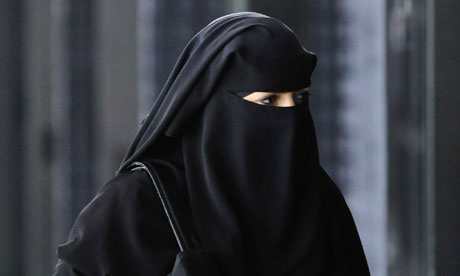
fear and of discrimination.  One piece that comes up regularly is the wearing of burqas or niqabs which cover everything except the eyes (and sometimes even the eyes) by Muslim women.  The arguments go two ways.  One says that such treatment of women is oppressive (that is another post).  The second is more prevalent now in these days following the terrorist attacks in Paris.  It says that these loose fitting garments allow someone to hide weapons which are then easily used to commit violence and prevent others from being able to identify the person wearing the garments.

The fact that the vast majority of terrorists are men and that loose garments that cover the majority of the body are often worn by folk for very practical reasons (spend any time in northern Minnesota in January without everything being covered?) and that in many states in the US, citizens are allowed to openly carry weapons down the center of the street tells us that this is more about fear of the other than about terrorism.

It is worth understanding Muslim discussions and thoughts regarding hijab - modesty of dress for both men and women - in various Muslim cultures and theological traditions but that is basically irrelevant at this point.  Many religious groups including orthodox Jews, the Amish, Sikhs,  some groups of evangelical Christians, and some Muslim traditions have proscribed ways of dress for both women and men.  The question is whether or not the government has the power to define religious expression in terms of dress.   Perhaps a more blunt way to phrase the question is whether or not the government has the power to tell you or me what we must wear?  If some Orthodox Jew finds it offensive that my wife's forearms are showing as she walks down the street or some Amish folk think my dress is too colorful should they be allowed to enforce their religious understandings?  Should a Sunni from Saudi Arabia be able to make my female readers wear a niqab?  We would be up on our hind legs in a second if any of those enforcements were to take place.   We should feel the same repulsion at the idea that the government can make a woman who believes that her religious commitment to hijab requires her to be covered to uncover herself. 

Thursday, August 27, 2015

Who Gets to Decide

More than once I've bristled at the term, "Radical Islam," especially when applied to folk like ISIS.  I've also grieved when I read or hear a statement that begins "Christians believe..." and goes on to include something I most definitely do not believe.  More than once my response has been... "that person is not a Christian," which is likely the same thing they would say about me.

In every religion with which I'm familiar, there is a degree of heterogeneity that includes folk at one point of the spectrum excluding folk at other points on the spectrum as not being real representatives of that tradition.  I have read Orthodox Jews say that Reformed Jews are not really Jewish.  I know Muslims who would say that the members of ISIS are not really Muslims and of course, those same members of ISIS routinely kill folk who call themselves Muslims but who do not measure up to their definitions.  Just the other day I had lunch with a very conservative Christian woman who flatly said that her family as not "Christian" - some of whom are central members of a church I know intimately.  Then there are those outside of the various religious traditions who often point to the very worst as examples... those who look at Islam and only see ISIS, at The Family Research Council as the spokespeople for Christianity... you get the picture.

Once I had a discussion with a hyper-conservative Calvinist.  At the end of our talk, she remarked, "We worship a different Jesus."  She was right.  It doesn't seem unreasonable then that the same title doesn't fit both of us.

So, who gets to decide?  And using what criteria?  Or is a decision even possible?

I would say, yes, a decision is possible and necessary.  We live in a world where information travels virtually instantly and every faith tradition finds itself out there, being judged in the marketplace of ideas and actions.  It is all too easy for folk to point at one element or another and generalize when that element may or may not fairly represent a religious tradition.  The label "Christian" is important to me and the way that label is read by others is then also important to me.

So... first, does the individual or group fit into the general trajectory of the tradition?  Every religious tradition changes through history, some more than others, but all change.  I would argue that in my tradition, we become more able to understand God's yearnings for humanity and move ever so slowly closer to God's "will."  While questions related to the founder like "what would Jesus do?" or "What would Mohamed do?" might be helpful, we must realize that we always see those founders through the lens of our current experience and even our theological stance.  The Jesus I see would be clearly different than the one Jonathan Edwards saw or the one that Tony Perkins of the Family Research Council sees.  Still, I believe we can look at the broad sweep of a tradition to see what direction it is moving and I would argue judge that something that spins off wildly from that trajectory doesn't fit the definition.  In spite of calling themselves "Christian," those in the Christian Identity Movement simply are not.    In spite of the word "Islam" being in the title of ISIS, they are not.

I would also argue that a group or person who claims to be trying to go back to the original intent is likely falling outside of the definition.  You can't go back... and indeed, God does not go backwards.  If the individual or group argues that everyone else has gone astray for the past decades or centuries... that is simply hubris.

Second, look at that trajectory again and ask how the tradition's understanding of who God is has moved... if the individual or group seems to be advocating a "God" outside of that tradition's trajectory, then clearly they are not one of them.

Finally, where did they come from?  If they pop up out of nowhere, they don't meet the definition.

The hard question of course is whether God can work outside of the tradition.  Of course.  God is God and can do whatever God wants... but those radical changes begin something new.  Christianity has Jewish roots, but it is not Judaism.  Islam has roots in Judaism and Christianity... but it is neither.  You get the point.

So, for today, I have no difficulty at all saying that ISIS is not Islam.  I'm a little more shy in my own tradition but if you asked me privately I'd tell you what I think about whether or not Westboro Baptist is really a Christian church.

What would your criteria be?  Or do you think it is not a worthy effort?

Saturday, February 04, 2012

A True American Story

The other day, a friend of mine shared a bit of his story.  His father was a devout man who held his faith deeply.  The nation where he lived made it very difficult to practice his faith as he believed God called him so, with pain and difficulty, leaving behind family, friends, job, and roots, moved to another country where he believed he would be able to faithfully practice his faith.  He put down new roots and raised a family, trying to be faithful and to build a good life.  Jump forward a generation and my friend, another faithful man, was trying to live out his understanding of his faith which didn't quite fit into the majority opinion of his homeland found himself in the US attending college.  It was a new world with a broad mix of religions and opinions about faith.  More important though,  it was a place with an expressed commitment to freedom of religion.  Each individual could practice his or her faith (or lack thereof) in a way that was most faithful to the deep commitments of their hearts.  My friend and his new wife decided, this was the kind of place they could truly be faithful to their understanding of God's yearnings for them.  It was the kind of place they wanted to raise their children.  They stayed in the US and became citizens here, working, putting down roots, raising a family, and living out their faith in freedom.

Can you think of a story that more characterizes the American dream?  Can you think of a story that is more consonant with the commitments that gave birth to this nation and continue to shape our culture as a people?  I can't.  This strikes me as the quintessential American story.  It just happens that Mukhtar is Muslim.  His father left India for Saudi Arabia to find a pace where he could live his Muslim faith without difficulty.  Mukhtar left Saudi Arabia to find a place where he could live out his faith in a way that was authentic to his understanding of God's yearnings for him... he came to the land of freedom of religion so he could faithfully live as a Muslim, next door to Catholics, Jews, Hindus, Sikhs, Protestants, Mormons, Atheists, and a hundred other commitments, all learning from one another, struggling with one another, and even disagreeing with one another... in freedom.

Thursday, March 24, 2011

Will the real....

_______ please stand up?

Back in my childhood, I remember watching the television show, To Tell the Truth. An individual with an unusual occupation or experience would be joined by two impostors and a panel of celebrities would question them and try to decide who was the real person. For some time I've struggled with the question, Would the real Baptists please stand up? or, Would the real Christians please stand up? And recently, Would the real Muslims please stand up? How do we decide who is the real thing? Who gets to define the term?

Let me give some examples. Early Baptists had four commitments that distinguished them from other Christian groups. They believed in soul liberty (an individual is responsible for his or her own faith), church freedom (no outside body can tell a church what its ministry must look like), freedom of the Bible (the scriptures speak for themselves and nobody can assign an official interpretation), and the separation of church and state(much more complicated than many people think, but that is another post). Those four commitments led to a wide variety of theological stances from fundamentalist to Unitarian but all stood within the tradition. Few Baptists today are willing to live with the implications of that freedom - think especially of the Southern Baptist Convention. Are they still Baptists?

How about Christianity in general? All Christians would presumably say they are trying to follow Jesus but their understanding of who Jesus is would differ to the point that, at least in some cases, they clearly are not talking about the same person. Let me give an example that is close to my heart and about which I'm willing to live with significant differences... but it is a real difference. The early Christians were pacifists. They followed the teachings of Jesus and understood the things he said about enemies as absolutely prohibiting participation in the military or acting in violence under any circumstances. Rather than take up arms against enemies, they chose to watch as loved ones were tortured and killed and to endure the same. Most in the Anabaptist traditions in the Church continue to understand the teachings of Jesus that way. Beginning with Constantine, Christianity began to identify more and more with the empire of the day and military service was seen as a appropriate way to express one's faith. There are movements in the US military today that absolutely identify themselves as followers of Jesus even as they launch missiles against Libya or attack enemies in Afghanistan. It is difficult to imagine a more different understanding of how to follow Jesus. Are they both Christian? Who decides and how? What does the term mean?

More recently there has been a great deal of discussions about the nature of Islam. We often hear statements like, "For Muhammad, religion and politics were one and the same so any Muslim is automatically against separation of religion and government and is out to impose Sharia law on the entire world. Convert or kill is the mandate." Whether or not that was Muhammad's original understanding is another discussion but it clearly is the understanding of some visible Muslims today. It also clearly is not the understanding of the overwhelming majority. Indeed, all of the Muslims I know are absolutely committed to freedom of religion and to a more peaceful expression of their faith. So, who gets to define the term?

I don't have any good answers. I find myself wanting to define the terms as I prefer they be used. Of course, that may or may not coincide with how you prefer they be defined or how the general population understands them. A good friend of mine was involved in a Black Muslim organization back in the 60's where they had a saying - "he who talks loudest gets over." Often these terms are defined by the most visible or most vocal groups... Do we allow the crazies (or at least the folk who don't think like us as they might define me as a crazy) to own the terms or do we keep trying to re-frame the discussions and redefine the terms? I have to admit that I'm growing tired of those battles... but they still feel worthwhile to me.

Thursday, March 10, 2011

Un-American

I'm a Baptist. One of the core commitments of all true Baptists is separation of church and state. Religion must be freely chosen and the government has no role in either curtailing or supporting religious practice. Essentially, religion must be invisible to government.

Today, Rep. King, a Republican from NY state is holding hearings to look into the "The Extent of Radicalization of Muslim Americans." While there is no doubt that there are radical Muslims in America and it might even be possible that the number is growing, to paint with such a broad brush is clearly a swipe against freedom of religion, a core principle upon which this nation was founded. When one faith group is singled out for attack, all are threatened.

Representative King, this is as un-american as it gets. You should be ashamed.

Tuesday, August 17, 2010

Ground Zero Mosque

I have not posted on this topic yet, largely because there are folk who have expressed my thoughts better than I could. At the foundation, I believe in freedom of religion. It is a core principle of our nation and one of the bedrocks of my tradition as a Baptist. The state has no right to interfere in religion at all... and that includes telling a faith community where it can or cannot worship. That said, there are so many other issues raised in the discussions surrounding the "ground zero mosque." The fact that approximately 10% of those killed on 9/11, including some first responders were Muslim... The fact that if "they hate us for our freedom," then the very best way to fight "them" is to exercise and live that freedom... The fact that the families of those who died at ground zero are anything but unanimous in their response to the proposed community center... And the fact that the proposed "ground zero mosque" is not at ground zero or even visible from the site.

A few days ago, Keith Olbermann commented on the controversy. It is well worth watching.

Visit msnbc.com for breaking news, world news, and news about the economy