OK... one of the issues we hear about most regarding the Obama years is the ACA and more than once I heard people say that "Hillary will double down on Obamacare." Trump has said that on day 1 he will repeal the ACA. I'm not sure how that is possible but... From what I can see the closest that the GOP has come to a proposed alternative is Paul Ryans 37 pages of talking points (it lists goals but doesn't really say how we get to any of them... and as the ACA has shown, the proof really is in the implimentation) or Trump's promise of something better with no details and as far as anyone from the outside can see, no work having been done on what would be a tremendously complex issue. Of course, the option of just repealing the ACA without replacing it with any legislative alternative is a real possibility... with all of the attendant chaos that would bring.
This one is very personal for me. I have an hereditary condition called heterozygous familial hyperlipidemia. What that means is that my liver doesn't fully function with regards to processing cholesterol and I end up with crazy high numbers of the bad kind (when I was first tested, my overall cholesterol was 613). That results in severe artery disease. Most of the men in my biological family died of heart attacks in their thirties (my father at 31). That means that on the private market I am simply uninsurable.
When it was discovered that I have this condition, my arteries were in very bad shape to the point that surgical intervention would do no good. I had not had a heart attack though. The medications (expensive) work very well for me and my cholesterol has been under control for nearly 30 years. I still have not had a heart attack and some of the arterial damage has healed itself.
Under the old system, health insurance differed dramatically from one state to another. In New York, I got excellent insurance at a reasonable price through the local council of churches which acted as a group. In California, I had to get it either through the denomination or as private insurance. Private was not available to me. Period. The broker literally laughed when he saw the medical history portion of my application. So we got it through the denomination which, because everyone who could get insurance cheaper had moved to another source, became a group of older individuals with more medical issues. I got insurance... but the year prior to the ACA, it cost nearly $4000 a month for my spouse and I. Yes. That is the correct number of zeros. When the ACA was implemented, that program disappeared because nobody was able for it to continue. Even under the ACA, our insurance started at $2000 a month... but that still was a savings of over $24000 a year.
Long story short... if the ACA is repealed without a replacement that provides insurance to people like me at a reasonable cost, I will likely die. I'm not trying to be dramatic here... only stating a reasonable understanding of what will happen.
Before the ACA, 45,000 died each year from the results of lack of insurance. 20 million people who had been uninsured got health insurance under the ACA. That number dropped significantly. If the ACA is repealed without a suitable replacement, we'll be looking at those numbers again... and I will likely be one of them.
Showing posts sorted by relevance for query ACA. Sort by date Show all posts
Showing posts sorted by relevance for query ACA. Sort by date Show all posts
Thursday, November 10, 2016


Friday, May 16, 2014
Obamacare... again
As I understood it, the Republicans were afraid that once Obamacare really got going, there would be no turning back. Well, it has taken hold. Clearly there have been problems and there are some folk, a small percentage in my understanding, who were truly impacted in a negative way by the program. One might even argue that it was not the best solution for the problems or that some of the biggest problems in our healthcare system were not even addressed as directly as they could have been.
Still, the ACA accomplished a number of things that I believe we as a nation needed to accomplish. It removed pre-existing conditions as a barrier to getting health insurance. It expanded the pool on which rates are based to include the entire community rather than a small slice or individual family. It removed the lifetime cap that insurance would be responsible to cover. It made insurance available and affordable to everyone (except in those states which have refused to expand Medicaid and continue to exclude the poorest folk from health insurance) and procvided health insurance to millions who did not have it before. And it standardized what an insurance policy must cover.
My family were serious beneficiaries of the ACA. For a whole variety of reasons my medical insurance, which was paid by my church, was insanely expensive. It was one of the largest line items in the church budget and was getting to the point that it was becoming unaffordable. A pre-existing condition made it impossible to get any other coverage at any price. Under the ACA, the church was able to get another policy with roughly the same coverage and save some $15K a year. My 25 year old son, working at a just above minimum wage job, had not had insurance for 4 years. He has it again. My daughter, son-in-law, and grandson were on an absolutely unaffordable COBRA plan after Christian lost his job, 2 months before the baby was expected. They couldn't get any other plan because of a pre-existing condition - pregnancy. To make things even more complicated, the company he had worked for changed their insurance 1 month before he lost his job. Simply put, the ACA saved their butts and things would have been even better had it been available 6 months earlier. I can tell multiple other stories of church members, friends, and acquaintances who were saved by the ACA. I can also tell stories of folk who suffered significantly and some who even died because of lack of insurance.
Of course there are the two big complaints... that everyone must purchase insurance and that some folk are having to purchase insurance for things they either will not use or even have some moral objection to using. The entire system falls apart without those two criteria though... so it becomes a choice between the keeping the positives or disposing of the negatives. As a country, I cannot see how we can morally even consider the latter. Indeed, that will kill people. I guess there are a small number of folk who actually do believe that poor people do not deserve health insurance and that the current system of going to the emergency room when things are dire is enough for them. I don't think that viewpoint is even worth discussing it is so immoral.
Here's the surprise. Over the past few weeks I've seen advertisements for two local politicians running for the House and promising to work to repeal Obamacare. Invariably, they always back-pedal when asked and say they only want to repeal the mandate and the government requirements for what an insurance policy will cover... but given the current system, that literally cannot work. Those two features cannot be removed without causing the rest to be unworkable. What they are really saying is that the poor need to be kicked off Medicaid, those with pre-existing conditions are on their own, and that any company can decide what it will or will not pay for via insurance for any reason they want and that if that happens to be the way you get your health insurance... too bad for you. And we cannot forget that in '09 a study showed that 45,000 people died annually in the US due to lack of insurance. I cannot imagine how anyone can think that is a good idea to repeal the ACA and I cannot imagine how anyone with a conscience would ever vote for a representative with that as a significant part of their agenda.
Still, the ACA accomplished a number of things that I believe we as a nation needed to accomplish. It removed pre-existing conditions as a barrier to getting health insurance. It expanded the pool on which rates are based to include the entire community rather than a small slice or individual family. It removed the lifetime cap that insurance would be responsible to cover. It made insurance available and affordable to everyone (except in those states which have refused to expand Medicaid and continue to exclude the poorest folk from health insurance) and procvided health insurance to millions who did not have it before. And it standardized what an insurance policy must cover.
My family were serious beneficiaries of the ACA. For a whole variety of reasons my medical insurance, which was paid by my church, was insanely expensive. It was one of the largest line items in the church budget and was getting to the point that it was becoming unaffordable. A pre-existing condition made it impossible to get any other coverage at any price. Under the ACA, the church was able to get another policy with roughly the same coverage and save some $15K a year. My 25 year old son, working at a just above minimum wage job, had not had insurance for 4 years. He has it again. My daughter, son-in-law, and grandson were on an absolutely unaffordable COBRA plan after Christian lost his job, 2 months before the baby was expected. They couldn't get any other plan because of a pre-existing condition - pregnancy. To make things even more complicated, the company he had worked for changed their insurance 1 month before he lost his job. Simply put, the ACA saved their butts and things would have been even better had it been available 6 months earlier. I can tell multiple other stories of church members, friends, and acquaintances who were saved by the ACA. I can also tell stories of folk who suffered significantly and some who even died because of lack of insurance.
Of course there are the two big complaints... that everyone must purchase insurance and that some folk are having to purchase insurance for things they either will not use or even have some moral objection to using. The entire system falls apart without those two criteria though... so it becomes a choice between the keeping the positives or disposing of the negatives. As a country, I cannot see how we can morally even consider the latter. Indeed, that will kill people. I guess there are a small number of folk who actually do believe that poor people do not deserve health insurance and that the current system of going to the emergency room when things are dire is enough for them. I don't think that viewpoint is even worth discussing it is so immoral.
Here's the surprise. Over the past few weeks I've seen advertisements for two local politicians running for the House and promising to work to repeal Obamacare. Invariably, they always back-pedal when asked and say they only want to repeal the mandate and the government requirements for what an insurance policy will cover... but given the current system, that literally cannot work. Those two features cannot be removed without causing the rest to be unworkable. What they are really saying is that the poor need to be kicked off Medicaid, those with pre-existing conditions are on their own, and that any company can decide what it will or will not pay for via insurance for any reason they want and that if that happens to be the way you get your health insurance... too bad for you. And we cannot forget that in '09 a study showed that 45,000 people died annually in the US due to lack of insurance. I cannot imagine how anyone can think that is a good idea to repeal the ACA and I cannot imagine how anyone with a conscience would ever vote for a representative with that as a significant part of their agenda.
Tuesday, November 05, 2013
winners and losers in the ACA
No doubt you have heard reports of folk who have lost health insurance or had it increase in price because of the Affordable Care Act. I know that in some of those instances, the reporting has been less than 100% accurate. In some cases, such as with Trader Joe's, the employer discontinued their employee insurance because they calculated that their employees could get coverage through the exchanges for less than their portion of the coverage they were getting at work. Dropping them actually got them equivalent insurance for less money. In other instances, people with woefully inadequate insurance found themselves having to pay more but also receiving significantly better coverage. All that said, I know there are folk who have seen increases in the cost of their insurance and I've heard some reports for which I have no data to question, that the reason is Obamacare. And finally there are those young adults who "don't need" health insurance until of course, they do. For them, any cost is an increase.
My experience has been different. As I said in an earlier post, moving to the exchange will save significantly money for my employer. I had no idea how much. To recap, my insurance is ridiculously high for a number of reasons. Clergy are a high risk group to begin with. They tend not to take good care of themselves so heart disease, stroke, and diabetes are rampant. Clergy also tend to be older which just increases the risk pool. Finally, the health insurance we get through our denomination is an even higher risk pool as it tends to include only those who cannot get insurance elsewhere. Until the ACA, I was part of that group. I also happen to live in an area where healthcare and insurance are very expensive. We received word that for next year, our denominational healthcare plan would increase by 11.5% and the increase has nothing to do with the ACA. Additionally, the co-pays all increase as does the out of pocket limit and fewer medications are covered. Add the fact that I move into another age category and insurance for my spouse and I would cost $4251 a month. Simply, that is beyond what the church could possibly afford and minus housing allowance, is more than my salary. Looking at the exchange, it seems that a platinum plan in our area at our age would be under $1900 a month for a savings of about $2,350 a month or over a 55% savings. It is still a lot of money but the church can afford to keep me covered.
My son-in-law, daughter, and grandson will experience an even larger savings. My son has been without health insurance for 3 years because as a single male he was not eligible for any government help and could not begin to afford coverage on the open market. He will have insurance beginning January 1 and I will breathe much easier every time he plays basketball or flag football.
I guess there are losers in all of this. I still agree that the overall shape of the ACA is not the best we could have done. Given the current situation and the political climate in which we live, I am more thankful than I could say for the ACA.
My experience has been different. As I said in an earlier post, moving to the exchange will save significantly money for my employer. I had no idea how much. To recap, my insurance is ridiculously high for a number of reasons. Clergy are a high risk group to begin with. They tend not to take good care of themselves so heart disease, stroke, and diabetes are rampant. Clergy also tend to be older which just increases the risk pool. Finally, the health insurance we get through our denomination is an even higher risk pool as it tends to include only those who cannot get insurance elsewhere. Until the ACA, I was part of that group. I also happen to live in an area where healthcare and insurance are very expensive. We received word that for next year, our denominational healthcare plan would increase by 11.5% and the increase has nothing to do with the ACA. Additionally, the co-pays all increase as does the out of pocket limit and fewer medications are covered. Add the fact that I move into another age category and insurance for my spouse and I would cost $4251 a month. Simply, that is beyond what the church could possibly afford and minus housing allowance, is more than my salary. Looking at the exchange, it seems that a platinum plan in our area at our age would be under $1900 a month for a savings of about $2,350 a month or over a 55% savings. It is still a lot of money but the church can afford to keep me covered.
My son-in-law, daughter, and grandson will experience an even larger savings. My son has been without health insurance for 3 years because as a single male he was not eligible for any government help and could not begin to afford coverage on the open market. He will have insurance beginning January 1 and I will breathe much easier every time he plays basketball or flag football.
I guess there are losers in all of this. I still agree that the overall shape of the ACA is not the best we could have done. Given the current situation and the political climate in which we live, I am more thankful than I could say for the ACA.
Wednesday, July 17, 2013
Health Insurance... the ACA can't come soon enough
Two weeks go my son-in-law lost his job. That is bad enough under the best of circumstances... but the circumstances are anything but "best." My daughter is 7 months pregnant. They have health insurance through the end of July... but the baby is due in September. They had decided to do their birth at a birth center with a midwife which involved negotiating with their insurance company to begin with... They live in one of the most expensive areas of the country . Of course, if they move, they have to find medical systems for the birth of the baby and find health insurance. If they stay, they have to figure out how to pay rent plus get health insurance. Christian got a job quickly although that income will render them ineligible for any government aid... and he is not eligible for health insurance at his new job for 90 days. Of course, he has not started as they wait for his drug test to return from the lab. And there is the ever there and overwhelming shadow of student loans which equal monthly payments higher than rent in most areas of the country. Those bills have made it impossible to accumulate any savings... so there is no money for COBRA or as a buffer against other costs. The ACA would make things easier for them... but it doesn't kick in completely until January.
My son has not had health insurance for over two years... and that makes us very nervous. He is an athlete and plays basketball, softball, and flag football at least twice a week. One injury and his life would be a mess. John rarely gets ill but when he does, he does. Since childhood he has run very high fevers. A year ago, he got some sort of virus and woke in the middle of the night with a fever of 104. You can imagine the fear and the number crunching that went on that night... does he got to the ER? The bills would be far beyond his ability to pay. Even to wait and go to Urgent Care in the morning would be devastating to his finances. He was able to get his temperature down and he went to Urgent Care the next morning. His income is minimal so he will be eligible for the MediCal part of the ACA beginning in January. It is not good insurance but it is something and I will breathe easier.
The same day Christian was fired, I received a note from MMBB, the benefits board for our denomination. As of January 2014, MMBB will no longer offer health insurance. Since moving to California we have gotten our health insurance through them. It is a reasonably good plan but is extremely expensive. Due to California insurance laws, the only other option for me would be to get insurance as an individual. Because of my familial hyperlipidemia no insurance company would offer me insurance at any price. Through the years, the MMBB medical plan became the plan of last resort for clergy in my denomination. Anyone who could get insurance elsewhere did. This led to an increasingly smaller and higher risk pool in a demographic group that is already higher risk than the general population (clergy tend to be older and have more stress and lifestyle related problems than the general population). That adds up to obscenely high premiums. My church pays health insurance premiums that are almost equal to my salary for my spouse and me. Our son is eligible to be included but the cost is so prohibitive that neither the church nor us can shoulder that additional cost. It is not an easy situation for the church but without this option, I would not have been able to accept the call to this church.
Because of the expense, I have been asked to search out other options every year for the past few years and each year have received the same answer from the broker - "not insurable at any price." It doesn't matter that we've known about the condition since 1987, it has been under control by medications, I've had no incidents, and every test shows that my coronary arteries are healthy. I assumed that this year, I would be asked to investigate the insurance exchange set up via the Affordable Care Act. I did not expect that there would be no option via MMBB. It does make sense that we go with the exchange. The price for roughly equivalent coverage looks to be at least 30% less than the church is currently paying and according to the ACA, they cannot deny me coverage because of my condition. Still, the letter felt like a punch in the stomach... and every headline that I see stating that groups are trying to completely derail the ACA literally reads like a death sentence for me. Without the medications I likely would have died within a year or so of my diagnosis in '87. Indeed, the meds were new enough that they were unsure whether they would really help someone with my condition. One cardiologist told me, "We're hopeful, but just in case, get your affairs in order." If I had to stop them now, it might take a couple of years... and then I would begin having heart attacks.
One might say, "you could continue the meds, you'd just have to pay for them." True... sort of. The meds require regular blood tests, require a physician to monitor them and prescribe them (our experience in CA is that the primary care physicians don't want to do this so I'd need to see a cardiologist), and none of those costs are inexpensive. At this point, they are still significantly less than what the church has been paying in premiums but one small incident... Add that my wife is likely going to need a hip replacement in the next year or two...
Others might ask why they should shoulder any of my medical risk or costs? That is a real question and comes down to how one feels about community responsibility or the fact that we've been paying health insurance premiums for these years, supporting costs for the health care of others (and salaries and profits for the health insurance industry).
All of this is just to rant about a system that is clearly broken, looks to get better in 2014 but still is not nearly what it needs to be, and which is frightening and frustrating for me.
My son has not had health insurance for over two years... and that makes us very nervous. He is an athlete and plays basketball, softball, and flag football at least twice a week. One injury and his life would be a mess. John rarely gets ill but when he does, he does. Since childhood he has run very high fevers. A year ago, he got some sort of virus and woke in the middle of the night with a fever of 104. You can imagine the fear and the number crunching that went on that night... does he got to the ER? The bills would be far beyond his ability to pay. Even to wait and go to Urgent Care in the morning would be devastating to his finances. He was able to get his temperature down and he went to Urgent Care the next morning. His income is minimal so he will be eligible for the MediCal part of the ACA beginning in January. It is not good insurance but it is something and I will breathe easier.
The same day Christian was fired, I received a note from MMBB, the benefits board for our denomination. As of January 2014, MMBB will no longer offer health insurance. Since moving to California we have gotten our health insurance through them. It is a reasonably good plan but is extremely expensive. Due to California insurance laws, the only other option for me would be to get insurance as an individual. Because of my familial hyperlipidemia no insurance company would offer me insurance at any price. Through the years, the MMBB medical plan became the plan of last resort for clergy in my denomination. Anyone who could get insurance elsewhere did. This led to an increasingly smaller and higher risk pool in a demographic group that is already higher risk than the general population (clergy tend to be older and have more stress and lifestyle related problems than the general population). That adds up to obscenely high premiums. My church pays health insurance premiums that are almost equal to my salary for my spouse and me. Our son is eligible to be included but the cost is so prohibitive that neither the church nor us can shoulder that additional cost. It is not an easy situation for the church but without this option, I would not have been able to accept the call to this church.
Because of the expense, I have been asked to search out other options every year for the past few years and each year have received the same answer from the broker - "not insurable at any price." It doesn't matter that we've known about the condition since 1987, it has been under control by medications, I've had no incidents, and every test shows that my coronary arteries are healthy. I assumed that this year, I would be asked to investigate the insurance exchange set up via the Affordable Care Act. I did not expect that there would be no option via MMBB. It does make sense that we go with the exchange. The price for roughly equivalent coverage looks to be at least 30% less than the church is currently paying and according to the ACA, they cannot deny me coverage because of my condition. Still, the letter felt like a punch in the stomach... and every headline that I see stating that groups are trying to completely derail the ACA literally reads like a death sentence for me. Without the medications I likely would have died within a year or so of my diagnosis in '87. Indeed, the meds were new enough that they were unsure whether they would really help someone with my condition. One cardiologist told me, "We're hopeful, but just in case, get your affairs in order." If I had to stop them now, it might take a couple of years... and then I would begin having heart attacks.
One might say, "you could continue the meds, you'd just have to pay for them." True... sort of. The meds require regular blood tests, require a physician to monitor them and prescribe them (our experience in CA is that the primary care physicians don't want to do this so I'd need to see a cardiologist), and none of those costs are inexpensive. At this point, they are still significantly less than what the church has been paying in premiums but one small incident... Add that my wife is likely going to need a hip replacement in the next year or two...
Others might ask why they should shoulder any of my medical risk or costs? That is a real question and comes down to how one feels about community responsibility or the fact that we've been paying health insurance premiums for these years, supporting costs for the health care of others (and salaries and profits for the health insurance industry).
All of this is just to rant about a system that is clearly broken, looks to get better in 2014 but still is not nearly what it needs to be, and which is frightening and frustrating for me.
Wednesday, October 30, 2013
Alternatives to Obamacare
I had an epiphany yesterday. Republicans in the House have voted to repeal the ACA 46 times and not once have they offered an alternative. The reason that they have not offered a reasonable alternative to Obamacare is because Obamacare was their idea. Yep. Back in 1974, the Nixon administration proposed an insurance program where all employers would provide insurance for all of their workers or face a fine. The poor would be added to an expanded Medicare and small businesses and low income folk would receive a government subsidy to help cover their insurance costs. It failed because Democrats wanted a public system rather than one based on private insurers. In 1989 the Heritage Foundation proposed a law with an individual mandate requiring everyone to purchase insurance and that feature began showing up in Republican proposals for healthcare reform up until Newt Gingrich made it a centerpiece of his agenda when he was Speaker. All of this on the federal level. Then, of course, Romney established a very similar plan in Massachusetts on the state level. Obamacare is a Republican program. A Democratic program would have centered on a public option with a single payer. The ACA is not socialized medicine, it is a program based on the private sector.
There are other options to the ACA. I prefer a single payer, public program. I think that is the only way to address the myriads of problems in our healthcare delivery system. There was no way the Republicans would have voted for truly socialized healthcare and there were enough Dems who would have sided with them that it was an idea that was dead in the water regardless of whether or not it might have been the best idea. It never even made it to the table for discussion.
I have heard two other options mentioned by some.
Leave the system alone. That is fine if you are someone who has good insurance from your employer without a large employee contribution or never experience any illnesses or accidents that cause injuries. It leaves out the folk who have no insurance or are under-insured. It causes many people to forgo treatment until it is too late and sends others to the most expensive healthcare option of all, the emergency room. It leaves those out who have pre-existing conditions which preclude them from purchasing insurance (and there is no way to stop insurance companies from excluding pre-existing conditions without an individual mandate). And regardless of what folk say, healthcare does not work like any other "free market" industry so in this option there is no way to slow the runaway price increases we've all experienced. Leaving it alone is not an option that I can see as making any sense at all.
I've recently seen multiple folk advocating another option which I find sickening (excuse the pun). They are arguing that we do away with insurance completely. Healthcare would become like any other commodity on the market with individuals bargaining with physicians and hospitals when needed, health care going only to those who can afford it, and the "free" market running its course. In their minds, those who are healthy would not have to subsidize those who are not and those who are not in this scenario are always caricatured as irresponsible folk whose poor choices are causing their problems. While there are many who do not need regular doctor visits or medications and think they can go without insurance, one accident or unexpected illness changes everything in a heartbeat. Those folk argue that a free market would bring down costs, but never imagine the ridiculousness of sitting in the emergency room with a broken bone sticking through their flesh while arguing with the doctor about the costs or leaving to go 55 miles to another hospital that treats heart attacks more inexpensively. I presume they would argue that anyone arriving at the hospital must pay in advance or not receive treatment. Without that stricture, who would pay for those who receive treatment and never pay? Most of all, this kind of idea completely excludes any sense of community and the greater good for the entire community. I can't help but think of politicians in New York and Colorado who argued against government disaster funds until their communities were struck by Sandy and terrible floods and they saw the light that we really are all in this together. The only folk for whom this option works are the very, very, very few who never get sick or injured or the extremely wealthy.
Are there other options that I've missed? Realistic ones that preserve a sense of community? I agree the ACA is not the best option. I would even agree that it does not represent any sense of a compromise. In spite of the fact that it was passed by the Dems, it is a completely Republican idea that Democrats supported, expecting that Republicans would own the baby they birthed. They did not. And they offered no reasonable alternatives... because their proposal was already on the table.
There are other options to the ACA. I prefer a single payer, public program. I think that is the only way to address the myriads of problems in our healthcare delivery system. There was no way the Republicans would have voted for truly socialized healthcare and there were enough Dems who would have sided with them that it was an idea that was dead in the water regardless of whether or not it might have been the best idea. It never even made it to the table for discussion.
I have heard two other options mentioned by some.
Leave the system alone. That is fine if you are someone who has good insurance from your employer without a large employee contribution or never experience any illnesses or accidents that cause injuries. It leaves out the folk who have no insurance or are under-insured. It causes many people to forgo treatment until it is too late and sends others to the most expensive healthcare option of all, the emergency room. It leaves those out who have pre-existing conditions which preclude them from purchasing insurance (and there is no way to stop insurance companies from excluding pre-existing conditions without an individual mandate). And regardless of what folk say, healthcare does not work like any other "free market" industry so in this option there is no way to slow the runaway price increases we've all experienced. Leaving it alone is not an option that I can see as making any sense at all.
I've recently seen multiple folk advocating another option which I find sickening (excuse the pun). They are arguing that we do away with insurance completely. Healthcare would become like any other commodity on the market with individuals bargaining with physicians and hospitals when needed, health care going only to those who can afford it, and the "free" market running its course. In their minds, those who are healthy would not have to subsidize those who are not and those who are not in this scenario are always caricatured as irresponsible folk whose poor choices are causing their problems. While there are many who do not need regular doctor visits or medications and think they can go without insurance, one accident or unexpected illness changes everything in a heartbeat. Those folk argue that a free market would bring down costs, but never imagine the ridiculousness of sitting in the emergency room with a broken bone sticking through their flesh while arguing with the doctor about the costs or leaving to go 55 miles to another hospital that treats heart attacks more inexpensively. I presume they would argue that anyone arriving at the hospital must pay in advance or not receive treatment. Without that stricture, who would pay for those who receive treatment and never pay? Most of all, this kind of idea completely excludes any sense of community and the greater good for the entire community. I can't help but think of politicians in New York and Colorado who argued against government disaster funds until their communities were struck by Sandy and terrible floods and they saw the light that we really are all in this together. The only folk for whom this option works are the very, very, very few who never get sick or injured or the extremely wealthy.
Are there other options that I've missed? Realistic ones that preserve a sense of community? I agree the ACA is not the best option. I would even agree that it does not represent any sense of a compromise. In spite of the fact that it was passed by the Dems, it is a completely Republican idea that Democrats supported, expecting that Republicans would own the baby they birthed. They did not. And they offered no reasonable alternatives... because their proposal was already on the table.
Thursday, April 06, 2017
The Problem with Health Insurance
Health insurance is complicated... who knew?
In the bass guitar world technology has been pushing the limits with lighter weight, smaller cabinets, massive power, and more low end extension. My 6 pound head can run rings around the 65 pound heads of my youth and my 34 pound cab puts out more low end than the refrigerator sized (and weight) cabs of that same time period. Still, common wisdom is that you cannot have cheap, light, loud, and low all in one package. The laws of physics still apply along with basic economics.
In order to fix our medical care system, we must first acknowledge that the rules of math apply. It is not possible to have everyone covered with good comprehensive coverage at lower prices that are affordable to everyone without government funding and government interference. Lower priced plans with reduced coverage are only helpful until they are not. Cutting payment to physicians or other providers can only go so far before the math no longer works. A for profit entity has a bottom line commitment to the bottom line... and something eventually has to give in order for the company to make its profits. All that adds up to one inescapable conclusion.: before the ACA, the system was broken. Too many people were not insured. Too many people went bankrupt because of medical bills. Too many died because of lack of care. Treatment plans were often chosen by bean counters rather than because of efficacy. The training of physicians is expensive and favors some specialties over others regardless of actual social needs. The nature of healthcare makes it impossible for it to respond to market pressures in the same way that other industries do.
The ACA attempted to fix some of the presenting problems without addressing underlying issues. It succeeded in that small way and would have been more successful had the Republican Party not worked so hard to obstruct it. (We hear how the CBO's numbers were so off... but that ignores the fact that their numbers were based on the plan actually being adopted while 29 states refused the Medicare expansion part of the program). Because the ACA sought to work within the then, current system of for profit private insurance companies, etc., it could never deliver the product it promised of affordable, comprehensive coverage for all.
To get the product that a civilized country deserves requires a complete overhaul from top to bottom including training of physicians, funding of medical research, decisions regarding what care is provided (and not provided), how funding is allocated and what fee structures look like. It will take years to accomplish... possibly decades... but if we do not begin the process, we will see our broken system continue to deteriorate and all but the very rich will suffer.
In the bass guitar world technology has been pushing the limits with lighter weight, smaller cabinets, massive power, and more low end extension. My 6 pound head can run rings around the 65 pound heads of my youth and my 34 pound cab puts out more low end than the refrigerator sized (and weight) cabs of that same time period. Still, common wisdom is that you cannot have cheap, light, loud, and low all in one package. The laws of physics still apply along with basic economics.
In order to fix our medical care system, we must first acknowledge that the rules of math apply. It is not possible to have everyone covered with good comprehensive coverage at lower prices that are affordable to everyone without government funding and government interference. Lower priced plans with reduced coverage are only helpful until they are not. Cutting payment to physicians or other providers can only go so far before the math no longer works. A for profit entity has a bottom line commitment to the bottom line... and something eventually has to give in order for the company to make its profits. All that adds up to one inescapable conclusion.: before the ACA, the system was broken. Too many people were not insured. Too many people went bankrupt because of medical bills. Too many died because of lack of care. Treatment plans were often chosen by bean counters rather than because of efficacy. The training of physicians is expensive and favors some specialties over others regardless of actual social needs. The nature of healthcare makes it impossible for it to respond to market pressures in the same way that other industries do.
The ACA attempted to fix some of the presenting problems without addressing underlying issues. It succeeded in that small way and would have been more successful had the Republican Party not worked so hard to obstruct it. (We hear how the CBO's numbers were so off... but that ignores the fact that their numbers were based on the plan actually being adopted while 29 states refused the Medicare expansion part of the program). Because the ACA sought to work within the then, current system of for profit private insurance companies, etc., it could never deliver the product it promised of affordable, comprehensive coverage for all.
To get the product that a civilized country deserves requires a complete overhaul from top to bottom including training of physicians, funding of medical research, decisions regarding what care is provided (and not provided), how funding is allocated and what fee structures look like. It will take years to accomplish... possibly decades... but if we do not begin the process, we will see our broken system continue to deteriorate and all but the very rich will suffer.
Tuesday, April 05, 2016
Medicare
My spouse becomes eligible for Medicare this year so we've been paying attention. We've had to pay attention to insurance for a number of years as I have a genetic condition that causes a chronic disease. It has been under control for me since 1987 but that is irrelevant. On the open market, I was not insurable at any price. I had medical insurance available through our denomination but it was nearly $4K a month and was no longer affordable by my employer or my family. The ACA saved us... me... literally. (This is not about the ACA and I see serious problems there which I have addressed before a number of times). So paying attention to Medicare didn't feel unusual.
I noticed quickly that while some folk have complaints, few of them are the elderly folk on Medicare... and the complaints that population does have are no different than the general population dealing with any insurance company - costs, restricted access, complexity... I do hear younger folk who say that Medicare is proof that the government can't run a healthcare insurance system. They say it is nearly bankrupt and doesn't work anyway.
So, with those thoughts in mind, we went to a two hour seminar yesterday to get a basic understanding of Medicare presented by a non-profit that advocates for the elderly and helps them with issues around Medicare. I came away with some impressions... Medicare is too complicated. Negotiating part D and supplemental plans is difficult and clearly a lot to ask of some seniors. $300-400 a month for a newly retired person in California for part B, a reasonable part D, and an F class supplemental plan is a lot of money, especially for someone on a fixed income... and it will only go up. The "free market" alternative - Medicare Advantage - may work somewhere, but it requires a population density that we don't have where we live so the choices here are thinning rapidly (there are only three plans available in Santa Barbara county now and only one that covers the entire county) as the companies can't make the level of profits they desire. Even where it might work, it still has the significant limitations commonly associated with HMO's. The donut hole is scary for someone with a chronic condition but the way that the ACA is filling in the hole is at least a little heartening.
It seems that making Medicare a single payer system, eliminating the need for Part D and supplemental plans would go a long way to simplifying the system. Both pieces feel to me like compromises made with the private sector so they can continue to get some portion of income from this group of high consumers of medical care. We are worried about the realities of paying that much money a month for insurance after having employer provided insurance our entire lives but I am more than glad to know that I will at least have coverage. I anticipate that at least one of my meds (which is stupidly expensive) may not be covered but that will be what it is. I have 3+ more years until I become eligible and another year beyond that until retirement so some of those worries are meaningless. A Republican president and congress could make the entire program go away. A Democratic one of each might strengthen the programs... time will tell there.
Of course there are the big public policy questions that continue... Is healthcare a right that everyone should be provided regardless of their economic condition? For me as a theologian, what are the theological implications of that question? How do we control costs while at the same time insuring good care? And for me a central question, what role should the profit motive have in healthcare? (I would argue none)
I noticed quickly that while some folk have complaints, few of them are the elderly folk on Medicare... and the complaints that population does have are no different than the general population dealing with any insurance company - costs, restricted access, complexity... I do hear younger folk who say that Medicare is proof that the government can't run a healthcare insurance system. They say it is nearly bankrupt and doesn't work anyway.
So, with those thoughts in mind, we went to a two hour seminar yesterday to get a basic understanding of Medicare presented by a non-profit that advocates for the elderly and helps them with issues around Medicare. I came away with some impressions... Medicare is too complicated. Negotiating part D and supplemental plans is difficult and clearly a lot to ask of some seniors. $300-400 a month for a newly retired person in California for part B, a reasonable part D, and an F class supplemental plan is a lot of money, especially for someone on a fixed income... and it will only go up. The "free market" alternative - Medicare Advantage - may work somewhere, but it requires a population density that we don't have where we live so the choices here are thinning rapidly (there are only three plans available in Santa Barbara county now and only one that covers the entire county) as the companies can't make the level of profits they desire. Even where it might work, it still has the significant limitations commonly associated with HMO's. The donut hole is scary for someone with a chronic condition but the way that the ACA is filling in the hole is at least a little heartening.
It seems that making Medicare a single payer system, eliminating the need for Part D and supplemental plans would go a long way to simplifying the system. Both pieces feel to me like compromises made with the private sector so they can continue to get some portion of income from this group of high consumers of medical care. We are worried about the realities of paying that much money a month for insurance after having employer provided insurance our entire lives but I am more than glad to know that I will at least have coverage. I anticipate that at least one of my meds (which is stupidly expensive) may not be covered but that will be what it is. I have 3+ more years until I become eligible and another year beyond that until retirement so some of those worries are meaningless. A Republican president and congress could make the entire program go away. A Democratic one of each might strengthen the programs... time will tell there.
Of course there are the big public policy questions that continue... Is healthcare a right that everyone should be provided regardless of their economic condition? For me as a theologian, what are the theological implications of that question? How do we control costs while at the same time insuring good care? And for me a central question, what role should the profit motive have in healthcare? (I would argue none)
Wednesday, November 09, 2016
Election 2016 Results #2
A newspaper writer in Pittsburgh commented a few weeks ago that those who opposed Trump took him literally but not seriously while those who supported his candidacy took him seriously but not literally.
Today we see they were both wrong. Trump is as serious as a heart attack (I choose that metaphor purposefully) and that is precisely because of his plans... plans that will likely be unimpeded since he'll have a Republican congress and, at least theoretically, a partisan judiciary.
11 million people deported... imagine what that does to our economy. And then imagine what that does to the places to which they are sent.
The ACA repealed... Perhaps as many as 20 million people who had been uninsured, who got insurance under the ACA, now uninsured again. 45,000 annual deaths in the US due to lack of insurance before the ACA and we'll be back there again. I have a very good chance of being one of them... more in a later post.
Fundamental threats to the freedom of the press and to the civilized transfer of the political process ("lock her up," or worse, "execute her").
Trade agreements torn up.
Social safety net shredded and replaced with privatized schemes.
Bigotry being enshrined under the cloak of religious freedom
Any desire to address the biggest issue we face today - climate change - in a substantive way is simply discarded.
People of color and LGBTQ folk being completely disenfranchised.
No checks or balances.
Today we see they were both wrong. Trump is as serious as a heart attack (I choose that metaphor purposefully) and that is precisely because of his plans... plans that will likely be unimpeded since he'll have a Republican congress and, at least theoretically, a partisan judiciary.
11 million people deported... imagine what that does to our economy. And then imagine what that does to the places to which they are sent.
The ACA repealed... Perhaps as many as 20 million people who had been uninsured, who got insurance under the ACA, now uninsured again. 45,000 annual deaths in the US due to lack of insurance before the ACA and we'll be back there again. I have a very good chance of being one of them... more in a later post.
Fundamental threats to the freedom of the press and to the civilized transfer of the political process ("lock her up," or worse, "execute her").
Trade agreements torn up.
Social safety net shredded and replaced with privatized schemes.
Bigotry being enshrined under the cloak of religious freedom
Any desire to address the biggest issue we face today - climate change - in a substantive way is simply discarded.
People of color and LGBTQ folk being completely disenfranchised.
No checks or balances.
Tuesday, October 15, 2013
What the Republicans Are Doing
It has been interesting watching the media cover the ongoing political mess. Fox News has refused to call it a government "shut down," preferring instead a government "slimdown." As has been noted by some, words are important and the one who controls the language, controls the debate. On October 10 at a press conference, press secretary Carney used the word "ransom" which was rejected by the press corp as being too provocative. The Republicans have repeatedly slammed the president for "refusing to negotiate" while the president has refused to allow the economy to be held "hostage." All the while, the media has implied more or less equal blame for the mess we're facing.
At this point, it is important to clarify what has actually happened. A law was passed (the ACA). That law was judged constitutional by a very conservative SCOTUS. The electorate re-elected the president, running on the basis of that law and even a majority of voters in House races voted Democratic, all endorsing the law. Republicans, largely because of gerrymandered districts held the House majority. Some 41 times, the tried to repeal the ACA, failing every single time. It should be noted that laws get repealed and modified all of the time... through the legislative process or via the courts. Neither worked for the Republicans so they decided to do an end run, holding first the budget hostage and then the full faith and credit of the United States. Make no mistake, when the Republicans in the House were unable to repeal Obamacare via the normal means, they decided to threaten severe damage to the economy of the country and indeed the world. Give them what they want, what they could not get by normal means, or they would destroy everything.
Perhaps "ransom" is too provocative... but terrorism is an accurate description. Here's one definition I found for that word... other definitions were all similar. "The use or threatened use of force or violence by a person or an organized group against people or property with the intention of intimidating or coercing societies or governments, often for ideological or political reasons."
At this point, it is important to clarify what has actually happened. A law was passed (the ACA). That law was judged constitutional by a very conservative SCOTUS. The electorate re-elected the president, running on the basis of that law and even a majority of voters in House races voted Democratic, all endorsing the law. Republicans, largely because of gerrymandered districts held the House majority. Some 41 times, the tried to repeal the ACA, failing every single time. It should be noted that laws get repealed and modified all of the time... through the legislative process or via the courts. Neither worked for the Republicans so they decided to do an end run, holding first the budget hostage and then the full faith and credit of the United States. Make no mistake, when the Republicans in the House were unable to repeal Obamacare via the normal means, they decided to threaten severe damage to the economy of the country and indeed the world. Give them what they want, what they could not get by normal means, or they would destroy everything.
Perhaps "ransom" is too provocative... but terrorism is an accurate description. Here's one definition I found for that word... other definitions were all similar. "The use or threatened use of force or violence by a person or an organized group against people or property with the intention of intimidating or coercing societies or governments, often for ideological or political reasons."
Tuesday, December 20, 2016
Failing presidents & hypocrisy
I've heard the word "hypocrite" a lot lately, referring to Democrats who complained about Republicans who pledged to obstruct Obama at every opportunity and yet seem determined to do exactly the same thing with Donald Trump. It isn't the same and here is why.
1. In spite of what we heard on Right Wing Talk Radio & TV, Obama is not and never was a communist out to destroy our country. He is a centrist, committed to working across the isle, many of whose ideas actually reflected Republican ideas. Take the ACA. It was a program very similar in its most important details to a health care proposal put forward by the right wing Heritage Foundation. It was centered around the private sector and enfranchised the insurance industry. Had he truly been a leftist, Obama would have argued for Medicare for all as Bernie Sanders has done.
Trump, on the other hand, seems to be poised to blow up the entire government. He has already skirted many of the common practices of the past such as releasing his tax returns so we can all see whether his interests conflict with those of the American people. He has chosen to avoid intelligence briefings, either because he truly believes there is nothing he needs to learn or because he doesn't trust the intelligence agencies. His cabinet appointees so far seem almost all to fall into one of two categories... either they have no experience and no knowledge of the area they will be heading or they are committed to destroying the role of the very agency they will head.
2. Obama clearly fell in line with the general trajectory of history. Whether we like what he dd or not, he didn't do anything that made people go, "What?"
Even before he is inaugurated, Trump is already breaking with policies and ideas that are foundational to our security both nationally and internationally. His thoughtless actions regarding our treaties have already begun to push Asian allies towards China and he has unnecessarily provoked China by skirting the one China doctrine. His relationship to Russia is troubling at best. His calls for the US military to commit war crimes and his commitment to sidestepping accepted rules that have to do with nepotism and conflicts of interest are equally troubling.
On the national level, he is either allowing or directing the dismantling of many of the social safety nets upon which many people depend.
3. Obama knew what government is and what its role is. Trump doesn't seem to understand that government is not a business and the rules by which it operates are not the same. If his business fails, it can declare bankruptcy and at least Donald walks away unscathed. It has happened multiple times. If government fails... that is something altogether different.
4. Obama knows that when the president speaks, things happen, so he is careful about what he says. Trump has no such wisdom or he enjoys the chaos that happens when he says something unwise. In either case... it is not good.
5. Obama has a heart to leave the world a better place. You may not agree with his vision of that, but you cannot argue the point. Nothing that Trump has ever done in his entire life would indicate that he has any concerns beyond himself. There is nothing beyond his skin that he seems to truly care about beyond the way that it impacts him.
6. The best you could say about the Republican obstructionists might be that some were acting consistently with their values - that they hate the federal government and literally want it to fail so by obstructing a president as thoughtful and charismatic as Obama who began his presidency with a real mandate, they were working to that end. And now they find a kindred soul in Trump, who wants to see government curtailed not out of some political ideology but because it constrains his personal behavior.
Democratic obstructionists will be working to preserve the rights and safety nets, some of which have been in place for decades and upon which many people depend. Without those safety nets, people will die.
So... are there areas where Dems should support Trump? Say, like if he proposes working on infrastructure? I have mixed feelings. I should say that I believe he will only propose improving the infrastructure if he will personally benefit from it. Still there clearly are areas where he may see his self-interests and those of the nations align... so yes, I would argue that we work on those issues with him. But we must never allow those issues to cause us to lose sight of the other things he is doing or allowing to not be done.
If Trump and the Republicans in office work to tear apart Social Security, Medicare, and the ACA (all of which they propose to do), I will do what I can to obstruct them and call upon my representatives to do the same. I want them to fail there. If they want to tear up treaties and alliances with other nations and put the entire world at risk, I will work to obstruct them and call upon my representatives to do the same. I want them to fail. If they continue to enfranchise hate groups and normalize the kind of behavior I would punish my grandson for, I will do what I can to obstruct them and call upon my representatives to do the same. I want them to fail. If the Republicans continue their march to destroy our government by undermining trust in all facets of it, I will do what I can to obstruct them and call upon my representatives to do the same. I want them to fail. If the Trump administration actually becomes the kleptocracy I expect it will be, I will do what I can to obstruct them and call upon my representatives to do the same. I want them to fail.
1. In spite of what we heard on Right Wing Talk Radio & TV, Obama is not and never was a communist out to destroy our country. He is a centrist, committed to working across the isle, many of whose ideas actually reflected Republican ideas. Take the ACA. It was a program very similar in its most important details to a health care proposal put forward by the right wing Heritage Foundation. It was centered around the private sector and enfranchised the insurance industry. Had he truly been a leftist, Obama would have argued for Medicare for all as Bernie Sanders has done.
Trump, on the other hand, seems to be poised to blow up the entire government. He has already skirted many of the common practices of the past such as releasing his tax returns so we can all see whether his interests conflict with those of the American people. He has chosen to avoid intelligence briefings, either because he truly believes there is nothing he needs to learn or because he doesn't trust the intelligence agencies. His cabinet appointees so far seem almost all to fall into one of two categories... either they have no experience and no knowledge of the area they will be heading or they are committed to destroying the role of the very agency they will head.
2. Obama clearly fell in line with the general trajectory of history. Whether we like what he dd or not, he didn't do anything that made people go, "What?"
Even before he is inaugurated, Trump is already breaking with policies and ideas that are foundational to our security both nationally and internationally. His thoughtless actions regarding our treaties have already begun to push Asian allies towards China and he has unnecessarily provoked China by skirting the one China doctrine. His relationship to Russia is troubling at best. His calls for the US military to commit war crimes and his commitment to sidestepping accepted rules that have to do with nepotism and conflicts of interest are equally troubling.
On the national level, he is either allowing or directing the dismantling of many of the social safety nets upon which many people depend.
3. Obama knew what government is and what its role is. Trump doesn't seem to understand that government is not a business and the rules by which it operates are not the same. If his business fails, it can declare bankruptcy and at least Donald walks away unscathed. It has happened multiple times. If government fails... that is something altogether different.
4. Obama knows that when the president speaks, things happen, so he is careful about what he says. Trump has no such wisdom or he enjoys the chaos that happens when he says something unwise. In either case... it is not good.
5. Obama has a heart to leave the world a better place. You may not agree with his vision of that, but you cannot argue the point. Nothing that Trump has ever done in his entire life would indicate that he has any concerns beyond himself. There is nothing beyond his skin that he seems to truly care about beyond the way that it impacts him.
6. The best you could say about the Republican obstructionists might be that some were acting consistently with their values - that they hate the federal government and literally want it to fail so by obstructing a president as thoughtful and charismatic as Obama who began his presidency with a real mandate, they were working to that end. And now they find a kindred soul in Trump, who wants to see government curtailed not out of some political ideology but because it constrains his personal behavior.
Democratic obstructionists will be working to preserve the rights and safety nets, some of which have been in place for decades and upon which many people depend. Without those safety nets, people will die.
So... are there areas where Dems should support Trump? Say, like if he proposes working on infrastructure? I have mixed feelings. I should say that I believe he will only propose improving the infrastructure if he will personally benefit from it. Still there clearly are areas where he may see his self-interests and those of the nations align... so yes, I would argue that we work on those issues with him. But we must never allow those issues to cause us to lose sight of the other things he is doing or allowing to not be done.
If Trump and the Republicans in office work to tear apart Social Security, Medicare, and the ACA (all of which they propose to do), I will do what I can to obstruct them and call upon my representatives to do the same. I want them to fail there. If they want to tear up treaties and alliances with other nations and put the entire world at risk, I will work to obstruct them and call upon my representatives to do the same. I want them to fail. If they continue to enfranchise hate groups and normalize the kind of behavior I would punish my grandson for, I will do what I can to obstruct them and call upon my representatives to do the same. I want them to fail. If the Republicans continue their march to destroy our government by undermining trust in all facets of it, I will do what I can to obstruct them and call upon my representatives to do the same. I want them to fail. If the Trump administration actually becomes the kleptocracy I expect it will be, I will do what I can to obstruct them and call upon my representatives to do the same. I want them to fail.
Thursday, October 10, 2013
Welcome to Crazy Town
I don't know whether to laugh, cry, or move to another country when I think about the current political mess in Washington. We have Tea Party folk willing to shut down the government because all of the normal ways of changing a law are out of their reach. So, to defund the ACA, which they are afraid will succeed, they are willing to directly hurt thousands of Americans and add one more drain on a still very fragile economy. Of course, they are willing to fund parts piecemeal - fund the WWII Memorial in DC but forget the EPA and the FDA... you get the picture. While FOX News calls it a government "slimdown," the reality is that it is being felt throughout the economy and is impacting the lives of all Americans, though clearly some much more than others.
And then comes the debt ceiling. I have to say that I don't fully understand all of the ins and outs of the debt ceiling. I do understand that if it is not increased, that the US government cannot pay all of its bills. That would be devastating to the economy of the US and the world. I also understand that even the threat of a default ripples through the skittish economy as Wall Street reacts to the slightest insecurity in the financial system. The last time they threatened to breach the debt ceiling (2011), the Dow dropped 2000 points and the US credit rating was impacted. A 2000 point drop is a serious hit on investments, people's 401Ks, retirement plans, etc. and that is just the impact on the US market. Because much of the world's markets rely on US Treasury bills as the safest investment in the world, a hiccup there is felt everywhere. Already the worldwide market seems to be reacting to the possibility of a default.
Here's the scary part... there are Republicans who are saying that a default wouldn't be a big deal, They are irresponsible. Every economist is saying that at best it would be an economic catastrophe. At worst, it would plunge us into a worldwide depression that would make the Great Depression look like a Tea Party (excuse the pun). Of course, these are the same folk who ignore the clear scientific consensus that Global Warming is real and caused by human activity, dismiss the clear scientific consensus that evolution is the way we got here, and even question whether children should be taught science and the humanities. Why would they listen to economists?
There is a worse group. They are seeing breaching the debt ceiling as the best strategy to destroy the government they hate. They believe it would be catastrophic but that would provide the easiest cover to dismantle Social Security, Medicare, the EPA, the FDA, public education, and virtually all of the other parts of government that help secure the common good. They want to destroy the US government as it exists. If the first group of Republicans are irresponsible, those in this group are treasonous.
I almost want to believe those folk are truly crazy. I feel sympathy for people with mental illness. I know it is not their fault and that they need treatment. If those Republicans are not crazy, the other options are not good. You could say they are stupid... or you could say they are very, very badly misled... or you could conclude they are evil. I like crazy better. Maybe with some thorazine they'd be OK. Why we've allowed the inmates to run the asylum is another question... addressed in the next paragraph.
There is a third group of Republicans, possibly the most despicable of all. They are the more moderate Republicans who see the other two and are afraid to stand against either. They are afraid they will be Tea Partied in the next primary and will lose their power and position so they acquiesce to the crazies and allow them to set the agenda and chart the course even though they know it is insane. They are motivated by self-preservation and lust for power, not by the best interests of their constituents or for the nation as a whole. They are not crazy. They are despicable.
I have said before that I believe in a two party system. Actually, I think we need more viable parties to represent a broader spectrum of views at the tables of power. I think decisions are best made when reasonable people of a variety of understandings struggle together to make compromises that work. I see nobody acting reasonably on the Republican side. Literally, nobody. I think they all need to be voted out of office so that another coalition of folk who truly represent conservative values and understandings can come to the table and wrestle responsibly. Let the far right come to the table as well... but do not allow the tail to wag the dog any longer. (FWIW, I'd like to see the Democrats split into multiple parties so that the true liberals get a voice at the table as well.)
And then comes the debt ceiling. I have to say that I don't fully understand all of the ins and outs of the debt ceiling. I do understand that if it is not increased, that the US government cannot pay all of its bills. That would be devastating to the economy of the US and the world. I also understand that even the threat of a default ripples through the skittish economy as Wall Street reacts to the slightest insecurity in the financial system. The last time they threatened to breach the debt ceiling (2011), the Dow dropped 2000 points and the US credit rating was impacted. A 2000 point drop is a serious hit on investments, people's 401Ks, retirement plans, etc. and that is just the impact on the US market. Because much of the world's markets rely on US Treasury bills as the safest investment in the world, a hiccup there is felt everywhere. Already the worldwide market seems to be reacting to the possibility of a default.
Here's the scary part... there are Republicans who are saying that a default wouldn't be a big deal, They are irresponsible. Every economist is saying that at best it would be an economic catastrophe. At worst, it would plunge us into a worldwide depression that would make the Great Depression look like a Tea Party (excuse the pun). Of course, these are the same folk who ignore the clear scientific consensus that Global Warming is real and caused by human activity, dismiss the clear scientific consensus that evolution is the way we got here, and even question whether children should be taught science and the humanities. Why would they listen to economists?
There is a worse group. They are seeing breaching the debt ceiling as the best strategy to destroy the government they hate. They believe it would be catastrophic but that would provide the easiest cover to dismantle Social Security, Medicare, the EPA, the FDA, public education, and virtually all of the other parts of government that help secure the common good. They want to destroy the US government as it exists. If the first group of Republicans are irresponsible, those in this group are treasonous.
I almost want to believe those folk are truly crazy. I feel sympathy for people with mental illness. I know it is not their fault and that they need treatment. If those Republicans are not crazy, the other options are not good. You could say they are stupid... or you could say they are very, very badly misled... or you could conclude they are evil. I like crazy better. Maybe with some thorazine they'd be OK. Why we've allowed the inmates to run the asylum is another question... addressed in the next paragraph.
There is a third group of Republicans, possibly the most despicable of all. They are the more moderate Republicans who see the other two and are afraid to stand against either. They are afraid they will be Tea Partied in the next primary and will lose their power and position so they acquiesce to the crazies and allow them to set the agenda and chart the course even though they know it is insane. They are motivated by self-preservation and lust for power, not by the best interests of their constituents or for the nation as a whole. They are not crazy. They are despicable.
I have said before that I believe in a two party system. Actually, I think we need more viable parties to represent a broader spectrum of views at the tables of power. I think decisions are best made when reasonable people of a variety of understandings struggle together to make compromises that work. I see nobody acting reasonably on the Republican side. Literally, nobody. I think they all need to be voted out of office so that another coalition of folk who truly represent conservative values and understandings can come to the table and wrestle responsibly. Let the far right come to the table as well... but do not allow the tail to wag the dog any longer. (FWIW, I'd like to see the Democrats split into multiple parties so that the true liberals get a voice at the table as well.)
Saturday, September 21, 2013
budget blues
Budgets are moral documents. Jesus put it this way - "where your treasure is, there is your heart." The converse is the same, where your heart is, there is where you put your money. I am appalled at the budget passed by the US House this week, cutting aid to millions of poor folk and defunding the ACA which provides health insurance for millions more. And these actions by those who call themselves pro family and pro life. They are neither. If this budget shows us where their hearts are, it is clearly on the side of the rich and powerful at the expense of those on the margins. As an American, and even more importantly as a person of faith and a follower of Jesus who always stood with those on the margins, I am disgusted by these actions. This bill is immoral and clearly at odds with anything taught by any religious tradition.
Unfortunately, or fortunately, my representative voted against this travesty. So, I cannot vote against a representative who so offends anything I value or that I think represents my faith or my understanding of what we stand for a as a nation. I will give to candidates running against those incumbents who so voted and I will call again and again for those who are my friends and acquaintances to put those people out of office. Their immoral visions do not represent any version of America I hold dear.
If you live in a district served by someone who voted for this immoral document, write, call, or email them, telling them that you cannot support a candidate who votes against the needs of the poorest and neediest. Then vote them out. If you vote for them, then you have forfeited your right to call yourself moral and certainly cannot claim to follow any religious tradition that is worth embracing.
Sojourners published a list of the representatives who voted for this immoral budget both by state and by last name.
Here they are ordered by last name. VOTE THEM OUT!
Unfortunately, or fortunately, my representative voted against this travesty. So, I cannot vote against a representative who so offends anything I value or that I think represents my faith or my understanding of what we stand for a as a nation. I will give to candidates running against those incumbents who so voted and I will call again and again for those who are my friends and acquaintances to put those people out of office. Their immoral visions do not represent any version of America I hold dear.
If you live in a district served by someone who voted for this immoral document, write, call, or email them, telling them that you cannot support a candidate who votes against the needs of the poorest and neediest. Then vote them out. If you vote for them, then you have forfeited your right to call yourself moral and certainly cannot claim to follow any religious tradition that is worth embracing.
Sojourners published a list of the representatives who voted for this immoral budget both by state and by last name.
Here they are ordered by last name. VOTE THEM OUT!
Robert Aderholt (R-Ala.)
Rodney Alexander (R-La.)
Justin Amash (R-Mich.)
Mark Amodei (R-Nev.)
Michele Bachmann (R-Minn.)
Spencer Bachus (R-Ala.)
Lou Barletta (R-Pa.)
Andy Barr (R-Ky.)
Joe Barton (R-Texas)
Dan Benishek (R-Mich.)
Kerry Bentivolio (R-Mich)
Gus Bilirakis (R-Fla.)
Rob Bishop (R-Utah)
Diane Black (R-Tenn.)
Marsha Blackburn (T-Tenn.)
John Boehner (R-Ohio)
Charles Boustany (R-La.)
Kevin Brady (R-Texas)
Jim Bridenstine (R-Okla.)
Mo Brooks (R-Ala.)
Susan W. Brooks (R-Indiana)
Paul Broun (R-Ga.)
Vern Buchanan (R-Fla.)
Larry Bucshon (R-Ind.)
Michael C. Burgess (R-Texas)
Ken Calvert (R-Calif.)
Dave Camp (R-Mich.)
John Campbell (R-Calif.)
Eric Cantor (R-Va.)
John Carter (R-Texas)
William Cassidy (R-La.)
Steve Chabot (R-Ohio)
Jason Chaffetz (R-Utah)
Howard Coble (R-N.C.)
Mike Coffman (R-Colo.)
Tom Cole (R-Okla.)
Doug Collins (R-Ga.)
Chris Collins (R-N.Y.)
Michael K. Conaway (R-Texas)
Paul Cook (R-Calif.)
Tom Cotton (R-Ark.)
Kevin Cramer (R-N.D.)
Rick Crawford (R-Ark.)
Ander Crenshaw (R-Fla.)
John Culberson (R-Texas)
Steve Daines (R-Mont.)
Rodney Davis (R-Ill.)
Jeff Denham (R-Calif.)
Charles W. Dent (R-Pa.)
Ron DeSantis (R-Fla.)
Scott DesJarlais (R-Tenn.)
Mario Diaz-Balart (R-Fla.)
Sean P. Duffy (R-Wis.)
Jeff Duncan (R-S.C.)
John J. Duncan, Jr. (R-Tenn.)
Renee Ellmers (R-N.C.)
Blake Farenthold (R-Texas)
Stephen Fincher (R-Tenn.)
Chuck Fleischmann (R-Tenn.)
John Fleming (R-La.)
Bill Flores (R-Texas)
Randy J. Forbes (R-Va.)
Virginia Foxx (R-N.C.)
Trent Franks (R-Ariz.)
Rodney Frelinghuysen (R-N.J.)
Cory Gardner (R-Colo.)
Scott Garrett (R-N.J.)
Jim Gerlach (R-Pa.)
Bob Gibbs (R-Ohio)
Phil Gingrey (R-Ga.)
Louie Gohmert (R-Texas)
Bob Goodlatte (R-Va.)
Paul A. Gosar (R-Ariz.)
Trey Gowdy (R-S.C.)
Kay Granger (R-Texas)
Tom Graves (R-Ga.)
Sam Graves (R-Mo.)
Tim Griffin (R-Ark.)
Morgan Griffith (R-Va.)
Brett S. Guthrie (R-Ky.)
Ralph M. Hall (R-Texas)
Gregg Harper (R-Miss.)
Andy Harris (R-Md.)
Vicky Hartzler (R-Mo.)
Doc Hastings (R-Wash.)
Joe Heck (R-Nev.)
Jeb Hensarling (R-Texas)
George Holding (R-N.C.)
Richard Hudson (R-N.C.)
Tim Huelskamp (R-Kan.)
Bill Huizenga (R-Mich.)
Randy Hultgren (R-Ill)
Duncan D. Hunter (R-Calif.)
Robert Hurt (R-Va.)
Darrell Issa (R-Calif)
Lynn Jenkins (R-Kan.)
Bill Johnson (R-Ohio)
Sam Johnson (R-Texas)
Jim Jordan (R-Ohio)
David Joyce (R-Ohio)
Mike Kelly (R-Pa.)
Steve King (R-Iowa)
Jack Kingston (R-Ga.)
Adam Kinzinger (R-Ill.)
John Kline (R-Minn.)
Raul R. Labrador (R-Idaho)
Doug LaMalfa (R-Calif.)
Doug Lamborn (R-Colo.)
Leonard Lance (R.-N.J.)
James Lankford (R-Okla.)
Tom Latham (R-Iowa)
Robert E. Latta (R-Ohio)
Billy Long (R-Mo.)
Frank Lucas (R-Okla.)
Blaine Luetkemeyer (R-Mo.)
Cynthia M. Lummis (R-Wyo.)
Kenny Marchant (R-Texas)
Tom Marino (R-Pa.)
Thomas Massie (R-Ky.)
Kevin McCarthy (R-Calif.)
Michael T. McCaul (R-Texas)
Tom McClintock (R-Calif.)
Patrick T. McHenry (R-N.C.)
Buck McKeon (R-Calif.)
David McKinley (R-W.Va.)
Cathy McMorris Rodgers (R-Wash.)
Mark Meadows (R-N.C.)
Luke Messer (R-Ind.)
John Mica (R-Fla.)
Jeff Miller (R-Fla.)
Candice Miller (R-Mich.)
Markwayne Mullin (R-Okla.)
Mick Mulvaney (R-S.C.)
Tim Murphy (R-Pa.)
Randy Neugebauer (R-Texas)
Kristi Noem (R-S.D.)
Richard Nugent (R-Fla.)
Devin Nunes (R-Calif.)
Alan Nunnelee (R-Miss.)
Pete Olson (R-Texas)
Steven Palazzo (R-Miss.)
Erik Paulsen (R-Minn.)
Steve Pearce (R-N.M.)
Scott Perry (R-Pa.)
Thomas Petri (R-Wis.)
Robert Pittenger (R-N.C.)
Joseph R. Pitts (R-Pa.)
Ted Poe (R-Texas)
Mike Pompeo (R-Kan.)
Bill Posey (R-Fla.)
Tom Price (R-Ga.)
Trey Radel (R-Fla.)
Tom Reed (R-N.Y.)
David G. Reichert (R-Wash.)
Jim Renacci (R-Ohio)
Reid Ribble (R-Wis.)
Tom Rice (R-S.C.)
Scott Rigell (R-Va.)
Martha Roby (R-Ala.)
Phil Roe (R-Tenn.)
Mike Rogers (R-Ala.)
Harold Rogers (R-Ky.)
Mike Rogers (R-Mich.)
Dana Rohrabacher (R-Calif.)
Todd Rokita (R-Ind.)
Tom Rooney (R-Fla.)
Ileana Ros-Lehtinen (R-Fla.)
Peter J. Roskam (R-Ill.)
Dennis Ross (R-Fla.)
Keith Rothfus (R-Pa.)
Ed Royce (R-Calif.)
Jon Runyan (R-N.J.)
Paul Ryan (R-Wis.)
Matt Salmon (R-Ariz.)
Mark Sanford (R-S.C.)
Steve Scalise (R-La.)
Aaron Schock (R-Ill.)
David Schweikert (R-Ariz.)
Austin Scott (R-Ga.)
James F. Sensenbrenner (R-Wis.)
Pete Sessions (R-Texas)
John Shimkus (R-Ill.)
Bill Shuster (R-Pa.)
Mike Simpson (R-Idaho)
Jason Smith (R-Mo.)
Adrian Smith (R-Neb.)
Lamar Smith (R-Texas)
Steve Southerland (R-Fla.)
Chris Stewart (R-Utah)
Steve Stivers (R-Ohio)
Steve Stockman (R-Texas)
Marlin Stutzman (R-Ind.)
Lee Terry (R-Neb.)
Glenn W. Thompson (R-Pa.)
Mac Thornberry (R-Texas)
Pat Tiberi (R-Ohio)
Scott Tipton (R-Colo.)
Michael Turner (R-Ohio)
Fred Upton (R-Mich.)
Ann Wagner (R-Mo.)
Tim Walberg (R-Mich.)
Greg Walden (R-Ore.)
Jackie Walorski (R-Ind.)
Randy Weber (R-Texas)
Daniel Webster (R-Fla.)
Brad Wenstrup (R-Ohio)
Lynn A. Westmoreland (R-Ga.)
Ed Whitfield (R-Ky.)
Roger Williams (R-Texas)
Joe Wilson (R-S.C.)
Robert J. Wittman (R-Va.)
Steve Womack (R-Ark.)
Robert Woodall (R-Ark.)
Kevin Yoder (R-Kan.)
Ted Yoho (R-Fla.)
C.W. Bill Young (R-Fla.)
Todd Young (R-Ind.)
Tuesday, November 15, 2016
Election 2016 #5 - now what?
Like many other folk, I found myself reeling at the results of the presidential election. I had difficulty understanding why anyone would vote for Donald Trump. I was (and am) afraid of what the future might bring. I posted a statement on Facebook - "I wonder whether this is a country in can live in." By that I meant that I was considering emigrating somewhere. I did play some of those scenarios out and indeed, depending on what happens with medical insurance, I may have to. Since last Wednesday I've thought differently... it most definitely is not a country in which I want to live, so I am committing myself to work harder to make it the country in which I do want to live. OK, now what? What do we do?
None of these thoughts are original. I've listened a lot to Van Jones recently. Some of what he has said is reflected here. I also found an article by Masha Gessen on how to live under an autocratic ruler that I found extremely helpful.
There is a phrase that's going around (from Salena Zito?) in a number of slightly different variations, "Trump's supporters take him seriously but not literally while his detractors take him literally but not seriously." I will take him seriously now and I will continue to take him literally. Gessen's first rule is to believe what the autocrat says. When Trump says he wants to make Muslims register, believe him. When Trump says he will repeal the ACA, believe him. When he says he wants to deport 11 million people, believe him. When he says that women who have abortions should be prosecuted, believe him. Now it is possible that he didn't mean what he said in at least a few instances but I would rather be prepared for the worst than be surprised when he follows up. It is possible that even the Republicans will stand against some of his excesses (although I doubt that) and he won't be able to accomplish some of his plans. Be vigilant and be ready.
Be aware of what he actually said but also how he has followed up in action. He spoke out against racists (rather softly) but then turned around and hired Steve Bannon.
Watch those behind the scenes. Trump does not seem to have any real ideology. Those behind him do.
Work to build relationships and community so we can stand against the damages his administrations wants to do. Be a part of a religious body that takes seriously the calls of faith. If you can't do religion, get together with a bunch of other people regularly an build something that is working towards being the Blessed Community. You can't change the world alone but together...
And be persistent. Wilburforce took 13 years to get his anti-slavery bill passed. As Hillary quoted in her concession speech, "So let us not grow weary in doing what is right, for we will reap at harvest time if we do not give up. (Gal. 6:9, NRSV)
Listen to those who voted for Trump and keep the truth in front of them. I truly believe we have a lot in common. I was not happy with the direction of the nation either and felt disappointed that Obama did not push more aggressively. I think we have at least some common goals. Let's find them and hold them up. Then, remind them when Trump fails to meet their expectations, as he will, and continue to point out the evils there. Most importantly, build relationships across lines.
Be outraged. It is tempting to look for ways to find the good in Trump. There may indeed be some areas where he does some good things. Do not allow that to dim your vision. See what is outrageous and call it out.
In two years we have the midterm elections. Throw the Republicans out. OK, I know it isn't that simple but those of us standing against the goals of this administration must organize and work to turn things around. A Democratic House and Senate would make things soooooo much easier. More Democratic legislatures and executives at the state level would make standing for what is right and good so much easier. Let us put everything we can into making that happen.
Work hard on the issues that are critical. We must stand with our Muslim friends. If they do try to register Muslims, be registered as a Muslim. I commit to do so. Work with Democratic legislators to guard the SCOTUS. Work to do all we can to meet the challenges of climate change.
Work to provide a safe place for those communities most threatened by this political change.
Finally, remember that time is on our side. The arc of history is long but it always bends towards justice. The fears that motivated the alt-right in this election are based in reality. The nation is becoming more diverse in every way. That cannot be stopped. Millenials didn't show up nearly as much as they needed to, but the election map of those under 25 is almost completely blue. Yes, the map that went around immediately following the election was not accurate and reflected polling from a few weeks before the election but the real one still looks like this
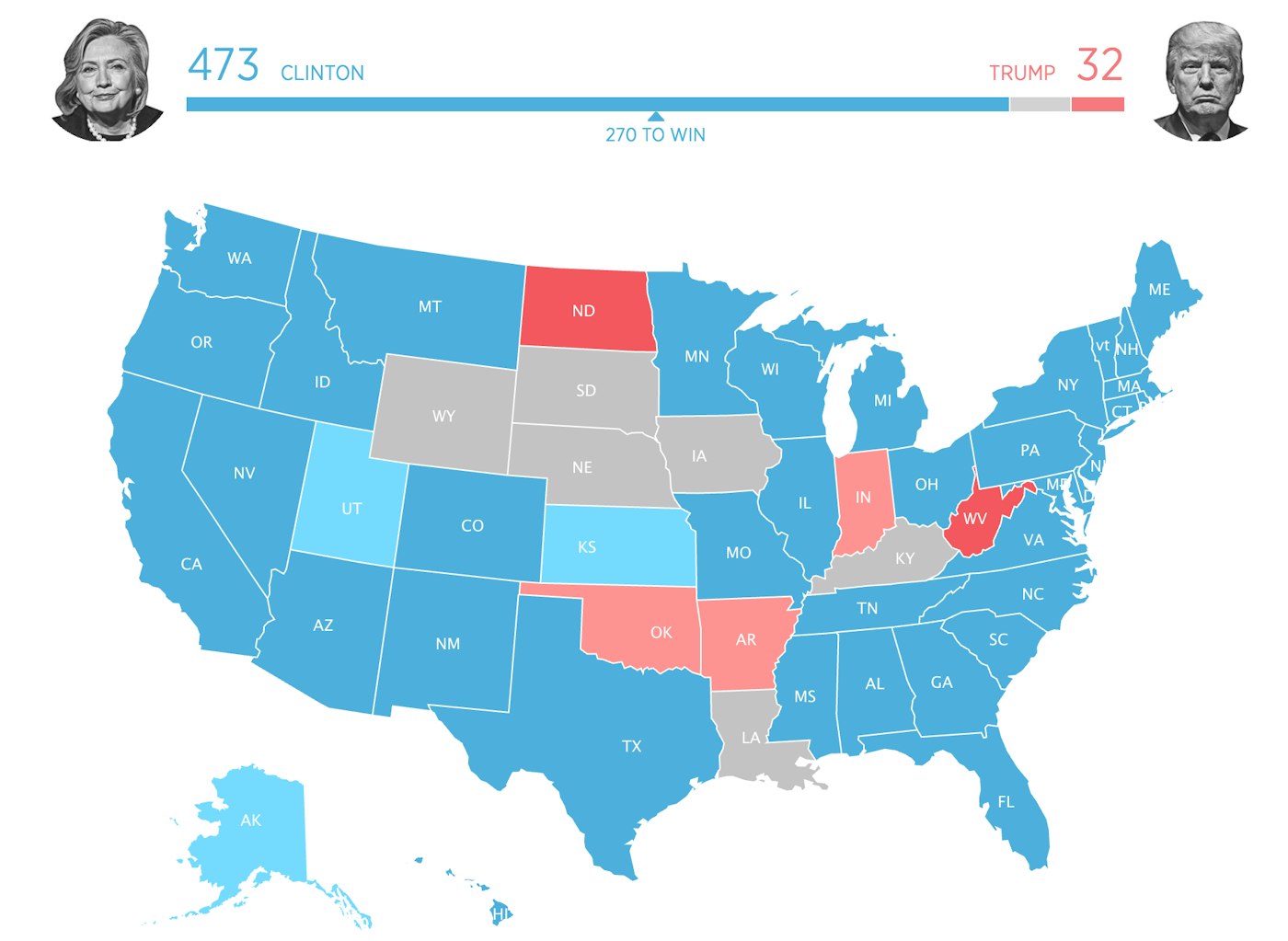 Time is on our side.
None of these thoughts are original. I've listened a lot to Van Jones recently. Some of what he has said is reflected here. I also found an article by Masha Gessen on how to live under an autocratic ruler that I found extremely helpful.
There is a phrase that's going around (from Salena Zito?) in a number of slightly different variations, "Trump's supporters take him seriously but not literally while his detractors take him literally but not seriously." I will take him seriously now and I will continue to take him literally. Gessen's first rule is to believe what the autocrat says. When Trump says he wants to make Muslims register, believe him. When Trump says he will repeal the ACA, believe him. When he says he wants to deport 11 million people, believe him. When he says that women who have abortions should be prosecuted, believe him. Now it is possible that he didn't mean what he said in at least a few instances but I would rather be prepared for the worst than be surprised when he follows up. It is possible that even the Republicans will stand against some of his excesses (although I doubt that) and he won't be able to accomplish some of his plans. Be vigilant and be ready.
Be aware of what he actually said but also how he has followed up in action. He spoke out against racists (rather softly) but then turned around and hired Steve Bannon.
Watch those behind the scenes. Trump does not seem to have any real ideology. Those behind him do.
Work to build relationships and community so we can stand against the damages his administrations wants to do. Be a part of a religious body that takes seriously the calls of faith. If you can't do religion, get together with a bunch of other people regularly an build something that is working towards being the Blessed Community. You can't change the world alone but together...
And be persistent. Wilburforce took 13 years to get his anti-slavery bill passed. As Hillary quoted in her concession speech, "So let us not grow weary in doing what is right, for we will reap at harvest time if we do not give up. (Gal. 6:9, NRSV)
Listen to those who voted for Trump and keep the truth in front of them. I truly believe we have a lot in common. I was not happy with the direction of the nation either and felt disappointed that Obama did not push more aggressively. I think we have at least some common goals. Let's find them and hold them up. Then, remind them when Trump fails to meet their expectations, as he will, and continue to point out the evils there. Most importantly, build relationships across lines.
Be outraged. It is tempting to look for ways to find the good in Trump. There may indeed be some areas where he does some good things. Do not allow that to dim your vision. See what is outrageous and call it out.
In two years we have the midterm elections. Throw the Republicans out. OK, I know it isn't that simple but those of us standing against the goals of this administration must organize and work to turn things around. A Democratic House and Senate would make things soooooo much easier. More Democratic legislatures and executives at the state level would make standing for what is right and good so much easier. Let us put everything we can into making that happen.
Work hard on the issues that are critical. We must stand with our Muslim friends. If they do try to register Muslims, be registered as a Muslim. I commit to do so. Work with Democratic legislators to guard the SCOTUS. Work to do all we can to meet the challenges of climate change.
Work to provide a safe place for those communities most threatened by this political change.
Finally, remember that time is on our side. The arc of history is long but it always bends towards justice. The fears that motivated the alt-right in this election are based in reality. The nation is becoming more diverse in every way. That cannot be stopped. Millenials didn't show up nearly as much as they needed to, but the election map of those under 25 is almost completely blue. Yes, the map that went around immediately following the election was not accurate and reflected polling from a few weeks before the election but the real one still looks like this
Subscribe to:
Posts (Atom)


