Friday, October 29, 2010

GAS


Guitar players talk about an affliction called GAS - Guitar Acquisition Syndrome. It stems from this belief that if only I can finally find the right guitar, the perfect guitar, then my playing will be incredible and the music of the spheres will find its release through my fingers. Two other ideas feed it - the first is that we live in the golden age of guitar building. There are literally hundreds of incredible builders who, in spite of the growing scarcity of the best wood, are building better guitars in more designs than have ever been done in history. This excellence trickles down even to the larger factory companies like Martin and Taylor building as many as 400 guitars a day and to the least expensive guitars built in Asian factories at numbers dwarfing the American factories. The second idea goes back to the Summer of Love. Back in the hippie days, consumerism was frowned upon and owning more than you needed was a serious no no... except when it came to musical instruments, especially guitars. Somehow, it was still OK to have very expensive guitars.

The three ideas come together and many guitar players go through instruments like candy. If you look at the classifieds on any guitar forum, you'll see significant numbers of hand built instruments for sale with prices nearing 5 figures or passing that barrier. Wherever you see a gathering of guitar players with their instruments, you're likely to see some serious and beautiful guitars.

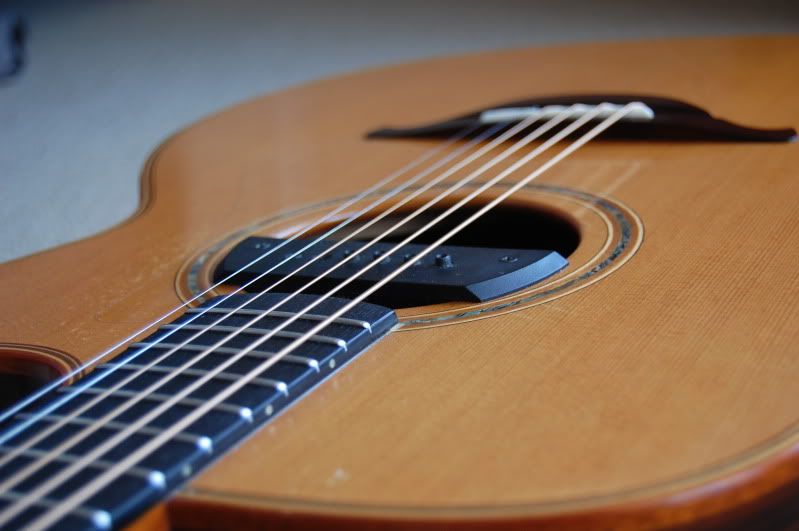
I'm not as susceptible to GAS as I once was because I'm pretty happy with my Lowden which is pictured above. When my previous Lowden was stolen in Philadelphia in '99, the folk at Lowden were amazing to me and built me a very special guitar. George himself carved the bracing in my guitar. I've been playing Lowdens since about '87 and the sound fits me. So, even though I deeply appreciate the art and beauty of lots of what I see out there, it is difficult to imagine finding something that I really want instead of my Lowden.

FAR-West
was one of the largest gatherings of guitar players I've attended so it was fun to see what instruments the performers had and what accessories they were using (also included under the general malady of GAS). I didn't count anything so these are just guesstimates... but fun for me none the less. It seemed that the single most popular make of guitar was Martin. That surprised me. I thought Martin had been dethroned by Taylor... which seemed to be the second most popular company. I wasn't surprised that neither one was a majority. I saw lots of smaller company guitars and a number of high end single luthier built instruments. I know how much money guitar players make so that part does surprise me... There was a very small number of Asian built guitars and one or two Larrivees, a quality Canadian factory built guitar that also has a factory in California.

Among the small shop guitars I saw a number from Santa Cruz Guitar Company who build Martin inspired guitars of very high quality and a few from James Goodall who builds a more modern style of guitar. I didn't see any Lowdens, Collings, or Bourgeois. I didn't see all of the players so I may have missed one or more of any of these companies. Then, I saw a number of the single luthier guitars... I saw one each of a Greenfield, a Sexhauer, a Wingert, and an Olson. All of those guitars pushed me towards a bout with GAS - beautiful sound, immaculate craftsmanship, sublime materials - although my wallet is nowhere near fat enough to even consider one. Then there were a few guitars that I didn't recognize which were likely built by other single luthiers without the same degree of recognition, at least to me.

Accessories were also interesting... I participate on the Acoustic Guitar Forum where a regular discussion comes up about cases vs. gig bags. It feels almost like my teen years when you were either a Ford or a Chevy person. There are a variety of different ways to carry and protect an instrument from high cost, extremely protective,low weight carbon fiber cases to cheap gig bags that are little more than a nylon grocery bag which do nothing more than keep the dust off. There are lots in the middle. Again, no counting, but from what I saw people carrying around, about 1/3 seemed to have Caltons. These are relatively expensive (around $800), very heavy fiberglass touring cases. If you're going to hand a $10K guitar to a baggage handler... they are a good idea but because of weight and size, don't ever expect to carry one onto a plane and figure that if you have to carry it very far, your arms will stretch to orangutan length. I had one for a while and appreciated the protectiveness of it, but it was far too heavy and bulky for me so I sold it. Another 1/3 had high quality gig bags. These usually run from about $150-$350 and are made of heavy nylon or leather with thick foam padding. They are much smaller and lighter than the Caltons and usually have some system of straps to wear them on your back. The argument for them is that because of the smaller size and weight, it is easier to keep your guitar in your hands or on your back and safe. FWIW, all of my guitars live in quality gig bags including a wonderful custom leather bag for my Lowden made by Glenn Cronkhite. The rest were in factory hard cases - the kind that usually come with a guitar when you purchase it and cost from about $80-200 on the aftermarket depending on the quality and company. I didn't see any carbon fiber cases even with the most expensive guitars.

So...no GAS for me... but I got very, very close to catching it again.

Thursday, October 28, 2010

FAR-West

In earlier posts - here and here, I've talked about the Cambridge Drive Concert Series. We have our second show coming up next week, Novemeber 5, with a wonderful performer named Anna Coogan for our headliner and Christina Grimm opening. More about that in a post to come...

Last week I was able to attend most of FAR-West, the western regional convention of the Folk Alliance International. The Folk Alliance is a professional organization dedicated to improving the ecology of folk music, building stronger artists, presenters, and audiences. How that plays out at the conventions is that there are workshops aimed at helping artists and presenters do what they do better and lots and lots and lots of performances.

I went as a presenter and so was there to learn things that would help us improve our concert series and to hear some acts for possible bookings. Both things happened.

The biggest learning for me was one which had to do with which artists I should book. Some of the more experienced presenters said that it is clear that the best concerts happen when the presenter truly likes the performer but that the audience should be the primary consideration. The performer must fit with the audience the venue has cultivated. So... a performer who fits the audience and whom the presenter likes is the best case scenario. Second comes a performer who fits the audience but isn't a favorite of the presenter. Last is an act that is a fav of the presenter but doesn't fit the audience. Given this, the mantra for presenters is, "know your audience."

We aren't there yet at the Cambridge Drive Concerts. We haven't yet developed our audience. Still, I need to be careful and book performers who I think will fit... and as I make these early booking decisions, I will likely shape the audience we will have in the future.

To the performers, the lesson here was that when a presenter does or does not book you, you know little about whether they like your music. It may be that you are their favorite among everything they've heard, but for some reason you don't work for their audience. Or - and this piece was a surprise to me - they may love you but just don't have a slot for you. Most of the presenters were booked at least a year out and some were booked multiple years out. One festival presenter said he sometimes is thinking 3 or 4 years down the road. That is astounding to me. I can't wrap my head around planning that far in advance. Who knows what wonderful new performers will appear between now and then... or whether some favorite will decide to give up the life of a traveling musician... My gut tells me not to book any more than a year out - ever - but I wonder whether that will preclude me from booking some acts that I would really like to present. Time will tell. For what it's worth, right now we're booked about 5 months out for the headliners and I'm waiting to hear back from one or two others so within a few days I could have my headline acts booked through May of 2011.

The performances are mind boggling. There are official "Premier Showcases," each giving half hour slots to 7 performers on Friday and 6 on Saturday in three rooms, chosen by a panel... so 21 Premiere Showcase performances took place on Friday and 18 on Saturday. Then there were two "Featured Performers" who also performed at the same time in two different rooms on Friday evening and one on Saturday. So, you listen for a song or two and then off to the next room to hear another performer for a song or two... Beside this, there is serious craziness - Guerrilla Showcases. A performer rents a hotel room, pushes the beds up against the wall and adds a few chairs and maybe some mood lighting and snacks and then books performers, usually in half hour slots, sometimes from late afternoon but certainly after the Premiere showcases ave ended at 10:00 until the wee hours of the morning. There were 25 Guerrilla Showcase rooms all on one floor of the hotel. Imagine the cacophony... and the difficulty when an acapella Celtic singer is performing in a room across the hall from a bluegrass band. Still, it was a great way to get little tastes of a LOT of music in a short time. The currency of the conference are 3X5 cards with a photo of the performer and name on one side and their schedule of Guerrilla Showcases on the other side.

I heard some wonderful music that I am working to book... and some wonderful music that may not work for our series. We've already booked James Hurley for January and Cindy Kalmenson for March and I'm talking with a number of other possibilities.

Tuesday, October 19, 2010

still an important election

I was talking with a friend about the upcoming election the other day who sincerely remarked - "Throw the bums out!" There clearly are some "bums" in office. The folk in power have not addressed the serious issues we face as well as they could have and they've done an even poorer job of capitalizing on the good things they have done. The result is legitimate anger and frustration. I understand, "throw the bums out." The question is whether or not the alternative is a good one.

On Sunday, Dick Polman, columnist for the Philadelphia Inquirer posted a column with a quiz regarding some things said by candidates for office this year and political statements by others in the news. Seriously, you need to take the quiz.

Think about the quotes... and ask whether these are really the kind of people you want elected? Whether these are the kind of people you want framing our political discourse? And they are not running for local dog catcher, these are folk running on major party tickets for the House, the Senate, for governor of states. These are people who get interviewed on television on the national news Then realize that only one of the people being quoted is currently in office. The rest are all trying to capitalize on "throw the bums out" either as candidates or in building political influence for themselves and their friends.

I have to say that these folk frighten me. They are riding a legitimate reasonable wave of frustration and anger but if they actually win positions of influence, things will get much, much worse. The issues are difficult and complicated. The solutions are neither simple nor free. Our nation does not have consensus regarding the solutions and anything that is done will require serious public relations work. And finally, at least the Republican Party has demonstrated no desire to work with those across the aisle. Add that all together and electing a bunch of ignorant crazies cannot but make things worse.

The only positive is that comedians already have an abundance of new material. I saw this parody of a political campaign ad. It would be hilarious if it wasn't so true.

Saturday, October 16, 2010

the future of music

Digital musical instruments have been around for a while. I remember back in the 80's when a friend of mine who was a studio musician purchased the first sampling synthesizer in Philly - a ridiculously expensive Fairlight
- and the first serious computerized drum machine - the Linndrum. Watching Herbie Hancock play a Fairlight on Sesame Street and listening to Peter Gabriel's ground breaking work with one was inspiring. The hardware allowed a musician to make and manipulate sounds in ways that couldn't even be imagined prior and those performers did just that, creating new sounds and textures. Still, the equipment couldn't begin to capture the subtleties of an actual acoustic instrument. A real pianist was never happy with a digital piano... and digital strings were not up to snuff when compared with real bows and resin scraped across real strings in the hands of someone who knew how to make a violin sing.

The technology has improved exponentially and the samples sound more and more realistic as shear computing power allows the machine to reproduce the incredible complexity of an acoustic instrument's sound. Add to that the ease of using a model and their popularity is understandable. Any keyboard player who used to carry a Hammond B3 and a Leslie to gigs deeply appreciates the possibility of using a sample controlled by a midi keyboard that weighs 20 pounds. A musician in her home studio can have an orchestra playing in the background for a minimal price for software and a controller. It doesn't sound exactly like the London Philharmonic, but it is a lot cheaper and less complicated. Some electric guitar players are thrilled to be able to use a Fractal Audio Axe-Fx to produce the sound of hundreds of different amplifiers and effects units while others say they still can hear and feel the difference between the "real thing" and a digital model. Digital models have even made it into the acoustic music world where acoustic guitar players use digital modeling to improve their live sound. Again, others say the models just sound like... imitations.

Theoretically, the models will get better and better and it will be possible to use one controller of a type that the player likes, whether it is a keyboard, a fretboard, or a wind controller, to reproduce the sound of any instrument ever played and numberless ones that have never existed before. And the price will get lower and lower if Moore's Law continues to hold true. Who knows... this may actually be the future of music. It is pretty cool... but I hope not.

Thursday, October 14, 2010

Tax Exempt Status & Separation of Church & State

Over the past few years there has been a good deal of discussion regarding the tax exempt status of churches. The question came to the forefront when a number of conservative churches decided to challenge current law and publicly endorse candidates in both the '08 and '10 elections. They are framing the argument as a constitutional one. They are correct and they should win the argument.

I've heard many people argue that tax exemption is a benefit given by the government and the price for that benefit is the inability to make official endorsement of candidates or to lobby in a substantive way. Jim Evans in Ethics Daily goes on to argue that the genesis of tax exempt status of churches goes back to the days when churches were part of the state and it made sense that a municipality would not tax its own property. He sees this as an argument that the benefit is just that and that in order to enjoy the exemption, churches must "play by the rules." That this argument is irrelevant seems obvious to me. However the practice began, we have not had state sponsored or owned churches since the founding of the country. So what happened? At the adoption of the Bill of Rights, they forgot to tax the newly emancipated properties? Sorry, there must be some other justification that the tax exempt status was retained.

Then, there is the prohibition itself. Churches were allowed to endorse candidates until 1954. In that year, then senator Lyndon Johnson introduced a law prohibiting 501(c)(3) organizations from endorsing political candidates. At the height of the McCarthy era, he was trying to silence some of his critics as he ran for office. It was only by coincidence that churches were silenced as they fell under the same IRS code as his nonprofit enemies.

While it is accurate that churches receive their tax exempt status under Section 501 (c)(3) of the Internal Revenue code, I would argue that churches are not the same as other nonprofit organizations and in the end cannot be treated the same way. Other non-profits receive tax benefits because they provide needed services to the community. The issue is clearly seen as one of public benefit. It is a quid pro quo... the nonprofit provides services so the state helps it by removing the burden of taxes and provides that contributions are deductible on the giver's taxes. Nonprofits do not appear in the Constitution or the Bill of Rights. On the other hand, religious institutions fall under the First Amendment and the relationship between the state and religion is clearly and uniquely defined. The government does not give benefits to a religious group. There would be no constitutional justification for an act like that. They are tax exempt because they are religious organizations. period. The first amendment provides that the government will neither establish nor prohibit the free exercise of any religion.

Here is where the question of taxes comes in. The power to tax is the power to control. If the government can levy taxes on religious institutions and decide what those taxes will be, they can decide which institutions will be viable. Frankly, if the little church I serve had to pay property taxes, we would likely close. How can that not be prohibiting free exercise? And isn't telling a congregation that it cannot speak on any issue defining its ministry for it, again prohibiting free exercise? To allow that a church can say whatever it wants so long as it is willing to give up its tax exempt status establishes a multi-tiered system for religious institutions with some being able to speak and others not, this time based on their financial ability to pay taxes. Again, we are seeing free exercise attacked.

We must not forget that taxes and tax benefits have often been used as tools of influence by the state. How often does a municipality give tax benefits to entice a company to re-locate? To use this part of the IRS code to silence religious organizations from speaking on issues that they clearly see as part of their call is an example of the state using the tax code to prohibit free exercise of religion. What would stop a community from using taxes, if it were allowed to tax religious organizations, to keep a mosque from being constructed? Or a religious building of any sort that was seen as offensive to the powers that be?

There is no argument for taxing religious institutions or for prohibiting them from speaking on any issue in any way they believe their faith calls them to speak that does not conflict with the First Amendment. The government has no right to tax churches and therefor tax exemption is not a benefit the government can bestow or withdraw. That some religious organization will speak out in ways that you or I don't appreciate on political issues is part of the price we pay for religious freedom.

Tuesday, October 12, 2010

new physics & church meetings

I never took physics in high school or college so I know next to nothing about it. I do understand that there have been lots of counter-intuitive findings of late including the idea that a particle can be in two different places at the same time. I want to do that.

Coming up in June, there are two conferences that I want to attend that are happening at the same time. They are very different and the rewards would be completely different from one to the other.

Every two years, my denomination, The American Baptist Churches, USA has a big meeting. It is a time for connecting with friends I only see every two years, a time of reinforcing my identity as a Baptist, and usually a time of reclaiming that word - Baptist - that has been defaced by the Southern Baptist Convention as they have swung into exclusivist fundamentalism. I have to admit though, that our biennial meetings have been less than inspirational for a long time... but it is my "family" and I really don't want to give up on the ABCUSA. And many of my friends have either given up on the ABC or cannot afford to attend so many of them will not be present. The event is taking place in Puerto Rico, a place I love and a people I love. I'd get to tack on a bit of vacation either before or after. tempting...

Then there is The Wild Goose Festival in North Carolina. Modeled after Greenbelt in the UK, this promises to be a really exciting time. Planned and staffed by some very bright and committed folk whom I deeply respect, this event would challenge and stretch me and could even play a role in the re-shaping of the Church that is going on now as it contributes to the formation of the next generation of leaders. The median age will probably be literally 1/2 that of the ABC biennial, a fact that is thrilling in itself. The big downside is that it includes camping. I've only camped once in my life and I will forever associate it with the kidney stone I passed in the rain in rural Pennsylvania.

As far as I know, nobody has been able to replicate that one particle in two places at once thing in human beings so I'll have to choose and I need to choose soon. What would you do?

Thursday, October 07, 2010

inspiration & showing up

I didn't read the book - Eat, Pray, Love. I did see the movie and other than the first scene in India, which rang soooo true to our first moments in Inida, didn't find it particularly engaging. So, I likely would never have watched Elizabeth Gilbert's TED talk.

My daughter, Alexis, put it up on her blog so I was obligated to watch it. It is a wonderful talk about the creative process. I was particularly struck by Gilbert's admonition to just show up and do your job. It got me thinking that showing up and doing your job is at the core of everything, not just creativity. Whether it be caring about the homeless guy at the corner, voting in an election, playing in the church band, being there for a grieving friend, whatever... it doesn't matter whether we are successful, whether we change the world, whether we make a difference that anyone else can see... what matters is whether or not we are (and here's the theological word) faithful.

So show up. Do your job or your part. And leave the results to God.

Wednesday, October 06, 2010

an important election

first, some disclaimers

Obama was not my first choice in the Democratic primary. He wasn't even my second one. He was and is too centrist for me. Still, there was no Republican that I would have even considered voting for over any of the Democratic candidates and given the practicalities of our current system, I would not have considered a third party candidate.

I am terribly disappointed in the current congress. They wasted so many opportunities to do what really needed to be done and what they said they would do.

Even when I find the Republican party disgusting (which is much of the time), I admire the way they work together, if not to accomplish something, then to keep something they don't want from being accomplished.

The current administration has accomplished some significant things. True, we don't know what would have happened without the bailouts, but the non-partisan folk who study such things tell us again and again that things would be much much worse. We are sort of out of Iraq. There is a time table for Afghanistan. There are proposals to right the biggest economic divide in this country since the Great Depression (and it isn't a coincidence that the economy fell apart when the divide got that big again).

Historically, the times when there has been the most economic growth and income growth for all people have been under democratic administrations (check it out).

I will vote a straight Democratic ticket and, as much as is possible in any election, do that happily and proudly.

Now for the non-partisan part. This is a very important election. If the Democrats retain control of congress, we will see more of the change that Obama promised enacted. Maybe not all of it, but more of it. If any more Supreme Court Justices are chosen, there is a chance that Obama's choices would balance a very right wing leaning court. If you want that change, then you must vote for the Democratic candidates. If you do not vote, remember that the other side is highly energized and the far right will likely vote in droves so not voting is like voting for the following...

If you are against the change that Obama promises to continue and want to see the changes we have seen be repealed, vote for the Republican candidates. They are clearly calling for a return to the Bush era economic policies and more, including privatizing Social Security and cutting many of the safety net programs. Some/many of the Tea Party candidates are also calling for dismantling current government agencies like the Department of Education, the Environmental Protection Agency, even the Food and Drug Administration and others. A woman's right to choose could also be challenged. If a Supreme Court Justice position opened a Republican congress would ensure that the person be as centrist as possible. While there are some Tea Party candidates who are against the Republican establishment which they see as equally part of the problem, most who have won primaries have already turned color and become part of the Republican establishment (see Tea and Crackers in Rolling Stone for some examples).

The differences could not be more clear and there is no excuse for anyone, anywhere on the political spectrum not to vote and to do so intelligently. It is a critical election which will impact our lives for years to come.

Thursday, September 30, 2010

More on the Cambridge Drive Concert Series


I'm a lousy interview. I've long known that. Part of it is hubris. I think quickly and can be pretty charming in most settings so, I go into an interview situation without having thought it through as carefully as I should have figuring I can wing it. Part of it is just cluelessness. Enough said. When I was president of the local clergy association, I got interviewed a lot. And when we lived in Albany, NY I found myself on the news or in the paper a few times so I should know better, but too often I don't.

Two days ago, a reporter from the Montecito Journal called to interview me about the up coming Cambridge Drive Concert Series. He asked me the most obvious question of all... "Why are you starting a new concert series?" It was the most obvious question and yet, I wasn't really prepared to answer it. There are a couple of other series that happen in greater Santa Barbara including two that I am aware of that happen in churches, so why another? I'm pretty sure my answer was lame. It did start me thinking though... why another concert series?

I should be honest and say that I've not attended many of the local series. Those in the big venues are frankly too expensive for me. I just can't justify spending $30 or $50 or more times two to see a musical act more than once every few years. The two church based series fly under my radar and I just never know who is performing or when. There have been a few series featuring local acts, mostly in coffee houses, and I try to visit them when I can. All too often life gets in the way and I suffer that loss.

So, here are the niches I think we're filling and I think we're unique in the mix at least. We're trying to bring in very talented regional and national acts who are fulltime musicians. In part, I want to support the musicians. It can be a difficult life and keeping the wolf away is a huge job. I'm hoping that we can provide one more possible venue as they travel around the country sharing their art. We have decided to always have a local opening act. There are some wonderful local performers and too few venues that allow them to play to an appreciative listening audience. Some are as good as any touring artist out there but are constrained for any number of reasons to stay local. Others are just honing their craft. In both cases they deserve to truly be heard and to have the opportunity to share a stage with other wonderful musicians.

Music can build community. I'm hoping that opening our doors to these wonderful musicians and to an audience will break down some of the walls that divide us and build some new relationships. At least for the present, the concerts are not seen as fundraisers for the church although we are also unable to subsidize them beyond opening doors, providing space and staff time, and being as hospitable as we can be.

We are substance free. I have talked to some folk who are a bit put off that there will be no alcohol available. They want a glass of wine while they listen. I understand that... but beyond being against the church by-laws, there are communities of folk who are excluded from venues with alcohol - young folk below the drinking age and folk with addiction issues. So we are substance free... except for caffeine maybe.

And here's the big piece... God's creation is filled with extravagant beauty. The other morning I happened to look out the window as I was spraying my orchid plant and saw a breath-taking sky - pink clouds and robin's egg blue sky. Then the light shifted and the colors faded. How many days have I missed an equally beautiful moment? A few weeks ago, for just a few moments, the light was perfect as I drove through the Gaviota Pass. Had I been 5 minutes later, the view would have been less amazing, or at least completely different. The songs of birds, the majesty of the mountains, the power of the ocean, the laughter of children, the intricate beauty of a tiny flower... God is a performance artist in the most sublime sense of the word. Part of what it means to be created in the image of God is to consciously contribute to this proliferation of beauty. And we will be doing just that at the Cambridge Drive Concert Series on the first Friday of every month. Frankly, there cannot be too much beauty.

I hope that if you are anywhere near Santa Barbara, you will come to the concert tomorrow and/or any subsequent ones. Bev Barnett & Greg Newlon and Rebecca Troon will be making the world a more beautiful place and when the performance is over, it will be gone except in the memories and lives of those who shared those moments...

Tuesday, September 28, 2010

Politics and Business

We have two significant political races in California this year where a former CEO is running for election - Meg Whitman for governor and Carly Fiorina for senate. I have strong feelings against both of them, but that is another post. The piece I want to raise is that business and government are not the same.

In both cases, their campaigns are arguing that because they were successful in business (perhaps questionable too), they would make great leaders in government. Now, because someone has been a successful business person is no reason to dismiss them as a politician. They may bring some wonderful skills to the job that translate well from one role to the other. The problem comes when folk involved don't realize that government is not business and should not and cannot be run like business. It is a completely different paradigm. The goals are different. The means are different. The metrics for measuring success are different. We simply cannot run government like a business.

So let's look at those three categories a bit. What are the goals of business? To make a profit. Obviously there are wonderful businesses out there that are concerned about providing a good product, caring for their communities, making the world a better place... but they only do any of things things to the degree they can do it profitably. A research firm may come up with a product that cures a specific cancer, but if they cannot produce it at a profit, they cannot make it. It doesn't matter that they want to do the right thing, the good thing... they are constrained by what they are to produce profits for their stockholders. And those stockholders, a very specific slice of the population, are the only people they are accountable to in the end. So people continue to die and research continues. Government has a much more nebulous goal - to promote the common good. And the population to whom it is accountable is everyone. Corporate bean counters are accountable to the bottom line. Government bureaucrats are accountable to the people. Huge difference.

How about means? Governments must build coalitions, appeal to common values, find compromises between competing ideas and ideals, and work through a sometimes difficult and complicated process of legislation. In business, many models allow a CEO to change everything with the stroke of a pen. There may be a board of directors who have some say but as likely as not, they rubber stamp most of what the CEO's propose and their role is almost never to be involved in daily decisions. Shareholders may vote, but it is very unlikely that they really have any say in any of the decisions made and likely don't care as long as stock and dividends are going up. Shareholders might be thrilled that a production facility is closed and 1000's of jobs moved overseas if it means higher profits. See how difficult it is to shut down a military production facility and we see the difference in a government setting.

And metrics? You know a business decision was a good one by looking at the bottom line. Did the company make money? Or is it poised to do so because of those decisions? Again, in government, things are not so simple. Let's look at a few actual programs briefly. First, social security. Depending upon whose numbers you believe, either it is solvent for the long term or it is pushing the entire government into a ditch. If it was a business decision, the way you read those numbers would answer the question. In government, the question becomes much more difficult when you look at the ways the program has changed our society. Poverty among the elderly has dropped significantly since the program began and even in our current economy is lower than it has ever been. One could even argue that some of the increase in life expectancy is due to social security and Medicare. So is it successful or not? And let's look at the War Against Terrorism. The Bush administration came into office with a huge budget surplus. They lowered taxes on the wealthiest Americans and went into two wars that cost billions of dollars, putting the government trillions in debt. Some would argue that their actions have made us safer. There is no question that had we not entered those wars, our national budget would be much healthier than it is today. Was it a successful thing to do?

Bottom line... politics is not business and cannot and should not be run like one. If we elect business people who do not understand that and/or expect them to run government like a business, we will all suffer. Are these two women just playing a game and saying what they think people want to hear in order to be elected and then will actually know how to govern vs. running a business? Or are they just caught up in the hubris of their own success and think they can impose a business paradigm where it does not fit? If they win, we will see...

Tea Party again

very interesting... my post on the Tea Party has received about 3X's more hits than any other post I've made. So, I guess if I want my blog to get more readers, I should keep posting on the Tea Party.

In addition to just a few comments, I've gotten some notes sent directly to me so there is a bit of material to which I can respond.

One person reminded me that the Tea Party is not monolithic and that many in that movement would not agree with everything I said. I agree. It is not a monolithic movement... but that frightens me even more. It seems to me that many of the more extreme voices are in positions of leadership and that while large numbers of the participants may not agree with some of the more radical views, they are still supporting and voting for the more radical fringe. For example, there are a number of very visible and vocal folk speaking out against public education. Does that mean all Tea Party folk want to see the public schools all shut down tomorrow? No, but if that vocal anti-public education leader gets elected, you can bet they will run with their agenda and claim a mandate for it. Same thing is true about social security, medicare, unemployment benefits, the FDA, OSHA, etc. etc.

One person chastised me for adding in infrastructure to my argument saying that n Tea Party person is against the government keeping up the infrastructure. Well... if that is true, and I'm not sure it is, then it won't be long. Let's be consistent here. If they are truly advocating that we stop the government from doing anything that is not explicitly outlined in the constitution, then they have to come out against government maintenance of infrastructure. It ain't there. And FWIW, Eisenhower's interstate system is the most "socialist" thing the federal government has ever done.

This same person said to me, "there are those with common sense who simply want to see smaller government and less taxes. We know it will be painful. And frankly we don't care." And that is the difference isn't it? I do care. And there are some pains that I believe we as a society should do everything we can do to alleviate.

I have no illusions that government can fix everything or save us from all ills. I see the problems, the corruption, the game playing, and the cronyism. I do believe though, that there are some things that only government can do and, that if this is to be the kind of society that I believe God yearns for us to be, then, government must do those things. Yes, it needs serious reform. Yes, we need to hold our elected officials accountable, but making government so small and weak that we can drown it in the bathtub is exactly the wrong answer. Again, I don't want to live in a Tea Party world and I would bet that most folk at the rallies wouldn't either if they really thought about the implications.

Finally, I've gotten a few comments about the "fruits and nuts of California," obviously putting me in that crop (sorry for the pun). By way of bio, I grew up in a blue collar family in Pittsburgh, PA and lived 18 years there, 3 in central PA, 13 in Philadelphia, 14 in Albany, NY, and 8 in CA. So, I'm not quite a Californian despite being seduced by the weather, the produce, and the beauty of the place. That said, the common misconception that California is a bastion of liberalism is just silly. Think about the last two presidents who came from CA - Nixon & Reagan. Instead, California is a polar place with lots of extreme liberals and lots of extreme conservatives and they never talk to one another or work together for the common good. The end result is an extremely dysfunctional state government that does next to nothing. Add in the system of propositions and you have a real mess. Unfortunately, I think that California model is the one being adopted on a federal level. That does not bode well for anyone.

Saturday, September 25, 2010

Laughing Jesus

As you enter our church office, the first thing you see is a painting of Jesus in the middle of a deep belly laugh. Virtually everyone comments the first time they see it... "I've never seen a picture of Jesus laughing like that..."

That says something about our theology. We see Jesus in prayer, in tears, dying on a cross, throwing over tables in the Temple, fighting with the religious hierarchy, even with children on his lap or a sheep over his shoulders, but never really laughing, never deeply enjoying anything. If Jesus lives that way, then we think we should too. Life is full of suffering and conflict with little room for joy, wonder, or genuine encounter of the other.

Mt friend Jon, posted this irreverent video the other day. When I saw it on his site, there was only one comment, complaining that a post like this doesn't take Satan seriously enough. I won't go down that path, but I will say the comment missed Jon's point. The folk who made the video obviously have encountered a Christianity in which Jesus never laughs, doesn't enjoy much at all, and interfaith relationships are always framed in terms of violent conflict. What a sad and empty version of the Christian faith that is...

Tuesday, September 21, 2010

International Day of Peace


Today is the UN designated International Day of Peace. What a dream that is...even one day of peace all across the world...
today I pray... and I cry...

(thanks to the Baptist Peace Fellowship of North America for the graphic.)

Saturday, September 18, 2010

A Tea Party World

I understand the allure of "small government" - indeed, there are areas, specifically around military expenditures where I'd like it to get a lot smaller - but in general, it is not a world where I want to live.

The arguments for small government come from two general directions. First, that people should be responsible for their own lives. What they earn, they keep. Where they stumble, that is their problem. They make their choices and live with them. This argument, in its best incarnation, assumes that everyone has equal access. This is, blatantly untrue. Some people are recipients of the hard work, good luck, or unlawful activity of their ancestors while others suffer because of mistakes made in previous generations or as the result of injustices suffered in years before. And of course, there are cultural differences, often related to the above issues, that come into play as well. Some people run the entire marathon with no training and no shoes while others start 10 feet from the end and could crawl across the line and still win. In its worst incarnation, the argument doesn't care that things aren't equal. "I got mine, so screw you."

The second direction is tied to the first, that people should not be forced to help others. Some would argue that they will do it on their own without the government interfering. In the case of businesses, the free market will push them to ethical behavior. In the case of individuals, compassion for others will push them to build a more just society. Beyond the fact that history shows otherwise, this argument requires a belief that human beings are by nature altruistic, compassionate, far sighted, and interested in the needs of others. There is no doubt that we see hints of this and that there are individuals who exhibit those traits, but as a species... I wouldn't count on it. The Christian tradition has a theological concept that applies here - original sin. I do not believe that people are by nature depraved or evil, but I do believe that when push comes to shove, most people put their own needs first and most people are predisposed to ignore the needs and pains of others. How many times have we heard someone ho has returned from a trip to Haiti or India or Africa or even some of the US inner cities or the Gulf Coast and remark, "I never imagined such poverty." Well, if you never imagined it, it was only because you closed your eyes. It has always been there. And of course, there is the second thread in this argument... people should not be forced to help others because they are where they deserve to be.

So what do we hear from the Tea Party, the bastion of small government thinking? I have heard arguments that we should terminate unemployment benefits, social security, welfare, and Medicare. There is no question that these kinds of programs cost significant money. Terminating them would shrink government significantly. Imagine our nation without them. Picture a time without social security. I know many elderly folk who live off of that small income alone. Without it, they literally would have no income. And if you take away their Medicare, many would face astronomical medical bills. And, given their health issues and age, no other insurance would ever take them. That would be a stupid business decision. So what happens to them? They would die miserable deaths in abject poverty. So the argument might go, "that is their fault. They should have saved for retirement." All well and good unless during your working years you live so close to the edge that you must make choices between food and heat.

Imagine if we did away with unemployment, as meager as it is, for that 9+% of people who are not able to find a job? What would happen to them and their families? Our current economic structure requires that somebody be out of work... what should happen to those people?

Imagine an infrastructure that has completely disintegrated as government spending on roads, bridges, public transportation, etc. disappeared completely.

Imagine nobody ever checking food or drugs for safety. Every trip to the grocery store might be a game of Russian Roulette. Think of cars without any safety features. Imagine no public utilities. Picture businesses polluting communities and poisoning workers with no constraints because no government agency is looking over their shoulders.

Imagine no public higher education and perhaps even no public schools at all.

Those are all scenarios that Tea Party candidates have endorsed.

Yes... taxes would be much lower... but it is not a world where I want to live.

Wednesday, September 15, 2010

Cambridge Drive Concerts


Isn't it wonderful when a number of threads converge? One thread... When we lived in Albany, NY, I was on the board of Directors for The Eighth Step, America's longest continuously running non-profit coffeehouse. It was great fun. I got to hear some amazing music, played with some wonderful people, and got to open for acts as different as Patty Larkin, The Nields, and shared stages with Tony Trischka and others. We had one of the best open mikes I've ever participated in and did some fun programing like Music from a Fishbowl (hopefully more about that at a later date... think of it as a teaser).

Thread two... I am pastor at Cambridge Drive Community Church at 550 Cambridge Drive in Goleta, CA where we have a wonderful commitment to opening our space to the broader community. We have three buildings on the property and they are in constant use by a variety of groups from AA to children's programs to yoga to a Japanese language class to student recitals. We have a nice room for gathering with a great sound system.

Thread three... I really miss thread number one.

weave them together and you get The Cambridge Drive Concert Series! You can follow us on Facebook here.

We're beginning with one show a month on the first Friday, beginning on October 1, 2010. I am really excited about the folk we've booked so far.


Our first show will feature Bev Barnett and Greg Newlon. I heard them at a Songwriters at Play show and loved them. Gorgeous harmonies, mature songwriting, and stellar guitar playing. What more can you ask for? Check out the free download Love Can Change the World on their website. Just beautiful! Opening for them will be a local musician named Rebecca Troon who is way above the local level in talent. Reserve tickets for $10 at 805 964-0436 or purchase at the door for $12.

Our second show is booked for November 5 and will feature Anna Coogan with her Roots and Urban Americana. Opening act will be Christina Grimm. The December show is scheduled to be a multi-performer Christmas/Solstice/Seasonal show. In 2011 we will be presenting the Jewish Soul of Soul Aviv, Ali Handal, and a bunch of other wonderful performers.

Tuesday, September 14, 2010

too much

It has been a while since I've posted to my blog. It hasn't been because I had nothing to say. Actually, I've had too much... and wasn't quite sure how to say it.

I wanted to write about Glenn Beck and how his connection with right wing Christians puzzles me when he is a Mormon. I wasn't sure how to say that without sounding like a religious bigot so I didn't finish the post.

Then I wanted to write about the Koran and a crazy who certainly got his 15 minutes of fame by threatening to burn Korans. I didn't want to give him any more attention than he was already getting... Just one piece I was going to say - many Americans see the Koran as being parallel to the Bible, a book that tells us about God's self-revelation. That is not a good analogy. Actually, as I understand it, the Koran is more parallel to Jesus than to the Bible as it is the revelation of God, not a book that points to that revelation. So burning Korans is not the same as burning any other book.

And I wanted to write about 9/11. I've been reading some of the 9/11 Truth stuff and I have to admit that I find at least some f the arguments pretty convincing that, at the very least, we are not getting the whole story. In my very core, I don't want to believe that my own government had anything to do with the horrors of that day but I wonder... and it makes me really, really depressed. So, I didn't write about that because I was afraid that some folk would think I'm crazy... and that if I wrote it down, I'd need to look more carefully and maybe make a decision about it.

So... no posts... but later today I'll write about the Cambridge Drive Concert Series. and that excites me!

Thursday, August 26, 2010

Viet Nam, Iraq, Afghanistan

Cheryl and I have been listening to The Things They Carried, a very powerful novel about Viet Nam, based on the authors real experiences there. I have to say that I was very hesitant to "read" this book. I was born in 1954 and grew up hearing the body count on the news every evening. I didn't have a lot of friends who served but I did know some folk who were there and that war was always at the edge of my generation's consciousness. The final year they drafted was 1972, the year I graduated high school. They continued to assign numbers for the next 4 years, just in case they decided to reinstate the draft. FWIW, info regarding the draft and links to charts of the draft numbers can be found here. My number was 32. Had the draft been in effect, I would have seen sunny South Viet Nam... or had to make some other life changing decision. I remember thinking about cutting off a toe, leaving for Canada, doing something to make myself ineligible. I do not know what I would have done - whether I would have served or not.

If I had ended up there, I don't know how the experience would have affected me. I have friends and acquaintances who have adjusted to the experience as well as anyone can. Like a scar, it has left something behind but doesn't impair their ability to function. In some ways it may have even helped them come to terms with the fragility and arbitrariness of life. Or there may be a cold, numb place in their hearts that will never completely heal. I know others who never recovered and as the John Gorka song, Semper Fi says, "Sometimes the wounds that never heal are easiest to hide," and "Some of the men who did survive were not the lucky ones." Our streets and homeless shelters are still littered with those men. I do know that as I listen to this powerful book, I feel a constant ache in my stomach as I imagine myself there, and I do imagine myself there. I feel a sadness at the dreams lost, at young men who never became old men, at families that never happened.

And then I think about Iraq and Afghanistan and the men and women there... those who will not come home... those who will come home with horrific injuries... and those who will come home with wounds we cannot see. Then, along with the ache in my stomach I feel an anger, a disgust, a profound sense of emptiness. I think of those who make decisions to go to war and wonder how they can sleep at night knowing the pain and loss and destruction their decisions have caused and I wonder whether they truly understand the cost...

what is a book?

Just what constitutes a book these days. I have shelves full of paper bound with glue and thread, covered in ink... I know those are books. Some of you read on Kindles of Ipads. Are those books? Cheryl and I listen to "books" on disk as we commute back and forth to Santa Barbara from Buellton along the Gaviota Coast. Are those books?

We've read or listened to some wonderful books recently and I've found myself wanting to blog about a few or at least mention them in my blogs but wasn't sure how. Should I say, "we're reading The Things They Carried" or do I say that "we're listening to...?" Frankly, something inside me is a little embarrassed to say that we're listening to whatever book as if that is cheating somehow. And in some ways it must be a different experience. The reader does impose himself or herself into the text and does interpret it with their inflections and tone of voice and somehow that does remove part of the experience we get when reading a bound document, providing the voice, the inflections, in our minds. Clearly it is not as different an experience as watching a movie made from a book, but it is still different in some way.

How significant is that difference? Is that audio book, whether on disk or MP3 or whatever, still a book or is it a different medium altogether? And how about an i-book? What do we lose when we don't hold the paper and flip the pages? What do you think?

Saturday, August 21, 2010

guitar cases

I haven't had a guitar related post for a while so here we go...

Cases... not very sexy but absolutely critical and full of options. There are gigbags, cardboard cases, wooden cases, plastic cases, fiberglass cases, and carbon fiber. Each kind of construction has strengths and weaknesses and can come in a wide variety of quality and price levels from cheap to very expensive. You can get a gigbag or cardboard case for $20... or you can pay $1400 for a custom carbon fiber case... and there are lots in between.

For normal use, I prefer a gigbag, essentially a backpack like arrangement made of some kind of fabric with padding and backstraps. All of my guitars live in medium to high end gig bags. The least expensive one I own cost me about $75 and the most expensive was just under $400 for a custom leather bag from Cronkhite Custom Cases made for my Lowden guitar. Gigbags don't offer the same kind of impact protection as a hard case, but they are generally lighter in weight and smaller so it is easier to be careful with the guitar. For general use, because of the ease of handling, I find them more protective than a hard case. I wouldn't trust an expensive guitar - the only kind I have - to a baggage handler in one though.

There are a few touring pros who do recommend flying with gigbags, arguing that they are easier to get onboard a plane. The downside though is that if that is refused, you have a very expensive bag of exotic wood toothpicks at the end of the flight. So, many players fly with a normal hardshell case as provided with most guitars when purchased. In general, I find those cases a poor compromise. IMHO, they are too heavy and clumsy for general use but not heavy duty enough for the rough handling a guitar may get on a baggage chute. For that you need a serious road case.

Until recently, that meant expensive and heavy. It still may as there are some wonderful fiberglass road cases that provide excellent protection. They are expensive and very heavy. I had one for a while, built by a great company called Calton. It was a great case and I loved it until my car broke down and I had to carry it two miles... my arm was 4 inches longer at the end of the walk. I bought a high quality gigbag for that guitar and sold the Calton.

The newest generation of road cases are just as sturdy or more so at a lighter weight but often considerably higher price. These cases are built from carbon fiber. I believe a company named Accord was the first to build these cases and they are wonderful... light weight, extremely protective, even elegant... and very pricey, i.e. more than many folk spend on a guitar. Since Accord pioneered these materials a number of other companies have begun using them as well including Calton, mentioned above, in their higher level cases.

I recently read about a company based in Chicago that is building very sturdy, carbon fiber cases at a much lower price named Hoffee. The cases look amazing and are very reasonably priced for what you get. Indeed, if I ever need a road case, they are at the top of my list. Watch the video below and you'll see why.

Tuesday, August 17, 2010

Ground Zero Mosque

I have not posted on this topic yet, largely because there are folk who have expressed my thoughts better than I could. At the foundation, I believe in freedom of religion. It is a core principle of our nation and one of the bedrocks of my tradition as a Baptist. The state has no right to interfere in religion at all... and that includes telling a faith community where it can or cannot worship. That said, there are so many other issues raised in the discussions surrounding the "ground zero mosque." The fact that approximately 10% of those killed on 9/11, including some first responders were Muslim... The fact that if "they hate us for our freedom," then the very best way to fight "them" is to exercise and live that freedom... The fact that the families of those who died at ground zero are anything but unanimous in their response to the proposed community center... And the fact that the proposed "ground zero mosque" is not at ground zero or even visible from the site.

A few days ago, Keith Olbermann commented on the controversy. It is well worth watching.

Visit msnbc.com for breaking news, world news, and news about the economy