Our economy requires unemployment. It requires that there be poor folk without jobs to keep the costs down for low skilled jobs. If you sat any Republican down and asked whether they really want 0% unemployment, if they were being honest, they'd say, "Absolutely not. If we had 0% unemployment who would work at McDonalds or Walmart? What would happen to prices? What would happen if some sector decided to go on strike and there was nobody available to replace them? We need people without jobs who are looking for work to drive wages down." For that reason, I find comments like the one in the video below to be particularly offensive. Even if it was true, it would be impossible... get real, where would we put all of the golf courses? The reality is that Romney does not want you or me to get rich and he certainly doesn't want everyone to get rich.
Tuesday, May 08, 2012


Sunday, May 06, 2012
just what you needed
is another sermon to enjoy on the web!
no seriously, I've begun to put some sermons up on the web for your listening pleasure... or comments...
you can find them at www.roydonkin.podbean.com
I've also added a little media player in the lower part of the right column that should update with each new post.
There are four available now and I'll add more as I feel moved. The four that are there are all within the last two or so months so it isn't a "best of" series, but I am particularly happy with each of them. The most recent one - Radical Inclusion - was from this morning and is done in a first person style, a style I find particularly effective when not used too much.
no seriously, I've begun to put some sermons up on the web for your listening pleasure... or comments...
you can find them at www.roydonkin.podbean.com
I've also added a little media player in the lower part of the right column that should update with each new post.
There are four available now and I'll add more as I feel moved. The four that are there are all within the last two or so months so it isn't a "best of" series, but I am particularly happy with each of them. The most recent one - Radical Inclusion - was from this morning and is done in a first person style, a style I find particularly effective when not used too much.
Wednesday, May 02, 2012
Here's to Singer/Songwriters
I get to rub shoulders with lot of great singer/songwriters at the Cambridge Drive Concert Series. They amaze me. I've never been a good songwriter. It requires skills that I just don't have. Think of it for a second... a good songwriter has to be able to write a memorable melody, surround it with chords that make sense and aren't too predictable, and has to be able to condense human experience into three or four verses with a chorus and bridge that fit rhythmically and likely have some sort of rhyme scheme. Then, they have to be able to play and sing all of that in front of an audience. More often than not, they do their own booking, web site management, and maintain their relationships with their fans. And they have to have at least a passing knowledge of how to use the gear they need and what gear is available to do whatever they need. It is just a very broad and diverse set of skills that not any people have.
I'm a reasonably good guitar player with a good ear, a good sense of melody, a good sense of how an acoustic guitar (vs. an electric guitar or some other instrument) works in a song, and reasonable knowledge of theory (both in my head and in my hands)... I'm not good at writing lyrics. I'm much too prosaic. And I'm not particularly good at performing by myself. I forget lyrics. When I'm singing, I tend to get nervous about the whole package and it impacts my guitar playing in a not good way. Then there are the other non-musical pieces... some I'm quite good at and others not so. I marvel at the singer/songwriters who do all of that while making incredible music.
So, here's to the singer/songwriters who do all of that AND make our lives richer with songs that touch our hearts and delight our ears!
I'm a reasonably good guitar player with a good ear, a good sense of melody, a good sense of how an acoustic guitar (vs. an electric guitar or some other instrument) works in a song, and reasonable knowledge of theory (both in my head and in my hands)... I'm not good at writing lyrics. I'm much too prosaic. And I'm not particularly good at performing by myself. I forget lyrics. When I'm singing, I tend to get nervous about the whole package and it impacts my guitar playing in a not good way. Then there are the other non-musical pieces... some I'm quite good at and others not so. I marvel at the singer/songwriters who do all of that while making incredible music.
So, here's to the singer/songwriters who do all of that AND make our lives richer with songs that touch our hearts and delight our ears!
Saturday, April 28, 2012
4 versions of Somebody...
It's been a while since I've posted a music video... so here are four versions of the same song, - Somebody that I Used to Know. I like the song
first the original by Goyte...
a second fun version by Walk Off the Earth (The Key of Awesome does a fun parody of this...)
and more a serious version by Pentatonix
and finally, a fairly straight cover by Ingrid Michaelson
So which one do you like best?
first the original by Goyte...
a second fun version by Walk Off the Earth (The Key of Awesome does a fun parody of this...)
and more a serious version by Pentatonix
and finally, a fairly straight cover by Ingrid Michaelson
So which one do you like best?
Tuesday, April 24, 2012
Oh Wow!
My wife is a chaplain/spiritual counselor for Visiting Nurse and Hospice Care of Santa Barbara in the hospice division. VNHCSBdoes amazing work and has scores of wonderful people on staff who support and care during one of the most intimate and difficult times of their lives. This past Sunday was the annual service of remembrance when family members and some of the staff gather to remember those who have passed in the previous year. Each year it is a moving time as photos are projected and names read...
The speaker this year got me thinking. He shared a quote which he attributed to Rumi. Since then, I've googled it and found it also referenced as a Tibetan Buddhist saying. It could be either or neither, but it still inspired this blog post. "When you are born, you cry, and the world rejoices. When you die, you rejoice, and the world cries." It made me think of what are reported as the final words of Steve Jobs, "Oh wow! Oh wow! Oh wow!"
Frankly, I don't think about an afterlife very often. I don't think the issue is all that important. I'm not entirely sure what I even believe about one (although I am pretty sure what I don't believe.). What I do believe is that the grace and love of God is all powerful and undeniable. Whatever it looks like after we die, it is shaped by the grace and love of God... a grace, a love so far beyond our understanding that all one could possibly do when confronting it without a veil between us and it is rejoice and exclaim, "oh wow!"
The speaker this year got me thinking. He shared a quote which he attributed to Rumi. Since then, I've googled it and found it also referenced as a Tibetan Buddhist saying. It could be either or neither, but it still inspired this blog post. "When you are born, you cry, and the world rejoices. When you die, you rejoice, and the world cries." It made me think of what are reported as the final words of Steve Jobs, "Oh wow! Oh wow! Oh wow!"
Frankly, I don't think about an afterlife very often. I don't think the issue is all that important. I'm not entirely sure what I even believe about one (although I am pretty sure what I don't believe.). What I do believe is that the grace and love of God is all powerful and undeniable. Whatever it looks like after we die, it is shaped by the grace and love of God... a grace, a love so far beyond our understanding that all one could possibly do when confronting it without a veil between us and it is rejoice and exclaim, "oh wow!"
Saturday, April 14, 2012
putting myself out there

She began to come with me on every gig and before long she was singing the entire night. A 9th grade class project came up where each student was supposed to pick a profession and do a report. Alexis chose singer/songwriter and shadowed a friend of mine - Amy Abdou - as she wrote and recorded material. Alexis and I wrote a couple of tunes together (including Call Down Thunder in the player on the right - the melody and the lyrics were hers) and performed them for her 9th grade class. We were officially a duo - originally called "d" and we began performing around the folk circuit in upstate NY and into Massachusetts. As Alexis became more comfortable on the stage, she took over. She was clearly the focus and we began to perform as Alexis d. I sang lead on two or three songs, but she clearly had become the star. We performed together and wrote material all through her high school years and shared the stage with some great acoustic acts including Patty Larkin, The Nields, and Tony Trischka. I had transformed from a solo performer to a back up musician.
It was fine with me. It gave me the chance to stretch out a bit on my guitar parts plus she was a great performer with a wonderful ear for unusual melodies. It made for music that I felt very good about. And if something went wrong, there was someone else on stage to help fix things (or to blame).
When we moved to Cali, Alexis came along and we continued to perform for the first year around Santa Barbara and into the LA area a few times. Then, she went back east to finish her school and Alexis d essentially bit the dust. She moved on as she should have.
I took a position playing electric guitar in a funk band for a while but discovered I'm too old to be playing bars anymore... then took on the role of acoustic guitar player for a singer/songwriter named Jamie Green. Together with an amazing drummer/percussionist named Bob Terry, we were a trio. Jamie is also a great performer and wonderful songwriter, but I was not part of the songwriting. I was charged with playing guitar parts from her recordings (which weren't always what I would have chosen to play so sometimes I played pretty closely to the recording and other times I made them my own) or coming up with something that worked in the stripped down acoustic trio setting when her recordings were full productions. I was even more of a sideman during those years but it still felt like a good fit to me. Last summer, Jamie decided to go in a different direction and with very little notice, I was suddenly no longer a sideman.
I looked for a while to try to find another singer to back up but in spite of running into some great singer/songwriters, none seemed to fit very well for a variety of reasons.
So now I'm struggling with trying to become a solo act again. I got used to playing some complicated and difficult parts and wrote some music with Alexis that I'm still proud of... but for the life of me, I'm having a difficult time playing those parts and singing her unusual melodies. But I'm putting myself out there. This week I did a songwriters circle, played at Songwriters at Play, and met and played for and with a wonderful musician named Randall Williams. Frankly, in each setting I screwed up some of the vocals and played my share of clams on the guitar while trying to sing. Still it was fun and terrifying and I'm inspired to do more and to try to write some new tunes all by myself. I'm excited about putting myself out there!
Monday, March 19, 2012
Ragamuffin
It's been a while since I've posted a music video...
This is Jason Kessler playing a song written by Michael Hedges called Ragamuffin which appeared on Hedges' 1984 ground breaking CD, Aerial Boundaries. Kessler is playing a Lowden F size 12 string guitar built of Honduran Rosewood and Adirondack spruce and is accompanied by percussionist Josh Dekaney and dancer Pallavi Gupta. just beautiful...
This is Jason Kessler playing a song written by Michael Hedges called Ragamuffin which appeared on Hedges' 1984 ground breaking CD, Aerial Boundaries. Kessler is playing a Lowden F size 12 string guitar built of Honduran Rosewood and Adirondack spruce and is accompanied by percussionist Josh Dekaney and dancer Pallavi Gupta. just beautiful...
Thursday, March 15, 2012
Why the Hate?
I have to admit that I've been more than a little puzzled by the political discourse regarding Obama. Yes, I know political discourse is always marked by exaggeration and hyperbole, but the stuff around Obama has just seemed over the top. There still are accusations that he is not an American, born in the USA. There are still prominent folk who claim he is really a Muslim. There is the constant buzz that he is a Socialist. Others say that he is the biggest threat to US security in the history of the nation. Simply put, none of the above is remotely true. Love him or not, he was born in Hawaii, is not a Muslim, is not a Socialist by any reasonable definition, and is clearly not the greatest threat to US security ever.
Many, especially in the African American community, have blamed the over the top hatred on race. Many on the right protest that they are not racist and his race has nothing to do with their disdain of Obama. Now, I know many folk far right of center who would never vote for Obama who are not racist and for whom race does not have any relevance. Still, I cannot help but think that the depth of invective against him is out of proportion to his policies. Indeed, most of his policies are literally continuations of those begun under the Bush administration. If that isn't about race, then what in the world is it?
And then today I saw a photo of a bumper sticker... it had the Obama logo with a circle and a line through it with the tag line - "Don't Re-Nig 2012." At first I wondered whether it was something made up by an Obama supporter to inflame the base so I googled it. I found a vendor selling the stickers along with other far right slogans. If that's not about race, then I have no idea what is.
Many, especially in the African American community, have blamed the over the top hatred on race. Many on the right protest that they are not racist and his race has nothing to do with their disdain of Obama. Now, I know many folk far right of center who would never vote for Obama who are not racist and for whom race does not have any relevance. Still, I cannot help but think that the depth of invective against him is out of proportion to his policies. Indeed, most of his policies are literally continuations of those begun under the Bush administration. If that isn't about race, then what in the world is it?
And then today I saw a photo of a bumper sticker... it had the Obama logo with a circle and a line through it with the tag line - "Don't Re-Nig 2012." At first I wondered whether it was something made up by an Obama supporter to inflame the base so I googled it. I found a vendor selling the stickers along with other far right slogans. If that's not about race, then I have no idea what is.
Thursday, March 08, 2012
Government Power vs. Religious Beliefs
Anyone who has read my blog knows that I am a staunch supporter of the separation of church and state. I believe the wall should be so high for government intrusion into issues of faith as to be almost impossible to even see over. I believe Native American religions that use peyote in a sacramental way should be allowed. Ditto for Rastafarians (I have to admit I know next to zilch about Rastafarianism so I could be off base here) with regards to marijuana. I get really uncomfortable even at government interference that requires a Christian Science family to provide medical care for their children. That is how I feel about these issues. That is not the way things work.
Today I read an article in The American Thinker by Tom Trinko in which he attacks liberals like Sandra Fluke for wanting the government to intrude on religious beliefs. Here's an important quote from the article...
Today I read an article in The American Thinker by Tom Trinko in which he attacks liberals like Sandra Fluke for wanting the government to intrude on religious beliefs. Here's an important quote from the article...
What greater crime can one commit against a person than using the force of government to coerce him to become an apostate to the faith he believes in?
Wednesday, February 29, 2012
Do You Hear What I Hear?
Guitar players are notorious for hearing with their eyes... a cool looking guitar always sounds better. For electric guitar players, they see some guitars or amps and hear them as "BIG!" Of course the epitome of this effect took place when a band's stage set up included a wall of huge speaker cabinets... except they were all empty and just for show. For acoustic players, lighter colored woods like maple for the backs and sides are heard as being thin and bright while darker colored woods like most rosewoods are heard as richer and deeper. That is why you see very few high end acoustic guitars with backs and sides of light colored woods and some companies traditionally dye medium colored woods like mahogany to make them darker (CF Martin is an example). For both groups of players, the shapes of the guitar also impacts what we hear. Now there clearly are differences between different kinds of woods and different shapes of instruments... but they are not always consistent with the assumptions.
It turns out there is a scientific background for this called the McGurk Effect. Watch this fascinating video...
Cool huh? I think that roughly the same thing is going on for the guitar players. Now, here's the question... does this work in theology? Politics? other social settings? And does it extend beyond just sight and hearing playing against each other? I think so. When I was doing my doctorate, we had a couple of faculty with southern accents. One of them joked that the right kind of southern accent always increased respect. The wrong kind, got you written off immediately. How many times I've heard a newscaster here in sunny Cali with Valley Girl inflections and written her off as a ditz... And it goes further still, when certain vocabulary is used I place the speaker in categories that impact what I hear. Start talking to me about seeing angels or getting people saved or the Cosmic All and I easily slide you into a slot defined by preconceptions which color what I hear and do not hear.
The good news is that I can be aware of it and work to really listen to whatever it is you're saying, trying to understand your language without my baggage getting in the way. The bad news is that like the McGurk Effect, I may not always be successful. I'm trying though.
It turns out there is a scientific background for this called the McGurk Effect. Watch this fascinating video...
Cool huh? I think that roughly the same thing is going on for the guitar players. Now, here's the question... does this work in theology? Politics? other social settings? And does it extend beyond just sight and hearing playing against each other? I think so. When I was doing my doctorate, we had a couple of faculty with southern accents. One of them joked that the right kind of southern accent always increased respect. The wrong kind, got you written off immediately. How many times I've heard a newscaster here in sunny Cali with Valley Girl inflections and written her off as a ditz... And it goes further still, when certain vocabulary is used I place the speaker in categories that impact what I hear. Start talking to me about seeing angels or getting people saved or the Cosmic All and I easily slide you into a slot defined by preconceptions which color what I hear and do not hear.
The good news is that I can be aware of it and work to really listen to whatever it is you're saying, trying to understand your language without my baggage getting in the way. The bad news is that like the McGurk Effect, I may not always be successful. I'm trying though.
Thursday, February 23, 2012
Political Life and Faith
First, let me begin with two disclaimers. 1. I fully believe there are politicians who are men and women of sincere and authentic faith. 2. I have no ability to judge the faith of another beyond what I see and whether their words and actions are consistent with their professed faith. Even that is shaky.
Back in the '80's we lived in Philadelphia and there was a pastor of one of the larger African American Churches who was elected to the House. He was charismatic. He was bright. e was a good "politician" in that he knew how to work with a variety of people to get things done. He was easily vetted. Everyone expected he would go far, perhaps even to become the first Black president. Then one day he resigned. He said that it was not possible to be a politician and to retain his integrity. He chose his integrity and he resigned.
Again, I don't doubt that there are some people of faith who retain their integrity in the political process, but it clearly is not an easy task. The temptations of power are always present. Doing things the easy way is just easier. Compromises of character are not the same as political compromises but it is easy to confuse the two. As I've been watching Rick Santorum, who presents himself as a man of faith and is often touted as such by the Christian Right, I'm struck that his behavior is not very "Christian." Often, he says things in his campaign speeches that are clearly not true. Yes, that is what politicians do... but it is not what Christians do, at least not real ones. By playing that faith card so prominently, he opens himself to that criticism and calls into question his integrity as a Christian and as a human being.
I'm struck too that the reverse is equally true... when people of faith become overly involved in partisan politics, they too risk losing their integrity. Earlier this week, Franklin Graham was on the television show, Morning Joe, and was asked about the faith of the president. He wouldn't go so far as to deny Obama's Christianity but at the very least he waffled, saying that he couldn't judge the veracity of another's faith. And he clearly does not like Obama's politics. When asked about Santorum, he was sure that he is a Christian. He volunteered the same knowledge regarding Gingrich. When the host stated that Graham was revealing an amazing double standard, Graham responded that Obama seems to be more concerned about the Muslims of the world than the "Christians murdered in the Muslim world." Here's a link to the interview. And here's a response to Graham from Zachary Bailes, an M. Div. student at Wake Forest, on the Associated Baptist Press. I don't follow Graham and so don't know whether he still had any integrity in this area, but if he did, he sure blew it in this interview.
Here's the piece that worries me. I obviously have strong political views (duh!) and even agree with Franklin Graham that my understanding of faith, of who Jesus is, and of his call on my life, must impact my political views. So, how do I avoid losing my integrity? Howdo I keep my faith from being so tied into partisan politics that it becomes co-opted? I try to be honest and to look at the whole picture. I try to be respectful of opinions that I clearly believe are wrong. I try to see the strengths and the failings of my own "side" as well as any other. Still, the risk is real. The best I can say is that I'm trying to retain my integrity as a person of faith while strongly holding opinions regarding important issues.
Back in the '80's we lived in Philadelphia and there was a pastor of one of the larger African American Churches who was elected to the House. He was charismatic. He was bright. e was a good "politician" in that he knew how to work with a variety of people to get things done. He was easily vetted. Everyone expected he would go far, perhaps even to become the first Black president. Then one day he resigned. He said that it was not possible to be a politician and to retain his integrity. He chose his integrity and he resigned.
Again, I don't doubt that there are some people of faith who retain their integrity in the political process, but it clearly is not an easy task. The temptations of power are always present. Doing things the easy way is just easier. Compromises of character are not the same as political compromises but it is easy to confuse the two. As I've been watching Rick Santorum, who presents himself as a man of faith and is often touted as such by the Christian Right, I'm struck that his behavior is not very "Christian." Often, he says things in his campaign speeches that are clearly not true. Yes, that is what politicians do... but it is not what Christians do, at least not real ones. By playing that faith card so prominently, he opens himself to that criticism and calls into question his integrity as a Christian and as a human being.
I'm struck too that the reverse is equally true... when people of faith become overly involved in partisan politics, they too risk losing their integrity. Earlier this week, Franklin Graham was on the television show, Morning Joe, and was asked about the faith of the president. He wouldn't go so far as to deny Obama's Christianity but at the very least he waffled, saying that he couldn't judge the veracity of another's faith. And he clearly does not like Obama's politics. When asked about Santorum, he was sure that he is a Christian. He volunteered the same knowledge regarding Gingrich. When the host stated that Graham was revealing an amazing double standard, Graham responded that Obama seems to be more concerned about the Muslims of the world than the "Christians murdered in the Muslim world." Here's a link to the interview. And here's a response to Graham from Zachary Bailes, an M. Div. student at Wake Forest, on the Associated Baptist Press. I don't follow Graham and so don't know whether he still had any integrity in this area, but if he did, he sure blew it in this interview.
Here's the piece that worries me. I obviously have strong political views (duh!) and even agree with Franklin Graham that my understanding of faith, of who Jesus is, and of his call on my life, must impact my political views. So, how do I avoid losing my integrity? Howdo I keep my faith from being so tied into partisan politics that it becomes co-opted? I try to be honest and to look at the whole picture. I try to be respectful of opinions that I clearly believe are wrong. I try to see the strengths and the failings of my own "side" as well as any other. Still, the risk is real. The best I can say is that I'm trying to retain my integrity as a person of faith while strongly holding opinions regarding important issues.
Tuesday, February 21, 2012
Radical Inclusion
I have never been to Burning Man... but it is sort of on my bucket list. There is something about the event that calls to me. I'm not sure that I'd enjoy a full week of desert, dust, and weirdness, but I would guess that in order to really experience it, you need to experience the entire event. And that has kept me from going.
If you don't know about Burning Man, it is a crazy bohemian hippie gathering in the middle of the desert that takes place in late August to early September. There are lots of interesting and bizarre people, art, music, and a unique ethic based on 10 principles -
1. radical inclusion
2. gifting
3. decomodification
4. radical self reliance
5. radical self expression
6. communal effort
7. civic responsibility
8. leaving no trace
9. participation
10. immediacy
As you can imagine that makes for a very interesting social experiment. And from what I understand, it has worked for the most part... until this year. Last year was a very good year with great weather and good press. It also sold out. This year the tickets went on sale and the immediate requests were 4 times the capacity of the event. Radical inclusion bit the dust. As the organizers said, "Radical inclusion does not mean we can all fit in the same place at the same time." Still, if there is one thing radical inclusion cannot mean it is, "sorry, you can't come."
All of this has me thinking about church... if there is a principle we should be embodying it is radical inclusion yet, we rarely do.
for a wonderful taste of Burning Man, here is part of the problem, a great video that went viral this year.
If you don't know about Burning Man, it is a crazy bohemian hippie gathering in the middle of the desert that takes place in late August to early September. There are lots of interesting and bizarre people, art, music, and a unique ethic based on 10 principles -
1. radical inclusion
2. gifting
3. decomodification
4. radical self reliance
5. radical self expression
6. communal effort
7. civic responsibility
8. leaving no trace
9. participation
10. immediacy
As you can imagine that makes for a very interesting social experiment. And from what I understand, it has worked for the most part... until this year. Last year was a very good year with great weather and good press. It also sold out. This year the tickets went on sale and the immediate requests were 4 times the capacity of the event. Radical inclusion bit the dust. As the organizers said, "Radical inclusion does not mean we can all fit in the same place at the same time." Still, if there is one thing radical inclusion cannot mean it is, "sorry, you can't come."
All of this has me thinking about church... if there is a principle we should be embodying it is radical inclusion yet, we rarely do.
for a wonderful taste of Burning Man, here is part of the problem, a great video that went viral this year.
Tuesday, February 14, 2012
The Authority of Faith or If You're Going to be a Catholic, Be a Catholic
I believe in freedom of religion. I believe politicians can and should vote their consciences and that their consciences should be informed by their faith. I also don't believe that public policy should be formed around religious preferences. That basically means that when a politician puts forward a policy that is consonant with their faith, they better also have some good reasons that are outside of their faith. A foundation in one's faith is not enough to form public policy.
I respect politicians who truly hold their faith, whatever it may be, and live it with authenticity. I have no respect for politicians who use faith as a wedge between constituencies and I have little respect for politicians who are less than genuine in their commitments.
That brings me to Rick Santorum and Newt Gingrich, both of who have been playing the "good Roman Catholic" card of late. Neither is a good Roman Catholic. Both are ignoring the nature of authority in the Catholic church. They think and act as if a good Roman Catholic can pick and choose between the teachings of the church and embrace those that fit their own politics or morals while rejecting others. While in fact, many who call themselves Roman Catholics in the US do just that, it is a difficult place to be when the Catholic Church is built on a hierarchy of authority which cannot be easily ignored. Juan Cole has an interesting blog piece entitled the Top Ten Roman Catholic Teaching Rick Santorum Rejects While Obsessing about Birth Control where he shows how Santorum does just that. These two politicians claim to be pro-life and point to their supposed Roman Catholic faith as the foundation for that understanding, all the while ignoring that in Roman Catholic teaching, pro-life is a much broader term that rejects capital punishment, any kind of pre-emptive war, most specific wars including Iraq, and which calls for universal health care, welfare for all needy families...
The first time a politician stands up and says "I am against birth control because I'm a Roman Catholic... and I'm also against capital punishment. I take Just War Theory seriously and I believe in a safety net that truly provides for the needs and dignity of the poor," I will take that person seriously. Until then, he or she can't say that they hold a position based on the authority of their church without me laughing at them. I laugh at Santorum and Gingrich.
Now, there are other kinds of Christians who understand authority very differently. The Baptist tradition, for example, says that an individual's relationship to God is between them and God. Authority does not come from a hierarchy but from responsible reflection by the individual and interaction with the Holy. Without responsible reflection and without relationship to the Holy, there is no authority. Even when the relationship is authentic, in this tradition, one still cannot generalize the shape or substance of another's relationship with the Holy. (This is why freedom of religion was an idea that came primarily from the early Baptists). I know many in this tradition, my tradition, who see things very differently than I do. Some I respect deeply because their views are based in responsible reflection and in their understanding of their relationships with God. Others... not so much.
Still other traditions place the authority in the gathered community. The bottom line is that if one is going to claim religious authority for a particular stand, they had better understand how authority works in that tradition and own the tradition.
I respect politicians who truly hold their faith, whatever it may be, and live it with authenticity. I have no respect for politicians who use faith as a wedge between constituencies and I have little respect for politicians who are less than genuine in their commitments.
That brings me to Rick Santorum and Newt Gingrich, both of who have been playing the "good Roman Catholic" card of late. Neither is a good Roman Catholic. Both are ignoring the nature of authority in the Catholic church. They think and act as if a good Roman Catholic can pick and choose between the teachings of the church and embrace those that fit their own politics or morals while rejecting others. While in fact, many who call themselves Roman Catholics in the US do just that, it is a difficult place to be when the Catholic Church is built on a hierarchy of authority which cannot be easily ignored. Juan Cole has an interesting blog piece entitled the Top Ten Roman Catholic Teaching Rick Santorum Rejects While Obsessing about Birth Control where he shows how Santorum does just that. These two politicians claim to be pro-life and point to their supposed Roman Catholic faith as the foundation for that understanding, all the while ignoring that in Roman Catholic teaching, pro-life is a much broader term that rejects capital punishment, any kind of pre-emptive war, most specific wars including Iraq, and which calls for universal health care, welfare for all needy families...
The first time a politician stands up and says "I am against birth control because I'm a Roman Catholic... and I'm also against capital punishment. I take Just War Theory seriously and I believe in a safety net that truly provides for the needs and dignity of the poor," I will take that person seriously. Until then, he or she can't say that they hold a position based on the authority of their church without me laughing at them. I laugh at Santorum and Gingrich.
Now, there are other kinds of Christians who understand authority very differently. The Baptist tradition, for example, says that an individual's relationship to God is between them and God. Authority does not come from a hierarchy but from responsible reflection by the individual and interaction with the Holy. Without responsible reflection and without relationship to the Holy, there is no authority. Even when the relationship is authentic, in this tradition, one still cannot generalize the shape or substance of another's relationship with the Holy. (This is why freedom of religion was an idea that came primarily from the early Baptists). I know many in this tradition, my tradition, who see things very differently than I do. Some I respect deeply because their views are based in responsible reflection and in their understanding of their relationships with God. Others... not so much.
Still other traditions place the authority in the gathered community. The bottom line is that if one is going to claim religious authority for a particular stand, they had better understand how authority works in that tradition and own the tradition.
Saturday, February 04, 2012
A True American Story
The other day, a friend of mine shared a bit of his story. His father was a devout man who held his faith deeply. The nation where he lived made it very difficult to practice his faith as he believed God called him so, with pain and difficulty, leaving behind family, friends, job, and roots, moved to another country where he believed he would be able to faithfully practice his faith. He put down new roots and raised a family, trying to be faithful and to build a good life. Jump forward a generation and my friend, another faithful man, was trying to live out his understanding of his faith which didn't quite fit into the majority opinion of his homeland found himself in the US attending college. It was a new world with a broad mix of religions and opinions about faith. More important though, it was a place with an expressed commitment to freedom of religion. Each individual could practice his or her faith (or lack thereof) in a way that was most faithful to the deep commitments of their hearts. My friend and his new wife decided, this was the kind of place they could truly be faithful to their understanding of God's yearnings for them. It was the kind of place they wanted to raise their children. They stayed in the US and became citizens here, working, putting down roots, raising a family, and living out their faith in freedom.
Can you think of a story that more characterizes the American dream? Can you think of a story that is more consonant with the commitments that gave birth to this nation and continue to shape our culture as a people? I can't. This strikes me as the quintessential American story. It just happens that Mukhtar is Muslim. His father left India for Saudi Arabia to find a pace where he could live his Muslim faith without difficulty. Mukhtar left Saudi Arabia to find a place where he could live out his faith in a way that was authentic to his understanding of God's yearnings for him... he came to the land of freedom of religion so he could faithfully live as a Muslim, next door to Catholics, Jews, Hindus, Sikhs, Protestants, Mormons, Atheists, and a hundred other commitments, all learning from one another, struggling with one another, and even disagreeing with one another... in freedom.
Can you think of a story that more characterizes the American dream? Can you think of a story that is more consonant with the commitments that gave birth to this nation and continue to shape our culture as a people? I can't. This strikes me as the quintessential American story. It just happens that Mukhtar is Muslim. His father left India for Saudi Arabia to find a pace where he could live his Muslim faith without difficulty. Mukhtar left Saudi Arabia to find a place where he could live out his faith in a way that was authentic to his understanding of God's yearnings for him... he came to the land of freedom of religion so he could faithfully live as a Muslim, next door to Catholics, Jews, Hindus, Sikhs, Protestants, Mormons, Atheists, and a hundred other commitments, all learning from one another, struggling with one another, and even disagreeing with one another... in freedom.
Wednesday, January 25, 2012
why I won't vote for any of the Republicans
OK... anyone who knows me knows that there is a simple answer - BECAUSE THEY'RE REPUBLICANS! There are clearly some Republican stands that do not work for me. In my estimation, they are all too quick to throw the poor under the bus and to shred the little safety net we have. As a party, they have focused on what I think is the wrong issue when they talk about the deficit while what we really need are jobs. Yes, yes, yes, the Dems are not much better, but they are a little better. So here are a few of my reasons with each of the four remaining candidates.
Newt... character counts. He has none. We can look at his hypocrisy as he claims to be a "family values" candidate while having done more to sully marriage than anyone I have ever known, read, or read of. And while involved in despicable behavior, he had the nerve to condemn Bill Clinton for similar acts. I know he says it was not about the sexual acts but about lying to congress, but when the moderator of the South Carolina debate asked about his behavior with his 2nd wife, he said it was despicable to ask such questions in the midst of a presidential campaign. Evidently it was fine to ask such questions of a sitting president?! He claims to have changed. People do change. I don't believe him. His mean-spiritedness through the debates shows that he is the same old Newt. There are those who talk of him as having "big thoughts" and "great ideas." When his big thoughts and great ideas include essentially doing away with child labor laws, they sound like terrible ideas and small thoughts to me.
Rick Santorum... I respect a person living their faith and bringing it to play in their politics. Every single political view that I hold is impacted by my understanding of who Jesus is and what it means to follow him. That said, Santorum's understanding of what it means to be a Christian is, in significant places, diametrically opposed to mine. And while I believe one can act ofor public policy changes based on his or her faith, public policy can never find its sole or even primary justification in anyone's faith. To believe that birth control should be outlawed is so far outside of the mainstream and so far outside of anything that is positive for our country that I can't imagine him being president. Add to that gender views that take us back at least a century. I guess I expect more from him since he calls himself a Christian and a Roman Catholic. When he completely dismisses the rest of the "pro-life" views of his church without a blink, I wonder how much of his political views really are based in faith.
Mitt... First, running a government is not the same as running a business and anyone who thinks it is or should be, doesn't understand government. Add to that the fact that his role in business was to purchase weak companies, strip them of anything of value, and essentially throw the rest away. Even if business and government were analogous, that is not how I want to see government run. That he is so incredibly rich that he doesn't have to work, makes more in a week off of investments that I do in a decade from work, and seems to see nothing wrong in paying a lower percentage of taxes than the vast majority of the 99% makes me wonder whether he really gets it. It also seems that he wants this job too bad. He seems to switch his views depending on what he thinks will get him elected... perhaps not an unusual trait for a politician but still one that I won't vote for if I can help it and it just seems too obvious with him. I do respect that he gives a much larger percentage of his income to charities than any other politician I know of.
Ron Paul... he's the one that really scares me. I don't think the Republican establishment would allow him to win, but I think he is the candidate who would be most able to beat Obama. Paul's commitment to reduce the role of the military and to end our empire is very attractive to me and to many liberals. His commitment to enforce the parts of the constitution that protect individuals from the powers of the state likewise is attractive. His libertarian views regarding drugs also are attractive to many liberals. His consistency is a wonderful thing in the days of politicians reading polls and changing their views like their ties. He could strip off many liberal voters who are disenchanted by Obama's militaristic bent or who drank the Koolaid that he is a socialist and expected him to act like one. He isn't and he hasn't! At the same time, I think that many Republicans who find those views distasteful would still vote for him just to vote against Obama. I think he might gain far more than he would lose. The parts that I don't like about Ron Paul scare me more than the parts I do like entice me... he is commitment to shredding the safety net for the poor, doing away with government involvement in ensuring safe food, water, air, and drugs. He does not believe government has a role providing an adequate education for all or providing foreign aid that can make a difference in saving the lives of literally millions overseas. Those views are more than I can take. Add his racist statements of the past and he is completely off my list too.
When I listen to what each of them envisions for the country, for the world, and look at the stands and characteristics they bring to the table, none are the kind of leader that I believe we need in this difficult time. None bring the kind of vision of the future I want to see implemented.
So that leaves me with Obama. Folk who know me also know that I've never been a huge fan of Obama. During the Democratic primary I described him to my friends as a centrist and looking at his work in office, that is exactly what he has been... and I'm anything but a centrist politically. I'm not thrilled... but I like him much, much, much better than any of the above. I wouldn't vote for a third party candidate even if there was one I loved because I'd be too afraid one of the above might win.
So, given the choices, for me, it's Obama 2012.
Newt... character counts. He has none. We can look at his hypocrisy as he claims to be a "family values" candidate while having done more to sully marriage than anyone I have ever known, read, or read of. And while involved in despicable behavior, he had the nerve to condemn Bill Clinton for similar acts. I know he says it was not about the sexual acts but about lying to congress, but when the moderator of the South Carolina debate asked about his behavior with his 2nd wife, he said it was despicable to ask such questions in the midst of a presidential campaign. Evidently it was fine to ask such questions of a sitting president?! He claims to have changed. People do change. I don't believe him. His mean-spiritedness through the debates shows that he is the same old Newt. There are those who talk of him as having "big thoughts" and "great ideas." When his big thoughts and great ideas include essentially doing away with child labor laws, they sound like terrible ideas and small thoughts to me.
Rick Santorum... I respect a person living their faith and bringing it to play in their politics. Every single political view that I hold is impacted by my understanding of who Jesus is and what it means to follow him. That said, Santorum's understanding of what it means to be a Christian is, in significant places, diametrically opposed to mine. And while I believe one can act ofor public policy changes based on his or her faith, public policy can never find its sole or even primary justification in anyone's faith. To believe that birth control should be outlawed is so far outside of the mainstream and so far outside of anything that is positive for our country that I can't imagine him being president. Add to that gender views that take us back at least a century. I guess I expect more from him since he calls himself a Christian and a Roman Catholic. When he completely dismisses the rest of the "pro-life" views of his church without a blink, I wonder how much of his political views really are based in faith.
Mitt... First, running a government is not the same as running a business and anyone who thinks it is or should be, doesn't understand government. Add to that the fact that his role in business was to purchase weak companies, strip them of anything of value, and essentially throw the rest away. Even if business and government were analogous, that is not how I want to see government run. That he is so incredibly rich that he doesn't have to work, makes more in a week off of investments that I do in a decade from work, and seems to see nothing wrong in paying a lower percentage of taxes than the vast majority of the 99% makes me wonder whether he really gets it. It also seems that he wants this job too bad. He seems to switch his views depending on what he thinks will get him elected... perhaps not an unusual trait for a politician but still one that I won't vote for if I can help it and it just seems too obvious with him. I do respect that he gives a much larger percentage of his income to charities than any other politician I know of.
Ron Paul... he's the one that really scares me. I don't think the Republican establishment would allow him to win, but I think he is the candidate who would be most able to beat Obama. Paul's commitment to reduce the role of the military and to end our empire is very attractive to me and to many liberals. His commitment to enforce the parts of the constitution that protect individuals from the powers of the state likewise is attractive. His libertarian views regarding drugs also are attractive to many liberals. His consistency is a wonderful thing in the days of politicians reading polls and changing their views like their ties. He could strip off many liberal voters who are disenchanted by Obama's militaristic bent or who drank the Koolaid that he is a socialist and expected him to act like one. He isn't and he hasn't! At the same time, I think that many Republicans who find those views distasteful would still vote for him just to vote against Obama. I think he might gain far more than he would lose. The parts that I don't like about Ron Paul scare me more than the parts I do like entice me... he is commitment to shredding the safety net for the poor, doing away with government involvement in ensuring safe food, water, air, and drugs. He does not believe government has a role providing an adequate education for all or providing foreign aid that can make a difference in saving the lives of literally millions overseas. Those views are more than I can take. Add his racist statements of the past and he is completely off my list too.
When I listen to what each of them envisions for the country, for the world, and look at the stands and characteristics they bring to the table, none are the kind of leader that I believe we need in this difficult time. None bring the kind of vision of the future I want to see implemented.
So that leaves me with Obama. Folk who know me also know that I've never been a huge fan of Obama. During the Democratic primary I described him to my friends as a centrist and looking at his work in office, that is exactly what he has been... and I'm anything but a centrist politically. I'm not thrilled... but I like him much, much, much better than any of the above. I wouldn't vote for a third party candidate even if there was one I loved because I'd be too afraid one of the above might win.
So, given the choices, for me, it's Obama 2012.
Saturday, January 21, 2012
annual pilgrimage

I first attended about 5 years ago and was struck first by the booth babes... you've seen photos of them at auto shows. They were exactly the same. 6 foot tall women wearing very little clothing and more often than not, surgically enhanced in multiple ways. As the economy went down over the last few years, the booth babes were the first expenditure to be cut and very, very few displays had them this year. Business seems to be on the way back up and attendance seemed higher than the last few years although there were some obvious manufacturers who were absent.
It is a convention only for people who are in the business so if you don't have a tie with a manufacturer, a retailer who will send you to the event, or are a big enough star to be able to get in for publicity's sake, you can't attend. I get in on a visitor's pass with Lowden Guitars and really enjoy getting to spend some time with George and his family, seeing their primary demonstrator at the booth, Thomas Leeb, and getting to see the newest and slickest that George and company have produced this year.
For those of you who don't know, Lowden is a small Irish family run company that builds what I consider to be the finest guitars in the world. They build about 500 guitars a year and are played by some of the finest guitar players in the world including Pierre Bensusan, Alex DeGrassi, Richard Thompson, and Thomas Leeb. Many other famous players have played Lowdens at one time or another in their careers and there are scores of wonderful players around the world who love these amazing guitars. I've been playing them since about '86 or '87 and currently own two. My primary guitar is an O25C Custom built in 2000 after my first Lowden, an L25C built in early '86, was stolen in Philadelphia in August of 1999. My second is a recently acquired S10P built in '87. It is old, beaten, abused, and scarred. The two guitars have slightly different voices but they clearly come from the same gene pool and both really sing. They are not inexpensive guitars, but at this quality one would never expect them to be. That said, I have not played any guitars at any price that I would choose over a Lowden and I have played some very expensive guitars.
 |
| African Blackwood F50 |
The real buzz came from two prototype fan fret guitars. Let me explain the concept behind these guitars. Longer strings work better for lower pitches and shorter strings work better for higher pitches. This is called scale length and tells you the distance between the nut (the piece of bone near the top of the guitars neck) and the saddle (the piece of bone in the bridge). The vast majority of guitars have a single scale length for all six strings which like many issues in guitar design, represents a compromise. Once you've chosen your scale length, there are formulas that tell you where to put the frets so the guitar can play in a well tempered scale (another compromise to tuning). What would happen if you had multiple scale lengths so the lowest strings were longer and the highest strings shorter? Theoretically the low pitches would be richer and deeper and the high ones clearer and more bell like. This is especially noticeable for folk who do lots of altered tunings. Of course, it requires some voodoo with the frets, nut, bridge, and braces to make it all work. Most visible is the arrangement of the frets... like a fan. A few individual builders have been producing guitars with these multiple scale lengths but they are often incredibly expensive and beyond the experience of almost all guitarists. George produced two prototypes of fan fret guitars and every player who visited the booth wanted to try them. The high point of my time there was when Colin Hay, known to many from his days in the 80's band Men at Work, and a friend of his played a gorgeous duet on the two fan frets in the quiet room at the Lowden display. Just sublime. The sound of the guitars was really beautiful and they fit together, hand in glove.
 |
| fan fret guitars |
I forget what the actual string lengths were, but, if I remember correctly, the lowest string is more than 1.5 inches longer than the highest one. Notice in the photo that the frets are arranged in a fan. The slanted bridge on the right hand guitar is the logical way to get a slanted saddle but the interior bracing of the guitar must be changed to accommodate the different placement of the bridge. The guitar on the left uses George's normal bridge with what struck me as a Salvador Dali'esque extension for the slanted saddle. This allows George to retain his signature bracing pattern. Some who looked at the guitar asked whether that additional wood would deaden the sound or lessen sustain. I certainly couldn't hear any deficits.
The orientation of the frets did cause many of the players to scratch their heads. Some reported that once they ignored what their eyes were telling them, they didn't feel any difference in playing. Others said that it would require some small adjustments to technique. I was in the second group. Given the depth and balance of George's "regular" guitars, I'm not sure I see the need need for the fan frets and so I can't see a situation where I'd feel the need to adjust. Others, especially some fingerstyle players who often play with the lower strings dropped a step or more, may see the design as a wonderful thing.
I didn't see much of the rest of the show... I walked through the entire center once and I did look at cases and gig bags since I need a new one for my S10P, but other than that, I stayed pretty close to the Lowden booth.
Tuesday, January 17, 2012
the beauty of a place
Once upon a time there was a Texan visiting the northeast. He had heard about the beauty of the place and was excited to see it. Standing on the side of a Vermont mountain, looking across a valley he turned to his host, shrugged and remarked, "I guess the scenery is nice... but it is so hard to see with all of those trees in the way."
I have been very few places that did not have real beauty. I love the stark beauty of the desert with the shapes of the rocks and colors of the hills. I love the impressionist like landscapes in the northeast. I love the rolling hills, dotted with grazing cattle and sheep that we saw in Scotland. I love the fecundity of Hawaii where the flowers bloom everywhere and the mountains fall into the sea. I love El Junque, just east of San Juan Puerto Rico where everything literally drips with life, the green is overwhelming, and the oxygen so thick it is almost oppressive. Oklahoma didn't do anything for me... and I've been a few places in the central valley of California where it was also difficult for me to see anything truly beautiful but I expect that if I spent even a few more hours in either place, I would find something.
 All that said, where I live is astoundingly beautiful. While I lived in the northeast, the picture I often had of California was of the sprawl of Orange County or the urban blight or extreme wealth of parts of LA (thanks television!). Those are certainly part of the picture here but the one piece that really surprised me, and still does at times, is how wild California is. About once a year we hear of a sighting of a mountain lion, often in a place where significant populations of people live. A few months ago, I was driving home along the Gaviota Coast and looked over to my right only see a golden eagle take off from a telephone pole. This past Friday, I was driving along the same coast in the other direction and looked out to the ocean only to see a whale spout about 200 yards off shore. It was the second time I'd seen a whale from my car while driving in that area. Then there are the more common wildlife - coyotes, hawks, hummingbirds, dolphins, sea birds, sea lions, elephant seals, varieties of lizards and snakes, and tarantula... And while we live in an area that is technically semi-arid, there are always flowers blooming of one sort or other. The hills are usually golden brown dotted with live oak trees, but after a rain, they turn green and then in spring they turn yellow, covered with mustard flowers. The sides of the mountains along with rock faces are often covered with the dirty green of chaparral, live oak, and evergreens. The mountains rise and fall into the ocean. In winter when the air is very clear, you can look south across the ocean (the coast runs east-west in the SB area) and it seems that you can reach out and touch the Channel Islands, the closest of which is 22 miles out.
Driving from Santa Barbara to Buellton, where we live, you go along the coast for about 20 miles and then turn north, paralleling the coast which also turns north a bit further west, and drive through the Gaviota Pass through the Santa Ynez Mountains... the mountains are glorious with the southern end of the pass being particularly dramatic. Once you get to the Santa Ynez Valley, you're in wine country with some of the best Rhone style and Pinot Noirs in the world surrounded by vineyards, cattle farms, and other produce.
So, I highly recommend a visit some time and I expect I may hear you sitting at a breakfast spot either in Santa Barbara looking out at the dolphins playing in the ocean or in the valley, enjoying Danish pancakes and in either place, talking across the table, wondering whether you might somehow be able to move here.
I have been very few places that did not have real beauty. I love the stark beauty of the desert with the shapes of the rocks and colors of the hills. I love the impressionist like landscapes in the northeast. I love the rolling hills, dotted with grazing cattle and sheep that we saw in Scotland. I love the fecundity of Hawaii where the flowers bloom everywhere and the mountains fall into the sea. I love El Junque, just east of San Juan Puerto Rico where everything literally drips with life, the green is overwhelming, and the oxygen so thick it is almost oppressive. Oklahoma didn't do anything for me... and I've been a few places in the central valley of California where it was also difficult for me to see anything truly beautiful but I expect that if I spent even a few more hours in either place, I would find something.

 |
| Gaviota Pass |
Driving from Santa Barbara to Buellton, where we live, you go along the coast for about 20 miles and then turn north, paralleling the coast which also turns north a bit further west, and drive through the Gaviota Pass through the Santa Ynez Mountains... the mountains are glorious with the southern end of the pass being particularly dramatic. Once you get to the Santa Ynez Valley, you're in wine country with some of the best Rhone style and Pinot Noirs in the world surrounded by vineyards, cattle farms, and other produce.
So, I highly recommend a visit some time and I expect I may hear you sitting at a breakfast spot either in Santa Barbara looking out at the dolphins playing in the ocean or in the valley, enjoying Danish pancakes and in either place, talking across the table, wondering whether you might somehow be able to move here.
Sunday, January 08, 2012
Do You Hear What I Hear?
My daughter was laughing that the other day about something she overheard. She was walking down a street and heard two young, elementary school aged girls singing a song they were much to young to be listening to - "I'm Sexy and I Know It" by LMFAO. There's a line in the song, "I've got passion in my pants and I ain't afraid to show it." The girls were obviously way too young to make sense of that line... so they heard it and sang it in a different way, "I've got cashews in my pants and I ain't afraid to show it..." Doesn't make much sense either, but it worked for them.
A few days ago I was talking with a friend about Cambridge Drive Church's community outreaches. We have multiple 12 step programs that meet on our property. As we talked, my friend mentioned SLA. He was talking about Sex/Love Addicts... I heard Symbionese Liberation Army, the domestic terrorist organization that kidnapped Patty Hearst in the 70's. Here's the connection... His SLA is a 12 step program. Mine goes back to my younger years and has a connection with the church because one of the Church members had a daughter who was part of the Symbionese Liberation Army. Obviously, the conversation quickly degraded until it made no sense.
How often does that happen in life? Even when we use the same words and hear the same words, they may have very different meanings for us and while we think we're making sense to one another, we may be missing something very important.
In the meantime... "I've got cashews in my pants..." and that would not be very comfortable. So be careful what you say.
A few days ago I was talking with a friend about Cambridge Drive Church's community outreaches. We have multiple 12 step programs that meet on our property. As we talked, my friend mentioned SLA. He was talking about Sex/Love Addicts... I heard Symbionese Liberation Army, the domestic terrorist organization that kidnapped Patty Hearst in the 70's. Here's the connection... His SLA is a 12 step program. Mine goes back to my younger years and has a connection with the church because one of the Church members had a daughter who was part of the Symbionese Liberation Army. Obviously, the conversation quickly degraded until it made no sense.
How often does that happen in life? Even when we use the same words and hear the same words, they may have very different meanings for us and while we think we're making sense to one another, we may be missing something very important.
In the meantime... "I've got cashews in my pants..." and that would not be very comfortable. So be careful what you say.
Wednesday, January 04, 2012
compromises
My primary instrument is acoustic guitar and I have two wonderful instruments, both built by Lowden Guitars, an Irish company that builds stunning guitars. They are not inexpensive but to my ears, they are well worth the cost. The sound is big, warm, responsive, elegant, and rich. Guitars though are not very loud as far as instruments go so to be heard in any but the most intimate of settings, they require some kind of amplification. Any instrument that embodies all of those adjectives is going to be very difficult to capture with any kind of pickup and amplifying it will necessarily involve multiple compromises between accuracy, complexity of the system used to capture the sound, susceptibility to feedback, and the choice of which characteristics of the instrument must be attenuated to play in a louder situation. I joke that I spent a significant amount on a great guitar only to be faced with multiple compromises when trying to amplify it and significant additional costs.
Getting a good live sound is a huge area of discussion among acoustic players. For me, the bottom line is always, which compromises am I willing to make? What characteristics of the sound of my guitar played in my living room am I willing to give up in order to be able to play for an audience of 50 or 100 or 500 people?
Compromise... is not a popular word in the US these days. For decades, compromise has been the primary work for politicians. In a nation growing ever more diverse, their job was to come together and work out deals with which nobody was completely happy but everyone got something they deemed important. Of course, there have always been instances where folk have had issues about which they could not compromise. Still, until recent times, politicians did a pretty good job of finding ways past those issues and making deals.
In recent years our culture has become more and more polar. In politics this has been fed in the primary process where the more extreme voters are likely to participate and many politicians, especially on the right, are pushed towards the extremes just to get nominated. As those more extreme groups have gained power in the primary process and have enabled some extreme candidates to get elected, they have become more entrenched and less willing to compromise. For what it's worth, the same thing has happened in religious circles.
Now, here's the piece that has me interested. A few days ago Glenn Greenwald published a fascinating article in The Salon comparing many of Obama's political stands to those of Ron Paul and traditional liberal stances. He said the issue was that many liberals are either downplaying the issues where Ron Paul is actually more in line with their beliefs or ignoring them altogether. The reality here is that progressives are being forced to compromise their views. They must decide whom they will embrace when one candidate stands for some of their issues and not others while the other candidate is the exact opposite. I think Greenwald is correct that in large degree the liberals are avoiding a conscious compromise and ignoring those issues where Obama stands in contrast to their historic views.
Coming out of Iowa, the Republicans have a similar dilemma. Mitt Romeny, Rick Santorum, and Ron Paul represent very different understandings of what it means to be a Republican and each would present an extremely different platform for that party in the next election. None seem to be a happy compromise for them. Indeed, I think that dis-ease with compromise has been the genesis of the revolving 2nd place candidates as many in the party are not happy with Romney while each option they put forward turns out to be worse. In any case, they will be forced to compromise, to choose which characteristics they can let go in order to keep some others. Some, like many in the Tea Party have already said they will not vote for Romney as he would be a compromise with their core principles. It will be interesting to see where this goes...
Getting a good live sound is a huge area of discussion among acoustic players. For me, the bottom line is always, which compromises am I willing to make? What characteristics of the sound of my guitar played in my living room am I willing to give up in order to be able to play for an audience of 50 or 100 or 500 people?
Compromise... is not a popular word in the US these days. For decades, compromise has been the primary work for politicians. In a nation growing ever more diverse, their job was to come together and work out deals with which nobody was completely happy but everyone got something they deemed important. Of course, there have always been instances where folk have had issues about which they could not compromise. Still, until recent times, politicians did a pretty good job of finding ways past those issues and making deals.
In recent years our culture has become more and more polar. In politics this has been fed in the primary process where the more extreme voters are likely to participate and many politicians, especially on the right, are pushed towards the extremes just to get nominated. As those more extreme groups have gained power in the primary process and have enabled some extreme candidates to get elected, they have become more entrenched and less willing to compromise. For what it's worth, the same thing has happened in religious circles.
Now, here's the piece that has me interested. A few days ago Glenn Greenwald published a fascinating article in The Salon comparing many of Obama's political stands to those of Ron Paul and traditional liberal stances. He said the issue was that many liberals are either downplaying the issues where Ron Paul is actually more in line with their beliefs or ignoring them altogether. The reality here is that progressives are being forced to compromise their views. They must decide whom they will embrace when one candidate stands for some of their issues and not others while the other candidate is the exact opposite. I think Greenwald is correct that in large degree the liberals are avoiding a conscious compromise and ignoring those issues where Obama stands in contrast to their historic views.
Coming out of Iowa, the Republicans have a similar dilemma. Mitt Romeny, Rick Santorum, and Ron Paul represent very different understandings of what it means to be a Republican and each would present an extremely different platform for that party in the next election. None seem to be a happy compromise for them. Indeed, I think that dis-ease with compromise has been the genesis of the revolving 2nd place candidates as many in the party are not happy with Romney while each option they put forward turns out to be worse. In any case, they will be forced to compromise, to choose which characteristics they can let go in order to keep some others. Some, like many in the Tea Party have already said they will not vote for Romney as he would be a compromise with their core principles. It will be interesting to see where this goes...
Thursday, December 29, 2011
conflation

Let me address each... I am pro-God... but it really does depend on what god you're talking about. If we're talking about the God revealed in Jesus, then, I'm right with you. If we're talking about the god worshiped in some national religion that equates God with capitalism, war, and most of all the USA, then I'm definitely not "pro-god."
I am pro-life, but I have to say that I cringe when I say that. All too often the term actually means "pro unborn babies and once their born they're on their own." If you really want to use that term, you need to use it as the Roman Catholic hierarchy professes to use it - anti abortion, anti-war, anti capital punishment, pro affirmative action (in the broadest sense). Then, you can really say you're pro-life. If you are against all f the programs that support poor children, for raising funding of the military industrial complex... well, you get the direction... and you aren't pro-life, you're pro unborn babies and once they're actually born, they're on their own.
Pro - gun? Frankly, I don't believe the 2nd amendment has anything to say in today's world and should be repealed (like that would ever happen). The real question though is what does this mean to these folk? Are they saying they have the right to have a gun to shoot intruders (see pro-life)? To stand up against a repressive government? Good luck using that 440 deer rifle against a fuel air bomb dropped from a jet... or are they just saying they can spend their own money any way they please and that they have some machismo issue that requires owning something that can kill from 100's of yards away? Or maybe it has to do with the aesthetics and engineering of some weapons and the deisre to own something beautiful or with historical import? I don't know, but do any of those ideas really measure up to needing a constitutional amendment?
Pro-country... I'm pro the USA. I believe it is the best idea that anyone has had for a political arrangement. I believe we really can still be the city on a hill if we truly embrace the best of the dreams that gave shape to this country. At the same time, I am not a tribalist. If there is something to be learned from another country, then one who truly loves this country will learn it. If this country does something that flies in the face of all of its stated ideals, then one who truly loves it will call it out. Truly loving the country cannot ever mean turning a blind eye to its failings. The most important parts of my religious tradition tell me that those failings have to do with treatment of the poor and vulnerable. Being pro-country means to me, standing up to make life better for them.
Anti-Obama? Go for it. That is part of the genius of our system. You can be against the president for any reason you like, even stupid ones, racist ones, selfish ones, and uninformed ones. And there are good ones too. Still, if you go to the website for the PAC that produced that little graphic, they are complaining about a lack of leadership... but proposing no leader. Somehow, I think they've dropped the ball. They want your money to dispose of one poor leader to put who in? Trust them... yeah right.
And finally, all of these ideas are conflated with being a Republican. I'm sure there are Republicans who hold only the very best of values and vote that way because their conscience leads them in that direction. Like me, when I vote Democratic, many of them hold their noses because the Republican party endorses some ideas that they feel are important while ignoring some they also think important... and they make what they perceive as the better of two bad options. I sort of understand that. Still, I cannot but see how the basic orientations of the Republican Party do stand in direct opposition to my understanding of what it means to follow Jesus. Indeed, of the five statements, only two seem to fit, for me, with the Republican platform - pro-gun and anti-Obama.
for a little smile, here is a cartoon from the naked pastor blog (one of my favorites) that relates to the poster and the way that I experience the Republican party although it clearly is not meant for them alone (it is likely aimed at factions within the Church) and calls me to look more carefully at myself both from a faith standpoint and in regards to my politics as well.

Monday, December 26, 2011
Occupy
First my disclaimers... I'm male. I'm white. I'm very well educated. I have a middle class salary. I live in a home that while not ostentatious at all, is quite nice, and when compared to houses in much of the country is pretty expensive. I have OK health insurance which likewise is ridiculously expensive. I grew up in a blue collar family in a blue collar city in a time when blue collar folk living in Pittsburgh made a solidly middle class living.
I'm aware of the other side though. I also went to a school district that was about 50% minority and I experienced first hand the ways that race impacts everything. I had friends who were poor and had no hope of ever being anything else and it didn't matter how hard they worked. I also saw first hand what happened when the good blue collar jobs disappeared from Pittsburgh and my parents slipped from being solidly middle class to poor. In their latter years, they struggled terribly. My younger sister was just far enough behind me to miss all of the benefits I experienced... and the fact that she was female with a learning disability didn't help at all.
My politics, theology, and economics were formed in the crucible of the 60's and early 70's and I never forgot where I came from. My formative influences were anabaptists, liberation theologians, and social radicals.
So here we are... read these words -
I recently read a powerful article by Kristin Rawls where she shares her frustration at a system that has failed her even as she did and does everything right and she feels that those on the more progressive side of the evangelical church have not stood with her and those like her. She asks for a church that will be "outraged with me and who practice solidarity by showing up when it matters and advocating for real economic justice. I want you to use your clout and influence to help..." Clearly she is asking for us, for me, to do exactly what Jesus would do. If we do anything less, Mary would remind us that we are standing against the work of God.
I don't know that I have any clout or real influence, Kristin, but I want to stand with you and your sisters and brothers who have been thrown under the economic bus. Yes, God does love even the 1%... but God clearly wants to bring them down from their thrones, send them away empty, while lifting up the lowly, filling the hungry with good things, and seeing the lowness of those under the bus.
I'm aware of the other side though. I also went to a school district that was about 50% minority and I experienced first hand the ways that race impacts everything. I had friends who were poor and had no hope of ever being anything else and it didn't matter how hard they worked. I also saw first hand what happened when the good blue collar jobs disappeared from Pittsburgh and my parents slipped from being solidly middle class to poor. In their latter years, they struggled terribly. My younger sister was just far enough behind me to miss all of the benefits I experienced... and the fact that she was female with a learning disability didn't help at all.
My politics, theology, and economics were formed in the crucible of the 60's and early 70's and I never forgot where I came from. My formative influences were anabaptists, liberation theologians, and social radicals.
So here we are... read these words -
46And Mary said, “My soul magnifies the Lord, 47and my spirit rejoices in God my Savior, 48for he has looked with favor on the lowliness of his servant. Surely, from now on all generations will call me blessed; 49for the Mighty One has done great things for me, and holy is his name. 50His mercy is for those who fear him from generation to generation. 51He has shown strength with his arm; he has scattered the proud in the thoughts of their hearts. 52He has brought down the powerful from their thrones, and lifted up the lowly; 53he has filled the hungry with good things, and sent the rich away empty.I can't imagine a better theological frame for the Occupy movement. This passage clearly shows that when class warfare takes place (and it is right now), God is always on the side of the poor. The prophets speak similar words again and again. From the beginning, God has called for a system that precludes those with power from rigging things for their interests. The one time we see Jesus angry, it is when those with power and position use it to take advantage of those with none (he turned over the tables of the money changers in the Temple as they took advantage of the poor who came to worship as required by the law). Unfortunately, the Church is not always on the same side as God.
I recently read a powerful article by Kristin Rawls where she shares her frustration at a system that has failed her even as she did and does everything right and she feels that those on the more progressive side of the evangelical church have not stood with her and those like her. She asks for a church that will be "outraged with me and who practice solidarity by showing up when it matters and advocating for real economic justice. I want you to use your clout and influence to help..." Clearly she is asking for us, for me, to do exactly what Jesus would do. If we do anything less, Mary would remind us that we are standing against the work of God.
I don't know that I have any clout or real influence, Kristin, but I want to stand with you and your sisters and brothers who have been thrown under the economic bus. Yes, God does love even the 1%... but God clearly wants to bring them down from their thrones, send them away empty, while lifting up the lowly, filling the hungry with good things, and seeing the lowness of those under the bus.
Wednesday, December 14, 2011
Christmas Carols #2 - gender
We have a gender issue in the Church. To hear folk like Mark Driscoll parse it, we've become too feminine. He wants us to get manly and to restructure the church so it is more masculine (as he defines that). Let me say this gently... he's wrong... in almost every way.
We'll leave most of the argument for another time, but today I want to look specifically at gender and Christmas carols. For centuries, Christian theology focused on a God who was pictured as a stern, unapproachable father, just waiting for you and I to do something wrong so we could be punished. In spite of the fact that "spirit" is feminine in Hebrew and neuter in Greek, the three persons of the trinity were universally portrayed as male. Leadership was segregated to men to the degree that even translations of the scripture reflected that prejudice. Any images of God that hinted at the feminine were down-played. It was no wonder that Mary was elevated almost to become a fourth member of the trinity... people wanted/needed a mother figure who would kiss their hurts away and love them regardless of what they had done. That brings us to carols.
Christmas is the time in the Christian year when the feminine cannot be denied. Mary moves to the forefront as she is given veto power over the very plans of God, decides to be part of God's plans, carries, and then births the baby. Like it or not, biology puts the woman at the center of the story and keeps her there. This is especially true in a patriarchal culture where caring for children is a woman's work. Joseph essentially disappears from the story because he is unimportant.
All of this appears in the carols as we remember the mother and her role in the story of salvation... and all of this elicits a backlash. The Church with its patriarchal understanding of God and of authority could not allow for any portion of the year to be owned by women... so the carols often reflect the push back. "Good Christian men rejoice..." "God rest ye merry gentlemen..." "Peace on the earth, goodwill to men, from heaven's all gracious King..." "As with gladness, men of old..." And also notice the hyper masculine kingly language that is often used. We must be reminded that this is not a baby, but a king even as he suckles at his mother's breast lest she have too much power in the scenario.
Yes, yes, I know that common English usage when those songs were written didn't provide an easy way to be inclusive, but I am arguing that the entire content betrays a desire to put the woman in her place, to move the focus away from the mother and baby, and to remove as much humanity as is possible from a baby who is dependent upon a woman.
Guess what? She is there! She is central! Without Mary's "yes," nothing happens at all. It all depends on a woman... heck, in our culture, she wouldn't even be considered a woman. It all depends on a girl.
So, Mark Driscoll... I don't think we're too feminine... I think we've pushed too hard for too long to disenfranchise women even in our Christmas carols.
We'll leave most of the argument for another time, but today I want to look specifically at gender and Christmas carols. For centuries, Christian theology focused on a God who was pictured as a stern, unapproachable father, just waiting for you and I to do something wrong so we could be punished. In spite of the fact that "spirit" is feminine in Hebrew and neuter in Greek, the three persons of the trinity were universally portrayed as male. Leadership was segregated to men to the degree that even translations of the scripture reflected that prejudice. Any images of God that hinted at the feminine were down-played. It was no wonder that Mary was elevated almost to become a fourth member of the trinity... people wanted/needed a mother figure who would kiss their hurts away and love them regardless of what they had done. That brings us to carols.
Christmas is the time in the Christian year when the feminine cannot be denied. Mary moves to the forefront as she is given veto power over the very plans of God, decides to be part of God's plans, carries, and then births the baby. Like it or not, biology puts the woman at the center of the story and keeps her there. This is especially true in a patriarchal culture where caring for children is a woman's work. Joseph essentially disappears from the story because he is unimportant.
All of this appears in the carols as we remember the mother and her role in the story of salvation... and all of this elicits a backlash. The Church with its patriarchal understanding of God and of authority could not allow for any portion of the year to be owned by women... so the carols often reflect the push back. "Good Christian men rejoice..." "God rest ye merry gentlemen..." "Peace on the earth, goodwill to men, from heaven's all gracious King..." "As with gladness, men of old..." And also notice the hyper masculine kingly language that is often used. We must be reminded that this is not a baby, but a king even as he suckles at his mother's breast lest she have too much power in the scenario.
Yes, yes, I know that common English usage when those songs were written didn't provide an easy way to be inclusive, but I am arguing that the entire content betrays a desire to put the woman in her place, to move the focus away from the mother and baby, and to remove as much humanity as is possible from a baby who is dependent upon a woman.
Guess what? She is there! She is central! Without Mary's "yes," nothing happens at all. It all depends on a woman... heck, in our culture, she wouldn't even be considered a woman. It all depends on a girl.
So, Mark Driscoll... I don't think we're too feminine... I think we've pushed too hard for too long to disenfranchise women even in our Christmas carols.
Tuesday, December 13, 2011
Adoption Day
 |
| my little boy, John that tree next to him is over 7 ft. |
It probably isn't proper to tell more of the story here but there is one piece that I can tell the world... that day was one of the most wonderful and impactful days of my life. John is my son no less than Alexis is my daughter, biology beside the point. I am so blessed to have him in my life and I am so proud of the man he has become and is becoming.
Monday, December 12, 2011
Christmas Carols #1
Of all of the sub genres of church music, I find Christmas carols the most interesting for a whole bunch of reasons.
First, the gospel is all about contextualization, but many theologians and many churches try to ignore that. They'll talk about trying to recapture the shape, style, and government of the Early Church, forgetting that there never was one early church and neglecting that the cultural differences would make it unworkable even if there had been. Incarnation is all about context. Jesus was born a boy in a very specific time and place with a very specific cultural setting, politics, and economics. His ministry becomes universal only because it is so contextual. The same continues to be true now. We see this most clearly in Christmas music.
Europeans moved the holiday to the middle of winter both to coincide with the shortest and bleakest time of the year and with pagan holidays that happened at the same time. One of my favorite carols is In the Bleak Midwinter. Now, how much more European can you get than that? "Snow had fallen, snow on snow..." "Water like a stone..." Jesus was born in a place where the weather just doesn't look that way. Still, the image works both for the setting of the singers, northern Europe and North America, and as metaphor. Here's a video of me playing this song in Santa Barbara at the Cambridge Drive Concerts Songs on a Midwinter's Night (sorry for the lighting and for the clam in the first verse) - another place where the weather doesn't fit at all, but the metaphor still works.
My favorite Christmas carol is Some Children See Him, one of the Alfred Burt carols with lyrics by Wihla Hutson from 1951. I blogged about the way this song reflects contextualism back in '06. Here are the lyrics.
In a few days, I'll be back with some thoughts about Christmas music and gender.
First, the gospel is all about contextualization, but many theologians and many churches try to ignore that. They'll talk about trying to recapture the shape, style, and government of the Early Church, forgetting that there never was one early church and neglecting that the cultural differences would make it unworkable even if there had been. Incarnation is all about context. Jesus was born a boy in a very specific time and place with a very specific cultural setting, politics, and economics. His ministry becomes universal only because it is so contextual. The same continues to be true now. We see this most clearly in Christmas music.
Europeans moved the holiday to the middle of winter both to coincide with the shortest and bleakest time of the year and with pagan holidays that happened at the same time. One of my favorite carols is In the Bleak Midwinter. Now, how much more European can you get than that? "Snow had fallen, snow on snow..." "Water like a stone..." Jesus was born in a place where the weather just doesn't look that way. Still, the image works both for the setting of the singers, northern Europe and North America, and as metaphor. Here's a video of me playing this song in Santa Barbara at the Cambridge Drive Concerts Songs on a Midwinter's Night (sorry for the lighting and for the clam in the first verse) - another place where the weather doesn't fit at all, but the metaphor still works.
My favorite Christmas carol is Some Children See Him, one of the Alfred Burt carols with lyrics by Wihla Hutson from 1951. I blogged about the way this song reflects contextualism back in '06. Here are the lyrics.
Some children see Him lily white,the baby Jesus born this night.Some children see Him lily white,with tresses soft and fair.Some children see Him bronzed and brown,The Lord of heav'n to earth come down.Some children see Him bronzed and brown,with dark and heavy hair.
Some children see Him almond-eyed,this Savior whom we kneel beside.some children see Him almond-eyed,with skin of yellow hue.Some children see Him dark as they,sweet Mary's Son to whom we pray.Some children see him dark as they,and, ah! they love Him, too!
The children in each different placewill see the baby Jesus' facelike theirs, but bright with heavenly grace,and filled with holy light.O lay aside each earthly thingand with thy heart as offering,come worship now the infant King.'Tis love that's born tonight!Those words reflect my understanding of incarnation more deeply than any song I can think of... and in that reflect the gospel in the deepest of ways. More than once, it has brought me to tears. Some Children has been recorded by a number of people but my favorite recording by far is by Stacy Sullivan. She changes the rhythm a bit and moves the melody some but I don't think does any violence to the song and makes it a bit more accessible for most folk. Unfortunately I can't find a video of her but you can purchase the MP3 at Amazon here. It is a gorgeous rendition of the song.
In a few days, I'll be back with some thoughts about Christmas music and gender.
Saturday, November 26, 2011
beat boxes
I love the NBC show, The Sing Off. It's got it all - great music, compassionate knowledgeable judges, and did I say, great music? I have a few favs... and two of them are finalists - Pentatonix and Urban Method. I also liked Delilah who were eliminated earlier.
If you haven't watched the show, go to Hulu and watch it. It really is a great show and I highly, highly recommend it.
I am routing for Pentatonix... They get a huge sound with just 5 voices arranged very, very well. The rhythm section is HUGE and just plain solid. The beat box guy - Kevin Olusola - also plays piano, cello, and sax and is evidently quite accomplished on each. I googled him the other day and found this incredible video of him playing cello and beat boxing... just amazing.
and here's Pentatonix
If you haven't watched the show, go to Hulu and watch it. It really is a great show and I highly, highly recommend it.
I am routing for Pentatonix... They get a huge sound with just 5 voices arranged very, very well. The rhythm section is HUGE and just plain solid. The beat box guy - Kevin Olusola - also plays piano, cello, and sax and is evidently quite accomplished on each. I googled him the other day and found this incredible video of him playing cello and beat boxing... just amazing.
and here's Pentatonix
Monday, November 14, 2011
new gear
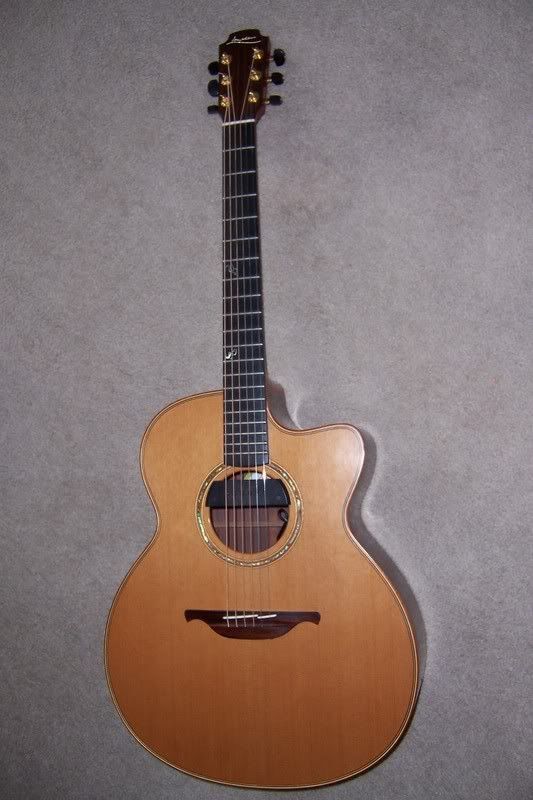 |
| my primary guitar |
 |
| an earlier incarnation of my rack |
For you gear heads, the signal path is a stereo out from the guitar to a stereo Sunrise buffer, to a Dtar Solstice blending preamp, with a dbx compressor in the channel inserts and a Digitech S100 digital effects unit in the effects loop, out to the PA. I generally run the guitar with a touch of compression, a little chorus, and a little reverb. The Sunrise is a touch louder than the McIntyre.
 |
| LowdenS10P - my 2nd guitar |
 |
| G Natural |
Now all I need is to get things together so I have more gigs more often. I have to either find the right musical partner or get serious about the solo thing.
FWIW, if the G Natural works as I hope, one of these days, I'll replace the pickups in my second guitar to match those in the #1...
Thursday, November 10, 2011
putting it out there
Last week we had a wonderful show in the Cambridge Drive Concert series with Terry Holder. At some point during the day, I was talking with Jerry, Terry's husband and guitar player. He wondered out loud why it was that guys in the audience assume that every female performer "is available to them" and told stories about guys who tried to pick Terry up. One fun story involved a guy who had purchased 3 CD's from her merchandise table and then learned that Jerry was her husband. He returned the three CD's and walked away without even asking for his money back.
I was thinking about the discussion this morning as I was walking to work and listening to some music. I love "If I Were a Boy" by Beyonce and, despite the controversy over the rights to the song, I think she just kills that song. Every time I hear it, I believe her. I feel the pain at being taken for granted by some guy and her yearning for "a better man," and I figured it out. A great performance involves putting it all out there.
As a culture, we're just immature about emotions. When a performer opens his or her soul and puts their emotions out there, it feels intimate. Indeed, it is intimate... but that doesn't mean we really have an intimate relationship with the performer. All those guys to whom Jerry was referring were just unable to experience emotional intimacy of any kind without assuming it came with sex. They really need to be "better men" who can experience powerful emotions without making assumptions.
So, here's my question... how do we raise a crop of better men who really do understand the emotions of other people? Who are emotionally mature, caring, and giving, and who understand where the lines are?
Here's a live performance of "If I Were a Boy..."
I was thinking about the discussion this morning as I was walking to work and listening to some music. I love "If I Were a Boy" by Beyonce and, despite the controversy over the rights to the song, I think she just kills that song. Every time I hear it, I believe her. I feel the pain at being taken for granted by some guy and her yearning for "a better man," and I figured it out. A great performance involves putting it all out there.
As a culture, we're just immature about emotions. When a performer opens his or her soul and puts their emotions out there, it feels intimate. Indeed, it is intimate... but that doesn't mean we really have an intimate relationship with the performer. All those guys to whom Jerry was referring were just unable to experience emotional intimacy of any kind without assuming it came with sex. They really need to be "better men" who can experience powerful emotions without making assumptions.
So, here's my question... how do we raise a crop of better men who really do understand the emotions of other people? Who are emotionally mature, caring, and giving, and who understand where the lines are?
Here's a live performance of "If I Were a Boy..."
Wednesday, November 09, 2011
handling the text
As a pastor, I take handling the text very, very seriously. It is my responsibility to help my congregation understand what the text meant in its own setting in life and then help them find the meaning it has for us in our setting. This can be tricky. Often the setting of the scripture is as foreign as it can be to our setting. Sometimes the details just don't make sense to us. Sometimes, especially in the case of the gospels, there is more than one setting. For the gospels, we have not only the setting of Jesus' ministry, but also the setting of the writers' churches. They looked back at Jesus' life and asked, "What stories or events from Jesus' life do my folk need to hear?" Understanding those passages often requires looking at both Biblical settings and our own. Then... there are just those passages that don't seem to fit our setting at all.
This past Sunday, I preached on Matthew 25:1-13. It is a passage that I don't think particularly speaks to my congregation. The more I thought about the parable, the more I became convinced that if Jesus was telling this story to my church or to most churches in America, the story would take a different tack. In the Biblical story, there are 5 wise maidens who have adequate supplies of oil for their lamps when the bridegroom is late and 5 who do not. When those who do not have enough ask the 5 wise maidens for help, they are sent away. When they finally arrive at the wedding feast, again, they are turned away. The point is to be ready at all times for the coming of Jesus. This was especially true for Matthew's church who thought Jesus was running very late. My congregation is just not concerned about the second coming.
Here's what I think Jesus would do with the story today. The 5 wise maidens would share their oil. But what if there isn't enough and everyone runs out? Think of the feeding of the 5000, of the Hanukah candles, of all of the instances where God's generosity overwhelms the needs and there is more than enough. I think Jesus would remind us that by sharing, everyone has enough and the wedding feast would be that much more wonderful with the additional folk there helping to party. I believe the call to us today here is not to worry about being prepared but to share all we can with others and watch as God's party gets bigger and bigger. And I think he would use it to condemn those in the Church who identify with the Tea Party, the followers of Ayn Rand, and the Republican party who are so bent on holding on to what they have to the detriment of those in need. And that is what I talked about on Sunday.
So I danced with eisegesis... clearly my message introduced something to the text that wasn't there... but I do believe that if Jesus was telling that same story to us today, that's the direction he'd go.
This past Sunday, I preached on Matthew 25:1-13. It is a passage that I don't think particularly speaks to my congregation. The more I thought about the parable, the more I became convinced that if Jesus was telling this story to my church or to most churches in America, the story would take a different tack. In the Biblical story, there are 5 wise maidens who have adequate supplies of oil for their lamps when the bridegroom is late and 5 who do not. When those who do not have enough ask the 5 wise maidens for help, they are sent away. When they finally arrive at the wedding feast, again, they are turned away. The point is to be ready at all times for the coming of Jesus. This was especially true for Matthew's church who thought Jesus was running very late. My congregation is just not concerned about the second coming.
Here's what I think Jesus would do with the story today. The 5 wise maidens would share their oil. But what if there isn't enough and everyone runs out? Think of the feeding of the 5000, of the Hanukah candles, of all of the instances where God's generosity overwhelms the needs and there is more than enough. I think Jesus would remind us that by sharing, everyone has enough and the wedding feast would be that much more wonderful with the additional folk there helping to party. I believe the call to us today here is not to worry about being prepared but to share all we can with others and watch as God's party gets bigger and bigger. And I think he would use it to condemn those in the Church who identify with the Tea Party, the followers of Ayn Rand, and the Republican party who are so bent on holding on to what they have to the detriment of those in need. And that is what I talked about on Sunday.
So I danced with eisegesis... clearly my message introduced something to the text that wasn't there... but I do believe that if Jesus was telling that same story to us today, that's the direction he'd go.
Thursday, November 03, 2011
just proves what's necessary
She's playing a really cheap and lousy guitar in an open tuning and clearly doesn't know the "correct" way to play a guitar... but what wonderful music! Just goes to prove that the most important part of making music is in the heart and soul of the player... technique is secondary (although she clearly has great technique even if it is "wrong") and the quality of the instrument is secondary (even though with a better guitar she would have sounded that much better).
So... the lesson for me is, "play, play, play... and then play some more. just make music and don't worry about the other things."
Subscribe to:
Posts (Atom)


