Showing posts with label acoustic guitar. Show all posts

Wednesday, January 18, 2017

Tiny Desk

Many of you know that back in the late 90's I performed in a duo with my daughter under her name, Alexis d, mostly around the Hudson & Pioneer Valleys in upstate NY & Massachusetts.  It was one of the most musically satisfying times of my life.

Life goes on and things change but Alexis and I still perform occasionally and still write every now and then.  This year, we have submitted a song to the NPR Tiny Desk Contest

Check it out...


Here are the lyrics...


V.
Don't know where I'm going
Not sure where I've been
It's the biggest hot mess
This thing I'm in
I call up experience
My blessings and my sins
But I still don't know,
The next step or when.

Chorus
We can talk about the future,
We can wish about the past
But all I want
Is the gift I know'll last

V2
I've traveled around the world
I've sure seen a lot
I've been granted riches
So others envy what i've got.
But all I know,
Is when I look at you,
That's got to be the best thing
I could ever choose.

Chorus

Bridge
Let's spend a little time
Just us two
That's the present,
I'll give to you.

V3
I might be lost
I might get found,
I may be up
I've certainly been down,
Truth be told,
Only one way to be,
Only one place,
That's where you're with me.

Chorus
Bridge
Tag

Tuesday, August 05, 2014

bass player or guitar player?

I've been playing bass in the church band since late 2010 or early 2011.  It was a struggle at first.  Guitar players often think they can play bass because they know where all of the notes are but the reality is that it is a very, very different instrument.  Back in March I posted the 10 commandments for bass players which really underscores the role of the bass player in keeping the groove.  Earlier, I posted a piece about the different language that bass players speak vs. guitar players.   I mentioned in one of those posts that I'm actually spending more time playing bass than guitar these days and that it is detrimental to my guitar playing.  That continues to be the case.  At the same time, I do really enjoy playing the bass.  There are these wonderful moments when I find myself connected to the drummer and it is almost as if we are one person/instrument and the groove really does take over.

So here's the thing... I find myself thinking sometimes that I should switch and define myself primarily as a bass player rather than a guitar player.  I am a good, if a little idiosyncratic, guitar player but I'm not getting a lot of opportunities to play.  I'm a reasonably good bass player too... and I think there would be more opportunities for that if I really worked at it and put myself out there.  To do that though, would, by necessity, push my guitar playing even further back on the shelf.  I do miss playing out though and the possibility of getting out more is really attractive.

I'd like to be intentional about the whole question rather than just sliding into it... we'll see.

Saturday, April 14, 2012

putting myself out there

About 20 years ago I regularly played out as a solo act.  I played at restaurants, coffeehouses, open mics... all as a solo performer.  I had a long list of cover tunes that I knew and a few originals.  I gigged three or four times in an average month.  Then something happened.  Alexis was growing up and showed the promise of being an excellent performer.  We learned a couple of songs together and I took her to a little vegetarian restaurant called Mother Earth to perform with me.  She was in 9th grade.  She sang on about half of the songs and we had a great time.  She was glowing by the end of the evening.  When I gave her half of the tip jar, she looked at me in sheer amazement... "You mean we get paid for this!?!?!?"  I laughed and smiled at her naivete.  She was bitten.

She began to come with me on every gig and before long she was singing the entire night.  A 9th grade class project came up where each student was supposed to pick a profession and do a report.  Alexis chose singer/songwriter and shadowed a friend of mine - Amy Abdou - as she wrote and recorded material.  Alexis and I wrote a couple of tunes together (including Call Down Thunder in the player on the right - the melody and the lyrics were hers) and performed them for her 9th grade class.  We were officially a duo - originally called "d"  and we began performing around the folk circuit in upstate NY and into Massachusetts.  As Alexis became more comfortable on the stage, she took over.  She was clearly the focus and we began to perform as Alexis d.  I sang lead on two or three songs, but she clearly had become the star.  We performed together and wrote material all through her high school years and shared the stage with some great acoustic acts including Patty Larkin, The Nields, and Tony Trischka.  I had transformed from a solo performer to a back up musician.

It was fine with me.  It gave me the chance to stretch out a bit on my guitar parts plus she was a great performer with a wonderful ear for unusual melodies.  It made for music that I felt very good about.  And if something went wrong, there was someone else on stage to help fix things (or to blame).

When we moved to Cali, Alexis came along and we continued to perform for the first year around Santa Barbara and into the LA area a few times.  Then, she went back east to finish her school and Alexis d essentially bit the dust.  She moved on as she should have.

I took a position playing electric guitar in a funk band for a while but discovered I'm too old to be playing bars anymore... then took on the role of acoustic guitar player for a singer/songwriter named Jamie Green.  Together with an amazing drummer/percussionist named Bob Terry, we were a trio.  Jamie is also a great performer and wonderful songwriter, but I was not part of the songwriting.  I was charged with playing guitar parts from her recordings (which weren't always what I would have chosen to play so sometimes I played pretty closely to the recording and other times I made them my own) or coming up with something that worked in the stripped down acoustic trio setting when her recordings were full productions.  I was even more of a sideman during those years but it still felt like a good fit to me.  Last summer, Jamie decided to go in a different direction and with very little notice, I was suddenly no longer a sideman.

I looked for a while to try to find another singer to back up but in spite of running into some great singer/songwriters, none seemed to fit very well for a variety of reasons.

So now I'm struggling with trying to become a solo act again.  I got used to playing some complicated and difficult parts and wrote some music with Alexis that I'm still proud of... but for the life of me, I'm having a difficult time playing those parts and singing her unusual melodies.  But I'm putting myself out there.  This week I did a songwriters circle, played at Songwriters at Play, and met and played for and with a wonderful musician named Randall Williams.  Frankly, in each setting I screwed up some of the vocals and played my share of clams on the guitar while trying to sing.  Still it was fun and terrifying and I'm inspired to do more and to try to write some new tunes all by myself.  I'm excited about putting myself out there!

Wednesday, January 04, 2012

compromises

My primary instrument is acoustic guitar and I have two wonderful instruments, both built by Lowden Guitars, an Irish company that builds stunning guitars.  They are not inexpensive but to my ears, they are well worth the cost.   The sound is big, warm, responsive, elegant, and rich.  Guitars though are not very loud as far as instruments go so to be heard in any but the most intimate of settings, they require some kind of amplification.  Any instrument that embodies all of those adjectives is going to be very difficult to capture with any kind of pickup and amplifying it will necessarily involve multiple compromises between accuracy, complexity of the system used to capture the sound, susceptibility to feedback, and the choice of which characteristics of the instrument must be attenuated to play in a louder situation.  I joke that I spent a significant amount on a great guitar only to be faced with multiple compromises when trying to amplify it and significant additional costs.

Getting a good live sound is a huge area of discussion among acoustic players.  For me, the bottom line is always, which compromises am I willing to make?  What characteristics of the sound of my guitar played in my living room am I willing to give up in order to be able to play for an audience of 50 or 100 or 500 people? 

Compromise... is not a popular word in the US these days.  For decades, compromise has been the primary work for politicians.  In a nation growing ever more diverse, their job was to come together and work out deals with which nobody was completely happy but everyone got something they deemed important.  Of course, there have always been instances where folk have had issues about which they could not compromise.  Still, until recent times, politicians did a pretty good job of finding ways past those issues and making deals.

In recent years our culture has become more and more polar.  In politics this has been fed in the primary process where the more extreme voters are likely to participate and many politicians, especially on the right, are pushed towards the extremes just to get nominated.  As those more extreme groups have gained power in the primary process and have enabled some extreme candidates to get elected, they have become more entrenched and less willing to compromise.  For what it's worth, the same thing has happened in religious circles.

Now, here's the piece that has me interested.  A few days ago Glenn Greenwald published a fascinating article in The Salon comparing many of Obama's political stands to those of Ron Paul and traditional liberal stances.  He said the issue was that many liberals are either downplaying the issues where Ron Paul is actually more in line with their beliefs or ignoring them altogether.   The reality here is that progressives are being forced to compromise their views.  They must decide whom they will embrace when one candidate stands for some of their issues and not others while the other candidate is the exact opposite.  I think Greenwald is correct that in large degree the liberals are avoiding a conscious compromise and ignoring those issues where Obama stands in contrast to their historic views.

Coming out of Iowa, the Republicans have a similar dilemma.  Mitt Romeny, Rick Santorum, and Ron Paul represent very different understandings of what it means to be a Republican and each would present an extremely different platform for that party in the next election.  None seem to be a happy compromise for them.  Indeed, I think that dis-ease with compromise has been the genesis of the revolving 2nd place candidates as many in the party are not happy with Romney while each option they put forward turns out to be worse.  In any case, they will be forced to compromise, to choose which characteristics they can let go in order to keep some others.  Some, like many in the Tea Party have already said they will not vote for Romney as he would be a compromise with their core principles.   It will be interesting to see where this goes...

Monday, November 14, 2011

new gear

my primary guitar
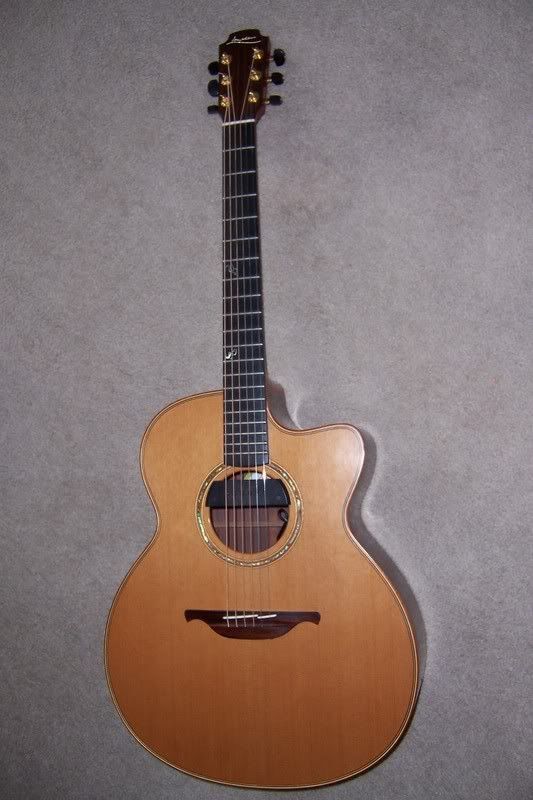
Guitar players are always looking for way to make their sound both better and easier.  I'm at a lace where I'm very happy with the cogent of my sound.  I have two amazing Lowden guitars that I love.  My primary guitar - the custom Lowden O25C  in the picture to the left -  has two pickups in it, a Sunrise magnetic and a McIntyre soundboard transducer.  Together they work very well for me... but to make them work well, I have a rack of stuff that is a royal pain to schlep around.

an earlier incarnation of my rack
The current incarnation has a different blender (the red thing on the top right) and I've removed the tuner (the 2nd thing from the bottom) but it is still the same overall size and essentially the same weight... and it sounds great.  When I was playing with Jamie Green, she would request that I bring that guitar and the rack so I could get that "beautiful guitar sound."  She was right.

For you gear heads, the signal path is a stereo out from the guitar to a stereo Sunrise buffer, to a Dtar Solstice blending preamp, with a dbx compressor in the channel inserts and a Digitech S100 digital effects unit in the effects loop, out to the PA.  I generally run the guitar with a touch of compression, a little chorus, and a little reverb.  The Sunrise is a touch louder than the McIntyre.

LowdenS10P - my 2nd guitar
My second guitar - an old Lowden S10P that is beaten to death, had some terrible repairs done, but sounds and plays great - has only one pickup, a Fishman UTS with the stock Fishman endpin preamp, so it doesn't require the blender or the buffer, but if I want the same rich sound with the compression, chorus, and reverb, I still needed to carry the entire rack... until now.  I got a new piece of equipment, a TC Electronics G Natural, that has pretty much everything that is in the rack plus more in one box that I can access on the floor and the whole thing is 11.2 X 10.5 X 3.5 inches and weighs 4.1 lbs.  And it sounds good..

G Natural
Because it is a digital unit, I can have the option to store 30 presets in addition to 30 factory set presets and I can recall them by stepping on the footswitches.  There are more effects there than I have in my rack plus switching between sounds is much easier and quicker.  It even looks as if I can set it up to work with the dual sources I have in my primary guitar so I can leave the rack at home almost all of the time.  I'm excited about that... if I could leave the rack at home all of the time and got the same quality of sound, it would be wonderful.

Now all I need is to get things together so I have more gigs more often.  I have to either find the right musical partner or get serious about the solo thing.

FWIW, if the G Natural works as I hope, one of these days, I'll replace the pickups in my second guitar to match those in the #1...

Saturday, August 06, 2011

a great song

Last night we presented Jill Knight at the Cambridge Drive Concert Series. Jackie Morris opened for Jill. It was a wonderful, wonderful show. Jill is a great songwriter, a great guitar player, and an engaging performer (if you ever have the opportunity to see her perform, don;'t miss it!).

Jill's most recent CD, Rare October is stripped down to just voice and guitar. It is perfectly recorded and perfectly performed. The songs are strong enough to stand with nothing other than a voice and a guitar, albeit a wonderful, soulful voice and stellar guitar work. That CD is in heavy rotation for me right now.

Last night, Jill performed many of the songs from that CD in a slightly different format. She brought along monster bass player, Bobby Santa Cruz. There were numerous jokes through the evening that guitar players can throw out some clams but there is no room for mistakes for a bass player. Well, Bobby provided this wonderful bottom end that grooved and added just enough and never too much. The songs still shown through. Jill even invited me to sit in on a few songs. I was thrilled to be able to play with her and enjoyed those few moments of thinking about adding a little icing to those great songs.

Bottom line of all of this is that a great song doesn't need whiz bang production, 14 highly paid studio musicians, or lasers and lights. All it needs is a competent, heartfelt performance.

Here's a video of "Carolina" with Bobby Santa Cruz on bass and me trying to add a little icing.

Tuesday, February 22, 2011

Kora on guitar

At the Western Regional Folk Alliance conference a few months ago I heard some wonderful music. There were some songwriters who wrote stories that felt like they came straight from my heart only in ways that I could never express. There were voices that brought tears to my eyes. Still, I rarely hear something that just makes me shake my head and smile. Walter Strauss was one of those performers.

Every now and then there is a guitar player who does something completely unexpected. The greatest players of all time have done just that. Django did it in jazz. Jimi took electric rock guitar to new places. Michael did the same for fingerstyle acoustic. Now, I wouldn't put Walter Strauss in those same categories but he did something completely new to me that was just amazing. Walter is a wonderful player who does kora music on the guitar. A kora is a 21 string African harp. Now, there may be some other players out there who do kora on guitar, but if there are, I've never run into them. And I can't imagine anyone doing it better than Walter does.

This video is getting a bunch of play now as Acoustic Guitar magazine has an article on Walter's guitar and included this video. Wow!


If you get a chance to see him perform, I highly recommend it. Here's his current calendar.

Tuesday, February 01, 2011

cut capos - duh!


I've been playing with cut capos since they were really cut capos. Here's the concept... a capo is a little clamp that goes across the strings of a guitar - like an extra finger - normally used to change the key of a song to fit a voice or to make certain chords easier to play. A normal capo goes all the way across the fingerboard so the relationships between the open strings stay consistent with whatever tuning you're using. A cut capo is just what it sounds like - you take a hack saw and an art knife to a normal capo and suddenly it only pushes down on selected strings instead of all six, changing the intervals between open strings. The first ones that people made covered three of the interior strings creating an Esus4 chord when the strings were played open or one that just leaves one string uncovered for the equivalent of a drop D, two frets higher. Fingerings remain the same. So, you get an interesting hybrid between the normal tuning of a guitar and an open tuning which allows you to do some things impossible in either of the other situations.

If you look at the photo, the capo on the right is an actual cut capo. It began life as a normal Kyser capo and I cut it to cover three strings only... probably did that one in the early 90's. Since then, they've found more widespread use and a number of companies sell them already configured. The capo on the right is a Shubb partial that does the Esus4 thing and is available in many music stores. The Kyser version of the Esus4 is called the Short Cut. Both also market a version that covers 5 strings. Kyser even markets a series in 4 different configurations with a lever that makes it easier to play the strings that pass under the capo.

So, I've been using cut capos for a number of years. If you go to the player on the right, you can hear some - Call Down Thunder and Beautiful Day have one cut capo. Heartbeat has two cut capos. With Jamie Green, I use a whole capo and a cut capo with a lever on Like to Be with You which I play very differently than the player did on her CD. So... I've been using them a long time, but I stopped experimenting a long time ago too. I've been taking them for granted and haven't pushed them nearly as far as I could.

A few weeks ago I saw that my friend Greg Newlon was giving a seminar on using cut capos in the Bay area... got me thinking about them a bit... Then I was surfing around the other day and ended up at Harvey Reid's site. He is a big proponent of using partial capos and has been doing so since the 80's. Looking at his site, I realized how much more I could do with partial capos than I have been doing. So I dumped all of my capos on the bed (and there are a lot of them in various configurations) and started playing around. He has a book called Capo Voodoo that I ordered, hoping it might inspire me a bit (which it has). So I'm working at using them more and more of them. I'll likely buy a few more in different configurations or maybe cut a few more...

Here's a video of a guy named Trace Bundy playing a song called Hot Capo Stew with 5 capos on his guitar - 4 cut ones and a whole one. Notice how sometimes he plays between and behind the capos...


So if you're a guitar player, they do open up some new and interesting possibilities for chord voicings that aren't possible in any other way. I'll be working more with mine. Who knows, maybe I'll follow Greg's lead and offer a workshop in the Santa Barbara area. Let me know if you'd be interested.

Tuesday, November 16, 2010

a million and a half


guitars that is...

C.F. Martin Guitars founded in 1833, is the grand-daddy of acoustic guitars, and their designs have been the model that almost all others either copy or react against. Located in Nazareth, PA, they are a factory now, producing something like 500 guitars a week. Even their limited edition guitars far outnumber the production of an individual luthier or small shop. Still, they do build some wonderful guitars and many of the most sought after guitars were constructed by the craftspeople of C.F. Martin. Go to any gathering of acoustic guitarists and you're bound to see scores of Martins and virtually ever acoustic player either has owned a Martin at one point or other or wants to. I've had three or four through the years. I have played a few that were astoundingly good - particularly an 0017H which I think was built in the '20's and a pre-war D28 - beautiful, beautiful guitars... It is hard for me to imagine a company that has been producing essentially the same product for over 170 years and which has had such a seminal influence in its industry as had Martin.

As you can see in the photo above, they're working on serial number 1,500,000 which is slated to debut at the January NAMM show in LA. The photo, by the way, comes from Harvey Leach, a very talented guitar builder who also does inlay work for Martin and a number of other guitar companies. Click here to see some of his inlay work. This guitar is just amazing. He was contracted, along with scrimshaw master Bob Hergert to do the inlay on number 1.5 million. He can't show us any more until Martin releases photos.

Congratulations to all the folk at C.F. Martin! And to Harvey Leach for being a part of this project.

Monday, March 16, 2009

amplifying acoustics

guitars that is...

I love acoustic guitars. It is amazing what a good luthier can do with a few thin plates of wood, some metal strings, and a few other assorted parts. And it amazes me how much variation there can be in what is a pretty mature art. It is clear that dimensions can only vary so much or you either end up with an instrument that self destructs or one that sounds like a table. The materials chosen also make a significant difference in the end product. You can hear the difference between mahogany and Indian rosewood or even Indian rosewood and Madagascar rosewood. Scale length makes a difference. the size and shape of the body makes a difference. Every little detail is important. It is no wonder that the best guitars are not inexpensive.

Oh... but playing a good one... it is such an intimate experience to wrap the instrument with your arms and coax music from it.

Then comes the problem of playing live. Acoustic guitars are not very loud instruments. Sitting in the living room with friends, they're perfect. Playing on a stage in front of 100 or 1000, they just don't cut it. You need to amplify them. And amplifying an acoustic guitar is always a series of trade-offs between accuracy, feedback rejection, expense, the degree to which the source requires changes in technique, and complexity. You can't get cheap, accurate, with a low feedback threshold. So, the irony is that you spend thousands of dollars for a wonderful acoustic guitar and then have to spend a thousand more to get a good signal to send to an amplifier or PA system.

Every player will come to his or her own conclusion regarding which trade-offs to make. For me, it is involves two different technologies of pickups. The first is a Sunrise. This pickup represents the same technology that is used in most electric guitar pickups - a magnet wound with wires that senses the movement of the string in a magnetic field. It is an old technology that is fraught with difficulties when used with acoustic guitars, not the least of which is that it tends to sound like an electric guitar rather than an acoustic. In my opinion, the Sunrise is the best magnetic pickup available for an acoustic guitar. It has a touch of the electric sound but only a touch. It also has a huge bass response and is the least likely pickup to feed back of anything out there. It is heavy, expensive, hard to get, and perhaps a bit ugly. By itself, I think it sounds OK. Paired with another source that makes up for its shortcomings, the Sunrise is amazing.

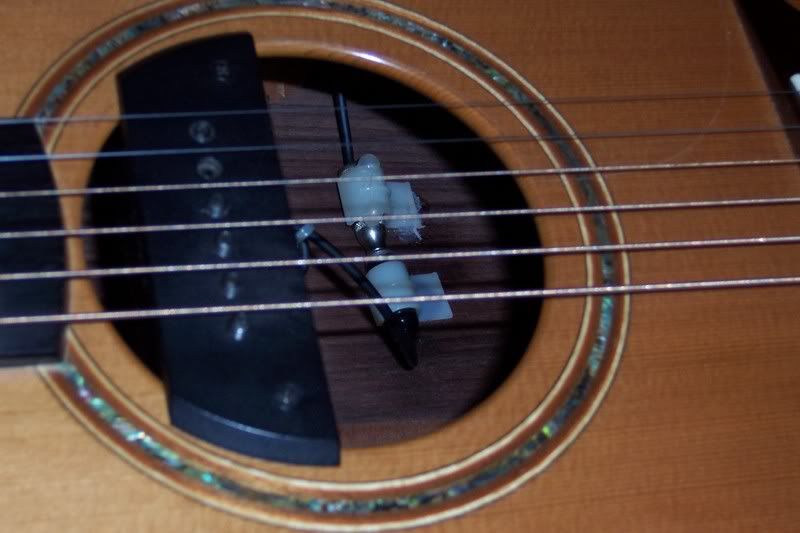
Which brings us to the second source in my guitars, a piezo soundboard transducer affixed to the inside of the top of the guitar. This type of pickup can give a fairly accurate representation of the sound of an instrument. It works when a piezo crystal vibrates and generates an electrical current that is analogous to th vibrations. The downside is that they are extremely sensitive to placement (the photo is probably not the best placement), feedback relatively easily, and pick up every sound including your shirt sleeve sliding across the top of the guitar. My Lowden has a McIntyre in it and my Silver Creek will have a jjb like the photo in it.

Together the two pickups go to a pre-amplifier and a buffer that refines the sounds even more and I end up with a sound that isn't the same as the guitar acoustically but it is a HUGE sound that I find really pleasing. The irony is that it is a very expensive way to amplify an acoustic guitar and requires a huge amount of technology to sound... old fashioned. In the case of the Silver Creek, the pickups cost about the same as the guitar and when you add in the pre-amps and effects, the electronics are worth way more than the instrument where the sound begins.

Monday, January 05, 2009

New Toy


I got a new guitar today - a Silver Creek D160 which is a solid mahogany sides and back, solid spruce top dreadnought. Sometimes I play places that I feel a little uncomfortable taking my Lowden. It is a pretty expensive guitar that I couldn't afford to replace. I've tried lots of cheap guitars, usually with laminated sides and backs and solid tops, and while some were OK, they still sounded, well, cheap.

My son played violin and cello for a while and we purchased some extremely nice Chinese made violins and cellos that held their own against European and American instruments at 2-3X's the price. Then I bought a Kenny Hill nylon string guitar which is quite nice... and made in China. So, I know they can build very nice instruments there for low prices. Yes, I know about cheap labor and all of the arguments. I also know that if it came to paying an American price for a solid wood guitar, I would have just passed at this point.

Just after Christmas I saw a deal online for this al solid wood guitar at a ridiculous price - $254 shipped with a hard case. I checked out the online reviews and they were all good. So I took a chance nd ordered one, figuring that if it was a dog, I could send it back and planning to sell my Yamaha knock around guitar to bring the overall cost even lower.

The Silver Creek arrived today and I am astounded. I have owned tons of high end guitars and even more low end ones and this guitar holds its own with the big boys. Bottom line is that it plays and sounds great... easily as good as US guitars at 5X's the price. So once it gets electrified, it will become my main gigging guitar.

If this guitar is representative of the line, I highly recommend them to anyone at any level of playing who is looking for a guitar. It isn't going to give you status or appreciate in value but when you play it, everyone will turn their heads and folk who spent 5X's as much will go home and look online at Silver Creek D160

and here's the back...

Thursday, June 12, 2008

some more wonderful guitar playing

I was looking on youtube for some more African music and some examples of different nylon string guitars and came across this

It isn't really African (he's from Canada), it isn't a nylon string guitar (but isn't the tone amazing?) but I found myself listening to it again and again. Boy, I love Lowden Guitars

The artist is Andy Sheppard

Tuesday, February 19, 2008

cool product

Guitar players are often gear whores... we have this myth that if we just purchase the correct equipment we'll become stars. So we go through lots of different guitars, amps, accessories (ask my wife, she can tell you how many guitars and amps I've gone through)... The problem is that while many are great, they are not qualitatively different from the one you just sold, and then you wish you had the old one back - boy I wish I had that '68 tele back and the '64 Deluxe Reverb and the '70 Marshall 50 and the...

Well, I came across a wonderful little product that is great and truly is qualitatively different. I had been using ivory picks made from old piano keys. They sound great and feel great but they are expensive, inconsistent, and hard to find. One of the guitar websites that I frequent has had a lot of buzz about a new pick company (how boring can you get?) with picks made of acrylic. Frankly, I wasn't expecting much and didn't plan to order any. When I visited NAMM, V-Picks had a booth and were handing out free samples. Their picks aren't cheap for picks - $4, but they're a lot less than my ivory ones. So, I picked one up, not expecting to be impressed. I was. It is great! It sounds great. It feels great. I like it as much or more than the ivory picks and it is 1/5th the price or less and it looks as if it will last a very long time. So I ordered some more including some of their acoustic models which have a slightly different bevel. Again, I didn't expect much. I knew that different materials sound different, but different bevels? Well, they are completely different and I am thrilled to have both.

If you play guitar, check out these picks. They really are amazing and do sound and play significantly differently than your stock music store picks. Thanks Vinni

Thursday, July 12, 2007

gigs!

Some of you know that I had a very frustrating time trying to put together a funk project with my good friend (and amazing vocalist) Stephanie - working title The Broken Hipsters. We found a great bass player in Johno Dunn and had problem after problem finding a drummer. It began to feel as if they were exploding like in Spinal Tap! Every time we found a good drummer something would go wrong. Finally we found one and it felt as if things were finally going to work. Then we tried to find a keyboard player and had more difficulties. Then the drummer quit the project and we were back to square one. We found another drummer who was very good and clicked extremely well with Johno and then other personal issues got in the way and I tore the tendon in my finger. Needless to say, the project never got off the ground in spite of showing lots of promise.


Just as the Hipsters were disintegrating completely, a great drummer friend of mine, Mike Golden, called me. He had met a singer/songwriter named Jamie Green who had recently moved to Santa Barbara from LA and was looking for an acoustic guitar player. I had been playing mostly electric for a while but Mike was so enthusiastic I thought I should make a contact. We connected and things clicked nicely.

It has been an interesting experience. Jamie is extremely professional and knows exactly what she wants. She played with the same guitar player in LA for about 5 years so it has been an adjustment for her to deal with a new player.

All of this is to say that we have three gigs scheduled over the coming days:

Friday July 13, 6-8 at Borders Books in Goleta, California
Sunday, July 15, 4-6, Northstar Coffeehouse, 918 State Street, Santa Barbara, CA
Saturday July 28, 8, Northstar Coffeehouse, opening for John Cragie.

If you're in the area, stop by and give a listen. If not, check out Jamie's music at the link above.