My primary instrument is acoustic guitar and I have two wonderful instruments, both built by Lowden Guitars, an Irish company that builds stunning guitars. They are not inexpensive but to my ears, they are well worth the cost. The sound is big, warm, responsive, elegant, and rich. Guitars though are not very loud as far as instruments go so to be heard in any but the most intimate of settings, they require some kind of amplification. Any instrument that embodies all of those adjectives is going to be very difficult to capture with any kind of pickup and amplifying it will necessarily involve multiple compromises between accuracy, complexity of the system used to capture the sound, susceptibility to feedback, and the choice of which characteristics of the instrument must be attenuated to play in a louder situation. I joke that I spent a significant amount on a great guitar only to be faced with multiple compromises when trying to amplify it and significant additional costs.
Getting a good live sound is a huge area of discussion among acoustic players. For me, the bottom line is always, which compromises am I willing to make? What characteristics of the sound of my guitar played in my living room am I willing to give up in order to be able to play for an audience of 50 or 100 or 500 people?
Compromise... is not a popular word in the US these days. For decades, compromise has been the primary work for politicians. In a nation growing ever more diverse, their job was to come together and work out deals with which nobody was completely happy but everyone got something they deemed important. Of course, there have always been instances where folk have had issues about which they could not compromise. Still, until recent times, politicians did a pretty good job of finding ways past those issues and making deals.
In recent years our culture has become more and more polar. In politics this has been fed in the primary process where the more extreme voters are likely to participate and many politicians, especially on the right, are pushed towards the extremes just to get nominated. As those more extreme groups have gained power in the primary process and have enabled some extreme candidates to get elected, they have become more entrenched and less willing to compromise. For what it's worth, the same thing has happened in religious circles.
Now, here's the piece that has me interested. A few days ago Glenn Greenwald published a fascinating article in The Salon comparing many of Obama's political stands to those of Ron Paul and traditional liberal stances. He said the issue was that many liberals are either downplaying the issues where Ron Paul is actually more in line with their beliefs or ignoring them altogether. The reality here is that progressives are being forced to compromise their views. They must decide whom they will embrace when one candidate stands for some of their issues and not others while the other candidate is the exact opposite. I think Greenwald is correct that in large degree the liberals are avoiding a conscious compromise and ignoring those issues where Obama stands in contrast to their historic views.
Coming out of Iowa, the Republicans have a similar dilemma. Mitt Romeny, Rick Santorum, and Ron Paul represent very different understandings of what it means to be a Republican and each would present an extremely different platform for that party in the next election. None seem to be a happy compromise for them. Indeed, I think that dis-ease with compromise has been the genesis of the revolving 2nd place candidates as many in the party are not happy with Romney while each option they put forward turns out to be worse. In any case, they will be forced to compromise, to choose which characteristics they can let go in order to keep some others. Some, like many in the Tea Party have already said they will not vote for Romney as he would be a compromise with their core principles. It will be interesting to see where this goes...
Showing posts with label amplification. Show all posts
Showing posts with label amplification. Show all posts
Wednesday, January 04, 2012


Monday, March 16, 2009
amplifying acoustics
guitars that is...
I love acoustic guitars. It is amazing what a good luthier can do with a few thin plates of wood, some metal strings, and a few other assorted parts. And it amazes me how much variation there can be in what is a pretty mature art. It is clear that dimensions can only vary so much or you either end up with an instrument that self destructs or one that sounds like a table. The materials chosen also make a significant difference in the end product. You can hear the difference between mahogany and Indian rosewood or even Indian rosewood and Madagascar rosewood. Scale length makes a difference. the size and shape of the body makes a difference. Every little detail is important. It is no wonder that the best guitars are not inexpensive.
Oh... but playing a good one... it is such an intimate experience to wrap the instrument with your arms and coax music from it.
Then comes the problem of playing live. Acoustic guitars are not very loud instruments. Sitting in the living room with friends, they're perfect. Playing on a stage in front of 100 or 1000, they just don't cut it. You need to amplify them. And amplifying an acoustic guitar is always a series of trade-offs between accuracy, feedback rejection, expense, the degree to which the source requires changes in technique, and complexity. You can't get cheap, accurate, with a low feedback threshold. So, the irony is that you spend thousands of dollars for a wonderful acoustic guitar and then have to spend a thousand more to get a good signal to send to an amplifier or PA system.
 Every player will come to his or her own conclusion regarding which trade-offs to make. For me, it is involves two different technologies of pickups. The first is a Sunrise. This pickup represents the same technology that is used in most electric guitar pickups - a magnet wound with wires that senses the movement of the string in a magnetic field. It is an old technology that is fraught with difficulties when used with acoustic guitars, not the least of which is that it tends to sound like an electric guitar rather than an acoustic. In my opinion, the Sunrise is the best magnetic pickup available for an acoustic guitar. It has a touch of the electric sound but only a touch. It also has a huge bass response and is the least likely pickup to feed back of anything out there. It is heavy, expensive, hard to get, and perhaps a bit ugly. By itself, I think it sounds OK. Paired with another source that makes up for its shortcomings, the Sunrise is amazing.
 Which brings us to the second source in my guitars, a piezo soundboard transducer affixed to the inside of the top of the guitar. This type of pickup can give a fairly accurate representation of the sound of an instrument. It works when a piezo crystal vibrates and generates an electrical current that is analogous to th vibrations. The downside is that they are extremely sensitive to placement (the photo is probably not the best placement), feedback relatively easily, and pick up every sound including your shirt sleeve sliding across the top of the guitar. My Lowden has a McIntyre in it and my Silver Creek will have a jjb like the photo in it.
Together the two pickups go to a pre-amplifier and a buffer that refines the sounds even more and I end up with a sound that isn't the same as the guitar acoustically but it is a HUGE sound that I find really pleasing. The irony is that it is a very expensive way to amplify an acoustic guitar and requires a huge amount of technology to sound... old fashioned. In the case of the Silver Creek, the pickups cost about the same as the guitar and when you add in the pre-amps and effects, the electronics are worth way more than the instrument where the sound begins.
I love acoustic guitars. It is amazing what a good luthier can do with a few thin plates of wood, some metal strings, and a few other assorted parts. And it amazes me how much variation there can be in what is a pretty mature art. It is clear that dimensions can only vary so much or you either end up with an instrument that self destructs or one that sounds like a table. The materials chosen also make a significant difference in the end product. You can hear the difference between mahogany and Indian rosewood or even Indian rosewood and Madagascar rosewood. Scale length makes a difference. the size and shape of the body makes a difference. Every little detail is important. It is no wonder that the best guitars are not inexpensive.
Oh... but playing a good one... it is such an intimate experience to wrap the instrument with your arms and coax music from it.
Then comes the problem of playing live. Acoustic guitars are not very loud instruments. Sitting in the living room with friends, they're perfect. Playing on a stage in front of 100 or 1000, they just don't cut it. You need to amplify them. And amplifying an acoustic guitar is always a series of trade-offs between accuracy, feedback rejection, expense, the degree to which the source requires changes in technique, and complexity. You can't get cheap, accurate, with a low feedback threshold. So, the irony is that you spend thousands of dollars for a wonderful acoustic guitar and then have to spend a thousand more to get a good signal to send to an amplifier or PA system.
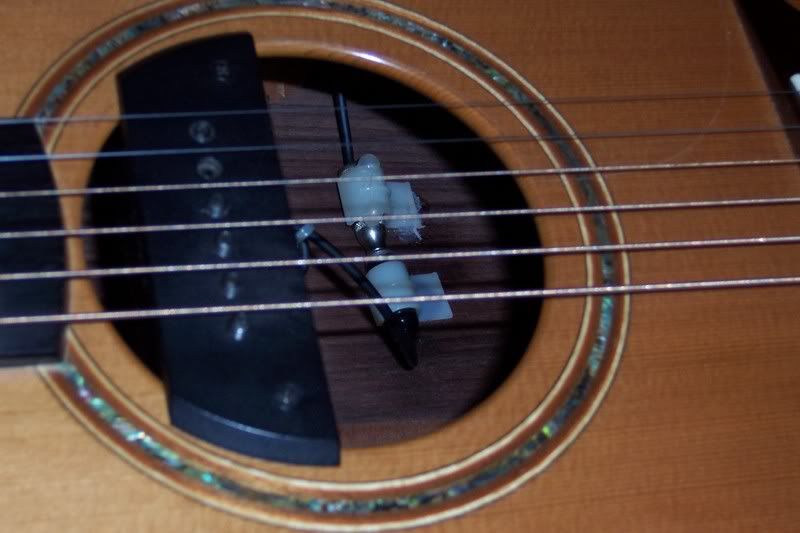 Every player will come to his or her own conclusion regarding which trade-offs to make. For me, it is involves two different technologies of pickups. The first is a Sunrise. This pickup represents the same technology that is used in most electric guitar pickups - a magnet wound with wires that senses the movement of the string in a magnetic field. It is an old technology that is fraught with difficulties when used with acoustic guitars, not the least of which is that it tends to sound like an electric guitar rather than an acoustic. In my opinion, the Sunrise is the best magnetic pickup available for an acoustic guitar. It has a touch of the electric sound but only a touch. It also has a huge bass response and is the least likely pickup to feed back of anything out there. It is heavy, expensive, hard to get, and perhaps a bit ugly. By itself, I think it sounds OK. Paired with another source that makes up for its shortcomings, the Sunrise is amazing.
 Which brings us to the second source in my guitars, a piezo soundboard transducer affixed to the inside of the top of the guitar. This type of pickup can give a fairly accurate representation of the sound of an instrument. It works when a piezo crystal vibrates and generates an electrical current that is analogous to th vibrations. The downside is that they are extremely sensitive to placement (the photo is probably not the best placement), feedback relatively easily, and pick up every sound including your shirt sleeve sliding across the top of the guitar. My Lowden has a McIntyre in it and my Silver Creek will have a jjb like the photo in it.
Together the two pickups go to a pre-amplifier and a buffer that refines the sounds even more and I end up with a sound that isn't the same as the guitar acoustically but it is a HUGE sound that I find really pleasing. The irony is that it is a very expensive way to amplify an acoustic guitar and requires a huge amount of technology to sound... old fashioned. In the case of the Silver Creek, the pickups cost about the same as the guitar and when you add in the pre-amps and effects, the electronics are worth way more than the instrument where the sound begins.
Subscribe to:
Posts (Atom)


