Thursday, March 08, 2012

Government Power vs. Religious Beliefs

Anyone who has read my blog knows that I am a staunch supporter of the separation of church and state.  I believe the wall should be so high for government intrusion into issues of faith as to be almost impossible to even see over.  I believe Native American religions that use peyote in a sacramental way should be allowed.  Ditto for Rastafarians (I have to admit I know next to zilch about Rastafarianism so I could be off base here) with regards to marijuana.  I get really uncomfortable even at government interference that requires a Christian Science family to provide medical care for their children.  That is how I feel about these issues.  That is not the way things work.

Today I read an article in The American Thinker by Tom Trinko in which he attacks liberals like Sandra Fluke for wanting the government to intrude on religious beliefs.    Here's an important quote from the article...
What greater crime can one commit against a person than using the force of government to coerce him to become an apostate to the faith he believes in?
Now, I'm not going to argue the issue at hand, even though I believe the Obama administration's solution was perfect and that the real issue for most conservatives has nothing at all to do with using the power of government to offend religious believers.  At it's core, I agree with the statement and would bet that I believe it a lot more strongly than Tom Trinko, although I can't be sure of that.  Here's why the argument doesn't work.  The government does that all of the time and these folk raise no concerns.  The government prohibitions against Native American use of peyote and Rastafarian use of marijuana are simple examples.  
 
Let me give two personal examples.  I am a pacifist.  I believe that the history of Christianity, the scriptures, and the person of Jesus allow for no other interpretation.  Still, I am required to pay taxes that go to supporting military interventions all over the world.  Indeed, we spend more on the military than basically everyone else combined and depending on how one reads the numbers, as much as 50% of our federal budget is related to "defense."  I am not given a religious option to abstain.  Now, you might say that the difference is personal beliefs vs. institutional beliefs.  The entire Roman Catholic Church stands against contraception.  That argument doesn't fly, though, as there are a number of denominations in the Anabaptist movement, known as "historic Peace Churches" that are officially pacifist.  The force of government is used to coerce us to be apostate to the faith we believe in.  A second example - I do not believe as a follower of Jesus that there ever is a time when capital punishment is appropriate.  Ditto again for the historic Peace Churches.  And again, I/we cannot opt out of paying for such barbarity and are so forced to act in denial of our expressed beliefs.

I would agree that there are times when the government can stop certain religious practices.  I don't care what you believe, the government has the power to curtail human sacrifice.  Bottom line though, that is not what this issue is about.  It has nothing to do with freedom of religion and everything about culture wars and the oppression of women.  And then, there is the fact that Sandra Fluke was speaking on behalf of a lesbian friend with no worry about pregnancy but who uses birth control pills as a means of halting the growth of ovarian cysts... but why confuse a good argument with facts.

Wednesday, February 29, 2012

Do You Hear What I Hear?

Guitar players are notorious for hearing with their eyes... a cool looking guitar always sounds better.  For electric guitar players, they see some guitars or amps and hear them as "BIG!"  Of course the epitome of this effect took place when a band's stage set up included a wall of huge speaker cabinets... except they were all empty and just for show.  For acoustic players, lighter colored woods like maple for the backs and sides are heard as being thin and bright while darker colored woods like most rosewoods are heard as richer and deeper.  That is why you see very few high end acoustic guitars with backs and sides of light colored woods and some companies traditionally dye medium colored woods like mahogany to make them darker (CF Martin is an example).  For both groups of players, the shapes of the guitar also impacts what we hear.  Now there clearly are differences between different kinds of woods and different shapes of instruments... but they are not always consistent with the assumptions.

It turns out there is a scientific background for this called the McGurk Effect.  Watch this fascinating video...


Cool huh?  I think that roughly the same thing is going on for the guitar players.  Now, here's the question... does this work in theology?  Politics?  other social settings?  And does it extend beyond just sight and hearing playing against each other?  I think so.  When I was doing my doctorate, we had a couple of faculty with southern accents.  One of them joked that the right kind of southern accent always increased respect.  The wrong kind, got you written off immediately.  How many times I've heard a newscaster here in sunny Cali with Valley Girl inflections and written her off as a ditz...  And it goes further still, when certain vocabulary is used I place the speaker in categories that impact what I hear.  Start talking to me about seeing angels or getting people saved or the Cosmic All and I easily slide you into a slot defined by preconceptions which color what I hear and do not hear. 

The good news is that I can be aware of it and work to really listen to whatever it is you're saying, trying to understand your language without my baggage getting in the way.  The bad news is that like the McGurk Effect, I may not always be successful.  I'm trying though.

Thursday, February 23, 2012

Political Life and Faith

First, let me begin with two disclaimers.  1. I fully believe there are politicians who are men and women of sincere and authentic faith.  2. I have no ability to judge the faith of another beyond what I see and whether their words and actions are consistent with their professed faith.  Even that is shaky.

Back in the '80's we lived in Philadelphia and there was a pastor of one of the larger African American Churches who was elected to the House.  He was charismatic.  He was bright.  e was a good "politician" in that he knew how to work with a variety of people to get things done.  He was easily vetted.  Everyone expected he would go far, perhaps even to become the first Black president.  Then one day he resigned.  He said that it was not possible to be a politician and to retain his integrity.  He chose his integrity and he resigned.

Again, I don't doubt that there are some people of faith who retain their integrity in the political process, but it clearly is not an easy task.  The temptations of power are always present.  Doing things the easy way is just easier.  Compromises of character are not the same as political compromises but it is easy to confuse the two.  As I've been watching Rick Santorum, who presents himself as a man of faith and is often touted as such by the Christian Right, I'm struck that his behavior is not very "Christian."  Often, he says things in his campaign speeches that are clearly not true.  Yes, that is what politicians do... but it is not what Christians do, at least not real ones.  By playing that faith card so prominently, he opens himself to that criticism and calls into question his integrity as a Christian and as a human being.

I'm struck too that the reverse is equally true... when people of faith become overly involved in partisan politics, they too risk losing their integrity.  Earlier this week, Franklin Graham was on the television show, Morning Joe, and was asked about the faith of the president.  He wouldn't go so far as to deny Obama's Christianity but at the very least he waffled, saying that he couldn't judge the veracity of another's faith.  And he clearly does not like Obama's politics.  When asked about Santorum, he was sure that he is a Christian.  He volunteered the same knowledge regarding Gingrich.  When the host stated that Graham was revealing an amazing double standard, Graham responded that Obama seems to be more concerned about the Muslims of the world than the "Christians murdered in the Muslim world."   Here's a link to the interview.  And here's a response to Graham from Zachary Bailes, an M. Div. student at Wake Forest, on the Associated Baptist Press.  I don't follow Graham and so don't know whether he still had any integrity in this area, but if he did, he sure blew it in this interview.

Here's the piece that worries me.  I obviously have strong political views (duh!) and even agree with Franklin Graham that my understanding of faith, of who Jesus is, and of his call on my life, must impact my political views.  So, how do I avoid losing my integrity?  Howdo I keep my faith from being so tied into partisan politics that it becomes co-opted?   I try to be honest and to look at the whole picture.  I try to be respectful of opinions that I clearly believe are wrong.  I try to see the strengths and the failings of my own "side" as well as any other.  Still, the risk is real.  The best I can say is that I'm trying to retain my integrity as a person of faith while strongly holding opinions regarding important issues.

Tuesday, February 21, 2012

Radical Inclusion

I have never been to Burning Man... but it is sort of on my bucket list.  There is something about the event that calls to me.  I'm not sure that I'd enjoy a full week of desert, dust, and weirdness, but I would guess that in order to really experience it, you need to experience the entire event.  And that has kept me from going. 

If you don't know about Burning Man, it is a crazy bohemian hippie gathering in the middle of the desert that takes place in late August to early September.  There are lots of interesting and bizarre people, art, music, and a unique ethic based on 10 principles - 
1. radical inclusion
2. gifting
3. decomodification
4. radical self reliance
5. radical self expression
6. communal effort 
7. civic responsibility 
8. leaving no trace
9. participation
10. immediacy

As you can imagine that makes for a very interesting social experiment.  And from what I understand, it has worked for the most part... until this year.  Last year was a very good year with great weather and good press.  It also sold out.  This year the tickets went on sale and the immediate requests were 4 times the capacity of the event.  Radical inclusion bit the dust.  As the organizers said, "Radical inclusion does not mean we can all fit in the same place at the same time."  Still, if there is one thing radical inclusion cannot mean it is, "sorry, you can't come." 

All of this has me thinking about church... if there is a principle we should be embodying it is radical inclusion yet, we rarely do.

for a wonderful taste of Burning Man, here is part of the problem, a great video that went viral this year.

Tuesday, February 14, 2012

The Authority of Faith or If You're Going to be a Catholic, Be a Catholic

I believe in freedom of religion.  I believe politicians can and should vote their consciences and that their consciences should be informed by their faith.  I also don't believe that public policy should be formed around religious preferences.   That basically means that when a politician puts forward a policy that is consonant with their faith, they better also have some good reasons that are outside of their faith.  A foundation in one's faith is not enough to form public policy.

I respect politicians who truly hold their faith, whatever it may be, and live it with authenticity.  I have no respect for politicians who use faith as a wedge between constituencies and I have little respect for politicians who are less than genuine in their commitments.

That brings me to Rick Santorum and Newt Gingrich, both of who have been playing the "good Roman Catholic" card of late.  Neither is a good Roman Catholic.  Both are ignoring the nature of authority in the Catholic church.  They think and act as if a good Roman Catholic can pick and choose between the teachings of the church and embrace those that fit their own politics or morals while rejecting others.  While in fact, many who call themselves Roman Catholics in the US do just that, it is a difficult place to be when the Catholic Church is built on a hierarchy of authority which cannot be easily ignored.  Juan Cole has an interesting blog piece entitled the Top Ten Roman Catholic Teaching Rick Santorum Rejects While Obsessing about Birth Control where he shows how Santorum does just that.  These two politicians claim to be pro-life and point to their supposed Roman Catholic faith as the foundation for that understanding, all the while ignoring that in Roman Catholic teaching, pro-life is a much broader term that rejects capital punishment, any kind of pre-emptive war, most specific wars including Iraq, and which calls for universal health care, welfare for all needy families...

The first time a politician stands up and says "I am against birth control because I'm a Roman Catholic... and I'm also against capital punishment.  I take Just War Theory seriously and I believe in a safety net that truly provides for the needs and dignity of the poor," I will take that person seriously.  Until then, he or she can't say that they hold a position based on the authority of their church without me laughing at them.  I laugh at Santorum and Gingrich.

Now, there are other kinds of Christians who understand authority very differently.  The Baptist tradition, for example, says that an individual's relationship to God is between them and God.  Authority does not come from a hierarchy but from responsible reflection by the individual and interaction with the Holy.  Without responsible reflection and without relationship to the Holy, there is no authority.  Even when the relationship is authentic, in this tradition, one still cannot generalize the shape or substance of another's relationship with the Holy.  (This is why freedom of religion was an idea that came primarily from the early Baptists).  I know many in this tradition, my tradition, who see things very differently than I do.  Some I respect deeply because their views are based in responsible reflection and in their understanding of their relationships with God.  Others... not so much.

Still other traditions place the authority in the gathered community.  The bottom line is that if one is going to claim religious authority for a particular stand, they had better understand how authority works in that tradition and own the tradition.

Saturday, February 04, 2012

A True American Story

The other day, a friend of mine shared a bit of his story.  His father was a devout man who held his faith deeply.  The nation where he lived made it very difficult to practice his faith as he believed God called him so, with pain and difficulty, leaving behind family, friends, job, and roots, moved to another country where he believed he would be able to faithfully practice his faith.  He put down new roots and raised a family, trying to be faithful and to build a good life.  Jump forward a generation and my friend, another faithful man, was trying to live out his understanding of his faith which didn't quite fit into the majority opinion of his homeland found himself in the US attending college.  It was a new world with a broad mix of religions and opinions about faith.  More important though,  it was a place with an expressed commitment to freedom of religion.  Each individual could practice his or her faith (or lack thereof) in a way that was most faithful to the deep commitments of their hearts.  My friend and his new wife decided, this was the kind of place they could truly be faithful to their understanding of God's yearnings for them.  It was the kind of place they wanted to raise their children.  They stayed in the US and became citizens here, working, putting down roots, raising a family, and living out their faith in freedom.

Can you think of a story that more characterizes the American dream?  Can you think of a story that is more consonant with the commitments that gave birth to this nation and continue to shape our culture as a people?  I can't.  This strikes me as the quintessential American story.  It just happens that Mukhtar is Muslim.  His father left India for Saudi Arabia to find a pace where he could live his Muslim faith without difficulty.  Mukhtar left Saudi Arabia to find a place where he could live out his faith in a way that was authentic to his understanding of God's yearnings for him... he came to the land of freedom of religion so he could faithfully live as a Muslim, next door to Catholics, Jews, Hindus, Sikhs, Protestants, Mormons, Atheists, and a hundred other commitments, all learning from one another, struggling with one another, and even disagreeing with one another... in freedom.

Wednesday, January 25, 2012

why I won't vote for any of the Republicans

OK... anyone who knows me knows that there is a simple answer - BECAUSE THEY'RE REPUBLICANS!  There are clearly some Republican stands that do not work for me.  In my estimation, they are all too quick to throw the poor under the bus and to shred the little safety net we have.  As a party, they have focused on what I think is the wrong issue when they talk about the deficit while what we really need are jobs.  Yes, yes, yes, the Dems are not much better, but they are a little better.  So here are a few of my reasons with each of the four remaining candidates.

Newt...  character counts.  He has none.  We can look at his hypocrisy as he claims to be a "family values" candidate while having done more to sully marriage than anyone I have ever known, read, or read of.  And while involved in despicable behavior, he had the nerve to condemn Bill Clinton for similar acts.  I know he says it was not about the sexual acts but about lying to congress, but when the moderator of the South Carolina debate asked about his behavior with his 2nd wife, he said it was despicable to ask such questions in the midst of a presidential campaign.  Evidently it was fine to ask such questions of a sitting president?!  He claims to have changed.  People do change.  I don't believe him.  His mean-spiritedness through the debates shows that he is the same old Newt.  There are those who talk of him as having "big thoughts" and "great ideas."  When his big thoughts and great ideas include essentially doing away with child labor laws, they sound like terrible ideas and small thoughts to me.

Rick Santorum... I respect a person living their faith and bringing it to play in their politics.  Every single political view that I hold is impacted by my understanding of who Jesus is and what it means to follow him.  That said, Santorum's understanding of what it means to be a Christian is, in significant places, diametrically opposed to mine.  And while I believe one can act ofor public policy changes based on his or her faith, public policy can never find its sole or even primary justification in anyone's faith.  To believe that birth control should be outlawed is so far outside of the mainstream and so far outside of anything that is positive for our country that I can't imagine him being president.  Add to that gender views that take us back at least a century.   I guess I expect more from him since he calls himself a Christian and a Roman Catholic.  When he completely dismisses the rest of the "pro-life" views of his church without a blink, I wonder how much of his political views really are based in faith.

Mitt... First, running a government is not the same as running a business and anyone who thinks it is or should be, doesn't understand government.  Add to that the fact that his role in business was to purchase weak companies, strip them of anything of value, and essentially throw the rest away.  Even if business and government were analogous,  that is not how I want to see government run.  That he is so incredibly rich that he doesn't have to work, makes more in a week off of investments that I do in a decade from work, and seems to see nothing wrong in paying a lower percentage of taxes than the vast majority of the 99% makes me wonder whether he really gets it.  It also seems that he wants this job too bad.  He seems to switch his views depending on what he thinks will get him elected... perhaps not an unusual trait for a politician but still one that I won't vote for if I can help it and it just seems too obvious with him.  I do respect that he gives a much larger percentage of his income to charities than any other politician I know of. 

Ron Paul... he's the one that really scares me.  I don't think the Republican establishment would allow him to win, but I think he is the candidate who would be most able to beat Obama.  Paul's commitment to reduce the role of the military and to end our empire is very attractive to me and to many liberals.  His commitment to enforce the parts of the constitution that protect individuals from the powers of the state likewise is attractive.  His libertarian views regarding drugs also are attractive to many liberals.  His consistency is a wonderful thing in the days of politicians reading polls and changing their views like their ties.  He could strip off many liberal voters who are disenchanted by Obama's militaristic bent or who drank the Koolaid that he is a socialist and expected him to act like one.  He isn't and he hasn't!  At the same time, I think that many Republicans who find those views distasteful would still vote for him just to vote against Obama.   I think he might gain far more than he would lose.  The parts that I don't like about Ron Paul scare me more than the parts I do like entice me... he is commitment to shredding the safety net for the poor, doing away with government involvement in ensuring safe food, water, air, and drugs.  He does not believe government has a role providing an adequate education for all or providing foreign aid that can make a difference in saving the lives of literally millions overseas.  Those views are more than I can take.  Add his racist statements of the past and he is completely off my list too.

When I listen to what each of them envisions for the country, for the world, and look at the stands and characteristics they bring to the table,   none are the kind of leader that I believe we need in this difficult time.  None bring the kind of vision of the future I want to see implemented.

So that leaves me with Obama.   Folk who know me also know that I've never been a huge fan of Obama.  During the Democratic primary I described him to my friends as a centrist and looking at his work in office, that is exactly what he has been... and I'm anything but a centrist politically.  I'm not thrilled... but I like him much, much, much better than any of the above.  I wouldn't vote for a third party candidate even if there was one I loved because I'd be too afraid one of the above might win.

So, given the choices, for me, it's Obama 2012.

Saturday, January 21, 2012

annual pilgrimage

This week was my annual pilgrimage to the NAMM convention in Anaheim, CA.  NAMM is a huge conference for dealers of musical instruments (and everything you can imagine might be tied to them) and manufacturers.  It is a big deal in that business and many of the manufacturers essentially do their entire years sales in the Anaheim convention center so they all trot out their newest and slickest.

I first attended about 5 years ago and was struck first by the booth babes... you've seen photos of them at auto shows.  They were exactly the same.  6 foot tall women wearing very little clothing and more often than not, surgically enhanced in multiple ways.  As the economy went down over the last few years, the booth babes were the first expenditure to be cut and very, very few displays had them this year.  Business seems to be on the way back up and attendance seemed higher than the last few years although there were some obvious manufacturers who were absent.

It is a convention only for people who are in the business so if you don't have a tie with a manufacturer, a retailer who will send you to the event, or are a big enough star to be able to get in for publicity's sake, you can't attend.  I get in on a visitor's pass with Lowden Guitars and really enjoy getting to spend some time with George and his family, seeing their primary demonstrator at the booth, Thomas Leeb, and getting to see the newest and slickest that George and company have produced this year.

For those of you who don't know,  Lowden is a small Irish family run company that builds what I consider to be the finest guitars in the world.  They build about 500 guitars a year and are played by some of the finest guitar players in the world including Pierre Bensusan, Alex DeGrassi, Richard Thompson, and Thomas Leeb.  Many other famous players have played Lowdens at one time or another in their careers and there are scores of wonderful players around the world who love these amazing guitars.  I've been playing them since about '86 or '87 and currently own two.  My primary guitar is an O25C Custom built in 2000 after my first Lowden, an L25C built in early '86, was stolen in Philadelphia in August of 1999.  My second is a recently acquired S10P built in '87.  It is old, beaten, abused, and scarred.  The two guitars have slightly different voices but they clearly come from the same gene pool and both really sing.  They are not inexpensive guitars, but at this quality one would never expect them to be.  That said, I have not played any guitars at any price that I would choose over a Lowden and I have played some very expensive guitars.

African Blackwood F50
Lowden had a bunch of gorgeous guitars in their booth but was really getting buzz about three of them.  One was a medium size guitar with a redwood top, very elegant appointments including a bevel on the lower bout that makes the guitar more comfortable to pay, and back and sides of a very rare and expensive wood (at least in sizes needed for guitars) called African Blackwood.  The wood has all of te characteristics needed for an excellent guitar and this one is.  It was also the most expensive guitar at the booth.

The real buzz came from two prototype fan fret guitars.  Let me explain the concept behind these guitars.  Longer strings work better for lower pitches and shorter strings work better for higher pitches.  This is called scale length and tells you the distance between the nut (the piece of bone near the top of the guitars neck) and the saddle (the piece of bone in the bridge).  The vast majority of guitars have a single scale length for all six strings which like many issues in guitar design, represents a compromise.  Once you've chosen your scale length, there are formulas that tell you where to put the frets so the guitar can play in a well tempered scale (another compromise to tuning).  What would happen if you had multiple scale lengths so the lowest strings were longer and the highest strings shorter?  Theoretically the low pitches would be richer and deeper and the high ones clearer and more bell like.  This is especially noticeable for folk who do lots of altered tunings.  Of course, it requires some voodoo with the frets, nut, bridge, and braces to make it all work.  Most visible is the arrangement of the frets... like a fan.  A few individual builders have been producing guitars with these multiple scale lengths but they are often incredibly expensive and beyond the experience of almost all guitarists.  George produced two prototypes of fan fret guitars and every player who visited the booth wanted to try them.  The high point of my time there was when Colin Hay, known to many from his days in the 80's band Men at Work, and a friend of his played a gorgeous duet on the two fan frets in the quiet room at the Lowden display.  Just sublime.  The sound of the guitars was really beautiful and they fit together, hand in glove.
fan fret guitars

I forget what the actual string lengths were, but, if I remember correctly, the lowest string is more than 1.5 inches longer than the highest one. Notice in the photo that the frets are arranged in a fan.  The slanted bridge on the right hand guitar is the logical way to get a slanted saddle but the interior bracing of the guitar must be changed to accommodate the different placement of the bridge.  The guitar on the left uses George's normal bridge with what struck me as a Salvador Dali'esque extension for the slanted saddle.  This allows George to retain his signature bracing pattern.  Some who looked at the guitar asked whether that additional wood would deaden the sound or lessen sustain.  I certainly couldn't hear any deficits. 

The orientation of the frets did cause many of the players to scratch their heads.  Some reported that once they ignored what their eyes were telling them, they didn't feel any difference in playing.  Others said that it would require some small adjustments to technique.  I was in the second group.  Given the depth and balance of George's "regular" guitars, I'm not sure I see the need need for the fan frets and so I can't see a situation where I'd feel the need to adjust.  Others, especially some fingerstyle players who often play with the lower strings dropped a step or more, may see the design as a wonderful thing.

I didn't see much of the rest of the show... I walked through the entire center once and I did look at cases and gig bags since I need a new one for my S10P, but other than that, I stayed pretty close to the Lowden booth.

Tuesday, January 17, 2012

the beauty of a place

Once upon a time there was a Texan visiting the northeast.  He had heard about the beauty of the place and was excited to see it.  Standing on the side of a Vermont mountain, looking across a valley he turned to his host, shrugged and remarked, "I guess the scenery is nice... but it is so hard to see with all of those trees in the way."

I have been very few places that did not have real beauty.  I love the stark beauty of the desert with the shapes of the rocks and colors of the hills.  I love the impressionist like landscapes in the northeast.  I love the rolling hills, dotted with grazing cattle and sheep that we saw in Scotland.  I love the fecundity of Hawaii where the flowers bloom everywhere and the mountains fall into the sea.  I love El Junque, just east of San Juan Puerto Rico where everything literally drips with life, the green is overwhelming, and the oxygen so thick it is almost oppressive.  Oklahoma didn't do anything for me... and I've been a few places in the central valley of California where it was also difficult for me to see anything truly beautiful but I expect that if I spent even a few more hours in either place, I would find something.

All that said, where I live is astoundingly beautiful.  While I lived in the northeast, the picture I often had of California was of the sprawl of Orange County or the urban blight or extreme wealth of parts of LA (thanks television!).   Those are certainly part of the picture here but the one piece that really surprised me, and still does at times, is how wild California is.  About once a year we hear of a sighting of a mountain lion, often in a place where significant populations of people live.  A few months ago, I was driving home along the Gaviota Coast and looked over to my right only see a golden eagle take off from a telephone pole.  This past Friday, I was driving along the same coast in the other direction and looked out to the ocean only to see a whale spout about 200 yards off shore.  It was the second time I'd seen a whale from my car while driving in that area.  Then there are the more common wildlife - coyotes, hawks, hummingbirds, dolphins, sea birds, sea lions, elephant seals, varieties of lizards and snakes, and tarantula...  And while we live in an area that is technically semi-arid, there are always flowers blooming of one sort or other.  The hills are usually golden brown dotted with live oak trees, but after a rain, they turn green and then in spring they turn yellow, covered with mustard flowers.  The sides of the mountains along with rock faces are often covered with the dirty green of chaparral, live oak, and evergreens.  The mountains rise and fall into the ocean.  In winter when the air is very clear, you can look south across the ocean (the coast runs east-west in the SB area) and it seems that you can reach out and touch the Channel Islands, the closest of which is 22 miles out. 
Gaviota Pass

Driving from Santa Barbara to Buellton, where we live, you go along the coast for about 20 miles and then turn north, paralleling the coast which also turns north a bit further west, and drive through the Gaviota Pass through the Santa Ynez Mountains... the mountains are glorious with the southern end of the pass being particularly dramatic.  Once you get to the Santa Ynez Valley, you're in wine country with some of the best Rhone style and Pinot Noirs in the world surrounded by vineyards, cattle farms, and other produce. 

So, I highly recommend a visit some time and I expect I may hear you sitting at a breakfast spot either in Santa Barbara looking out at the dolphins playing in the ocean or in the valley, enjoying Danish pancakes and in either place, talking across the table, wondering whether you might somehow be able to move here.

Sunday, January 08, 2012

Do You Hear What I Hear?

My daughter was laughing that the other day about something she overheard.  She was walking down a street and heard two young, elementary school aged girls singing a song they were much to young to be listening to - "I'm Sexy and I Know It" by LMFAO.  There's a line in the song, "I've got passion in my pants and I ain't afraid to show it."  The girls were obviously way too young to make sense of that line... so they heard it and sang it in a different way, "I've got cashews in my pants and I ain't afraid to show it..."  Doesn't make much sense either, but it worked for them.

A few days ago I was talking with a friend about Cambridge Drive Church's community outreaches.  We have multiple 12 step programs that meet on our property.  As we talked, my friend mentioned SLA.  He was talking about Sex/Love Addicts... I heard Symbionese Liberation Army, the domestic terrorist organization that kidnapped Patty Hearst in the 70's.  Here's the connection... His SLA is a 12 step program.  Mine goes back to my younger years and has a connection with the church because one of the Church members had a daughter who was part of the Symbionese Liberation Army.  Obviously, the conversation quickly degraded until it made no sense.

How often does that happen in life?  Even when we use the same words and hear the same words, they may have very different meanings for us and while we think we're making sense to one another, we may be missing something very important.

In the meantime... "I've got cashews in my pants..." and that would not be very comfortable.  So be careful what you say.

Wednesday, January 04, 2012

compromises

My primary instrument is acoustic guitar and I have two wonderful instruments, both built by Lowden Guitars, an Irish company that builds stunning guitars.  They are not inexpensive but to my ears, they are well worth the cost.   The sound is big, warm, responsive, elegant, and rich.  Guitars though are not very loud as far as instruments go so to be heard in any but the most intimate of settings, they require some kind of amplification.  Any instrument that embodies all of those adjectives is going to be very difficult to capture with any kind of pickup and amplifying it will necessarily involve multiple compromises between accuracy, complexity of the system used to capture the sound, susceptibility to feedback, and the choice of which characteristics of the instrument must be attenuated to play in a louder situation.  I joke that I spent a significant amount on a great guitar only to be faced with multiple compromises when trying to amplify it and significant additional costs.

Getting a good live sound is a huge area of discussion among acoustic players.  For me, the bottom line is always, which compromises am I willing to make?  What characteristics of the sound of my guitar played in my living room am I willing to give up in order to be able to play for an audience of 50 or 100 or 500 people? 

Compromise... is not a popular word in the US these days.  For decades, compromise has been the primary work for politicians.  In a nation growing ever more diverse, their job was to come together and work out deals with which nobody was completely happy but everyone got something they deemed important.  Of course, there have always been instances where folk have had issues about which they could not compromise.  Still, until recent times, politicians did a pretty good job of finding ways past those issues and making deals.

In recent years our culture has become more and more polar.  In politics this has been fed in the primary process where the more extreme voters are likely to participate and many politicians, especially on the right, are pushed towards the extremes just to get nominated.  As those more extreme groups have gained power in the primary process and have enabled some extreme candidates to get elected, they have become more entrenched and less willing to compromise.  For what it's worth, the same thing has happened in religious circles.

Now, here's the piece that has me interested.  A few days ago Glenn Greenwald published a fascinating article in The Salon comparing many of Obama's political stands to those of Ron Paul and traditional liberal stances.  He said the issue was that many liberals are either downplaying the issues where Ron Paul is actually more in line with their beliefs or ignoring them altogether.   The reality here is that progressives are being forced to compromise their views.  They must decide whom they will embrace when one candidate stands for some of their issues and not others while the other candidate is the exact opposite.  I think Greenwald is correct that in large degree the liberals are avoiding a conscious compromise and ignoring those issues where Obama stands in contrast to their historic views.

Coming out of Iowa, the Republicans have a similar dilemma.  Mitt Romeny, Rick Santorum, and Ron Paul represent very different understandings of what it means to be a Republican and each would present an extremely different platform for that party in the next election.  None seem to be a happy compromise for them.  Indeed, I think that dis-ease with compromise has been the genesis of the revolving 2nd place candidates as many in the party are not happy with Romney while each option they put forward turns out to be worse.  In any case, they will be forced to compromise, to choose which characteristics they can let go in order to keep some others.  Some, like many in the Tea Party have already said they will not vote for Romney as he would be a compromise with their core principles.   It will be interesting to see where this goes...

Thursday, December 29, 2011

conflation

This morning, this graphic showed up in my Facebook feed.  I have no issue with people allowing their faith to inform their politics and I do not have a problem with people of faith speaking out on political issues.  Indeed, I think we should.  Still, this little graphic really interests me.  While I'm sure there are those who are actually pro those four things and anti-Obama and who genuinely hold all of those stances, I have real problems when they are conflated.  I have met far too many folk who say that they are a package deal and if you don't own all of them, you don't own any of them.  Add to that, my basic orientation that says that to some degree, these statements are anti-thetical and you can see where I have issues.

Let me address each... I am pro-God... but it really does depend on what god you're talking about.  If we're talking about the God revealed in Jesus, then, I'm right with you.  If we're talking about the god worshiped in some national religion that equates God with capitalism, war, and most of all the USA, then I'm definitely not "pro-god."

I am pro-life, but I have to say that I cringe when I say that.  All too often the term actually means "pro unborn babies and once their born they're on their own."  If you really want to use that term, you need to use it as the Roman Catholic hierarchy professes to use it - anti abortion, anti-war, anti capital punishment, pro affirmative action (in the broadest sense).  Then, you can really say you're pro-life.  If you are against all f the programs that support poor children, for raising funding of the military industrial complex... well, you get the direction... and you aren't pro-life, you're pro unborn babies and once they're actually born, they're on their own.

Pro - gun?  Frankly, I don't believe the 2nd amendment has anything to say in today's world and should be repealed (like that would ever happen).  The real question though is what does this mean to these folk?  Are they saying they have the right to have a gun to shoot intruders (see pro-life)?  To stand up against a repressive government?   Good luck using that 440 deer rifle against a fuel air bomb dropped from a jet... or are they just saying they can spend their own money any way they please and that they have some machismo issue that requires owning something that can kill from 100's of yards away?   Or maybe it has to do with the aesthetics and engineering of some weapons and the deisre to own something beautiful or with historical import?  I don't know, but do any of those ideas really measure up to needing a constitutional amendment?

Pro-country... I'm pro the USA.  I believe it is the best idea that anyone has had for a political arrangement.  I believe we really can still be the city on a hill if we truly embrace the best of the dreams that gave shape to this country.  At the same time, I am not a tribalist.  If there is something to be learned from another country, then one who truly loves this country will learn it.  If this country does something that flies in the face of all of its stated ideals, then one who truly loves it will call it out.   Truly loving the country cannot ever mean turning a blind eye to its failings.  The most important parts of my religious tradition tell me that those failings have to do with treatment of the poor and vulnerable.  Being pro-country means to me, standing up to make life better for them.

Anti-Obama?  Go for it.  That is part of the genius of our system.  You can be against the president for any reason you like, even stupid ones, racist ones, selfish ones, and uninformed ones.  And there are good ones too.   Still, if you go to the website for the PAC that produced that little graphic, they are complaining about a lack of leadership... but proposing no leader.  Somehow, I think they've dropped the ball.  They want your money to dispose of one poor leader to put who in?  Trust them...  yeah right.

And finally, all of these ideas are conflated with being a Republican.  I'm sure there are Republicans who hold only the very best of values and vote that way because their conscience leads them in that direction.  Like me, when I vote Democratic, many of them hold their noses because the Republican party endorses some ideas that they feel are important while ignoring some they also think important... and they make what they perceive as the better of two bad options.  I sort of understand that.  Still, I cannot but see how the basic orientations of the Republican Party do stand in direct opposition to my understanding of what it means to follow Jesus.  Indeed, of the five statements, only two seem to fit,  for me, with the Republican platform - pro-gun and anti-Obama. 

for a little smile, here is a cartoon from the naked pastor blog (one of my favorites) that relates to the poster and the way that I experience the Republican party although it clearly is not meant for them alone (it is likely aimed at factions within the Church) and calls me to look more carefully at myself both from a faith standpoint and in regards to my politics as well.


Monday, December 26, 2011

Occupy

First my disclaimers...  I'm male.  I'm white.  I'm very well educated.  I have a middle class salary.  I live in a home that while not ostentatious at all, is quite nice, and when compared to houses in much of the country is pretty expensive.  I have OK health insurance which likewise is ridiculously expensive.  I grew up in a blue collar family in a blue collar city in a time when blue collar folk living in Pittsburgh made a solidly middle class living.

I'm aware of the other side though.  I also went to a school district that was about 50% minority and I experienced first hand the ways that race impacts everything.  I had friends who were poor and had no hope of ever being anything else and it didn't matter how hard they worked.   I also saw first hand what happened when the good blue collar jobs disappeared from Pittsburgh and my parents slipped from being solidly middle class to poor.  In their latter years, they struggled terribly.  My younger sister was just far enough behind me to miss all of the benefits I experienced... and the fact that she was female with a learning disability didn't help at all.

My politics, theology, and economics were formed in the crucible of the 60's and early 70's and I never forgot where I came from.  My formative influences were anabaptists, liberation theologians, and social radicals.

So here we are...  read these words -
46And Mary said, “My soul magnifies the Lord, 47and my spirit rejoices in God my Savior, 48for he has looked with favor on the lowliness of his servant. Surely, from now on all generations will call me blessed; 49for the Mighty One has done great things for me, and holy is his name. 50His mercy is for those who fear him from generation to generation. 51He has shown strength with his arm; he has scattered the proud in the thoughts of their hearts. 52He has brought down the powerful from their thrones, and lifted up the lowly; 53he has filled the hungry with good things, and sent the rich away empty.
I can't imagine a better theological frame for the Occupy movement.  This passage clearly shows that when class warfare takes place (and it is right now), God is always on the side of the poor.  The prophets speak similar words again and again.  From the beginning, God has called for a system that precludes those with power from rigging things for their interests.  The one time we see Jesus angry, it is when those with power and position use it to take advantage of those with none (he turned over the tables of the money changers in the Temple as they took advantage of the poor who came to worship as required by the law).  Unfortunately, the Church is not always on the same side as God.

I recently read a powerful article by Kristin Rawls where she shares her frustration at a system that has failed her even as she did and does everything right and she feels that those on the more progressive side of the evangelical church have not stood with her and those like her.  She asks for a church that will be "outraged with me and who practice solidarity by showing up when it matters and advocating for real economic justice.  I want you to use your clout and influence to help..."  Clearly she is asking for us, for me, to do exactly what Jesus would do.  If we do anything less, Mary would remind us that we are standing against the work of God.

I don't know that I have any clout or real influence, Kristin, but I want to stand with you and your sisters and brothers who have been thrown under the economic bus.  Yes, God does love even the 1%... but God clearly wants to bring them down from their thrones, send them away empty, while lifting up the lowly, filling the hungry with good things, and seeing the lowness of those under the bus.

Wednesday, December 14, 2011

Christmas Carols #2 - gender

We have a gender issue in the Church.  To hear folk like Mark Driscoll parse it, we've become too feminine.  He wants us to get manly and to restructure the church so it is more masculine (as he defines that).  Let me say this gently... he's wrong... in almost every way.

We'll leave most of the argument for another time, but today I want to look specifically at gender and Christmas carols.  For centuries, Christian theology focused on a God who was pictured as a stern, unapproachable father, just waiting for you and I to do something wrong so we could be punished.  In spite of the fact that "spirit" is feminine in Hebrew and neuter in Greek, the three persons of the trinity were universally portrayed as male.  Leadership was segregated to men to the degree that even translations of the scripture reflected that prejudice.  Any images of God that hinted at the feminine were down-played.   It was no wonder that Mary was elevated almost to become a fourth member of the trinity... people wanted/needed a mother figure who would kiss their hurts away and love them regardless of what they had done.  That brings us to carols.

Christmas is the time in the Christian year when the feminine cannot be denied.  Mary moves to the forefront as she is given veto power over the very plans of God, decides to be part of God's plans,  carries, and then births the baby.  Like it or not, biology puts the woman at the center of the story and keeps her there.  This is especially true in a patriarchal culture where caring for children is a woman's work.  Joseph essentially disappears from the story because he is unimportant.

All of this appears in the carols as we remember the mother and her role in the story of salvation... and all of this elicits a backlash.  The Church with its patriarchal understanding of God and of authority could not allow for any portion of the year to be owned by women...  so the carols often reflect the push back.  "Good Christian men rejoice..."  "God rest ye merry gentlemen..."  "Peace on the earth, goodwill to men, from heaven's all gracious King..."  "As with gladness, men of old..."  And also notice the hyper masculine kingly language that is often used.  We must be reminded that this is not a baby, but a king even as he suckles at his mother's breast lest she have too much power in the scenario.

Yes, yes, I know that common English usage when those songs were written didn't provide an easy way to be inclusive, but I am arguing that the entire content betrays a desire to put the woman in her place, to move the focus away from the mother and baby, and to remove as much humanity as is possible from a baby who is dependent upon a woman.

Guess what?  She is there!  She is central!  Without Mary's "yes," nothing happens at all.  It all depends on a woman... heck, in our culture, she wouldn't even be considered a woman.  It all depends on a girl.

So, Mark Driscoll... I don't think we're too feminine... I think we've pushed too hard for too long to disenfranchise women even in our Christmas carols.

Tuesday, December 13, 2011

Adoption Day

my little boy, John
that tree next to him is over 7 ft.
On December 13, 16 years ago, the Donkin forever family enlarged.  The story is long and complicated, filled with frustrations and joys and fears and relief.  After John had been a part of our family for five years, on December 13, 1995,  Cheryl, Alexis, John and I appeared in family court in Albany, NY and finalized the adoption of John.

It probably isn't proper to tell more of the story here but there is one piece that I can tell the world... that day was one of the most wonderful and impactful days of my life.  John is my son no less than Alexis is my daughter, biology beside the point.   I am so blessed to have him in my life and I am so proud of the man he has become and is becoming.

Monday, December 12, 2011

Christmas Carols #1

Of all of the sub genres of church music, I find Christmas carols the most interesting for a whole bunch of reasons.

First, the gospel is all about contextualization, but many theologians and many churches try to ignore that.  They'll talk about trying to recapture the shape, style, and government of the Early Church, forgetting that there never was one early church and neglecting that the cultural differences would make it unworkable even if there had been.  Incarnation is all about context.  Jesus was born a boy in a very specific time and place with a very specific cultural setting, politics, and economics.  His ministry becomes universal only because it is so contextual.  The same continues to be true now.  We see this most clearly in Christmas music.

Europeans moved the holiday to the middle of winter both to coincide with the shortest and bleakest time of the year and with pagan holidays that happened at the same time.  One of my favorite carols is In the Bleak Midwinter.  Now, how much more European can you get than that?  "Snow had fallen, snow on snow..."  "Water like a stone..."  Jesus was born in a place where the weather just doesn't look that way.  Still, the image works both for the setting of the singers, northern Europe and North America,  and as metaphor.   Here's a video of me playing this song in Santa Barbara at the Cambridge Drive Concerts Songs on a Midwinter's Night (sorry for the lighting and for the clam in the first verse) -  another place where the weather doesn't fit at all, but the metaphor still works.


My favorite Christmas carol is Some Children See Him, one of the Alfred Burt carols with lyrics by Wihla Hutson from 1951.  I blogged about the way this song reflects contextualism back in '06.  Here are the lyrics.
Some children see Him lily white,the baby Jesus born this night.Some children see Him lily white,with tresses soft and fair.Some children see Him bronzed and brown,The Lord of heav'n to earth come down.Some children see Him bronzed and brown,with dark and heavy hair. 
Some children see Him almond-eyed,this Savior whom we kneel beside.some children see Him almond-eyed,with skin of yellow hue.Some children see Him dark as they,sweet Mary's Son to whom we pray.Some children see him dark as they,and, ah! they love Him, too!
The children in each different placewill see the baby Jesus' facelike theirs, but bright with heavenly grace,and filled with holy light.O lay aside each earthly thingand with thy heart as offering,come worship now the infant King.'Tis love that's born tonight!
Those words reflect my understanding of incarnation more deeply than any song I can think of... and in that reflect the gospel in the deepest of ways.  More than once, it has brought me to tears.  Some Children has been recorded by a number of people but my favorite recording by far is by Stacy Sullivan.  She changes the rhythm a bit and moves the melody some but I don't think does any violence to the song and makes it a bit more accessible for most folk.  Unfortunately I can't find a video of her but you can purchase the MP3 at Amazon here.  It is a gorgeous rendition of the song.

In a few days, I'll be back with some thoughts about Christmas music and gender.

Saturday, November 26, 2011

beat boxes

I love the NBC show, The Sing Off.  It's got it all - great music, compassionate knowledgeable judges, and did I say, great music?  I have a few favs... and two of them are finalists -  Pentatonix and Urban Method.  I also liked Delilah who were eliminated earlier.

If you haven't watched the show, go to Hulu and watch it.  It really is a great show and I highly, highly recommend it.

I am routing for Pentatonix...  They get a huge sound with just 5 voices arranged very, very well.  The rhythm section is HUGE and just plain solid.  The beat box guy - Kevin Olusola - also plays piano, cello, and sax and is evidently quite accomplished on each.  I googled him the other day and found this incredible video of him playing cello and beat boxing... just amazing.


and here's Pentatonix

Monday, November 14, 2011

new gear

my primary guitar
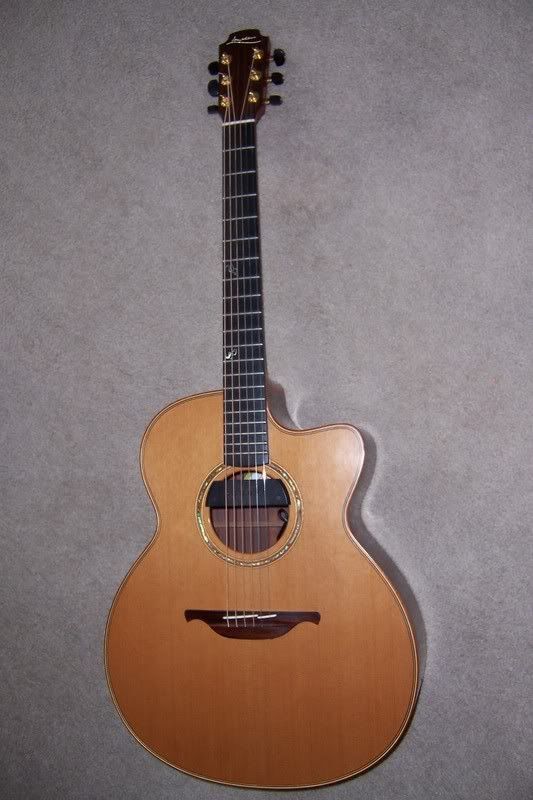
Guitar players are always looking for way to make their sound both better and easier.  I'm at a lace where I'm very happy with the cogent of my sound.  I have two amazing Lowden guitars that I love.  My primary guitar - the custom Lowden O25C  in the picture to the left -  has two pickups in it, a Sunrise magnetic and a McIntyre soundboard transducer.  Together they work very well for me... but to make them work well, I have a rack of stuff that is a royal pain to schlep around.

an earlier incarnation of my rack
The current incarnation has a different blender (the red thing on the top right) and I've removed the tuner (the 2nd thing from the bottom) but it is still the same overall size and essentially the same weight... and it sounds great.  When I was playing with Jamie Green, she would request that I bring that guitar and the rack so I could get that "beautiful guitar sound."  She was right.

For you gear heads, the signal path is a stereo out from the guitar to a stereo Sunrise buffer, to a Dtar Solstice blending preamp, with a dbx compressor in the channel inserts and a Digitech S100 digital effects unit in the effects loop, out to the PA.  I generally run the guitar with a touch of compression, a little chorus, and a little reverb.  The Sunrise is a touch louder than the McIntyre.

LowdenS10P - my 2nd guitar
My second guitar - an old Lowden S10P that is beaten to death, had some terrible repairs done, but sounds and plays great - has only one pickup, a Fishman UTS with the stock Fishman endpin preamp, so it doesn't require the blender or the buffer, but if I want the same rich sound with the compression, chorus, and reverb, I still needed to carry the entire rack... until now.  I got a new piece of equipment, a TC Electronics G Natural, that has pretty much everything that is in the rack plus more in one box that I can access on the floor and the whole thing is 11.2 X 10.5 X 3.5 inches and weighs 4.1 lbs.  And it sounds good..

G Natural
Because it is a digital unit, I can have the option to store 30 presets in addition to 30 factory set presets and I can recall them by stepping on the footswitches.  There are more effects there than I have in my rack plus switching between sounds is much easier and quicker.  It even looks as if I can set it up to work with the dual sources I have in my primary guitar so I can leave the rack at home almost all of the time.  I'm excited about that... if I could leave the rack at home all of the time and got the same quality of sound, it would be wonderful.

Now all I need is to get things together so I have more gigs more often.  I have to either find the right musical partner or get serious about the solo thing.

FWIW, if the G Natural works as I hope, one of these days, I'll replace the pickups in my second guitar to match those in the #1...

Thursday, November 10, 2011

putting it out there

Last week we had a wonderful show in the Cambridge Drive Concert series with Terry Holder.  At some point during the day, I was talking with Jerry, Terry's husband and guitar player.  He wondered out loud why it was that guys in the audience assume that every female performer "is available to them" and told stories about guys who tried to pick Terry up.  One fun story involved a guy who had purchased 3 CD's from her merchandise table and then learned that Jerry was her husband.  He returned the three CD's and walked away without even asking for his money back.

I was thinking about the discussion this morning as I was walking to work and listening to some music.  I love "If I Were a Boy" by Beyonce and, despite the controversy over the rights to the song, I think she just kills that song.  Every time I hear it, I believe her.  I feel the pain at being taken for granted by some guy and her yearning for "a better man,"  and I figured it out.  A great performance involves putting it all out there.

As a culture, we're just immature about emotions.  When a performer opens his or her soul and puts their emotions out there, it feels intimate.  Indeed, it is intimate... but that doesn't mean we really have an intimate relationship with the performer.  All those guys to whom Jerry was referring were just unable to experience emotional intimacy of any kind without assuming it came with sex.  They really need to be "better men"  who can experience powerful emotions without making assumptions.

So, here's my question... how do we raise a crop of better men who really do understand the emotions of other people?  Who are emotionally mature, caring, and giving, and who understand where the lines are?

Here's a live performance of "If I Were a Boy..."

Wednesday, November 09, 2011

handling the text

As a pastor, I take handling the text very, very seriously.  It is my responsibility to help my congregation understand what the text meant in its own setting in life and then help them find the meaning it has for us in our setting.  This can be tricky.  Often the setting of the scripture is as foreign as it can be to our setting.  Sometimes the details just don't make sense to us.  Sometimes, especially in the case of the gospels, there is more than one setting.  For the gospels, we have not only the setting of Jesus' ministry, but also the setting of the writers' churches.  They looked back at Jesus' life and asked, "What stories or events from Jesus' life do my folk need to hear?"  Understanding those passages often requires looking at both Biblical settings and our own.  Then... there are just those passages that don't seem to fit our setting at all.

This past Sunday, I preached on Matthew 25:1-13.  It is a passage that I don't think particularly speaks to my congregation.  The more I thought about the parable, the more I became convinced that if Jesus was telling this story to my church or to most churches in America, the story would take a different tack.  In the Biblical story, there are 5 wise maidens who have adequate supplies of oil for their lamps when the bridegroom is late and 5 who do not.  When those who do not have enough ask the 5 wise maidens for help, they are sent away.  When they finally arrive at the wedding feast, again, they are turned away.  The point is to be ready at all times for the coming of Jesus.  This was especially true for Matthew's church who thought Jesus was running very late.  My congregation is just not concerned about the second coming.

Here's what I think Jesus would do with the story today.  The 5 wise maidens would share their oil.  But what if there isn't enough and everyone runs out?  Think of the feeding of the 5000, of the Hanukah candles, of all of the instances where God's generosity overwhelms the needs and there is more than enough.  I think Jesus would remind us that by sharing, everyone has enough and the wedding feast would be that much more wonderful with the additional folk there helping to party.  I believe the call to us today here is not to worry about being prepared but to share all we can with others and watch as God's party gets bigger and bigger.  And I think he would use it to condemn those in the Church who identify with the Tea Party, the followers of Ayn Rand, and the Republican party who are so bent on holding on to what they have to the detriment of those in need.  And that is what I talked about on Sunday.

So I danced with eisegesis... clearly my message introduced something to the text that wasn't there... but I do believe that if Jesus was telling that same story to us today, that's the direction he'd go.

Thursday, November 03, 2011

just proves what's necessary


She's playing a really cheap and lousy guitar in an open tuning and clearly doesn't know the "correct" way to play a guitar... but what wonderful music!  Just goes to prove that the most important part of making music is in the heart and soul of the player... technique is secondary (although she clearly has great technique even if it is "wrong") and the quality of the instrument is secondary (even though with a better guitar she would have sounded that much better).

So... the lesson for me is, "play, play, play... and then play some more.  just make music and don't worry about the other things."

Saturday, October 29, 2011

Fall

I miss fall... at least the kind of fall we had in upstate New York - when the air turns crisp, the leaves turn from green to reds and yellows and then brown, you put on sweaters and the first coats of winter, eat hearty soups,  maybe even a little snow falls that hints of what is coming, and the last deluge of produce comes forth, especially the apples and the products made from them - cider, apple cider donuts, pies, and crisps...  I feel it every year.  I see the apples in the grocery store and I'm not impressed.  They just aren't the same.  Literally, they are different varieties than we loved in Pennsylvania and New York.  The apples there were crisp and tart.  Many of the ones here, even at the farmers' markets, are sweet and mushy.

Of course, there are other signs of fall here.  The last of the grapes are picked and crushed and the new wines are beginning to ferment.  Many wineries bottle wines to free up space in the barrel rooms and sales are abundant because of the need for warehouse space for the new bottlings.

While the temperatures in the low 80's would never have betrayed it, today was a fall day here.  Cheryl and I jumped in the car and headed north to See Canyon in San Luis Opisbo county.  I don't know why they can grow good apples there, but they do.  And we have a favorite orchard - Gopher Glen - that grows 60 varieties of apples including some that we love from the northeast and some we enjoyed that were new to us.  Two weeks ago they were selling Stayman Winesaps - one of our favorites from Pennsylvania and we bought ten pounds.  They're all gone now.   Today we purchased ten pounds of an apple we didn't know as they weren't selling the Stayman Winesaps - Arkansas Black - and two gallons of cider (if you've never had fresh pressed cider directly from an orchard, you've never tasted cider).  It gives us a taste of the fall we know from our past.  Some warm cider donuts would have made me think I had died and gone to heaven... or at least to upstate New York.

Then we headed south, towards home and stopped at Core Winery in Orcutt to pick up a wine club shipment.  Dave and Becky Corey run a great little winery that is just fun.  The wines are quite good and very reasonably priced but it was the family atmosphere that pulled us in and inspired us to join.  So, we enjoyed some wines, talked with folk, picked up our three bottles (and bought three more) and headed home.

Yes, it was 80 degrees and didn't feel anything like an October day in upstate New York (where it was snowing today), but it still felt like fall... and that felt good.

goodbye Cathedral Music

If you look down at the links at the bottom right of my page, you'll see a link to Cathedral Music (my favorite guitar store).  After 16 years, Cathedral is going out of business.  Klem says that it is time for a new chapter in his life, which I understand, but I can't but imagine the economy has a lot to do with the timing.

Cathedral is a small shop that never had the largest inventory, but as Klem said, "we don't sell no junk," and every guitar at any price point that came out of that shop was at least a good guitar if not a stellar one. There was a period when my daughter was taking harp lessons about a mile from Cathedral and about 15 miles from my home so every week, I'd drop Alexis at her lesson and then head over to Cathedral to play some wonderful guitars (there are a couple that still haunt me) and chew the fat with Klem.  He never gave me a hard time about not purchasing anything.  I quickly learned to get out of the way when a real paying customer was there but never, ever felt pressured in any way.  I only purchased one guitar via Klem.  When my Lowden L25C was stolen, Klem was the dealer that worked with me on my O25C Custom.  I remember the experience of going to pick up that guitar as if it was yesterday... the anticipation as he brought the case out and the satisfaction of the first notes played.   So, he never made much money from me - I don't know that he made anything on that guitar at all - but through those days of playing wonderful guitars and visiting, we became friends and I have a very soft spot in my heart for that little store.   He is a man of impeccable integrity and was the kind of dealer guitarists all long to have a long term relationship with.   And now Cathedral is closing...

I will miss knowing that store is there but wish only the very best for Klem as he begins this next chapter of his life.  Good journey's my friend!

In the meantime, if you are looking for a guitar or a uke, Klem is having a wonderful sale on everything in his inventory except the consignment instruments.  Tell him that I sent you.

Tuesday, October 25, 2011

Cambridge Drive Concerts Video

well... not actually a video of a concert, but a promo video...


CD concerts
by: roy_d


it is my first fledgling attempt to use xtranormal.  The next one will be better but I feel OK abut this first one

Friday, October 21, 2011

Does Romney Understand?

Earlier this month Mitt Romney stated that he is in favor of a constitutional amendment stating that human life begins at conception.  I can only hope that it is a position he doesn't understand or hasn't really thought about.  It is a statement that could be made only by three categories of people... 1. the ignorant,  2. the political opportunist who doesn't really believe it but is hoping for votes, and 3. the insanely anti-abortion folk.  Here's why.

Conception happens when an egg and a sperm connect.  If at that point we have a human being, we have a number of issues to face.  Many fertilized eggs naturally do not implant themselves on the uterine wall.  If a human life begins at conception, every time that happens, we have had the death of a human being with all of the attending legal ramifications regardless of the cause.  Some women experience ectopic pregnancies where the egg implants somewhere other than the uterine wall, most often in the fallopian tubes.  This is extremely dangerous for the woman.  If the fertilized egg is not removed, she will die.  If the fertilized egg is a human being, we're talking about murder here... even though there is no chance that the fertilized egg would remain viable through an entire pregnancy.  A number of the most popular birth control methods do not stop the egg from being fertilized but rather from implanting in the uterine wall.  This would amount to murder.   Many couples find themselves unable to conceive in the normal ways and use in vitro fertilization which typically results in numerous fertilized eggs, some of which are discarded at one time or another.  Again, we're talking about murder if human life begins at conception.  We haven't mentioned instances of rape or incest where the morning after pill - which prevents a fertilized egg from implanting - would no longer be an option.   We also have raised other issues such as the mother's life, the health of the fetus, etc. etc. etc.  Regardless of how one feels in general about abortion, this stance is as radical as it can possibly be.

So either Mitt Romney doesn't understand how conception works and how it relates to pregnancy and birth control, he does know all of this and is just trying to get votes, or he actually believes what he said... in each case, the possibility that he could become president is just frightening to me and should be doubly so to any woman of child bearing age.

a smile

for you cat lovers - you'll identify... (just ask my wife about Espresso and her computer)

for you cat haters - you'll find more reason...

here's Simon's cat

Thursday, October 20, 2011

i love my car

We Americans love our cars don't we?  Back in 2010 I wrote a piece about cars being the modern equivalent of a household god... it was a fun piece and think the concept holds water.   Speaking of which, my first car was a 1964 VW Beetle.  It had it's issues.  It had rusted through in the wheelwells about half way up so when I drove in the rain, water splashed into the front of the driver and passenger compartments and would sit there until it dried out.  It sat there virtually all of the time.  I did drill a hole in the floorboard to allow it to drain but the hole would get plugged and the water would still sit.  Growing up in Pittsburgh, that meant that in the winter, it would freeze and for a few months each winter, I had an inch or two of ice on the floor of my car.  Air cooled VW's didn't do heaters either so I carried an ice scraper to scrape ice from both the outside and the inside of my front window.  It only had about 60K miles on it when I got it in 1971.  I loved that car and cried when the frame rusted through and I had to get rid of it in the winter of '73.

I've been through a bunch of cars since then.  Some I loved (a Fiat spider when it ran), some I hated (a Dodge dart convertible), most I just drove until we replaced them.

not my car but it looks just like this
I have a car I love again.  It is another VW - a 2002 GTI that I bought new when we moved to Santa Barbara.  In spite of the story (apocryphal?) of Bill Gates claiming that if automotive technology kept up with computers we'd be driving cars that cost $25 and got 1000 miles to the gallon, the technology has changed in incredible ways.  I think my bug had 40 horsepower and got about 25 mpg.  My GTI has 170 horses and gets 28-30.  It has nearly 140K miles on it and is still running strong.  Oh... the heater works really well (even though I rarely need it).  It is true that I don't live in a place where they use salt to melt snow, but I do live in a place where the salt breeze comes off the ocean all year round... and there isn't a spot of rust on the car.   With the back seats down I can carry all kinds of stuff - guitars, PA stuff, amps, suitcases, groceries, even furniture.  I have had to do very, very, very little in repairs beyond the normal replace the tires when they wear out stuff.   Yeah, I wish it got 50 mpg but I love this car.

The other day we were playing the "what would you do if you won the lottery" game.  You know the musician's answer - "gig until the money ran out."  I might consider that but I realized that I wouldn't replace my car!  I hope I can get another 140K out of it!  I love my car.

Wednesday, October 19, 2011

word cloud

so here are the words I use most...


Wordle: thin places

What DO Progressive Christians Believe?

Often Christians who are labeled as either "progressive" or "liberal" are described as having wishy washy faith systems or theologies that change at a whim.  Try reading most of the professional theologians who represent that side of the spectrum and you're likely to find dense and difficult going, far beyond the commitment of a layperson and even many pastors.  Pastors, if they understood it, have not done a good job of communicating it to their congregations.  As a result many lay folk who fall outside of the conservative camp are not particularly articulate about what they believe.  They are only able to tell you what they do not believe in conservative theologies.

One subset of progressive theology is process theology... a form that I find particularly attractive but also often particularly difficult to understand as it is articulated by many of it's primary thinkers.  More recently there has been a movement to bring process theology into the local churches.  Philip Clayton of the Claremont School of Theology  and his Transforming Theology initiative has been particularly important in that movement.   They describe the mission of the initiative thus:
Our goal is an ambitious one: to rekindle powerful Christian theologies that have a transformative effect on church and society. It is widely believed that only the conservative church knows how to speak in a distinctively Christian voice, that only conservatives are qualified to represent Jesus' message and mission. We believe that the gospel of Jesus Christ is far more complex, far more interesting, and far more relevant than what the Religious Right has offered for consumption in recent years.
Amen.

I have found Clayton's book Transforming Christian Theology for Church and Society particularly helpful.

Bruce Epperly is another writer/theologian/pastor/academic who has tried to make process theology accessible to a wider range of folk.   At Cambridge Drive we have used his book Holy Adventure: 41 Days of Audacious Living for a study/devotional series and found it just wonderful and a much, much better fit for us than the other 40 Days books.  One of our lay members was so excited at the end of the 41 days.  He told me that every day he found himself identifying with the book and better able to put words to what he had known in his heart all along.  (I highly recommend this book for a small group study/devotion series)

My friend, Bob Cornwall, just posted a piece by Bruce Epperly on his blog where Epperly gives a short capsulation of process theology. If you have ever looked for a good short explanation of process theology, here it is.  If you haven't, read it anyway.  Take a read and let me know what you think.