OK... let me begin with a couple of facts.
I am pro-choice. I have no idea why or how that gets conflated with "pro-abortion." I don't know anyone who is "pro-abortion." Indeed even the abortion providers with whom I'm familiar would like nothing better than to see the procedure disappear.
Being pro-choice is a stance based in my understanding of my faith. It is by no means in conflict with my commitment to following Jesus.
Given that lots of folk are writing about safe and legal these days given the current situation, I want to write a little about "rare." Again, let me been with the assertion that everyone I know who is pro-choice wants abortion to become rare. I'm less sure that is the case with many of those who call themselves "pro-life" but who I would rather call "anti-choice."
So what are the conditions that allow that to happen... Women who get pregnant want to be pregnant. They see a way forward that truly involves life.
So how do we get there... first the easy steps.
We make birth control easily available to all. I remember being shocked when one of my young church members reported going off to college and being confronted by bowls of condoms in his dorm common areas. I now think it was a wonderful idea. Perhaps such a bowl should be in every high school rest room. But condoms must not be the only method freely and easily available. Make other methods freely and easily available to young girls.
We make sex ed a requirement for ALL youth beginning before they reach puberty. No parental op out. Get rid of the stupid abstinence only programs. One of my clergy friends used to say "abstinence works... until it doesn't." There is clearly a reason why there are large numbers of young girls from evangelical families seeking abortions. They have been indoctrinated with the idea that abstinence is the only option... so they don't understand or have birth control available. Too often they end up with a pregnancy for which they are unprepared and for which they certainly have not planned.
Work to teach boys that they are responsible for unplanned pregnancies and put teeth in that responsibility.
Now the more difficult ones...
Provide supports for mothers and young children. This would involve free day care, support for the mother so that a pregnancy does not derail her entire future, food, shelter, housing supports where needed, enhanced supports for special needs children. We see again and again that economic pressure, poor education, and reduced options lead to higher abortion rates while societal supports for women inevitably pushes the abortion rate down. There are reasons that poor women have more abortions. We can remedy that.
Some time ago I read an article written by an anti-choice mother of a child with Down's Syndrome. She remarked that one sees fewer and fewer children with Down's Syndrome and that the vast majority of parents ho learn of that marker in a pregnancy seek an abortion. She cited both the loss that entails to society and the difficulties one faces as a parent of a child with those issues. She was especially articulate regarding the fears she had as a parent, worrying about her child's future should something happen to her and her husband. She then talked of a trip she made to Northern Europe - an area where abortion is less stigmatized than in the US and much more available. She was surprised to see what she perceived as significantly more people with Down's Syndrome. As she enquired, she quickly saw that the parents there had much less anxiety than parents of Down's Syndrome children in the US. They felt sure that should something happen to them, the general society would be there to make sure the child was not abandoned. She described what she saw as a clear method to lessen abortions of fetuses with Down's Syndrome markers - have strong societal and governmental support for the children and their parents. That gave the parents the luxury of saying "yes," knowing they would not be forced to deal with all of the pressures on their own.
We can make abortion more rare. It involves political choices that we can make if we are really interested in making abortion more rare as opposed to exerting control over women's bodies and autonomy.
Wednesday, May 22, 2019


Wednesday, March 20, 2019
New Car Day
I live 35 miles from my work. That means I make a significant commute each day. For 14 years I drove an '02 Volkswagen GTI and averaged about 32 MPG. That added up to a BIG carbon footprint.
As much as I loved that car, when it died of old age (the transmission died at 260K miles), we wanted something with less carbon footprint that would still cover the various needs the GTI did - specifically carrying my music gear.
We bought a Ford C Max Energy (plug in hybrid). With careful driving and use of the electric motor, the C-Max allowed me to cut my gasoline use to one third of my previous use. Big step forward!
At the same time, we've had our eyes on solar panels for our home. We live in a place where electricity is among the most expensive in the nation and where the sun shines a lot. That adds up to a very attractive place for solar panels. Unfortunately we live in a condo with a shared roof. Most condo homeowners associations do not allow solar panels. Ours does... but then we had difficulty finding a vendor who would install on a shared roof. Eventually we found one and got 16 solar panels installed on the roof.
My spouse's car was also getting long in the tooth - an '03 Honda Accord with 250K miles. We decided to sell the Honda and get an all electric for me to use in commuting. We were really excited
about the recently released Arcimoto FUV. Indeed, we still have a small deposit on one. We got to test drive one a few weeks ago and the descriptor is right on target. It is fun. The downside is that while it would be a great commuter vehicle, I'm not sure I could carry my bass rig and pretty positive my acoustic guitar and rack would never fit. And that is without my spouse. If she's in the vehicle too, I think a gallon of milk is about all we can carry beyond the two of us. (Did I say it is fun?)
 |
| Arcimoto FUV |
That moved us to the back-up plan.
Like a number of other manufacturers, Fiat began building an all electric vehicle - the 500e - in about '13 to lower
their fleet gasoline mileage to meet new government requirements. Unfortunately the perception was that the car was still over priced even after the tax rebates so they weren't selling. To remedy this, Fiat put them on the road on ridiculously inexpensive low mileage leases - $99 a month. The current lease on the same car is $149 a month for a low mileage lease. Each year since '16 that has meant that a bunch have come off lease and are available on the used market. The '16's are currently coming off lease now, are priced very attractively, and most have low mileage. The car is rated at 84 mile range with a 20 KWH battery. The back seat is only useful for stuff or small children but you can fit groceries or a bass and amp plus a second person.
 |
| image from wikimedia, taken by mr.choppers |
So... we went with the back-up plan. We're collecting solar energy to charge it at home and my work allows me to plug in there so thus far the range is fine for me. We do have the plug in hybrid for longer trips or when we need more space. Most of all, my carbon footprint is waaaayyyy down and we anticipate we'll only need to add any gasoline about every month or month and a half under normal use.
The Fiat is also really fun to drive. The heavy battery mounted down low gives it a low center of gravity which makes the car stick to the road like a go cart. Electric motors tend to have more torque than their gasoline powered cousins so the little guy has serious get up and go... (much more than the gasoline powered 500). The temptation is to drive it like a sports car... but if you do you can almost watch the charge level on the battery drop as you accelerate. So even though it could be a lot of fun to drive, I find myself driving like an old man (no smart comments thank you very much) and instead of being proud of my time in an autocross, I watch my range and strive to get more distance out of a charge.
I am considerably more aware at how few charging stations are out there, how many that are there are not functioning, and worst of all, how often a non-electric car is parked in those spots. ARRRHHH
Cory & the Seventh Story - a book review
I’ve been writing book reviews for some time but this review is unique… I’m reviewing a Cory & the Seventh Story by Brian MacLaren and Gareth Higgins. A disclaimer is important. Both Brian and Gareth are acquaintances of mine and I have the deepest respect for them both.

So how does a 60 something year old man review a children’s book? I read it to my grandchildren, in this case, particularly to my 5 year old grandson who is a particularly good children’s book listener. Kiddo enjoyed the book and loved to join in with Owl, “who, who, who will help us?” He couldn’t distinguish between the 6 dysfunctional stories and I’m not entirely sure that he got the idea that the stories we tell ourselves shape the way we live together, but he did get the idea that we can love and welcome one another and that is indeed, a better way to live together.
Like all good children’s stories, this one is also written to be overheard by the grownups reading the story to their littles. This one does that well and the story of Cory’s village presents very real concerns in a way that gets underneath some of the defenses and pre-conceptions of the adults present. I do have to say that the six dysfunctional stories are not as distinguished from one another as they might be and had I not heard one of Brian’s talks on the 7thstory, and/or read the companion adult book, I may have missed one or two. Still, the alternative way of living and being is there, calling to the reader and the one being read to.
Kiddo’s mother was very excited about the book and has also read it to him more than once.
All in all, the book does require a bit of maturity from the listener and even then needs some discussion… but it is a good discussion starter.
Tuesday, November 06, 2018
This is Hard
This political situation is the hardest one I’ve experienced in my adult life.
There has been a lot of talk about reaching across barriers and the need to break down the divisions that are so damaging in the US right now... I saw a meme the other day that said something to the effect of “I can still talk with you after the election even if you didn’t vote as I did. That’s what being an adult means.”
Here’s the thing... I’m not sure about that. It feels to me that the election happening today is not just about opinions or two competing ideas regarding how to work for the common good. It really does look to me that the actions of the current administration are evil. I really see no reason to even suspect that they (he) have the common good in mind. And the GOP is complicit in that.
If somebody votes for that party, it seems that they are either choosing to close their eyes to the evil or supportive of it. I don’t see any other option. I really don’t know how to reach out under those circumstances.
There has been a lot of talk about reaching across barriers and the need to break down the divisions that are so damaging in the US right now... I saw a meme the other day that said something to the effect of “I can still talk with you after the election even if you didn’t vote as I did. That’s what being an adult means.”
Here’s the thing... I’m not sure about that. It feels to me that the election happening today is not just about opinions or two competing ideas regarding how to work for the common good. It really does look to me that the actions of the current administration are evil. I really see no reason to even suspect that they (he) have the common good in mind. And the GOP is complicit in that.
- They have abandoned traditional conservative values. I’m not a conservative but I appreciate the place that viewpoint needs to have in our national discourse.
- They have allowed Trump to tear down democratic institutions.
- They have been willing to sacrifice anything and everything for power.
- Like Trump they have been willing to abandon truth without the slightest hint of discomfort.
If somebody votes for that party, it seems that they are either choosing to close their eyes to the evil or supportive of it. I don’t see any other option. I really don’t know how to reach out under those circumstances.
Wednesday, October 17, 2018
Making America Great Again: Fairy Tale? Horror Story? Dream Come True? - a book review
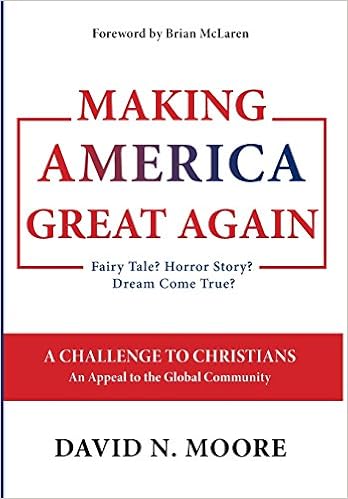 Let me begin this book review with a disclaimer. David Moore is a friend of mine. That does not disqualify me from reviewing his book. All I can say is that if I had not found the book meaningful and helpful, I would have remained silent. My simple review is that I find the book very, very important.
My second disclaimer is a personal one. I am a white, older, well-educated, middle class, male. My life is marked by privilege about which I am aware only when I choose to be. I grew up in the inner city, have leaned far to the left both culturally and politically almost all of my life. I am a Christian. Indeed, For part of my life I identified with the broader evangelical movement but I do not now and have not for about 30 years. I consider myself pretty woke... but as soon as I say that, I remind myself that I am a white, older, well educated, middle class male... and that brings with it a certain set of blinders.
I’ve read the book three times in the course of preparing to write this review. The first time I approached the book as David's friend. I found the book a wonderful and intimate sharing. I learned things about my friend that I suspect he would never have shared under other circumstances. This was all enhanced by the fact that my first go through was listening to the audio book, read by David himself. The second time, I tried to come at the book more objectively and read a physical copy of the book. I found a powerful and personal look through a lens that is not the one I have. It felt a bit more hard hitting than the first read. I think this experience was enhanced by the gravity of a hard back book in my hands... The third time was just to make sure I hadn’t missed something important. I allowed my earlier perspectives to meld a bit and went back and forth between the audio and the physical copies.
My biggest take-away of this book is the reminder that my experience of the church is not normative for all people... that my black friends, no matter how easily they seem to move in the same circles as I, always do so with an asterisk beside their name... and a sense of tension that “one of these things is not like the other.” I have always been aware of the degree to which race colors every experience in our culture including the church, but have not thought as critically as I have needed to about the exact meaning of that awareness in this particular instance. This book encourages me to do so. In response I have found myself talking with other black friends about the ways that race has impacted their experience of church. Had that been the only result of reading this book, it would have been well worth my time.
David’s story is personal. I suspect that it is also fairly universal for my black friends who move in the broader, white, church. It does resonate with the experiences of my friends with whom I talked after reading. The book is courageous and generous. It is prophetic and heartbreaking. David gives a gift to those of us who claim to follow Jesus by sharing his story and calling us to a deeper and more authentic walk of faith and to a community of awareness and caring.
If you know black folk who are part of the Church, this book will help you understand the tensions they likely feel. If you wonder how and why black evangelicals differ so vehemently from white evangelicals in the cultural debates of the time, this book will open the door a bit for you. If you assume that Church is one place where racism does not impact our way of living, this book tears away the bandages that hide the wounds. If you want to hear one honest man share his story and find your life both enriched and challenged by that life, read this book. If you're white, read this book. If you are a person of color, read this book. In every case, allow it to be an inspiration to share your experience of race in the Church and in the broader culture and a doorway to deeper understanding.
Disclosure of Material Connection: I received this book free from the author and/or publisher through the Speakeasy blogging book review network. I was not required to write a positive review. The opinions I have expressed are my own. I am disclosing this in accordance with the Federal Trade Commission’s 16 CFR,Part 255.
Tuesday, June 26, 2018
Shaming as a political tactic
We’ve all heard that three Trump administration officials have been either shamed into leaving restaurants or refused service over the past few days.
First a couple of observations...
They are not being singled out because of their political views. They are being singled out because of the reprehensible actions of the administration of which they are integral parts. That is a huge difference.
Their cases are being compared to the cases of a bakery and a florist denying service to gay couples by booth sides of the political spectrum, calling out hypocrisy on the other side because of their stands on the florist and bakery cases. The issues are not the same. Political views do not render one a protected class (remember it really isn’t about political views anyway) and businesses do have the right to deny service to patrons for any reason as long as it is not because they are part of a protected class. Second, The LGBTQ folk denied service are being denied because of who they are while the Trump officials are denied because of something they have done. Some on the right might argue that in both cases it has to do with the actions of the individuals involved and moral judgements, based on religious understandings are what is at stake. OK... if we give that, there is still a huge difference. The actions of the LGBTQ couples are private and have zero impact on the public sphere. Indeed, we have no idea whether any “actions” are taking place at all. There is no way to know whether or not the couple is sexually active or not. Finally making a cake for a couple or a floral arrangement has no real implication that the vendor is participating in actions that may or may not be happening. The actions of the Trump administration officials are very public. They have public consequences that impact all of us. And, as public employees, their actions are being done in the names of the public - you and me.
So... it is legal. It is morally understandable. It is politically understandable.
All that said, I do not know how I feel about these actions and Maxine Waters’ call to continue and increase the public shaming of Trump administration officials. Clearly, I think they should be ashamed. The actions of this administration are reprehensible. They are immoral. They are unamerican (and not only the immigration issues - they are literally working to destroy almost all of the institutions upon which this nation is built). Clearly I think they should be called out for their public actions... certainly at the voting booth and in the halls of political decision making but perhaps also publicly. Do they deserve to have that shaming and calling out intrude into their private lives? I don’t know. And how far down the food chain do we go? I saw a report that some lower level administration employees are even having difficulty getting dates when the potential partner finds out they work for the Trump administration.
The more I wrestle with these questions, the more depressed I become... that we have fallen that far and that we literally have given power to a political party that is actively working to destroy our democracy. Yes, I do believe that. I also find myself more and more feeling that the folk who are participating in that strategy deserve to be called out at every opportunity.
Tuesday, May 29, 2018
Sermons as Story Telling
Stories work. They have a way of getting past our intellectual defenses and impacting us on a gut level. That is why a good sermon almost always has a great story or three. For years I’ve occasionally preached sermons that are one single story, told from the viewpoint from a character, often in the Biblical narrative. I like to preach that style. There was a period when I did it a lot. The joke at my then congregation was, “Who is Roy going to be today?”
For a number of reasons I have done it less often at my current congregation and hadn’t preached a sermon in that style at all since we began videoing the sermons and putting them up on YouTube over a year ago. Well, I preached a 1st person sermon this past Sunday - Looking for Jesus. Here it is. Let me know what you think.
For a number of reasons I have done it less often at my current congregation and hadn’t preached a sermon in that style at all since we began videoing the sermons and putting them up on YouTube over a year ago. Well, I preached a 1st person sermon this past Sunday - Looking for Jesus. Here it is. Let me know what you think.
Tuesday, May 15, 2018
I’m Angry...
Yesterday the US opened its new embassy in Jerusalem. That is another post. What I’m really angry about today is that two “Christian” clergy were invited to pray at the dedication - Robert Jeffress and John Hagee. Not only are they fundamentalists but they represent a certain strain of fundamentalism that is actively hopping for and hoping to help institigate Armageddon. They believe that a war which will basically destroy the world is slated to begin in Israel and they want to see it happen. Of course, it also means that any Jews who do not convert to their brand of Christianity will go directly to Hell and not pass go along with everyone else who does not fit their definition of Christian.
Let me say this as clearly as I can. They want war to begin in Israel and they believe this step will help that to begin. They believe it is God’s plan for the horrors of war to come to that land and that people and they are excited to be part of making it happen. They have no political reason for wanting the embassy moved. They have no vision for how to get to peace, indeed, they do not want peace. Their desire is for a religious war. It is that simple. They are no better and no different than ISIS except they wear suits and ties and wield the power of the US state rather than small arms and suicide bombs.
Now, I don’t think Trump believes their twisted and radically unchristian theology. I doubt he even understands it. I don’t believe he even sees how playing into their hands may indeed be a self-fulfilling prophesy. I think he is just continuing his “I want to undo anything Obama did regardless of the cost” and a big part of that is playing to this sick, twisted, heretical sect who claim to be following the Bible. It is the worst blending of religion and state that I can think of in the history of this nation and we, along with millions around the world, will pay for it. Israel will pay dearly as it will help to bring war to their doorsteps and will help continue their path to a nation that either will no longer be a Jewish state or it will not be democratic because as Ehud Barack has said, this path leads to a place where Israel cannot be both.
Tuesday, May 08, 2018
Vote
I've been thinking about the train wreck this current administration is...
in no particular order and by no means a complete list...
Now, anybody who has read anything I wrote knows that I place at least some of the blame for this at the feet of third party candidates and the folk who voted for them, especially those who said that HRC was a terrible choice and so voted for someone with zero chance of winning or who stayed home and didn't vote at all, helping this current administration to win in states that were assumed to be "safe." I'm not going there today... except to say...
Votes count. Decisions have consequences. We can make a difference going forward. We must make a difference going forward. This administration is bent on destroying our nation, selling whatever they can, and running off with the profits, whatever the cost to the world. As we come up to the mid-term elections, THINK. Think about the possible consequences of not throwing every single one of these Republicans out of office. If you live in a place where they seem safe. VOTE AGAINST THEM ANYWAY. Who knows, maybe enough folk will vote to get them out of office. At the very least, they'll hear that somebody is watching.
in no particular order and by no means a complete list...
- They've been installing judges who will impact the courts in horrific ways perhaps for decades.
- They are destroying environmental protections that, in spite of not being perfect, have made a significant impact on the state of our air, water, and wildlife.
- They have changed the tone of our public discourse and emboldened hate groups.
- They are shredding safety nets upon which scores of people depend.
- They have turned our federal government into a kleptocracy.
- They have damaged, perhaps beyond repair, the reputation of people who claim to follow Jesus.
- They have made the United States the laughingstock of the world.
- They have destroyed our reputation as a dependable partner.
- They have worked against every positive institution in our society including law enforcement, education, religion, healthcare, etc.
- Today, they decided to tear up the Iran agreement which could lead to yet another war, causing millions of needless deaths and untold suffering... and the only reason seems to be spite.
Now, anybody who has read anything I wrote knows that I place at least some of the blame for this at the feet of third party candidates and the folk who voted for them, especially those who said that HRC was a terrible choice and so voted for someone with zero chance of winning or who stayed home and didn't vote at all, helping this current administration to win in states that were assumed to be "safe." I'm not going there today... except to say...
Votes count. Decisions have consequences. We can make a difference going forward. We must make a difference going forward. This administration is bent on destroying our nation, selling whatever they can, and running off with the profits, whatever the cost to the world. As we come up to the mid-term elections, THINK. Think about the possible consequences of not throwing every single one of these Republicans out of office. If you live in a place where they seem safe. VOTE AGAINST THEM ANYWAY. Who knows, maybe enough folk will vote to get them out of office. At the very least, they'll hear that somebody is watching.
Wednesday, April 25, 2018
Sermons - Here's to Preaching at You
 |
| this is a thumbnail from one of my sermons on Youtube... not flattering is it? but maybe fun? |
I've heard some bad sermons... and some really bad ones. Some were just poorly constructed. More reflected bad theology. More than once, I've looked around a congregation at smiling faces and nodding heads and thought to myself, "they don't really believe that." I've heard some good ones too... sermons that touched my heart and called me to deeper faith and better personhood. I've heard a few that I remember years later. I still carry with me a sermon that I heard Jim Forbes preach at an American Baptist Churches of New York State meeting over 20 years ago and remember bits of other ones I heard him preach at various settings. (He is one of my favorite preachers).
I take my preaching seriously. I think I do it fairly well. I had a good prof in seminary who provided a model that I think works well at taking the scripture and the human condition and bringing them together... I try to do that each Sunday. I try to construct a sermon that takes the scriptures seriously in their context but also takes seriously our context and our experiences. I spend a good deal of time and energy trying to write sermons that are both faithful to the text and relevant to the lives of the hearers... and I try to be honest. I'm not sure any of that matters. But I stick with it. At the very least I need to be faithful to the folk who choose each Sunday to sit at Cambridge Drive Community Church and spend a little more than an hour there and do my best for them.
In January 2017 we began to put my sermons preached at Cambridge Drive Community Church up on YouTube and the church has a channel where you can watch them. We've struggled at time getting the technology where it should be, but they are there. Somebody has taken a look. A few have over 100 hits. A few others have zero. I have no idea why one gets watched and another not. If you have any interest in listening to preaching, I invite you to take a listen. If you do though, actually listen. Ask questions of yourself (or me) regarding how that passage applies to your life? about whether or not my handling of it is faithful to it? and about the underlying theology? Does it reflect your understanding of who God is and how God works in the world? Does it call you to be a better and more faithful person?
In the end, if I'm preaching at you, then I think I've failed. On the other hand, if a sermon has become a catalyst for interaction with the Holy, a starting point for wrestling with real issues of life, then we're onto something.
Saturday, December 02, 2017
The pure is the enemy of the real
I run in leftist circles (surprise, surprise). Before the last election there was a lot of talk in those circles that HRC was a terrible candidate. They pointed at her economic policies as representing the same neo-conservative track begun with Carter, enhanced by Reagan, then Bill, and continued by every president since. True enough. Then they pointed to a list of personal failings straight out of the right wing smear machine that had been targeting her since Bill was first elected. Not true. And we won’t even mention they way that they, along with many of Trump’s true believers, swallowed the Russian propaganda hook line and sinker. They looked at Trump and said as inept as he was, he still wasn’t much worse than HRC... besides, he would never beat her so they were going to “vote their conscience” and give their vote to a third party candidate who truly represented their pure visions for the US. After all, why should they compromise?
Well... we have seen why. Trump did win. Indeed, there were many on the left who were predicting he would win (Michael Moore immediately comes to mind). He has decimated every agency of government. He has established a kleptocracy more brazen than we American’s could even imagine. He has nominated judges who will literally change the direction of US law, perhaps forever. He has engineered a new zeitgeist where moral values don’t count and truth and facts no longer hold sway. And this morning, the Republicans voted in lock step to dismantle our economy, shifting everything to their wealthy overloads.
I almost can’t blame Trump. He is simply stupid. I truly believe that he does not realize the consequences of his actions... and because of who he is, when he does realize them, he doesn’t care. Nothing more could be expected from him. Ditto the Trump heads - low information voters filled with fear and hate - nothing better could be expected. The Republican elected officials? Them I can blame. They knew what they were doing. Some had been telling us this was their plan all along and we can’t be surprised at them, but there were a few who seemed to be thoughtful, principaled people. They still voted to rape the poor, the elderly, the middle class, children, the disabled, and just about every other category other than the top .01%. Yes, I blame them and I hope that the electorate will get smart enough and motivated enough to vote enough of them out in ‘18 to turn the tables and begin to rebuild America.
The one’s I am most disappointed in and are worried about as we move forward are those on the far left. If you voted third party, I blame you. I don’t care where you live, just by arguing for your moral purity you motivated people to stay home or to vote for third party candidates. It didn’t take very many staying home, complaining that there was no good choice, the give the election to Trump. You helped elect him and the minions below who are enabling his dystopian vision. I only hope that moving forward you will be able to see that elections have consequences... that pure choices do not exist... that sometimes we have to hold our noses and vote for a candidate who will not destroy the very ideals that have made us who we are/were.
Wednesday, November 22, 2017
The face of evil
Charles Manson died Sunday. For decades he was the face of evil. He was evil. That much is clear. I could write more about that but that isn’t the issue that caught my attention. When he was arrested everybody knew his name. Everybody knew the crimes of which he was accused. Many of us even knew the names of his little band of followers. Some argued that he was mentally ill but nobody disagreed that he was evil. There was discussion regarding whether or not he should have been executed but there was no discussion that he might ever be rehabilitated and able to find his way back into society. Charlie Manson was the stuff nightmares are made of.
Jeffrey Dahmer likewise was evil. We know his name too.
Here’s the bit that caught my attention today. We don’t recognize evil today. On October 1 a guy killed 57 people in Las Vegas and injured 546 more and I don’t even know his name. It can be argued that reporting his name would lead to copycats but the reason I don’t know his name is not because it was not reported... it was reported. I looked it up. Steven Paddock. No, the reason I didn’t know his name is because within a few days all of us who were not directly impacted by the violence moved on and essentially forgot what had happened. Seven days ago another gunman killed four at an elementary school and again, I don’t know his name either. We have grown numb to the violence and even an act as horrendous as the Las Vegas Massacre doesn’t frighten us as much as Charles Manson.
I don’t know what else to say about this beyond the fact that it frightens me and saddens me...
Tuesday, November 21, 2017
blogging
It has been a long time since I’ve blogged. Life has been busy. I found myself wondering whether anybody really read my posts. I began posting videos of my sermons on YouTube . Then a week or so I was on a panel at an interfaith event and a person from the audience whom I’d not met before introduced herself and told me that she reads my blog. I couldn’t help but feel guilty for not posting... so I’m going to try to be more regular. We’ll see.
Wednesday, August 30, 2017
The antifa and neo-Nazis
Well... the antifa has been on the front page of my local newspaper the past two days and I assume is on others as well as probably being big news on every right or right leaning news outlet. Yesterday's headline here on the Santa Barbara News Press (one of the only papers in the country that endorsed Trump for president) was "Attack on Free Speech." Today's front page article condemned Democratic elected officials for not speaking out loudly against the antifa.
Let me begin by speaking out. I am a pacifist and believe that violence is never justified. That is another post. I know there are folk across the political spectrum who are happy to find ways to justify their actions based in some myth of redemptive violence. I condemn those actions by the antifa as being immoral. Second, in this case, violence is particularly poorly planned. It allows the neo-Nazis to be portrayed as the victims of radicals seeking to deny them their rights as Americans rather than the hateful radicals they are. We see that alternative narrative already moving to the foreground as in both of the articles I referenced above. So, I condemn the antifa's violent actions as being counter productive.
That said, I find it particularly troubling that those on the right are making some kind of equivalency between the alt-right and the antifa. There is no equivalency here.
Let us begin by the simple observation - "antifa" is short for "anti fascist." That strikes me a good thing. Indeed, you could easily have labeled the entire US as "antifa" during WWII. Certainly the US military was acting as an "antifa" organization. I am not arguing that a group of thugs dressed in black is the equivalent morally or in any other way to the US military - but the basic orientation and goal of the antifa falls solidly within our historical values. The neo-Nazis and other alt-right groups fall solidly outside of everything we claim to be as a culture. It is important to underscore that the core values of the neo-Nazi movement enshrine violence against black folk, immigrants, LGBTQ folk, Jews, and basically anyone else who do not fit into their immediate community. That is unAmerican. Clearly there are some anarchists and far left folk who are part of the antifa... but I would argue that even those political views are more closely aligned with what it means to be an American than the views of the neo-fascists.
The goals of the antifa movement are based in positive ends. They were in Charlottesville to protect protestors from the alt-right demonstrators, many of whom had come ready for violence carrying everything from semi-automatic long rifles to plywood shields decorated with swastikas. In other instances they have sought to curtail hate speech, often by inappropriately violent means, that calls for and advocates violence against members of any number of marginalized groups.
I would be thrilled to see the antifa movement embrace non-violent ways of standing up to the alt-right. Examples have shown that they are much more effective and do not feed the desire of the alt-right to be portrayed as persecuted victims. In the meantime, I refuse to remain silent when people make the false equivalency between them and the alt-right.
Wednesday, June 28, 2017
Blue Ocean Faith - book review
I believe in the Church. Now, I do not believe in the Church the same way I believe in Jesus... but it is close. It is close because I do not believe it is possible to be a follower of Jesus outside of the community of faith. Community is central to being faithful. At the same time, Church is full of cultural bits and as culture changes, the institutional expression of Church changes too. We are in the midst of huge changes culturally and that is impacting the institution of the Church in significant ways. Indeed, I believe that we are facing the birth of a new incarnation of Church that will be radically different from the institution in which I was formed and by which I'm employed. So, my eyebrows usually go up when someone mentions a book that might be giving a glimpse of the not quite here yet... Blue Ocean Faith by David Schmelzer promised to be one such book.
Let me begin by saying this book frustrates me. A lot. And I think I'll likely be proposing it to my church board for the next all church study book.
So, what about it frustrates me? The author speaks to a post-Evangelical audience. I am so post post-evangelical that those arguments have no interest for me whatsoever.
The argument whether or not we should be centered set vs. bounded set is not one I even see worth entertaining. Indeed, if you need to question who we need to exclude... I don't have time or energy for you.
He writes about a third way when facing controversial issues that allows for room to differ over non-essentials and then defines the essentials as dogma - the ideas included in the Apostolic and Nicene creeds and says that if one does not hold those ideas, then they're talking about a different faith than Christianity. I'm not sure about that. Indeed, I come from a tradition that specifically rejects creedalism in favor of Statements of Faith which a very thoughtful friend of mine said must always be written in pencil. The author defines disputable issues as those that bring together competing implications from dogma and over which otherwise faithful people might reasonably disagree. I like the intent here... but fear we might disagree over what is disputable. Schmelzer includes the issue of LGBTQ folk here. I cannot see that as disputable. Indeed, reject those folk and you're talking about something other than Christianity in my mind. The bottom line is that I'm not sure how one defines the essentials vs. the disputables.
Perhaps most important of all, the author sees this new movement of the church standing on the statement - Solus Jesus (as opposed to sola scriptura). I like that... but I fear we might have a lot of very different understandings of who Jesus is. The implications of that range of images is very serious.
I observed earlier that Schmelzer is writing to a post-evangelical audience. This became most apparent as he embraces ideas that more mainline churches have held for a long time as if they are new ideas. He treats centered set as if it is new (he does give credit to a theologian from Fuller who wrote about it in the 70's) but in my circles it was part of the discussion in the 1980's. He speaks of joyful engagement with secular culture when the mainline church never rejected scientific inquiry, the arts, etc. etc. He calls for ecumenism when the mainline church embraced that wholeheartedly in the 50's and went on to wrestle with the even larger issues of interfaith connectedness.
Finally, the book doesn't really address the institutional questions with which I struggle daily. What does the coming Church look like? How does it work in society? What forms might worship take? Ministry? Do we have trained leadership and if not, what happens to a body of knowledge and wisdom that has been gained through centuries and requires a kind of commitment to it which lay folk don't have time or skills to address?
So... what do I like?
Their six distinctives are a good start... and especially for those in the post-evangelical world. I have a bunch of younger friends who grew up in evangelical churches, left as they became more mature, and have been inoculated against church, thinking that all real Christian churches believe and act like the ones they abandoned. There was no convincing them that something else exists out there where their gay friends would be welcomed, women can hold leadership, they don't have to leave their brains in the parking lot, and real faith is not identified with white middle class Republicanism. This may have helped...
The dsitinctives are:
I like his pointing at Francis as providing a model for the Christian life... and his call for a real embrace of diversity.
So... it is worth a read, especially if you're coming from an evangelical background and feeling as if there must be something more. If you're looking for hints as to what the next incarnation of Church might look like... you'll be a bit disappointed I think. I love to visit other churches when I'm travelling and will look for a member church of this organization as I travel.
Disclosure of Material Connection: I received this book free from the author and/or publisher through the Speakeasy blogging book review network. I was not required to write a positive review. The opinions I have expressed are my own. I am disclosing this in accordance with the Federal Trade Commission’s 16 CFR,Part 255.
Let me begin by saying this book frustrates me. A lot. And I think I'll likely be proposing it to my church board for the next all church study book.
So, what about it frustrates me? The author speaks to a post-Evangelical audience. I am so post post-evangelical that those arguments have no interest for me whatsoever.
The argument whether or not we should be centered set vs. bounded set is not one I even see worth entertaining. Indeed, if you need to question who we need to exclude... I don't have time or energy for you.
He writes about a third way when facing controversial issues that allows for room to differ over non-essentials and then defines the essentials as dogma - the ideas included in the Apostolic and Nicene creeds and says that if one does not hold those ideas, then they're talking about a different faith than Christianity. I'm not sure about that. Indeed, I come from a tradition that specifically rejects creedalism in favor of Statements of Faith which a very thoughtful friend of mine said must always be written in pencil. The author defines disputable issues as those that bring together competing implications from dogma and over which otherwise faithful people might reasonably disagree. I like the intent here... but fear we might disagree over what is disputable. Schmelzer includes the issue of LGBTQ folk here. I cannot see that as disputable. Indeed, reject those folk and you're talking about something other than Christianity in my mind. The bottom line is that I'm not sure how one defines the essentials vs. the disputables.
Perhaps most important of all, the author sees this new movement of the church standing on the statement - Solus Jesus (as opposed to sola scriptura). I like that... but I fear we might have a lot of very different understandings of who Jesus is. The implications of that range of images is very serious.
I observed earlier that Schmelzer is writing to a post-evangelical audience. This became most apparent as he embraces ideas that more mainline churches have held for a long time as if they are new ideas. He treats centered set as if it is new (he does give credit to a theologian from Fuller who wrote about it in the 70's) but in my circles it was part of the discussion in the 1980's. He speaks of joyful engagement with secular culture when the mainline church never rejected scientific inquiry, the arts, etc. etc. He calls for ecumenism when the mainline church embraced that wholeheartedly in the 50's and went on to wrestle with the even larger issues of interfaith connectedness.
Finally, the book doesn't really address the institutional questions with which I struggle daily. What does the coming Church look like? How does it work in society? What forms might worship take? Ministry? Do we have trained leadership and if not, what happens to a body of knowledge and wisdom that has been gained through centuries and requires a kind of commitment to it which lay folk don't have time or skills to address?
So... what do I like?
Their six distinctives are a good start... and especially for those in the post-evangelical world. I have a bunch of younger friends who grew up in evangelical churches, left as they became more mature, and have been inoculated against church, thinking that all real Christian churches believe and act like the ones they abandoned. There was no convincing them that something else exists out there where their gay friends would be welcomed, women can hold leadership, they don't have to leave their brains in the parking lot, and real faith is not identified with white middle class Republicanism. This may have helped...
The dsitinctives are:
- Our primary framework is SOLUS JESUS
- Our primary metaphor is CENTERED SET
- Our approach to spiritual development is CHILDLIKE FAITH
- Our approach to controversial issues in THIRD WAY
- Our approach to other churches is ECUMENICAL
- Our engagement to secular culture is JOYFUL ENGAGEMENT
I like his pointing at Francis as providing a model for the Christian life... and his call for a real embrace of diversity.
So... it is worth a read, especially if you're coming from an evangelical background and feeling as if there must be something more. If you're looking for hints as to what the next incarnation of Church might look like... you'll be a bit disappointed I think. I love to visit other churches when I'm travelling and will look for a member church of this organization as I travel.
Disclosure of Material Connection: I received this book free from the author and/or publisher through the Speakeasy blogging book review network. I was not required to write a positive review. The opinions I have expressed are my own. I am disclosing this in accordance with the Federal Trade Commission’s 16 CFR,Part 255.
Wednesday, June 14, 2017
Monster 7 Red Microphone by Sire - review
 | ||
| Sire Monster 7 Red |
I’m doing a review here
of the Monster 7 microphone built by Sire, a company known for its very high
quality basses built to Marcus Miller’s specs at a crazy price point to quality
ratio. I received the mic for free from
the company and was asked to share my thoughts about the mic. There was no requirement that I give a
positive review for the mic so these thought are my own and represent my honest
assessments of the mic.
OK, now some background. I play as a side player on acoustic guitar
and on fretless bass with a number of different folk, play fretless bass in a church band at Cambridge Drive Community Church in Goleta, CA (outside of Santa Barbara),
and produce a small acoustic music series at the church called
Cambridge Drive Concerts.
No microphone reproduces
exactly what goes into it. Each adds a
little bit here and takes away a little there, giving each model its own sonic
signature. As a result, no microphone is
perfect for every singer. Some sound
better with a given voice than others.
Then there are other characteristics such as pick-up patterns,
susceptibility to pops and handling noise, gain available, how robust the
construction, proximity effect, etc. etc. that also contribute to how well a
mic works under given circumstances.
So I have a couple of
personal mics and we have a couple of other choices for the 4 singers in the
church band and the performers at our series.
My first test was to line up 5 different mics and then have the 4
singers from the church band go down the line, singing through each. They shared their opinion of which mic they
preferred for themselves and the members of the church band shared their
opinions.
 |
| Heil PR35, AKG 535, Monster 7, Heil PR20, ECM-80 |
The line up was a Heil PR35, AKG 535, Heil PR20, the Monster 7, and a Gauge ECM-80 - all some pretty good mics. Just for information we have more than one of
a couple of those mics and in addition have an Audix OM3 and an old Ibanez mic
from the 70’s built to compete with a Shure SM58 that we left out of the
line-up. Other than the Monster, the
price points range from the mid $100’s up to about $375. We have a very high quality sound system
through which we were testing the mics.
The four singers are
each fairly different. There are two
males: both baritones but with fairly different tonalities; and two females:
a richer alto voice and a thinner soprano.
The first surprise was
that for 3 of 4 singers, the Monster was either the first or second choice. It sounded very good with each voice. Only one singer (one of the males) strongly preferred a different
mic above the Monster. For the other singers it was always
I like the _____ and the Monster the best.
The listeners agreed in large degree with the thoughts of the singers. The Monster sounds most similar to the AKG
535 or the Heil PR35 from our choices – two excellent mics at the higher price points. Indeed, those two mics re always my first choices for the concert series. The Monster does have significantly less
handling noise or susceptibility to plosives than the PR35 and slightly better
than the 535. Sire says it has a cardiod
pick-up pattern and it seemed very similar to the Heil in that respect.
In the end, we ended up chosing a Monster
on the lower female voice, the Heil PR 35 on one of the males (although we may
cycle it out and replace it with a second Monster), the AKG for the higher female voice
and the other male singer strongly preferred the bigger low end of the Heil
PR20. That is the line up we used this past Sunday and will going forward with the possibility of swapping the PR35 out for the other Monster 7.
My second test was at a
fundraiser concert for a wonderful singer/songwriter who has been struggling
with the financial burden of a serious illness.
We had 10 acts – male and female singers, some of whom are touring pros,
a couple of professional producers, a couple of journeyman performers, and one who is a highly skilled
amateur. We had three set ups on stage –
the two primary set-ups had Monster 7’s as the vocal mic and the third (at the grand piano) had the Heil PR35. I asked the performers to let me know what they thought about the mics. One did.
Again, it was apparent
that everyone sounded good with the Monster 7 although I did notice a bit of
thinness on one of the thinner female voices.
She may have benefited from something with a more hyped low end. It was nothing that I couldn’t fix with a
little EQ adjustment though. That is exactly what I did - bring the bass up a tiny bit - and all was good. We did have
problems with plosives from a few of the performers. I didn't pay close enough attention to tell if that reflected some
difference between our two Monsters, if the problem was there with both, or if
it was just a reflection of less than perfect technique on the part of the singer. The Monster was still less susceptible to plosives than either Heil. One of the female performers said that she felt
the Monster was very sensitive to distance and that she had to be right on top of
it and on axis for it to sound good. I
didn’t notice that as being more so than any other mics we have.
Here's a little video from the concert... the singers are on Monster 7's and the recording was done on an Iphone (thanks Lars!). The primary singer/guitarist is Rebecca Troon with vocal back-up from Penny Nichols and Susan Marie Reeves with Dale LaDuke on accordion and me on bass. It gives a taste of the mics...
Monday, June 05, 2017
Biased Press
There have been scores of recent articles decrying the bias of the press against Donald Trump. As proof they compare the percentage of negative articles written about Trump during these first months of his presidency vs. the percentage of negative articles written about other presidents. Regardless of the veracity of those numbers, the argument falls down for two reasons or at the very least requires significantly more investigation before those numbers really mean anything.
The first is that while there clearly are news outlets with bias (Fox News is clearly one, but so is MSNBC), as a general rule, the news media is biased towards the sensational. In a world where they compete with the internet and truly fake news, they look for the sensational to catch the attention of an audience. Whatever one thinks about Donald Trump, he pours out the sensational each and every day. Stories that under normal circumstances would be front page - the attack by the Turkish president's body guards on US citizens on a Washington DC street - barely get any mention because there simply isn't room. It can be argued that the overwhelming coverage of his campaign by the mainstream press was the equivalent of millions of dollars worth of free advertising and clearly contributed to his winning. Donald is always on the news because he is always doing something sensational.
Now, this leads to the real question... how many of those sensational actions of DT are negative? If one president does 50 negative things while andother does 100, doesn't it make sense that the second one would have twice the negative articles? If one acomplishes three major legislative intitiatives while another accomplishes 1, doesn't it make sense that the first one would get 3X's the positive press? So, does DT do 40% more negative things than did a given previous president? I would argue, "yes." I'd be hard pressed to come up with anything I could point to as a positive thing done by the current administration and the negatives roll off the tongue. From everything that I can see, reality has a negative take on DT's administration.
One might argue that the reason that is so is because I am a stooge for the mainstream news, the "enemy." Actually, my local paper (which I do read) is one of only two I believe that endorsed Trump for president. If there is a biased outlet, it is that one and it is clearly pro-Trump. I do read some articles in the NY Times, the Washington Post, and the Guardian online but I am aware of what the "other side" is saying.
Clearly I am not pro-Trump. My avatar on Facebook still says "resist" and will until this administration and the spineless Republican legislators who keep putting power before country are gone. I was never one willing to give him the benefit of the doubt because I agreed with almost nothing he promised during his campaigns and find him as a person utterly with redeeming qualities. That does not stop me from acknowledging that the rise in the stock market increased after his election (maybe a good thing). The point is that if I saw something that looked positive, I think I could grudgingly agree it was there.
Nope... the press is not biased against Trump nor are they out to get him. He simply is an easy target who keeps doing ridiculously stupid things. As long as that continues... that is what we will see in the news.
Friday, June 02, 2017
Rules for Revolutionaries: How Big Organizing Can Change Everything - book review
If by some chance you haven't read anything I've posted in the past, I am a leftist. I half joked that Bernie Sanders was not liberal enough for me... and it was only half a joke. I am a child of the 60's. The Civil Rights Movement and the Anti-War Movement were important parts of my formation. I am also a Christian and a pastor of a Christian church. I believe in radical transformation. I believe we are on the cusp of significant change as a culture, as a world, and in the Church.
When this title by Becky Bond & Zack Exley, Rules for Revolutionaries: How Big Organizing Can Change Everything, presented itself as a possibility for a book review, I envisioned 5 Easy Steps to Changing the World... or maybe even 5 Really Hard Steps to Changing the World. I was hoping that the book would pick up where Naomi Klein's This Changes Everything left off and do a better job of providing direction than Tom Sine's, Live Like You Give a Damn did. As a parenthesis, if you haven't read Klein's book, it is a must read for anybody concerned about the direction our world is going. I was hoping for some insights that might apply to the Church and to churches as we seek to navigate this turbulent time.
I got what I wanted... sort of... and didn't get what I wanted... sort of... The book claims to not just be a re-hashing of what happened in the Bernie Sanders presidential campaign and then proceeds to be exactly that. For those who are interested in understanding how the Sanders campaign worked and why it was as successful as it was, this book is a must read. For whoever decides to run for the Democrats in 2020, it is likewise a must read. For change smaller that a presidential campaign, the book requires a bit more work to make relevant. Still, there are some key ideas that speak to anyone involved in working for significant change whether on the macro level or the more local one. A couple that jumped out at me are:
Disclosure of Material Connection: I received this book free from the author and/or publisher through the Speakeasy blogging book review network. I was not required to write a positive review. The opinions I have expressed are my own. I am disclosing this in accordance with the Federal Trade Commission’s 16 CFR,Part 255.
When this title by Becky Bond & Zack Exley, Rules for Revolutionaries: How Big Organizing Can Change Everything, presented itself as a possibility for a book review, I envisioned 5 Easy Steps to Changing the World... or maybe even 5 Really Hard Steps to Changing the World. I was hoping that the book would pick up where Naomi Klein's This Changes Everything left off and do a better job of providing direction than Tom Sine's, Live Like You Give a Damn did. As a parenthesis, if you haven't read Klein's book, it is a must read for anybody concerned about the direction our world is going. I was hoping for some insights that might apply to the Church and to churches as we seek to navigate this turbulent time.
I got what I wanted... sort of... and didn't get what I wanted... sort of... The book claims to not just be a re-hashing of what happened in the Bernie Sanders presidential campaign and then proceeds to be exactly that. For those who are interested in understanding how the Sanders campaign worked and why it was as successful as it was, this book is a must read. For whoever decides to run for the Democrats in 2020, it is likewise a must read. For change smaller that a presidential campaign, the book requires a bit more work to make relevant. Still, there are some key ideas that speak to anyone involved in working for significant change whether on the macro level or the more local one. A couple that jumped out at me are:
- The first is that change can happen... but if we want to see real change we have to embrace something big that includes all of the issues AND we must envision radical change rather than incremental change. People are willing to work if they are inspired. Incremental change doesn't inspire folk.
- Personal contact is central to everything
- Institutions and practices that used to work just get in the way now.
- Let volunteers run with their gifts.
- Be willing to make mistakes.
- Expect pushback even from folk you expected would be on your side.
Disclosure of Material Connection: I received this book free from the author and/or publisher through the Speakeasy blogging book review network. I was not required to write a positive review. The opinions I have expressed are my own. I am disclosing this in accordance with the Federal Trade Commission’s 16 CFR,Part 255.
Thursday, April 06, 2017
The Problem with Health Insurance
Health insurance is complicated... who knew?
In the bass guitar world technology has been pushing the limits with lighter weight, smaller cabinets, massive power, and more low end extension. My 6 pound head can run rings around the 65 pound heads of my youth and my 34 pound cab puts out more low end than the refrigerator sized (and weight) cabs of that same time period. Still, common wisdom is that you cannot have cheap, light, loud, and low all in one package. The laws of physics still apply along with basic economics.
In order to fix our medical care system, we must first acknowledge that the rules of math apply. It is not possible to have everyone covered with good comprehensive coverage at lower prices that are affordable to everyone without government funding and government interference. Lower priced plans with reduced coverage are only helpful until they are not. Cutting payment to physicians or other providers can only go so far before the math no longer works. A for profit entity has a bottom line commitment to the bottom line... and something eventually has to give in order for the company to make its profits. All that adds up to one inescapable conclusion.: before the ACA, the system was broken. Too many people were not insured. Too many people went bankrupt because of medical bills. Too many died because of lack of care. Treatment plans were often chosen by bean counters rather than because of efficacy. The training of physicians is expensive and favors some specialties over others regardless of actual social needs. The nature of healthcare makes it impossible for it to respond to market pressures in the same way that other industries do.
The ACA attempted to fix some of the presenting problems without addressing underlying issues. It succeeded in that small way and would have been more successful had the Republican Party not worked so hard to obstruct it. (We hear how the CBO's numbers were so off... but that ignores the fact that their numbers were based on the plan actually being adopted while 29 states refused the Medicare expansion part of the program). Because the ACA sought to work within the then, current system of for profit private insurance companies, etc., it could never deliver the product it promised of affordable, comprehensive coverage for all.
To get the product that a civilized country deserves requires a complete overhaul from top to bottom including training of physicians, funding of medical research, decisions regarding what care is provided (and not provided), how funding is allocated and what fee structures look like. It will take years to accomplish... possibly decades... but if we do not begin the process, we will see our broken system continue to deteriorate and all but the very rich will suffer.
Thursday, February 09, 2017
Sermons now on YouTube
The church I serve has begun to put videos of the sermon up
on youtube each week. The program has
raised some interesting issues.
First, there are the aesthetic questions. We’re using an inexpensive camera (Zoom Q4n)
and trying to be as unobtrusive as possible so there is one camera angle with a
bit of fisheye to the image. The camera
allows an AB or XY microphone arrangement so we tried both to see what would
give us better sound. I also quickly
learned that a dark jacket works better against the background of the
sanctuary. Watching myself also has me thinking about how I move when I'm preaching, what I do with my hands, etc. etc.
The more important questions have had to do with the shaping
of the sermon itself. I preach from the
lectionary. For those unfamiliar with a
lectionary, it is a list of 4 scripture readings for each Sunday of the church
year in a three year cycle. The readings include an historic passage (usually from the Old Testament), a Psalm, a
gospel passage, and a reading from the letters in the New Testament. The passages are chosen to fit together (in
the eyes of those who put the lectionary together) and are intended to go
through all of the major themes of the Bible over the three year cycle. More liturgical churches read all four
lections each Sunday. Because we’re in
the free church tradition, we have no such expectation. Indeed, using the lectionary at all is a choice I make. From the 4 readings, I choose two passages for each Sunday and
preach on the second one. It seems
important to me that we, who call ourselves Biblical Christians, read at least
two passages each Sunday. (many more conservative churches don't really read any passages from the Bible, instead just proof-texting during the sermon to prove whatever preconceptions they already hold). Again, being
in the Free Church tradition, I am not compelled to use the lectionary and
indeed, there are times when I stray from it.
Still, for me, it is a discipline that forces me to preach on passages
that I might not choose otherwise and to wrestle with themes that are uncomfortable for me. Of
course, I do still pick from among the four readings.
All of that said, I try to choose passages that I think
relate to the context of Cambridge Drive Community Church. And I try to construct a sermon that speaks
to the issues with which we’re living at the moment. A sermon out there in the ether is divorced
from that context and may or may not speak in the same way to someone watching
in a very different setting. While
Cambridge Drive is by no means homogeneous theologically or otherwise, I can
reasonably expect that someone might watch one of these sermons who comes from
a very different place culturally or theologically than those sitting in the
sanctuary. And the folk in the chairs in our sanctuary know me well enough to know how to take things, when I'm joking, what struggles the passage imposes on me... To what degree do I try to
generalize my sermon for those outside?
Should I avoid context specific remarks, knowing that doing so might
make the sermon less effective for those in the congregation while making it
more effective for some hypothetical watcher from elsewhere? Do I downplay the relationships I have with my congregation to make a sermon more general or do I just allow the outside to overhear what is going on here?
I spoke with a friend this morning about those questions and she asked whether my sermons have changed since we began videoing them. I responded that I'm not sure... but I am certainly being more thoughtful about what I say and how I say it.
In any case... the sermons are now up there for any to see... Here's the link to the channel
And here's the sermon from February 5 for an easier look...
Let me know what you think...
Subscribe to:
Posts (Atom)


