I began this blog as a place to write about topics slightly outside the scope of my normal public presentations - i.e. sermons. Certainly a sermon is a place where I raise the concerns that the culture is impressing on me and my hopes and dreams for the congregation in response to the witness of scripture... but... and it is a big but... sermons walk the fine line of speaking what I see and feel while respecting the views and experiences of the congregation. There are times when I must push this over the line, but I have to be careful there. For example, as I understand the words of Jesus, a Christian must be a pacifist. Members of my congregation have come to different conclusions than I have. So, I can preach about peace without requiring people to become total pacifists and allow them to struggle with what that means when their theology allows for war/violence under some circumstances. So, I envisioned the blog as a place where I could let loose without those constraints. I envisioned most of my topics as being theological or related to my therapy - music and guitars.
It feels as if I write most often about politics. I don't like that. I know that politics, as the way that groups of people make collective decisions, is by definition theological. How we live together says something about what we believe and what we believe says something about the ways we live together. So my understanding of God's yearnings for us is always reflected in my political acts and writings... and that is rarely material that makes it into my sermons because there is considerable diversity even in my little congregation with regards to any of these questions. So, I know where it is coming from... I write it here because I don't feel it is appropriate to say there... And it often comes across as more hard line than I really see myself.
So I'd like to write a bit about something less contentious... and this week I will. In two days I go to NAMM, the biggest trade show for the music industry. I go as a guest of Lowden Guitars, get to see George and some of the other folk from Lowden, connect with my friend Thomas Leeb, get to check out all of the newest doodads available for musicians to purchase, and see some of the bizarreness that is the LA commercial music scene. This year things will be a bit more serious for me as I'll be thinking about equipment etc. for use at the Cambridge Drive Concert Series but it will still be a fun couple of days. And I am soooo looking forward to not thinking about or writing about Sarah Palin, Sharon Angle, or any of the rest of that bunch. Instead, I'll get to think about things that are important to me - strings, pickups, guitar builders, microphones, etc. - but which make little difference in the grand scheme of things.
Tuesday, January 11, 2011


Sunday, January 09, 2011
The Word and words
As Americans we denigrate the power of words. We believe actions more than statements and often with good reason. When was the last time you trusted a politician to keep their promises? And if you have, will you do that again? Psychologists tell us that we believe body language more than words. We have sayings like, "sticks and stones may break my bones but names will never hurt me," as if there is no power in the words. In our culture it is not a surprise that someone can use violent images in rhetoric and be surprised when someone takes those words seriously. That assessment of words is inadequate. Words have power. And there is Biblical basis for that understanding.
The Christian scriptures tells us that "in the beginning was the Word... and the Word was God..." The Hebrew scriptures tell us that all that is comes into being when God speaks a word... And in the other creation narrative, the creatures take on their nature once the man speaks a word and names them. Before that, they are incomplete. The power of the word is more than metaphoric, it gives shape and substance to all that is. It is our language, our words that form the paradigm through and in which we experience and shape the world. If those words are full of hatred and violence and images that separate us from one another, that will be the world we create. If the words are words of respect and community, building up the other, then that will be the kind of world we create. What kind of world do we want? Choose your words carefully...
The Christian scriptures tells us that "in the beginning was the Word... and the Word was God..." The Hebrew scriptures tell us that all that is comes into being when God speaks a word... And in the other creation narrative, the creatures take on their nature once the man speaks a word and names them. Before that, they are incomplete. The power of the word is more than metaphoric, it gives shape and substance to all that is. It is our language, our words that form the paradigm through and in which we experience and shape the world. If those words are full of hatred and violence and images that separate us from one another, that will be the world we create. If the words are words of respect and community, building up the other, then that will be the kind of world we create. What kind of world do we want? Choose your words carefully...
Saturday, January 08, 2011
Palin's graphic & more
here is the graphic that appeared on the website of Palin's PAC... targeting Representative Giffords with a gunsight...

I have to say that I am deeply offended by the statement released by Sarah Palin...
Given her rhetoric, how can she imagine that her condolences and prayers are enough.
And read these words from the sheriff of the county where the shooting took place as reported on the Huffington Post...

I have to say that I am deeply offended by the statement released by Sarah Palin...
My sincere condolences are offered to the family of Rep. Gabrielle Giffords and the other victims of today's tragic shooting in Arizona.
On behalf of Todd and my family, we all pray for the victims and their families, and for peace and justice.
- Sarah Palin
Given her rhetoric, how can she imagine that her condolences and prayers are enough.
And read these words from the sheriff of the county where the shooting took place as reported on the Huffington Post...
Sheriff Clarence Dupnik, speaking about Arizona:
"When you look at unbalanced people, how they respond to the vitriol that comes out of certain mouths about tearing down the government. The anger, the hatred, the bigotry that goes on in this country is getting to be outrageous. And, unfortunately, Arizona I think has become sort of the capital. We have become the Mecca for prejudice and bigotry.
"It's not unusual for all public officials to get threats constantly, myself included. And that's the sad thing of what's going on in America. Pretty soon, we're not going to be able to find reasonable, decent people who are willing to subject themselves to serve in public office."
He later added:
DUPNIK: Let me just say one thing, because people tend to poo-poo this business about all the vitriol that we hear inflaming the American public by people who make a living off of doing that. That may be free speech. But it's not without consequences.
REPORTER: How do you know that that's what caused it.
DUPNIK: You don't.
An Atmosphere of Hate and Violence
This morning, Congresswoman Gabrielle Giffords was shot at a political event in Tuscon, AZ. As I write, details are still sketchy but early reports are saying that 12 were shot and 6 killed. Reports are conflicting as to whether the congresswoman is alive or dead. Likewise, at this time, there is no solid evidence made public that the shooting was politically motivated... Still, it is difficult to suspect anything else.
Giffords was on Sarah Palin's "hit list." This is the same Sarah Palin who has said - "don't retreat, reload." How are we to understand those statements?
In '09 a gun was dropped at a Giffords event and her office was vandalized following the healthcare votes during the last session of congress. She voted for the healthcare reform act.
An anti-Giffords event was held in June with the billing: "Get on Target for Victory in November. Help remove Gabrielle Giffords from office. Shoot a fully automatic M16 with Jesse Kelly." She won a difficult race against a Tea Party candidate.
Go into any African American neighborhood and talk politics for a length of time and inevitably someone will tell you they fully expect a serious attempt to assassinate Obama at some point during his presidency. They feel the hatred in the air
We have heard rhetoric from numerous Tea Party and Republican party folk equating the current administration with terrorists, calling for the people to rise up and "take our country back" (as if someone from the outside has stolen it), and some have gone so far as to hint at or even directly call for armed insurrection. Did they mean these statements to be taken literally? Some probably not... some likely so... In either case, it should not be a surprise that someone has taken the calls literally and has followed up with gunfire, especially in a state like Arizona which still exhibits more than a little of the "law of the gun" old west mentality and has some of the most liberal gun laws in the country.
When I worked at Haverford State Mental Hospital, my supervisor told us,"be careful what you preach... someone will believe it." He was specifically talking about the hospital patients and referred to passages like the one in Matthew that advises you to pluck out your eye if it offends you...(Matthew 5:29). He warned us that if we preached that, we might very well come to the hospital the next day, only to find a patient missing an eye. When leaders called for the assassination of political opponents, they should not be surprised when someone takes them seriously.
Speaker Boehner and Palin have both released statements of condolences and prayers... that is not enough. They, and the rest of the leadership of both the Republican Party and the Tea Party must take responsibility for their part in building this atmosphere of hatred. If they, like Palin, have used this kind of langage, they must personally apologize to the family and to the American people. Whether they personally have used this kind of language or not, they must condemn those who use such irresponsible rhetoric and incite such an atmosphere of hatred and violence that nurtures these kind of acts. As to those who continue to use this rhetoric, and some will, Republican and Tea Party leaders must condemn them and distance themselves from them.
My prayers are with the families of the victims of this horrendous act of violence and with this nation where democracy is so fragile and there are people with positions of power and influence so willing to act irresponsibly.
Wednesday, January 05, 2011
a Patridge in a Pear Tree
Today is the 12th day of Christmas although you'd never know that by looking at anything in the larger culture. In the larger culture, "the Christmas season" begins on Black Friday, the day following Thanksgiving when the traditional shopping season takes off in earnest. Radio stations play cheesy Christmas music. Homes are decorated. Christmas Lights go up and on. Christmas abruptly ends on December 26th as the leftovers go on sale and unwanted or wrong sized gifts are returned to stores. The cheesy music stops. Decorations begin to come down. Life goes back to normal.
The Church calendar is very different. Beginning with the 4th Sunday prior to Christmas Day, we observe Advent. It is a contemplative and even penitential time when Christians are supposed to prepare their hearts to receive the very presence of God in our midst. The traditional color for church paraments is purple, the same as Lent, although in more recent years some churches have moved to blue, emphasizing that the penitence of Advent isn't exactly the same as that of Lent. Still, it is a time of penitence and not celebration. The music is hopeful but perhaps a bit somber in that it struggles with the realities that surround us even as it looks forward to the new kindom, yet to be established. Scriptures in the lectionary are full of promise not yet filled full. It is a time of pregnancy, not of birth. Christmas carols aren't to be sung until Christmas Eve and then continue through the 12 days of Christmas which end on January 5, the day before Epiphany.
Every year I struggle through these times. I want to use the season of Advent as a time of spiritual preparation rather than an orgy of commercialism. I don't want to sing "Joy to the World" and I certainly don't want to sing, "Santa Claus Is Coming to Town" when I need to be wrestling with the needs and brokenness around me. Then when Christmas does arrive, I want to sing those songs of joy and wonder in response even while I continue to hope for that which is not yet. Needless to say, there are folk in my church who want to sing Christmas Carols during the time they have experienced as "the Christmas Season" all of their lives - Black Friday through December 25. And then when December 26th comes, they're tired of Christmas.
Most years, I choose a few carols to sing on the 4th Sunday of Advent and through the 12 days of Christmas but it just doesn't feel right. I want to observe Advent and then Christmas.
I know that the liturgical calendar is artificial. It doesn't appear in the Bible and indeed, Jesus wasn't born on December 25 anyway. Depending on how cynical you are, the date was either chosen to co-opt a pagan holiday or as a theological statement of the Light of the World coming into the world precisely when it was at its darkest (at least in the northern hemisphere). Still, the liturgical calendar is helpful for me. It imposes a rhythm into the year for me that is theologically formed and informed. It reminds me to frame my experiences in terms of God's activities through history.
Christmas ends today... so I don't have to struggle with the questions for another 10 months or so. I hope your 12 days of Christmas were filled with blessings and gifts of love.
Friday, December 31, 2010
Christmas presents
Our daughter Alexis is pretty much a Renaissance woman. She is a great musician (listen to the links to the right), a great writer (read her blog), and a wonderful painter. She spent two years at Bard College as an art major. If you search my blog for stations of the cross, you can see more of her work. During her time there she made me a charcoal drawing of me playing guitar that I absolutely loved. For a variety of reasons I never got it hung... and then during our last move, I lost it.
I feel terrible about that. I really loved the drawing and was looking for the perfect place to hang it (which I have now) plus it was a gift from my daughter... It was one of those losses that you feel the absence... and I do.
Recently Alexis has been painting more and I asked her to do me a painting with me and a guitar. I showed her where I was planning to hang it and told her that I'd be happy to pay her for it (she is struggling financially these days).
She gave it to me as a Christmas present! I love it! This one, I hung immediately in my office for all to see. I don't see myself in it (maybe I'm not there), but it is full of guitars and guitar parts.

She did a painting for her mother as well which we have hung in our bathroom. This one picks up some images and colors from a hooked rug that Cheryl's grandmother made which we have in the bathroom as well.

We have two other paintings that Alexis did in our home... one that was a gift and another that is on loan from the artist until she has a wall big enough for it. We're hoping that she takes a long time before she gets a room that can house that painting.
running silent

Last Sunday, Cheryl and I headed off to Pacifica for three nights to get away. She has been pretty fried from her work lately and I wasn't feeling much better... so off we went... about a 5 hour drive on Sunday afternoon to a beautiful area on the coast just south of San Francisco. Some nice hiking along the ocean or in the hills and a short drive into SF for museums or across the bay to see Alexis and Christian, all of which we did.
So, we arrived at the hotel (that photo is the view from our room) and unpacked only to discover that I had forgotten my backpack... with my computer. Now, I have a data plan with my phone but hate to use it for e-mail and the web... but I thought I was still OK and could use it if I had to... No signal at the hotel. I was off line FOR THREE WHOLE DAYS!
I survived. Barely. And have a lot to say over the next couple of days.
Happy New Year!
Saturday, December 25, 2010
Friday, December 24, 2010
so who's better?
There is a common assumption that government is inefficient at providing anything. A comment on an earlier post included a link to a paper arguing that a completely privatized road system would be better than the system we currently have and would even lower the rate of automobile related deaths. It is rare that the argument goes that far, but there we are.
I would argue that for many areas of life, government is not only the logical but also the better provider of services. Let's look at a specific example, privatized fire protection. It might be cheaper (although we won't address the ways that is accomplished). A community has two companies providing fire departments. Taxes dropped significantly when the public department was abolished. Property owners purchase subscriptions for their service. Both companies do what they do well and the price is competitive between them and lower than the attendant taxes were. They truly are competitors in all of the best and worst senses of the term. A fire breaks out at a house with nobody home. The neighbors call a fire company and the dispatcher looks up the address, only to tell the caller that the homeowner does not have a subscription with them. Then the dispatcher tells the caller that the next door neighbor does have a subscription and they will be there to keep the fire from spreading. They arrive quickly, set up, and begin hosing down the neighbors home to keep the fire from spreading... while watching the first house burn. In the meantime, the caller has contacted the second company who send a truck. When they arrive, the first company is in their way and they cannot get close enough to efficiently address the fire. Plus, the additional call cost them abut 5-10 minutes, during which time the fire got a lot worse. And it is discovered that the neighbor on the other side, trying to save money, has neglected to purchase a subscription from either company. That house catches fire and the entire neighborhood is threatened. A third house, also without a subscription, begins to catch and the second company, which has a lot of subscriptions in the area, decides to address that house to keep things from spreading further. After the incident, they send a bill to the final home and the owner responds, "I didn't ask you to put out the fire." Those who have purchased subscriptions wonder whether they should drop theirs... look at the results - one house with a subscription is gone and one without was saved.
Would it not have been more efficient had there been one department, paid for by public funds, with the responsibility of keeping the entire community safe?
Here's the basic issue for me. A for profit company has as its primary responsibility, making a profit. Indeed, it has a legal and fiduciary responsibility to make money. If a given service cannot be done profitably, it will not be done. Decisions are made based on the bottom line, and usually with short term goals in mind. Many companies provide excellent services or products and rightly pride themselves on excellence but they must be able to make a profit or they do not provide that service or product. Government, on the other hand, has as its primary responsibility, the welfare of the citizenry. There are times when that welfare will not easily translate to a dollars and cents bottom line and other times when it clearly will not be profitable, especially in the short term.
Let's look at another example - medical care (which I believe should be provided by the government). When the Obama plan (which I'm not happy with) was being discussed two big scary terms thrown out by the opponents were "death panels" and "rationing" as if either was a new thing. There already are both. Panels decide what care will be provided. I have an insurance policy with scores of exclusions. Somebody sat down and said, "we will not cover this. no exceptions." About 5 years ago, we paid nearly $60K for a surgery that our daughter needed because our company never paid for that surgery. Without it, she would have gone deaf in one ear, had difficulty chewing, and likely would have had her jaw lock periodically, requiring visits to the emergency room to have it broken. "Sorry. Not covered. Ever." As for rationing, we were able to come up with the money. It really hit our finances hard but we did it. Had we not been able to, rationing would have come into play... no money = no surgery and she would likely be deaf now and facing the other issues. For those without insurance, every medical decision is a similar one. Questions are not always asked regarding the value of a procedure, the prognosis for the patient, or even if it is good science. Long term questions are not asked regarding the way that decision will impact the larger society. Instead, a bean counter asks who will pay and how much? I would much rather have a panel of scientists asking whether the procedure is likely to be successful than a panel of bean counters asking whether it will be profitable.
And finally, if a service is being provided for profit, every dollar that is shunted off into profits is a dollar not spent on meeting the need.
There is no question that government is not always efficient and that the services it provides could be improved. Often those with the loudest voices get their needs addressed while those with less power are ignored. Often government responds to misinformation and acts in ways that clearly go against the common good... that is what we have elections for. It is the responsibility of the whole of the citizenry to stand up and change those in power. Still, that basic difference of primary goal is critical. For profit businesses are there to make money. Meeting needs is only the way they make money. Government is there to meet needs.
Thursday, December 23, 2010
Sin vs. human need
I used to participate in a Christian bulletin board that was populated mostly by fairly right wing folk who tended to be close to libertarian about the cold sins and very authoritarian regarding hot ones. They thought the government should not be involved in educating children or restricting business activities and certainly shouldn't be taking taxes from them but it was the governments business to restrict with whom or how you had sex. Sin was a big word for them but it only had to do with individual behavior, never corporate or systemic issues.
Whenever the discussion of entitlement programs came up, invariably someone would argue that the government should not be forcing them to help others... that indeed, were it not for the onerous tax system, they would take care of those in need. Now, these are folk who have more than a healthy respect for the fallen nature of humanity but they seem to forget their own theology when helping those in need comes up. Suddenly the better nature of human beings comes into play and we can count on good Christian people to do what is necessary to take care of those in need, providing food, shelter, education, etc.
Sin is not as important a word in my theological vocabulary as it is for them. Indeed, I rarely use the term. In this instance I would be more likely to use the terms selfishness, greed, and lack of a sense of community responsibility. I have no expectation that good Christian folk either could or would meet the needs of those in their communities if suddenly the government programs disappeared. For those of us who live in our comfortable suburban settings, it is all too easy to ignore the needs of those across the tracks. For those of us serving the needy, we know the needs are overwhelming. For those of us struggling to keep our heads above water, our children fed, the heat on... our needs are too immediate to have resources to help others.
Yes, I have seen and experienced the sacrificial love of many good Christian (and non-Christian) folk. As government funding for programs for the needy has shrunk, I have seen many good people work and give to pick up the slack. I do not believe that generosity is strong enough to overcome human greed or selfishness. I do not believe that enough good folk are open to the needs more than a few blocks away in a sustained way to meet those needs. I do not believe that without government intervention that there would be adequate resources to make a difference. The power of human sin is just too great. And I am always surprised that my brothers (they are all men) on that forum think otherwise.
Wednesday, December 22, 2010
George Ought to Help
This is a typical argument of those who are against government programs that help the needy. It feels right and it seems to make sense. After all, isn't it my money that I worked hard for? And if it is, shouldn't I be able to decide what I do with it and help others only when and if that is what I decide to do?
Unfortunately, the argument is incomplete. It implies that one earns what they earn entirely on their own... that the accumulation of wealth is based solely on the talents and work of the individual. Let's add some other variables to the argument.
Let's say that Otis is blessed with incredible genetics. He has an off the chart IQ. He lives in a place where there are no public schools and dad dies in a mining accident when he is 7. At that point, in a country with no safety nets, Otis must go to work in the mines to help support the family. That his IQ is 40 points higher than that of the guy who owns the mine is irrelevant. The owner gets the profits and he dies of black lung disease at a young age.
How about Fred... he invents a new doohickey. He is pretty sure that he can come up with capital to put together a manufacturing facility to make the doohickeys but the roads and the railroads have fallen apart do to lack of government investment and he cannot get the doohickeys to market. The company fails.
Jack got a hold of one of the doohickeys and was mighty impressed. Off he goes to some other developing country and copies it, with much cheaper labor and lower quality materials. He makes a killing.
How bout Marianne... She worked hard all of her life. The company she worked for made tons of money for the owners and stock holders. She was proud of her contribution. She made a reasonable salary... but not enough to invest any significant amount for the future. She retired and was doing OK... then she got sick. She didn't have health insurance - too old and her health was poor so the cost was prohibitive. The children of the owners, who just inherited their wealth, lived in ease in gated mansions, while she made choices between heat, food, and the medicines she needed.
And James... grew up in a very poor neighborhood in a decaying city. The schools spent more energy on discipline than teaching. He didn't know anyone with two parents in the household. Half of the men he knew were either in jail or recently released. Few had legitimate jobs. When he began to skip school in 7th grade and sell drugs on the corner, nobody was surprised. His brother Bob tried to learn in school but it was difficult. He spent as much time watching his back as studying. When he graduated, he was able to get into a local college but he was so far behind the other students, he couldn't catch up and flunked out.
Steve comes from a middle class family. He went through a good school system, paid for with government funds and got a job working for a good company. They rely on a workforce that is well educated provided via the public schools. It is not possible for their employees to live with walking distance of their offices and factories so they rely on a good system of roads for people to travel to work. The monetary system is relatively stable so they can make plans for months or years in advance. They have good police and fire services to keep their capital safe. Steve's bosses are smart enough to know that the business depends on the input of all of the workers at each level and that without the infrastructure the government provides, they could make no profit at all.
And finally there is George. He is likable, smart enough, and able to keep up without working too hard. Indeed, he is a "C" student and spends a lot of time partying. He lives in the best neighborhood and is going to a top rated school. When he graduate, he gets into an Ivy League school, not because of his grades or even sports, but because of his last name. He goes to school with the sons and daughters of other powerful people and when they all graduate, they all move into positions of power and wealth.
All of that is to say that the system is not fair. Nobody makes it or fails entirely on their own. I would argue that those who benefit most from the system - like George and to a lesser but still significant extent Steve - should pay the most to maintain the system. I would even argue that the system requires some to be outside of it. Ask any Chamber of Commerce how they would feel about total employment and they will quickly tell you that someone has to be out of a job or the system would fail.
Bottom line when someone tells you that the government is stealing money they made from them, tell them to go and make that money without any of the supports that come from the government.
In a day or two I'll address another piece of the puzzle... Human generosity vs. human sin. Then, I'll get to who is better at providing for basic needs, government or for profit business.
Tuesday, December 21, 2010
I'm a liberal
Bet you're not surprised if you've read any of my blogs.
My brother-in-law sent me a link to a 10 question quiz published by a libertarian organization that evidently positions a person on the political spectrum pretty accurately. My scores came out 90 on personal issues and 20 on economic, with higher scores indicating less government intervention. That puts me far into the liberal area of their chart which they define as:
you can find the quiz here.
My brother-in-law sent me a link to a 10 question quiz published by a libertarian organization that evidently positions a person on the political spectrum pretty accurately. My scores came out 90 on personal issues and 20 on economic, with higher scores indicating less government intervention. That puts me far into the liberal area of their chart which they define as:
Liberals usually embrace freedom of choice in personal matters, but tend to support significant government control of the economy. They generally support a government-funded "safety net" to help the disadvantaged, and advocate strict regulation of business. Liberals tend to favor environmental regulations, defend civil liberties and free expression, support government action to promote equality, and tolerate diverse lifestyles.
you can find the quiz here.
Monday, December 20, 2010
mother nature
The last few days, I've been struck by the wonders of this place where I live. It is breathtakingly beautiful and the boundaries between civilization and the wilderness are quite narrow and close by. It is very common to see a pod of dolphins and not unheard of that one will see whales from the beach. Bears and deer are very often seen and there are many hiking trails with warnings about mountain lions. Rattlesnakes and tarantulas are found on mountain trails. Then there are the mountain lions of the sea - sharks - and they are sighted fairly often and every few years one attacks a swimmer or surfer. The power, the beauty, the danger, the wonder are all there. Today, three pieces really got me - one pretty dramatic and two more ordinary.
There was a song back in the 70's that had a chorus that went something like - "it never rains in California, but boy, don't they warn ya, it pours, man, it pours." It's been pouring where we live. Typical rainfall in Santa Barbara is about 15 inches a year spread over the rainy season. Now it is true that it usually comes in a few larger storms rather than a bunch of small ones. This week has been a doozy! Since Friday morning, at the San Marcos Pass which goes across the Santa Ynez Mountains just south of Santa Barbara, there has been almost 12 inches of rain and as much as 5 more are forecast before Wednesday night. The city of Santa Barbara has gotten 7+ in the same time period. It is wild to see the runoff in the creeks which just a short time ago were dry. And you can almost see the water rise in the man-made lake where we get much of our drinking water. Luckily there have not been any serious landslides but that still could happen.

Yesterday, as I was going into my office I looked down at the sidewalk and saw what I thought was a stick about 3 inches long that looked like a newt. I went into the office and remarked to Cheryl how cool the little stick was. A few minutes later as I walked past it on my way to one of our other buildings, I looked again... and sure enough, it was a newt. The coolest little thing. I moved him (without touching him - that can be bad for newts) so nobody would step on him.
The third piece happened this afternoon. We stopped by one of our favorite wineries - Beckmen - and on the way home, going down a country road, we came around a bend and there in the middle of the road was a beautiful coyote... with a rooster in his mouth. He dropped the rooster and ran when he saw us. The rooster was quite dead so it didn't do anyone any good. Hopefully the coyote came back and got his meal... why should the rooster have died for nothing?
Friday, December 17, 2010
fundamentalist atheists
The other day my daughter called me an Enlightenment thinker on her blog and then referred to her mother's "hooby dooby perspective." I'm not going to argue even though I want to... although there is likely more truth there than I would like to admit. Still, it got me thinking about things. Add Christmas into the picture and a lot has been swirling around for me.
The direction things took is nothing original to me, but still it has been weighing heavily these days as we approach Christmas. I've been thinking of literalism, which presumably is a piece of enlightenment thinking, vs. the question of mystery which clearly slides over into hooby dooby. Over the past few years there have been a lot of "evangelical" atheists out there, trying to convince others of the rightness of their system. Interestingly enough, they have sided most clearly with the fundamentalists as both have argued from a position of taking scriptures absolutely literally. How many times have we heard Bill Maher denigrate religious people as ignorant with a statement about a talking snake? There is no room to approach the text in any way other than a literal, historical document that is either correct or incorrect. For the atheists, it seems silly and therefore is discarded. For literalist believers (of any particular religion), it must be true so it becomes the lens through which science, sociology, and history must be seen. Neither position allows for mystery, poetry, or myth (in the technical sense).
As we approach Christmas, someone will invariably note that the date was chosen to coincide with a Pagan holiday and that many of the practices recall Pagan winter holidays. Others will note the difference between the Greek and Hebrew versions of Isaiah's sign to Ahaz speaking of a young girl vs. a virgin. Many will remind us that Christ is the reason for Christmas but few will get past the simple questions and wrestle with the mystery, the poetry, and the myth (again, in the technical sense of the word).
If you observe Christmas, I hope you can get in touch with a bit more of the hooby dooby side - find the mystery, poetry, and myth and be transformed by a story so amazing that it can't and must be true at the same time. It really is the most radical message that I can imagine.
Finally, I want to share a quote from David Mowaljarlai, an Ngarinyin aboriginal elder, that I had as an e-mail signature for some time and still revisit every now and then... "Once it stops bein' a mystery, it stops bein' true." At that point, the literalist and the atheist have both missed out... because there is no room at the inn for mystery. But the mystery cannot be denied... and it happens in the stable, quietly and inexplicably transforming the world.
Have a Blessed Christmas!
Wednesday, December 08, 2010
taxes
Back in seminary we were given the option to opt out of Social Security on religious grounds. The requirement was a religious objection for clergy to receive government aid. As you can guess, a few classmates did opt out on anything but religious grounds. Even then (mid 1970's) there was discussion that Social Security would not be there when we began to retire. These classmates felt that they would do better by contributing the same amount to investments managing those resources on their own. I have no idea whether or how they did. My guess is that at least some of them made no additional investments and will be in a real mess when they come to retirement as they will not be eligible to receive Social Security or Medicare. Others may have been disciplined about investing and have done quite well. We'll see how it plays out for them.
I remember the discussions very clearly. I remember arguing that beyond the question of whether or not it is moral to claim a religious exemption when one is really thinking only about the economics of the situation, there is the question of one's responsibility to the common good. I argued that it didn't matter whether or not SS would be there when I retired, it was my responsibility to pay in to support those who had given their lives building the society whose benefits I enjoyed. I still feel that way even though my quarterly payments of self-employment tax (the equivalent of the payroll tax) do hurt and the fact that I am more than frustrated by the most regressive tax in our system.
Those who benefit from the structures of the society should pay to support that system and those who benefit the most should pay proportionately more. I am not only willing to pay my part... I am morally obligated to do so and the size of my part is based on the benefits I receive and have received from the system.
This chart is a very important one for thinking about taxes... and about our current situation

A few observations -
I would argue that the wealthy and the corporations that do business in the United States receive the most benefits from the system and should proportionately pay more to sustain that system.
Taxes are the lowest percentage of GDP in 60 years... No wonder we're having a budget crisis.
Corporate taxes - in a time of HUGE profits to corporations - are the lowest they have been on the chart. We have all heard of huge corporations like Exxon in 2009 reporting a tax benefit of 1.1 million on 45.2 billion in profits. The GAO reported in '08 that from '98-'05, 2/3rds of US corporations paid no income tax.
Employment taxes - Social Security, Medicare, etc - are probably the largest percentage of the chart... and are the most regressive tax in our system, effecting the poor and middle class while not being levied on higher incomes.
Estate and gift taxes, the closest things we had (and I did say had) to a wealth tax, were never large but they did contribute to the fiscal pie, have shrunk to zero.
Clearly, this situation is not sustainable. The question is what should be done. The government does things that are necessary to have a civil society and those things cost money. They must be paid for and the only way to do that is via taxes. Somebody has to pay taxes and the lion's share are now being borne by workers through the payroll tax. In this situation, the Republicans and a few Democrats are arguing that we must extend tax cuts for the wealthiest 2% while cutting safety nets, social programs, and other expenditures that contribute to a civil society. This is exactly the wrong answer. Taxes should be raised on those who benefit the most.
The argument goes that raising taxes on the wealthy will cause them to invest less, resulting in fewer jobs, etc. This logic fails when you think about it. If money is invested, that removes it from the taxable income so logically, a higher tax rate encourages rather than discourages investment. Why give the money to the government when you can use it to add capital to a business and thereby avoid paying the taxes?
Wednesday, November 17, 2010
Church & State... again
Yesterday I was lurking on a conservative Christian forum and read something that took shocked me... one of the participants said that he and his wife had "agreed to pray against Barack Obama... to pray for his utter failure." I wondered about the implications. If a presidency "utterly fails," what does that mean for the people? What about those who would lose their jobs or their lives if that prayer were answered? What does such a prayer tell us about an individual's understanding both of God and of their role in society? And how does it jive with Biblical injunctions to ray for those in power or even to love our enemies? How does praying for something that would invariably cause the suffering of so many people remotely resemble anything that Jesus would do?
Then today, I saw a link to a report on Ethics Daily, a centrist to left leaning Baptist publication, that tells about a meeting of about 40 conservative Christian leaders who met in Dallas to strategize about what they could do to defeat Obama in 2012.
I have posted before that I believe freedom of religion ensures that people of faith, any faith no matter how repugnant, can bring their religious belief to their political decisions. So at a technical level, I have no issue with what the poster said on the forum or what the "Christian leaders" did. On a faith level, I think they have all missed the boat and are reflecting anything but a Christian understanding of the issues before us. Whenever I read these kinds of things I am always taken back to my seminary days at Eastern Baptist Seminary where one of my professors declared, "It is not possible to be a Christian and a conservative." I think there may have been a bit of hyperbole going on, but as a general statement, I think the prof was accurate.
On a political level and a pastoral level, I mourn such closed minds. How can they speak to a culture which has embraced at least openness to discussion if not pluralism? What happens to church members who are not quite so sure about specific political stances? What happens to anyone who is able to see merit even in some opposing opinions? And what about those who need healthcare, unemployment insurance, Social Security, etc.? What does it say from a pastoral standpoint when you're unemployed and your pastor stands in the pulpit and argues that we should suspend unemployment benefits while at the same time extending tax cuts for the richest in our society? And not only should we do these things, they are the things that God requires of us? (guess they haven't read any of the prophets).
And finally, I read a quote from St. Augustine the other day that seems appropriate here... when St. Augustine was asked for the three great principles of Christianity, he replied: "First, humility. Second, humility. Third, humility." If I try to think of any characteristics, good or bad, that might define those people... humility ain't it.
Tuesday, November 16, 2010
a million and a half

guitars that is...
C.F. Martin Guitars founded in 1833, is the grand-daddy of acoustic guitars, and their designs have been the model that almost all others either copy or react against. Located in Nazareth, PA, they are a factory now, producing something like 500 guitars a week. Even their limited edition guitars far outnumber the production of an individual luthier or small shop. Still, they do build some wonderful guitars and many of the most sought after guitars were constructed by the craftspeople of C.F. Martin. Go to any gathering of acoustic guitarists and you're bound to see scores of Martins and virtually ever acoustic player either has owned a Martin at one point or other or wants to. I've had three or four through the years. I have played a few that were astoundingly good - particularly an 0017H which I think was built in the '20's and a pre-war D28 - beautiful, beautiful guitars... It is hard for me to imagine a company that has been producing essentially the same product for over 170 years and which has had such a seminal influence in its industry as had Martin.
As you can see in the photo above, they're working on serial number 1,500,000 which is slated to debut at the January NAMM show in LA. The photo, by the way, comes from Harvey Leach, a very talented guitar builder who also does inlay work for Martin and a number of other guitar companies. Click here to see some of his inlay work. This guitar is just amazing. He was contracted, along with scrimshaw master Bob Hergert to do the inlay on number 1.5 million. He can't show us any more until Martin releases photos.
Congratulations to all the folk at C.F. Martin! And to Harvey Leach for being a part of this project.
Thursday, November 11, 2010
The Music of the Spheres
As I was reflecting more on music in worship, I remembered this silly little piece by Steve Martin
I don't believe for a second that atheists have no songs... but there is something inherently "spiritual" or "religious" about music when it is at its best. There are those moment when music takes us outside and beyond ourselves and connects us with that for which there are no words. I remember the first time I herd a good soprano sing Puccini and felt the goosebumps on my back... Gorecki's Sorrowful Songs moved me to tears. When I first heard Edgar Varese's Density 21.5 as a junior high student, it made me hear things in a new way. Julie Miller's Broken Things felt so right after 9/11. My list could go on and on... I have heard so many performances that have opened new windows for me, taken me to places I had never imagined, broken my heart, and healed it, connected me to other people and the world around me, and shown me how isolated and alone I am.
As a performer, that spiritual side of music is even more pronounced. There are those moments when a band or choir or duo melt together and it isn't a group of individuals playing or singing, it is one body in touch with something in the very structure of creation. The performers disappear and all that is there is the music. When that happens, it is communion in the deepest sense.
Which brings me to the tiny bit I have read about string theory - that everything is made of tiny strings which are constantly vibrating (music) and the "pitch" of the vibration determines whether the strings make up matter or energy... At it's deepest level, everything that is, is a song sung by God. And I get to sing and make music along with God.
Wednesday, November 10, 2010
church music
I've been thinking a lot about church music these days. I'm trained as a classical musician (my undergraduate degree) although "serious" music is rarely my first choice for listening. I'm much more interested and moved by "folk music" as defined as the music of the people. It amazes me how simple words and a simple melody and chord progression can effect a person... which brings me to music in the church.
A person I follow on Twitter tweeted a link the other day to an entry on Adam Young's blog with a recording of a song we do in worship sometimes written by Keith Getty and Stuart Townsend called In Christ Alone. I find the song moving (and I like his version). I love the melody. The chord changes are simple, but just work for me. It picks up a bit of a Celtic flavor, which always hooks me. But... there are bits of the theology that rub me the wrong way. Adam leaves out the second verse which, in the second half, says -
I don't worry about the wrath of God. Indeed, I don't believe in the wrath of God, so when we sing it, we substitute "love" for "wrath" although it still has some implications regarding atonement that don't fit my theology. Likewise in the third verse, the last line makes me cringe a bit - "bought with the precious blood of Christ." Yep... we change "blood to "love" also. But the theory of the atonement implied still isn't mine. I understand the crucifixion in a very different way than is implied in these verses. And then the 4th verse, which is the last one in Adam's recording, seems to imply a bit of Calvinism... that God has marked out my destiny and nothing can move me from God's pre-ordained path. Again, this makes me cringe.
But I love the song. And the reality is that there are not that many congregational songs out there that have both good and deep theology. If you're looking for music that moves a person on top of the theology, the choices are many, many fewer.
Add to that - my experience tells me that people are more likely to get their theology from the songs they sing than from the sermons they hear (think about that the next time your kid listens to some gangster rap on his or her Ipod) even if they aren't really paying attention to what is being said/sung. So what do I do? Obviously, from the first sentence in my second paragraph, sometimes I choose songs with which I'm not entirely happy. Sometimes I change a word or two, here or there (in Amazing Grace, we change "wretch" (or worm) to "one.") Sometimes, I just let a beautiful melody catch my heart and take it where it wants to go, hoping that when we sit and talk about things, our theology will straighten things out and we'll enjoy the beauty and throw out the parts that don't fit.
How about you? Do you sing or play songs that, if you think about them, really don't measure up to your theology? to your experience of God? Do you lean towards getting the theology right or having music that causes your heart to soar? And how do those two pieces influence one another?
A person I follow on Twitter tweeted a link the other day to an entry on Adam Young's blog with a recording of a song we do in worship sometimes written by Keith Getty and Stuart Townsend called In Christ Alone. I find the song moving (and I like his version). I love the melody. The chord changes are simple, but just work for me. It picks up a bit of a Celtic flavor, which always hooks me. But... there are bits of the theology that rub me the wrong way. Adam leaves out the second verse which, in the second half, says -
'Til on the cross as Jesus died
the wrath of God was satisfied.
For every sin on Him was laid;
here in the death of Christ I live.
I don't worry about the wrath of God. Indeed, I don't believe in the wrath of God, so when we sing it, we substitute "love" for "wrath" although it still has some implications regarding atonement that don't fit my theology. Likewise in the third verse, the last line makes me cringe a bit - "bought with the precious blood of Christ." Yep... we change "blood to "love" also. But the theory of the atonement implied still isn't mine. I understand the crucifixion in a very different way than is implied in these verses. And then the 4th verse, which is the last one in Adam's recording, seems to imply a bit of Calvinism... that God has marked out my destiny and nothing can move me from God's pre-ordained path. Again, this makes me cringe.
But I love the song. And the reality is that there are not that many congregational songs out there that have both good and deep theology. If you're looking for music that moves a person on top of the theology, the choices are many, many fewer.
Add to that - my experience tells me that people are more likely to get their theology from the songs they sing than from the sermons they hear (think about that the next time your kid listens to some gangster rap on his or her Ipod) even if they aren't really paying attention to what is being said/sung. So what do I do? Obviously, from the first sentence in my second paragraph, sometimes I choose songs with which I'm not entirely happy. Sometimes I change a word or two, here or there (in Amazing Grace, we change "wretch" (or worm) to "one.") Sometimes, I just let a beautiful melody catch my heart and take it where it wants to go, hoping that when we sit and talk about things, our theology will straighten things out and we'll enjoy the beauty and throw out the parts that don't fit.
How about you? Do you sing or play songs that, if you think about them, really don't measure up to your theology? to your experience of God? Do you lean towards getting the theology right or having music that causes your heart to soar? And how do those two pieces influence one another?
Wednesday, November 03, 2010
Christian Music?
The other day I was talking with someone about the Cambridge Drive Concert Series and the person asked me whether or not we presented Christian music.
It is a curious question, isn't it? I answered, "no," but now I wonder whether that was the right answer. I'm not entirely sure what the question means. In my theology, to be "Christian" involves a commitment to try to follow Jesus. How could a song do that? You might argue that lyrical content could define a piece of music as either "Christian" or not, but you'd need to be very careful there. What about instrumental music? There have been times when cultural definitions have come into play and certain intervals, rhythms, or even specific instruments have been declared anti-Christian... In some traditions, having instruments at all is still considered idolatrous. It wasn't that long ago that Larry Norman asked, "why should the Devil have all of the good music?" Now you wouldn't find many churches in SoCal that don't have a band with bass and drums. As times and cultures change so have those definitions of sinful music. And what about a song with lyrics that never mentions God? Can it be "Christian?" The Song of Songs in the Bible is interesting in that it never mentions God and includes material that according to many definitions might be labeled as pornography, especially if the euphemisms where translated into modern language. So context and interpretation become important. So what does the question mean. What is "Christian" music?
After thinking about it, I'd push the question in a different way and ask myself, "what is the role of music (or art) in the yearnings of God?
I have a clear answer to that question. We do art or music because we are created in the image of God, at least part of which means that we are by nature, creative. When God created, God pronounced what had been made as "good." We can continue to add to the beauty, the goodness of creation by what we create. In creating, we show forth our nature as human beings. In creating, we present new ways of experiencing and knowing the creation and of experiencing and knowing God.
So... I'd have a hard time finding much art that isn't "Christian." Sure there are some things out there that are just gratuitous and even some that just make the world uglier, without inspiring us to see with new eyes or hear with new ears... but sometimes even those works tell us about the pains and frustrations of being human and illuminate the work yet to be done.
Next time I think I'll answer "yes... Christian, but not necessarily religious" and let the questioner figure out what that means.
Monday, November 01, 2010
Friday, October 29, 2010
GAS
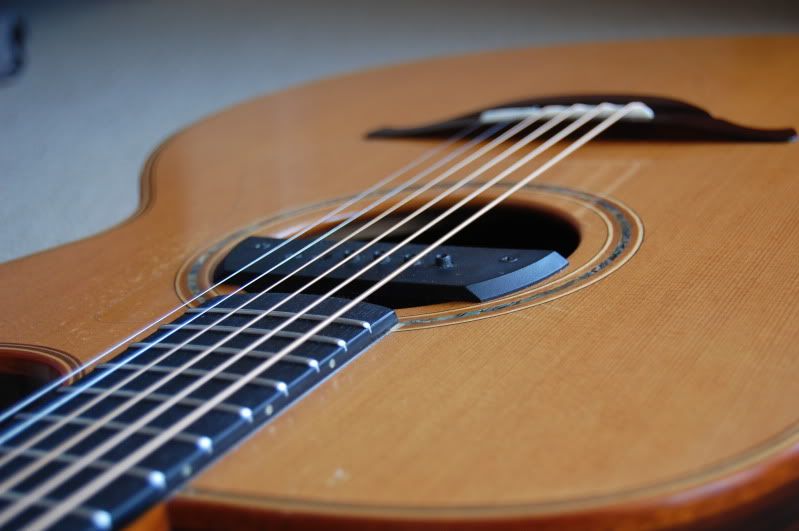
Guitar players talk about an affliction called GAS - Guitar Acquisition Syndrome. It stems from this belief that if only I can finally find the right guitar, the perfect guitar, then my playing will be incredible and the music of the spheres will find its release through my fingers. Two other ideas feed it - the first is that we live in the golden age of guitar building. There are literally hundreds of incredible builders who, in spite of the growing scarcity of the best wood, are building better guitars in more designs than have ever been done in history. This excellence trickles down even to the larger factory companies like Martin and Taylor building as many as 400 guitars a day and to the least expensive guitars built in Asian factories at numbers dwarfing the American factories. The second idea goes back to the Summer of Love. Back in the hippie days, consumerism was frowned upon and owning more than you needed was a serious no no... except when it came to musical instruments, especially guitars. Somehow, it was still OK to have very expensive guitars.
The three ideas come together and many guitar players go through instruments like candy. If you look at the classifieds on any guitar forum, you'll see significant numbers of hand built instruments for sale with prices nearing 5 figures or passing that barrier. Wherever you see a gathering of guitar players with their instruments, you're likely to see some serious and beautiful guitars.
I'm not as susceptible to GAS as I once was because I'm pretty happy with my Lowden which is pictured above. When my previous Lowden was stolen in Philadelphia in '99, the folk at Lowden were amazing to me and built me a very special guitar. George himself carved the bracing in my guitar. I've been playing Lowdens since about '87 and the sound fits me. So, even though I deeply appreciate the art and beauty of lots of what I see out there, it is difficult to imagine finding something that I really want instead of my Lowden.
FAR-West was one of the largest gatherings of guitar players I've attended so it was fun to see what instruments the performers had and what accessories they were using (also included under the general malady of GAS). I didn't count anything so these are just guesstimates... but fun for me none the less. It seemed that the single most popular make of guitar was Martin. That surprised me. I thought Martin had been dethroned by Taylor... which seemed to be the second most popular company. I wasn't surprised that neither one was a majority. I saw lots of smaller company guitars and a number of high end single luthier built instruments. I know how much money guitar players make so that part does surprise me... There was a very small number of Asian built guitars and one or two Larrivees, a quality Canadian factory built guitar that also has a factory in California.
Among the small shop guitars I saw a number from Santa Cruz Guitar Company who build Martin inspired guitars of very high quality and a few from James Goodall who builds a more modern style of guitar. I didn't see any Lowdens, Collings, or Bourgeois. I didn't see all of the players so I may have missed one or more of any of these companies. Then, I saw a number of the single luthier guitars... I saw one each of a Greenfield, a Sexhauer, a Wingert, and an Olson. All of those guitars pushed me towards a bout with GAS - beautiful sound, immaculate craftsmanship, sublime materials - although my wallet is nowhere near fat enough to even consider one. Then there were a few guitars that I didn't recognize which were likely built by other single luthiers without the same degree of recognition, at least to me.
Accessories were also interesting... I participate on the Acoustic Guitar Forum where a regular discussion comes up about cases vs. gig bags. It feels almost like my teen years when you were either a Ford or a Chevy person. There are a variety of different ways to carry and protect an instrument from high cost, extremely protective,low weight carbon fiber cases to cheap gig bags that are little more than a nylon grocery bag which do nothing more than keep the dust off. There are lots in the middle. Again, no counting, but from what I saw people carrying around, about 1/3 seemed to have Caltons. These are relatively expensive (around $800), very heavy fiberglass touring cases. If you're going to hand a $10K guitar to a baggage handler... they are a good idea but because of weight and size, don't ever expect to carry one onto a plane and figure that if you have to carry it very far, your arms will stretch to orangutan length. I had one for a while and appreciated the protectiveness of it, but it was far too heavy and bulky for me so I sold it. Another 1/3 had high quality gig bags. These usually run from about $150-$350 and are made of heavy nylon or leather with thick foam padding. They are much smaller and lighter than the Caltons and usually have some system of straps to wear them on your back. The argument for them is that because of the smaller size and weight, it is easier to keep your guitar in your hands or on your back and safe. FWIW, all of my guitars live in quality gig bags including a wonderful custom leather bag for my Lowden made by Glenn Cronkhite. The rest were in factory hard cases - the kind that usually come with a guitar when you purchase it and cost from about $80-200 on the aftermarket depending on the quality and company. I didn't see any carbon fiber cases even with the most expensive guitars.
So...no GAS for me... but I got very, very close to catching it again.
Thursday, October 28, 2010
FAR-West
In earlier posts - here and here, I've talked about the Cambridge Drive Concert Series. We have our second show coming up next week, Novemeber 5, with a wonderful performer named Anna Coogan for our headliner and Christina Grimm opening. More about that in a post to come...
 Last week I was able to attend most of FAR-West, the western regional convention of the Folk Alliance International. The Folk Alliance is a professional organization dedicated to improving the ecology of folk music, building stronger artists, presenters, and audiences. How that plays out at the conventions is that there are workshops aimed at helping artists and presenters do what they do better and lots and lots and lots of performances.
I went as a presenter and so was there to learn things that would help us improve our concert series and to hear some acts for possible bookings. Both things happened.
The biggest learning for me was one which had to do with which artists I should book. Some of the more experienced presenters said that it is clear that the best concerts happen when the presenter truly likes the performer but that the audience should be the primary consideration. The performer must fit with the audience the venue has cultivated. So... a performer who fits the audience and whom the presenter likes is the best case scenario. Second comes a performer who fits the audience but isn't a favorite of the presenter. Last is an act that is a fav of the presenter but doesn't fit the audience. Given this, the mantra for presenters is, "know your audience."
We aren't there yet at the Cambridge Drive Concerts. We haven't yet developed our audience. Still, I need to be careful and book performers who I think will fit... and as I make these early booking decisions, I will likely shape the audience we will have in the future.
To the performers, the lesson here was that when a presenter does or does not book you, you know little about whether they like your music. It may be that you are their favorite among everything they've heard, but for some reason you don't work for their audience. Or - and this piece was a surprise to me - they may love you but just don't have a slot for you. Most of the presenters were booked at least a year out and some were booked multiple years out. One festival presenter said he sometimes is thinking 3 or 4 years down the road. That is astounding to me. I can't wrap my head around planning that far in advance. Who knows what wonderful new performers will appear between now and then... or whether some favorite will decide to give up the life of a traveling musician... My gut tells me not to book any more than a year out - ever - but I wonder whether that will preclude me from booking some acts that I would really like to present. Time will tell. For what it's worth, right now we're booked about 5 months out for the headliners and I'm waiting to hear back from one or two others so within a few days I could have my headline acts booked through May of 2011.
The performances are mind boggling. There are official "Premier Showcases," each giving half hour slots to 7 performers on Friday and 6 on Saturday in three rooms, chosen by a panel... so 21 Premiere Showcase performances took place on Friday and 18 on Saturday. Then there were two "Featured Performers" who also performed at the same time in two different rooms on Friday evening and one on Saturday. So, you listen for a song or two and then off to the next room to hear another performer for a song or two... Beside this, there is serious craziness - Guerrilla Showcases. A performer rents a hotel room, pushes the beds up against the wall and adds a few chairs and maybe some mood lighting and snacks and then books performers, usually in half hour slots, sometimes from late afternoon but certainly after the Premiere showcases ave ended at 10:00 until the wee hours of the morning. There were 25 Guerrilla Showcase rooms all on one floor of the hotel. Imagine the cacophony... and the difficulty when an acapella Celtic singer is performing in a room across the hall from a bluegrass band. Still, it was a great way to get little tastes of a LOT of music in a short time. The currency of the conference are 3X5 cards with a photo of the performer and name on one side and their schedule of Guerrilla Showcases on the other side.
I heard some wonderful music that I am working to book... and some wonderful music that may not work for our series. We've already booked James Hurley for January and Cindy Kalmenson for March and I'm talking with a number of other possibilities.
Tuesday, October 19, 2010
still an important election
I was talking with a friend about the upcoming election the other day who sincerely remarked - "Throw the bums out!" There clearly are some "bums" in office. The folk in power have not addressed the serious issues we face as well as they could have and they've done an even poorer job of capitalizing on the good things they have done. The result is legitimate anger and frustration. I understand, "throw the bums out." The question is whether or not the alternative is a good one.
On Sunday, Dick Polman, columnist for the Philadelphia Inquirer posted a column with a quiz regarding some things said by candidates for office this year and political statements by others in the news. Seriously, you need to take the quiz.
Think about the quotes... and ask whether these are really the kind of people you want elected? Whether these are the kind of people you want framing our political discourse? And they are not running for local dog catcher, these are folk running on major party tickets for the House, the Senate, for governor of states. These are people who get interviewed on television on the national news Then realize that only one of the people being quoted is currently in office. The rest are all trying to capitalize on "throw the bums out" either as candidates or in building political influence for themselves and their friends.
I have to say that these folk frighten me. They are riding a legitimate reasonable wave of frustration and anger but if they actually win positions of influence, things will get much, much worse. The issues are difficult and complicated. The solutions are neither simple nor free. Our nation does not have consensus regarding the solutions and anything that is done will require serious public relations work. And finally, at least the Republican Party has demonstrated no desire to work with those across the aisle. Add that all together and electing a bunch of ignorant crazies cannot but make things worse.
The only positive is that comedians already have an abundance of new material. I saw this parody of a political campaign ad. It would be hilarious if it wasn't so true.
Saturday, October 16, 2010
the future of music
Digital musical instruments have been around for a while. I remember back in the 80's when a friend of mine who was a studio musician purchased the first sampling synthesizer in Philly - a ridiculously expensive Fairlight
- and the first serious computerized drum machine - the Linndrum. Watching Herbie Hancock play a Fairlight on Sesame Street and listening to Peter Gabriel's ground breaking work with one was inspiring. The hardware allowed a musician to make and manipulate sounds in ways that couldn't even be imagined prior and those performers did just that, creating new sounds and textures. Still, the equipment couldn't begin to capture the subtleties of an actual acoustic instrument. A real pianist was never happy with a digital piano... and digital strings were not up to snuff when compared with real bows and resin scraped across real strings in the hands of someone who knew how to make a violin sing.
The technology has improved exponentially and the samples sound more and more realistic as shear computing power allows the machine to reproduce the incredible complexity of an acoustic instrument's sound. Add to that the ease of using a model and their popularity is understandable. Any keyboard player who used to carry a Hammond B3 and a Leslie to gigs deeply appreciates the possibility of using a sample controlled by a midi keyboard that weighs 20 pounds. A musician in her home studio can have an orchestra playing in the background for a minimal price for software and a controller. It doesn't sound exactly like the London Philharmonic, but it is a lot cheaper and less complicated. Some electric guitar players are thrilled to be able to use a Fractal Audio Axe-Fx to produce the sound of hundreds of different amplifiers and effects units while others say they still can hear and feel the difference between the "real thing" and a digital model. Digital models have even made it into the acoustic music world where acoustic guitar players use digital modeling to improve their live sound. Again, others say the models just sound like... imitations.
Theoretically, the models will get better and better and it will be possible to use one controller of a type that the player likes, whether it is a keyboard, a fretboard, or a wind controller, to reproduce the sound of any instrument ever played and numberless ones that have never existed before. And the price will get lower and lower if Moore's Law continues to hold true. Who knows... this may actually be the future of music. It is pretty cool... but I hope not.
Thursday, October 14, 2010
Tax Exempt Status & Separation of Church & State
Over the past few years there has been a good deal of discussion regarding the tax exempt status of churches. The question came to the forefront when a number of conservative churches decided to challenge current law and publicly endorse candidates in both the '08 and '10 elections. They are framing the argument as a constitutional one. They are correct and they should win the argument.
I've heard many people argue that tax exemption is a benefit given by the government and the price for that benefit is the inability to make official endorsement of candidates or to lobby in a substantive way. Jim Evans in Ethics Daily goes on to argue that the genesis of tax exempt status of churches goes back to the days when churches were part of the state and it made sense that a municipality would not tax its own property. He sees this as an argument that the benefit is just that and that in order to enjoy the exemption, churches must "play by the rules." That this argument is irrelevant seems obvious to me. However the practice began, we have not had state sponsored or owned churches since the founding of the country. So what happened? At the adoption of the Bill of Rights, they forgot to tax the newly emancipated properties? Sorry, there must be some other justification that the tax exempt status was retained.
Then, there is the prohibition itself. Churches were allowed to endorse candidates until 1954. In that year, then senator Lyndon Johnson introduced a law prohibiting 501(c)(3) organizations from endorsing political candidates. At the height of the McCarthy era, he was trying to silence some of his critics as he ran for office. It was only by coincidence that churches were silenced as they fell under the same IRS code as his nonprofit enemies.
While it is accurate that churches receive their tax exempt status under Section 501 (c)(3) of the Internal Revenue code, I would argue that churches are not the same as other nonprofit organizations and in the end cannot be treated the same way. Other non-profits receive tax benefits because they provide needed services to the community. The issue is clearly seen as one of public benefit. It is a quid pro quo... the nonprofit provides services so the state helps it by removing the burden of taxes and provides that contributions are deductible on the giver's taxes. Nonprofits do not appear in the Constitution or the Bill of Rights. On the other hand, religious institutions fall under the First Amendment and the relationship between the state and religion is clearly and uniquely defined. The government does not give benefits to a religious group. There would be no constitutional justification for an act like that. They are tax exempt because they are religious organizations. period. The first amendment provides that the government will neither establish nor prohibit the free exercise of any religion.
Here is where the question of taxes comes in. The power to tax is the power to control. If the government can levy taxes on religious institutions and decide what those taxes will be, they can decide which institutions will be viable. Frankly, if the little church I serve had to pay property taxes, we would likely close. How can that not be prohibiting free exercise? And isn't telling a congregation that it cannot speak on any issue defining its ministry for it, again prohibiting free exercise? To allow that a church can say whatever it wants so long as it is willing to give up its tax exempt status establishes a multi-tiered system for religious institutions with some being able to speak and others not, this time based on their financial ability to pay taxes. Again, we are seeing free exercise attacked.
We must not forget that taxes and tax benefits have often been used as tools of influence by the state. How often does a municipality give tax benefits to entice a company to re-locate? To use this part of the IRS code to silence religious organizations from speaking on issues that they clearly see as part of their call is an example of the state using the tax code to prohibit free exercise of religion. What would stop a community from using taxes, if it were allowed to tax religious organizations, to keep a mosque from being constructed? Or a religious building of any sort that was seen as offensive to the powers that be?
There is no argument for taxing religious institutions or for prohibiting them from speaking on any issue in any way they believe their faith calls them to speak that does not conflict with the First Amendment. The government has no right to tax churches and therefor tax exemption is not a benefit the government can bestow or withdraw. That some religious organization will speak out in ways that you or I don't appreciate on political issues is part of the price we pay for religious freedom.
Tuesday, October 12, 2010
new physics & church meetings
I never took physics in high school or college so I know next to nothing about it. I do understand that there have been lots of counter-intuitive findings of late including the idea that a particle can be in two different places at the same time. I want to do that.
Coming up in June, there are two conferences that I want to attend that are happening at the same time. They are very different and the rewards would be completely different from one to the other.
Every two years, my denomination, The American Baptist Churches, USA has a big meeting. It is a time for connecting with friends I only see every two years, a time of reinforcing my identity as a Baptist, and usually a time of reclaiming that word - Baptist - that has been defaced by the Southern Baptist Convention as they have swung into exclusivist fundamentalism. I have to admit though, that our biennial meetings have been less than inspirational for a long time... but it is my "family" and I really don't want to give up on the ABCUSA. And many of my friends have either given up on the ABC or cannot afford to attend so many of them will not be present. The event is taking place in Puerto Rico, a place I love and a people I love. I'd get to tack on a bit of vacation either before or after. tempting...
Then there is The Wild Goose Festival in North Carolina. Modeled after Greenbelt in the UK, this promises to be a really exciting time. Planned and staffed by some very bright and committed folk whom I deeply respect, this event would challenge and stretch me and could even play a role in the re-shaping of the Church that is going on now as it contributes to the formation of the next generation of leaders. The median age will probably be literally 1/2 that of the ABC biennial, a fact that is thrilling in itself. The big downside is that it includes camping. I've only camped once in my life and I will forever associate it with the kidney stone I passed in the rain in rural Pennsylvania.
As far as I know, nobody has been able to replicate that one particle in two places at once thing in human beings so I'll have to choose and I need to choose soon. What would you do?
Thursday, October 07, 2010
inspiration & showing up
I didn't read the book - Eat, Pray, Love. I did see the movie and other than the first scene in India, which rang soooo true to our first moments in Inida, didn't find it particularly engaging. So, I likely would never have watched Elizabeth Gilbert's TED talk.
My daughter, Alexis, put it up on her blog so I was obligated to watch it. It is a wonderful talk about the creative process. I was particularly struck by Gilbert's admonition to just show up and do your job. It got me thinking that showing up and doing your job is at the core of everything, not just creativity. Whether it be caring about the homeless guy at the corner, voting in an election, playing in the church band, being there for a grieving friend, whatever... it doesn't matter whether we are successful, whether we change the world, whether we make a difference that anyone else can see... what matters is whether or not we are (and here's the theological word) faithful.
So show up. Do your job or your part. And leave the results to God.
Wednesday, October 06, 2010
an important election
first, some disclaimers
Obama was not my first choice in the Democratic primary. He wasn't even my second one. He was and is too centrist for me. Still, there was no Republican that I would have even considered voting for over any of the Democratic candidates and given the practicalities of our current system, I would not have considered a third party candidate.
I am terribly disappointed in the current congress. They wasted so many opportunities to do what really needed to be done and what they said they would do.
Even when I find the Republican party disgusting (which is much of the time), I admire the way they work together, if not to accomplish something, then to keep something they don't want from being accomplished.
The current administration has accomplished some significant things. True, we don't know what would have happened without the bailouts, but the non-partisan folk who study such things tell us again and again that things would be much much worse. We are sort of out of Iraq. There is a time table for Afghanistan. There are proposals to right the biggest economic divide in this country since the Great Depression (and it isn't a coincidence that the economy fell apart when the divide got that big again).
Historically, the times when there has been the most economic growth and income growth for all people have been under democratic administrations (check it out).
I will vote a straight Democratic ticket and, as much as is possible in any election, do that happily and proudly.
Now for the non-partisan part. This is a very important election. If the Democrats retain control of congress, we will see more of the change that Obama promised enacted. Maybe not all of it, but more of it. If any more Supreme Court Justices are chosen, there is a chance that Obama's choices would balance a very right wing leaning court. If you want that change, then you must vote for the Democratic candidates. If you do not vote, remember that the other side is highly energized and the far right will likely vote in droves so not voting is like voting for the following...
If you are against the change that Obama promises to continue and want to see the changes we have seen be repealed, vote for the Republican candidates. They are clearly calling for a return to the Bush era economic policies and more, including privatizing Social Security and cutting many of the safety net programs. Some/many of the Tea Party candidates are also calling for dismantling current government agencies like the Department of Education, the Environmental Protection Agency, even the Food and Drug Administration and others. A woman's right to choose could also be challenged. If a Supreme Court Justice position opened a Republican congress would ensure that the person be as centrist as possible. While there are some Tea Party candidates who are against the Republican establishment which they see as equally part of the problem, most who have won primaries have already turned color and become part of the Republican establishment (see Tea and Crackers in Rolling Stone for some examples).
The differences could not be more clear and there is no excuse for anyone, anywhere on the political spectrum not to vote and to do so intelligently. It is a critical election which will impact our lives for years to come.
Thursday, September 30, 2010
More on the Cambridge Drive Concert Series

I'm a lousy interview. I've long known that. Part of it is hubris. I think quickly and can be pretty charming in most settings so, I go into an interview situation without having thought it through as carefully as I should have figuring I can wing it. Part of it is just cluelessness. Enough said. When I was president of the local clergy association, I got interviewed a lot. And when we lived in Albany, NY I found myself on the news or in the paper a few times so I should know better, but too often I don't.
Two days ago, a reporter from the Montecito Journal called to interview me about the up coming Cambridge Drive Concert Series. He asked me the most obvious question of all... "Why are you starting a new concert series?" It was the most obvious question and yet, I wasn't really prepared to answer it. There are a couple of other series that happen in greater Santa Barbara including two that I am aware of that happen in churches, so why another? I'm pretty sure my answer was lame. It did start me thinking though... why another concert series?
I should be honest and say that I've not attended many of the local series. Those in the big venues are frankly too expensive for me. I just can't justify spending $30 or $50 or more times two to see a musical act more than once every few years. The two church based series fly under my radar and I just never know who is performing or when. There have been a few series featuring local acts, mostly in coffee houses, and I try to visit them when I can. All too often life gets in the way and I suffer that loss.
So, here are the niches I think we're filling and I think we're unique in the mix at least. We're trying to bring in very talented regional and national acts who are fulltime musicians. In part, I want to support the musicians. It can be a difficult life and keeping the wolf away is a huge job. I'm hoping that we can provide one more possible venue as they travel around the country sharing their art. We have decided to always have a local opening act. There are some wonderful local performers and too few venues that allow them to play to an appreciative listening audience. Some are as good as any touring artist out there but are constrained for any number of reasons to stay local. Others are just honing their craft. In both cases they deserve to truly be heard and to have the opportunity to share a stage with other wonderful musicians.
Music can build community. I'm hoping that opening our doors to these wonderful musicians and to an audience will break down some of the walls that divide us and build some new relationships. At least for the present, the concerts are not seen as fundraisers for the church although we are also unable to subsidize them beyond opening doors, providing space and staff time, and being as hospitable as we can be.
We are substance free. I have talked to some folk who are a bit put off that there will be no alcohol available. They want a glass of wine while they listen. I understand that... but beyond being against the church by-laws, there are communities of folk who are excluded from venues with alcohol - young folk below the drinking age and folk with addiction issues. So we are substance free... except for caffeine maybe.
And here's the big piece... God's creation is filled with extravagant beauty. The other morning I happened to look out the window as I was spraying my orchid plant and saw a breath-taking sky - pink clouds and robin's egg blue sky. Then the light shifted and the colors faded. How many days have I missed an equally beautiful moment? A few weeks ago, for just a few moments, the light was perfect as I drove through the Gaviota Pass. Had I been 5 minutes later, the view would have been less amazing, or at least completely different. The songs of birds, the majesty of the mountains, the power of the ocean, the laughter of children, the intricate beauty of a tiny flower... God is a performance artist in the most sublime sense of the word. Part of what it means to be created in the image of God is to consciously contribute to this proliferation of beauty. And we will be doing just that at the Cambridge Drive Concert Series on the first Friday of every month. Frankly, there cannot be too much beauty.
I hope that if you are anywhere near Santa Barbara, you will come to the concert tomorrow and/or any subsequent ones. Bev Barnett & Greg Newlon and Rebecca Troon will be making the world a more beautiful place and when the performance is over, it will be gone except in the memories and lives of those who shared those moments...
Tuesday, September 28, 2010
Politics and Business
We have two significant political races in California this year where a former CEO is running for election - Meg Whitman for governor and Carly Fiorina for senate. I have strong feelings against both of them, but that is another post. The piece I want to raise is that business and government are not the same.
In both cases, their campaigns are arguing that because they were successful in business (perhaps questionable too), they would make great leaders in government. Now, because someone has been a successful business person is no reason to dismiss them as a politician. They may bring some wonderful skills to the job that translate well from one role to the other. The problem comes when folk involved don't realize that government is not business and should not and cannot be run like business. It is a completely different paradigm. The goals are different. The means are different. The metrics for measuring success are different. We simply cannot run government like a business.
So let's look at those three categories a bit. What are the goals of business? To make a profit. Obviously there are wonderful businesses out there that are concerned about providing a good product, caring for their communities, making the world a better place... but they only do any of things things to the degree they can do it profitably. A research firm may come up with a product that cures a specific cancer, but if they cannot produce it at a profit, they cannot make it. It doesn't matter that they want to do the right thing, the good thing... they are constrained by what they are to produce profits for their stockholders. And those stockholders, a very specific slice of the population, are the only people they are accountable to in the end. So people continue to die and research continues. Government has a much more nebulous goal - to promote the common good. And the population to whom it is accountable is everyone. Corporate bean counters are accountable to the bottom line. Government bureaucrats are accountable to the people. Huge difference.
How about means? Governments must build coalitions, appeal to common values, find compromises between competing ideas and ideals, and work through a sometimes difficult and complicated process of legislation. In business, many models allow a CEO to change everything with the stroke of a pen. There may be a board of directors who have some say but as likely as not, they rubber stamp most of what the CEO's propose and their role is almost never to be involved in daily decisions. Shareholders may vote, but it is very unlikely that they really have any say in any of the decisions made and likely don't care as long as stock and dividends are going up. Shareholders might be thrilled that a production facility is closed and 1000's of jobs moved overseas if it means higher profits. See how difficult it is to shut down a military production facility and we see the difference in a government setting.
And metrics? You know a business decision was a good one by looking at the bottom line. Did the company make money? Or is it poised to do so because of those decisions? Again, in government, things are not so simple. Let's look at a few actual programs briefly. First, social security. Depending upon whose numbers you believe, either it is solvent for the long term or it is pushing the entire government into a ditch. If it was a business decision, the way you read those numbers would answer the question. In government, the question becomes much more difficult when you look at the ways the program has changed our society. Poverty among the elderly has dropped significantly since the program began and even in our current economy is lower than it has ever been. One could even argue that some of the increase in life expectancy is due to social security and Medicare. So is it successful or not? And let's look at the War Against Terrorism. The Bush administration came into office with a huge budget surplus. They lowered taxes on the wealthiest Americans and went into two wars that cost billions of dollars, putting the government trillions in debt. Some would argue that their actions have made us safer. There is no question that had we not entered those wars, our national budget would be much healthier than it is today. Was it a successful thing to do?
Bottom line... politics is not business and cannot and should not be run like one. If we elect business people who do not understand that and/or expect them to run government like a business, we will all suffer. Are these two women just playing a game and saying what they think people want to hear in order to be elected and then will actually know how to govern vs. running a business? Or are they just caught up in the hubris of their own success and think they can impose a business paradigm where it does not fit? If they win, we will see...
Subscribe to:
Posts (Atom)


