More than once I've bristled at the term, "Radical Islam," especially when applied to folk like ISIS. I've also grieved when I read or hear a statement that begins "Christians believe..." and goes on to include something I most definitely do not believe. More than once my response has been... "that person is not a Christian," which is likely the same thing they would say about me.
In every religion with which I'm familiar, there is a degree of heterogeneity that includes folk at one point of the spectrum excluding folk at other points on the spectrum as not being real representatives of that tradition. I have read Orthodox Jews say that Reformed Jews are not really Jewish. I know Muslims who would say that the members of ISIS are not really Muslims and of course, those same members of ISIS routinely kill folk who call themselves Muslims but who do not measure up to their definitions. Just the other day I had lunch with a very conservative Christian woman who flatly said that her family as not "Christian" - some of whom are central members of a church I know intimately. Then there are those outside of the various religious traditions who often point to the very worst as examples... those who look at Islam and only see ISIS, at The Family Research Council as the spokespeople for Christianity... you get the picture.
Once I had a discussion with a hyper-conservative Calvinist. At the end of our talk, she remarked, "We worship a different Jesus." She was right. It doesn't seem unreasonable then that the same title doesn't fit both of us.
So, who gets to decide? And using what criteria? Or is a decision even possible?
I would say, yes, a decision is possible and necessary. We live in a world where information travels virtually instantly and every faith tradition finds itself out there, being judged in the marketplace of ideas and actions. It is all too easy for folk to point at one element or another and generalize when that element may or may not fairly represent a religious tradition. The label "Christian" is important to me and the way that label is read by others is then also important to me.
So... first, does the individual or group fit into the general trajectory of the tradition? Every religious tradition changes through history, some more than others, but all change. I would argue that in my tradition, we become more able to understand God's yearnings for humanity and move ever so slowly closer to God's "will." While questions related to the founder like "what would Jesus do?" or "What would Mohamed do?" might be helpful, we must realize that we always see those founders through the lens of our current experience and even our theological stance. The Jesus I see would be clearly different than the one Jonathan Edwards saw or the one that Tony Perkins of the Family Research Council sees. Still, I believe we can look at the broad sweep of a tradition to see what direction it is moving and I would argue judge that something that spins off wildly from that trajectory doesn't fit the definition. In spite of calling themselves "Christian," those in the Christian Identity Movement simply are not. In spite of the word "Islam" being in the title of ISIS, they are not.
I would also argue that a group or person who claims to be trying to go back to the original intent is likely falling outside of the definition. You can't go back... and indeed, God does not go backwards. If the individual or group argues that everyone else has gone astray for the past decades or centuries... that is simply hubris.
Second, look at that trajectory again and ask how the tradition's understanding of who God is has moved... if the individual or group seems to be advocating a "God" outside of that tradition's trajectory, then clearly they are not one of them.
Finally, where did they come from? If they pop up out of nowhere, they don't meet the definition.
The hard question of course is whether God can work outside of the tradition. Of course. God is God and can do whatever God wants... but those radical changes begin something new. Christianity has Jewish roots, but it is not Judaism. Islam has roots in Judaism and Christianity... but it is neither. You get the point.
So, for today, I have no difficulty at all saying that ISIS is not Islam. I'm a little more shy in my own tradition but if you asked me privately I'd tell you what I think about whether or not Westboro Baptist is really a Christian church.
What would your criteria be? Or do you think it is not a worthy effort?
Showing posts with label Christianity. Show all posts
Showing posts with label Christianity. Show all posts
Thursday, August 27, 2015


Sunday, January 26, 2014
Zealot
Wow... it's been more than a month since I've posted...

I finished reading Reza Aslan's book Zealot a few days ago. If you haven't heard of it, it is an attempt to place Jesus in an historical context and thus make him more understandable. I have to say I have very mixed feelings about the book.
The pros - If we believe in the Incarnation, we have to see that Jesus was not only a man but a man in a very specific time and place. We could argue over what that specificity has to do with God's self revelation, but in any case, we cannot divorce that revelation from that setting. We cannot understand Jesus without placing him in his context and we cannot understand incarnation without understanding contextualization. Aslan does a good job at explaining the social context in which Jesus found himself as well as the particular profusion of Judean self-styled messiahs, gathering followers and calling for the overthrow of Rome. A thorough understanding of the setting is critical for understanding Jesus and his teaching. Aslan helps make that possible. He does the same to a lesser degree for Paul.
The negatives - Aslan aknowledges that Jesus does not quite fit the common models of his day for the messiah but still tries to pigeon hole him into those models, dismissing any possibilities of Jesus bringing anything really unique to the discussion. He goes on to say essentially that Christianity as we know it is an invention of Paul that has very little to do with Jesus.
Additionally, Aslan picks and chooses his scholarship to fit his presuppositions. For example, he refers to Jesus' parables as incomprehensible when scholars going back to Jeremias' seminal 1947 book The Parables of Jesus, says that the parables were stories that used everyday experiences to reinforce a single message to the audience in a way they would understand.
And of course, he writes not as a person of faith but as a scholar looking for a more accurate picture of the historical Jesus whom he distinguishes from the Christ of faith. I think there is great value in this approach both for academia and for people of faith all the while knowing that for many Christians, such a differentiation is offensive.
So... my short review is that it is a worthwhile read but do not expect it to be a devotional book nor the best scholarship. It is however a fairly easy read that will help to enlighten the life and times of Jesus of Nazareth.
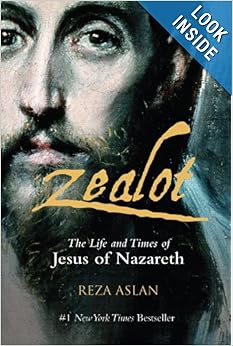
I finished reading Reza Aslan's book Zealot a few days ago. If you haven't heard of it, it is an attempt to place Jesus in an historical context and thus make him more understandable. I have to say I have very mixed feelings about the book.
The pros - If we believe in the Incarnation, we have to see that Jesus was not only a man but a man in a very specific time and place. We could argue over what that specificity has to do with God's self revelation, but in any case, we cannot divorce that revelation from that setting. We cannot understand Jesus without placing him in his context and we cannot understand incarnation without understanding contextualization. Aslan does a good job at explaining the social context in which Jesus found himself as well as the particular profusion of Judean self-styled messiahs, gathering followers and calling for the overthrow of Rome. A thorough understanding of the setting is critical for understanding Jesus and his teaching. Aslan helps make that possible. He does the same to a lesser degree for Paul.
The negatives - Aslan aknowledges that Jesus does not quite fit the common models of his day for the messiah but still tries to pigeon hole him into those models, dismissing any possibilities of Jesus bringing anything really unique to the discussion. He goes on to say essentially that Christianity as we know it is an invention of Paul that has very little to do with Jesus.
Additionally, Aslan picks and chooses his scholarship to fit his presuppositions. For example, he refers to Jesus' parables as incomprehensible when scholars going back to Jeremias' seminal 1947 book The Parables of Jesus, says that the parables were stories that used everyday experiences to reinforce a single message to the audience in a way they would understand.
And of course, he writes not as a person of faith but as a scholar looking for a more accurate picture of the historical Jesus whom he distinguishes from the Christ of faith. I think there is great value in this approach both for academia and for people of faith all the while knowing that for many Christians, such a differentiation is offensive.
So... my short review is that it is a worthwhile read but do not expect it to be a devotional book nor the best scholarship. It is however a fairly easy read that will help to enlighten the life and times of Jesus of Nazareth.
Thursday, March 24, 2011
Will the real....
_______ please stand up?
Back in my childhood, I remember watching the television show, To Tell the Truth. An individual with an unusual occupation or experience would be joined by two impostors and a panel of celebrities would question them and try to decide who was the real person. For some time I've struggled with the question, Would the real Baptists please stand up? or, Would the real Christians please stand up? And recently, Would the real Muslims please stand up? How do we decide who is the real thing? Who gets to define the term?
Let me give some examples. Early Baptists had four commitments that distinguished them from other Christian groups. They believed in soul liberty (an individual is responsible for his or her own faith), church freedom (no outside body can tell a church what its ministry must look like), freedom of the Bible (the scriptures speak for themselves and nobody can assign an official interpretation), and the separation of church and state(much more complicated than many people think, but that is another post). Those four commitments led to a wide variety of theological stances from fundamentalist to Unitarian but all stood within the tradition. Few Baptists today are willing to live with the implications of that freedom - think especially of the Southern Baptist Convention. Are they still Baptists?
How about Christianity in general? All Christians would presumably say they are trying to follow Jesus but their understanding of who Jesus is would differ to the point that, at least in some cases, they clearly are not talking about the same person. Let me give an example that is close to my heart and about which I'm willing to live with significant differences... but it is a real difference. The early Christians were pacifists. They followed the teachings of Jesus and understood the things he said about enemies as absolutely prohibiting participation in the military or acting in violence under any circumstances. Rather than take up arms against enemies, they chose to watch as loved ones were tortured and killed and to endure the same. Most in the Anabaptist traditions in the Church continue to understand the teachings of Jesus that way. Beginning with Constantine, Christianity began to identify more and more with the empire of the day and military service was seen as a appropriate way to express one's faith. There are movements in the US military today that absolutely identify themselves as followers of Jesus even as they launch missiles against Libya or attack enemies in Afghanistan. It is difficult to imagine a more different understanding of how to follow Jesus. Are they both Christian? Who decides and how? What does the term mean?
More recently there has been a great deal of discussions about the nature of Islam. We often hear statements like, "For Muhammad, religion and politics were one and the same so any Muslim is automatically against separation of religion and government and is out to impose Sharia law on the entire world. Convert or kill is the mandate." Whether or not that was Muhammad's original understanding is another discussion but it clearly is the understanding of some visible Muslims today. It also clearly is not the understanding of the overwhelming majority. Indeed, all of the Muslims I know are absolutely committed to freedom of religion and to a more peaceful expression of their faith. So, who gets to define the term?
I don't have any good answers. I find myself wanting to define the terms as I prefer they be used. Of course, that may or may not coincide with how you prefer they be defined or how the general population understands them. A good friend of mine was involved in a Black Muslim organization back in the 60's where they had a saying - "he who talks loudest gets over." Often these terms are defined by the most visible or most vocal groups... Do we allow the crazies (or at least the folk who don't think like us as they might define me as a crazy) to own the terms or do we keep trying to re-frame the discussions and redefine the terms? I have to admit that I'm growing tired of those battles... but they still feel worthwhile to me.
Back in my childhood, I remember watching the television show, To Tell the Truth. An individual with an unusual occupation or experience would be joined by two impostors and a panel of celebrities would question them and try to decide who was the real person. For some time I've struggled with the question, Would the real Baptists please stand up? or, Would the real Christians please stand up? And recently, Would the real Muslims please stand up? How do we decide who is the real thing? Who gets to define the term?
Let me give some examples. Early Baptists had four commitments that distinguished them from other Christian groups. They believed in soul liberty (an individual is responsible for his or her own faith), church freedom (no outside body can tell a church what its ministry must look like), freedom of the Bible (the scriptures speak for themselves and nobody can assign an official interpretation), and the separation of church and state(much more complicated than many people think, but that is another post). Those four commitments led to a wide variety of theological stances from fundamentalist to Unitarian but all stood within the tradition. Few Baptists today are willing to live with the implications of that freedom - think especially of the Southern Baptist Convention. Are they still Baptists?
How about Christianity in general? All Christians would presumably say they are trying to follow Jesus but their understanding of who Jesus is would differ to the point that, at least in some cases, they clearly are not talking about the same person. Let me give an example that is close to my heart and about which I'm willing to live with significant differences... but it is a real difference. The early Christians were pacifists. They followed the teachings of Jesus and understood the things he said about enemies as absolutely prohibiting participation in the military or acting in violence under any circumstances. Rather than take up arms against enemies, they chose to watch as loved ones were tortured and killed and to endure the same. Most in the Anabaptist traditions in the Church continue to understand the teachings of Jesus that way. Beginning with Constantine, Christianity began to identify more and more with the empire of the day and military service was seen as a appropriate way to express one's faith. There are movements in the US military today that absolutely identify themselves as followers of Jesus even as they launch missiles against Libya or attack enemies in Afghanistan. It is difficult to imagine a more different understanding of how to follow Jesus. Are they both Christian? Who decides and how? What does the term mean?
More recently there has been a great deal of discussions about the nature of Islam. We often hear statements like, "For Muhammad, religion and politics were one and the same so any Muslim is automatically against separation of religion and government and is out to impose Sharia law on the entire world. Convert or kill is the mandate." Whether or not that was Muhammad's original understanding is another discussion but it clearly is the understanding of some visible Muslims today. It also clearly is not the understanding of the overwhelming majority. Indeed, all of the Muslims I know are absolutely committed to freedom of religion and to a more peaceful expression of their faith. So, who gets to define the term?
I don't have any good answers. I find myself wanting to define the terms as I prefer they be used. Of course, that may or may not coincide with how you prefer they be defined or how the general population understands them. A good friend of mine was involved in a Black Muslim organization back in the 60's where they had a saying - "he who talks loudest gets over." Often these terms are defined by the most visible or most vocal groups... Do we allow the crazies (or at least the folk who don't think like us as they might define me as a crazy) to own the terms or do we keep trying to re-frame the discussions and redefine the terms? I have to admit that I'm growing tired of those battles... but they still feel worthwhile to me.
Friday, December 17, 2010
fundamentalist atheists
The other day my daughter called me an Enlightenment thinker on her blog and then referred to her mother's "hooby dooby perspective." I'm not going to argue even though I want to... although there is likely more truth there than I would like to admit. Still, it got me thinking about things. Add Christmas into the picture and a lot has been swirling around for me.
The direction things took is nothing original to me, but still it has been weighing heavily these days as we approach Christmas. I've been thinking of literalism, which presumably is a piece of enlightenment thinking, vs. the question of mystery which clearly slides over into hooby dooby. Over the past few years there have been a lot of "evangelical" atheists out there, trying to convince others of the rightness of their system. Interestingly enough, they have sided most clearly with the fundamentalists as both have argued from a position of taking scriptures absolutely literally. How many times have we heard Bill Maher denigrate religious people as ignorant with a statement about a talking snake? There is no room to approach the text in any way other than a literal, historical document that is either correct or incorrect. For the atheists, it seems silly and therefore is discarded. For literalist believers (of any particular religion), it must be true so it becomes the lens through which science, sociology, and history must be seen. Neither position allows for mystery, poetry, or myth (in the technical sense).
As we approach Christmas, someone will invariably note that the date was chosen to coincide with a Pagan holiday and that many of the practices recall Pagan winter holidays. Others will note the difference between the Greek and Hebrew versions of Isaiah's sign to Ahaz speaking of a young girl vs. a virgin. Many will remind us that Christ is the reason for Christmas but few will get past the simple questions and wrestle with the mystery, the poetry, and the myth (again, in the technical sense of the word).
If you observe Christmas, I hope you can get in touch with a bit more of the hooby dooby side - find the mystery, poetry, and myth and be transformed by a story so amazing that it can't and must be true at the same time. It really is the most radical message that I can imagine.
Finally, I want to share a quote from David Mowaljarlai, an Ngarinyin aboriginal elder, that I had as an e-mail signature for some time and still revisit every now and then... "Once it stops bein' a mystery, it stops bein' true." At that point, the literalist and the atheist have both missed out... because there is no room at the inn for mystery. But the mystery cannot be denied... and it happens in the stable, quietly and inexplicably transforming the world.
Have a Blessed Christmas!
The direction things took is nothing original to me, but still it has been weighing heavily these days as we approach Christmas. I've been thinking of literalism, which presumably is a piece of enlightenment thinking, vs. the question of mystery which clearly slides over into hooby dooby. Over the past few years there have been a lot of "evangelical" atheists out there, trying to convince others of the rightness of their system. Interestingly enough, they have sided most clearly with the fundamentalists as both have argued from a position of taking scriptures absolutely literally. How many times have we heard Bill Maher denigrate religious people as ignorant with a statement about a talking snake? There is no room to approach the text in any way other than a literal, historical document that is either correct or incorrect. For the atheists, it seems silly and therefore is discarded. For literalist believers (of any particular religion), it must be true so it becomes the lens through which science, sociology, and history must be seen. Neither position allows for mystery, poetry, or myth (in the technical sense).
As we approach Christmas, someone will invariably note that the date was chosen to coincide with a Pagan holiday and that many of the practices recall Pagan winter holidays. Others will note the difference between the Greek and Hebrew versions of Isaiah's sign to Ahaz speaking of a young girl vs. a virgin. Many will remind us that Christ is the reason for Christmas but few will get past the simple questions and wrestle with the mystery, the poetry, and the myth (again, in the technical sense of the word).
If you observe Christmas, I hope you can get in touch with a bit more of the hooby dooby side - find the mystery, poetry, and myth and be transformed by a story so amazing that it can't and must be true at the same time. It really is the most radical message that I can imagine.
Finally, I want to share a quote from David Mowaljarlai, an Ngarinyin aboriginal elder, that I had as an e-mail signature for some time and still revisit every now and then... "Once it stops bein' a mystery, it stops bein' true." At that point, the literalist and the atheist have both missed out... because there is no room at the inn for mystery. But the mystery cannot be denied... and it happens in the stable, quietly and inexplicably transforming the world.
Have a Blessed Christmas!
Saturday, September 25, 2010
Laughing Jesus
As you enter our church office, the first thing you see is a painting of Jesus in the middle of a deep belly laugh. Virtually everyone comments the first time they see it... "I've never seen a picture of Jesus laughing like that..."
That says something about our theology. We see Jesus in prayer, in tears, dying on a cross, throwing over tables in the Temple, fighting with the religious hierarchy, even with children on his lap or a sheep over his shoulders, but never really laughing, never deeply enjoying anything. If Jesus lives that way, then we think we should too. Life is full of suffering and conflict with little room for joy, wonder, or genuine encounter of the other.
Mt friend Jon, posted this irreverent video the other day. When I saw it on his site, there was only one comment, complaining that a post like this doesn't take Satan seriously enough. I won't go down that path, but I will say the comment missed Jon's point. The folk who made the video obviously have encountered a Christianity in which Jesus never laughs, doesn't enjoy much at all, and interfaith relationships are always framed in terms of violent conflict. What a sad and empty version of the Christian faith that is...
That says something about our theology. We see Jesus in prayer, in tears, dying on a cross, throwing over tables in the Temple, fighting with the religious hierarchy, even with children on his lap or a sheep over his shoulders, but never really laughing, never deeply enjoying anything. If Jesus lives that way, then we think we should too. Life is full of suffering and conflict with little room for joy, wonder, or genuine encounter of the other.
Mt friend Jon, posted this irreverent video the other day. When I saw it on his site, there was only one comment, complaining that a post like this doesn't take Satan seriously enough. I won't go down that path, but I will say the comment missed Jon's point. The folk who made the video obviously have encountered a Christianity in which Jesus never laughs, doesn't enjoy much at all, and interfaith relationships are always framed in terms of violent conflict. What a sad and empty version of the Christian faith that is...
Friday, July 30, 2010
rejecting Christianity

This week Anne Rice announced on Facebook that she is rejecting Christianity. She said "I refuse to be anti-gay. I refuse to be anti-feminist. I refuse to be anti-artificial birth control. I refuse to be anti-Democrat. I refuse to be anti-secular humanism. I refuse to be anti-science. I refuse to be anti-life." She went on to say that she will remain committed to Jesus.
I understand the sentiment. I have a number of friends who are walking the same journey. I understand... but I'm not convinced. Who says that Christianity is anti all of those things? Certainly not me and not any of the groupings of which I am a part. The journey presumes that there is one Christianity, one Church. There isn't and there never was. In spite of what many evangelicals will tell us about the "Early Church" there have always been a wide variety of understandings of doctrine, of practice, of the role of revelation... Yes, there are versions of Christianity, likely even a majority that are anti-gay, anti-feminist, etc. etc. but there are also versions that are both welcoming and affirming of GLBT folk, that stand with Paul in saying "in Christ there is no male or female," that are for all of the things Anne Rice sees Christianity as being against. Diane Butler Bass has a wonderful commentary on Rice's journey where she argues that Rice is really arguing for the need to return to an authentically liberal faith. I agree. Those of us who embrace a progressive version of Christianity need to stand up and own our faith publicly.
I do see another piece in Rice's journey and perhaps even more so in the journey of my friends... being a part of a community is messy. Disagreements happen. People get hurt. Organizations do stupid things and eat up resources that clearly could do more good somewhere else. In their optimism, these folk want to see a perfect community of faith where these wounds do not happen. When they cannot find it (or build it), they abandon the search. And they exit the community. I fear that their faith and their commitment to following Jesus will suffer without the support of a "church." I do not believe that following Jesus can be done as a lone ranger. It takes a community to which one can be accountable. It takes a community who do mission together. It takes a community who provide caring and support and challenge. I don't care how you name it, it is a "church" and it requires some degree of institutionalization. You have to plan to meet together, arrange for whatever leadership is required to make sure there is a time and a place and maybe even a plan for once everyone arrives. As the group gets larger, there needs to be a budget for space and a strategy for living out faith as a community. Like it or not, it is a "church." So yes, please reform the churches. Please build smaller and larger communities that truly reflect the ministry and person of Jesus. Do build institutions that struggle with their use of resources. Do meet together and ask the difficult questions, laugh together, cry together, eat together, play together, worship together, work together... They are and always will be institutions full of human beings with all of their strengths and weaknesses. They do fall short and sometimes even derail the very yearnings of God... but they are still necessary if we are truly to follow Jesus.
Friday, January 25, 2008
Favorite words
Once a month I have breakfast with a good friend who is on a spiritual search. She struggles with some of the traditional doctrines of the Christian Church, can't completely abandon her upbringing in the Christian Science Church, is both attracted to and repelled by tradition, and just can't ignore Jesus.
As we eat, we usually talk politics, gender issues, and it always come to questions about faith. I think I puzzle her when I don't embrace all of the doctrines that she thinks a good Christian is supposed to believe. I find myself coming back again and again to my two favorite words in my theological construct - paradox and contextualization.
She asked me about the trinity the other day. I'm not sure that I believe it in a way that would make most fundamentalists happy but I do believe in that doctrine. I haven't a clue as to how to conceptualize it though. I fall back on the first word - it is a paradox. Some might say that is a cop out but, I believe that paradox is central to faith. As I understand it, Christianity is full of paradoxes. I believe Jesus is the only way to God... but I don't believe everyone else is going to hell and I believe God is revealed to one degree or another in virtually all faith systems. I believe that Jesus is fully human ad fully God at the same time... make sense of that one. I believe God is all powerful and all loving and is personally concerned with individuals but I also see the problem of evil in the world. The list could go on. Bottom line is that God is too big for my understanding. The universe is too complicated for me to hold it in my mind. The result is paradox.
I love when my friend says that she cannot ignore Jesus. As a Christian, I believe that Jesus is the primary self-revelation of God to humankind. But he was clearly a male, first century Jew living in a remote corner of the Roman Empire. His experience of life was about as culturally different from mine as it could possibly be. Here's the rub... You can't have incarnation with contextualization. For Jesus to identify with all of us, he had first to identify with a specific group of us. To be human is to live in a cultural context that shapes everything for us from the way we experience God even to the way we count (heard that on NPR the other day... a language that is disappearing that counts both in base 12 and base 20!) Had Jesus been above his context, he would not have been able to identify with us or we with him and he would be meaningless. God speaks to us and encounters us in the context in which we live. It is a paradox that the most personal is also the most universal. Without a specific context, there is no universality.
And this concept of contextualization/incarnation is the pretty unique in Christianity from what I know. Sure other religions have gods that put on flesh and walk the earth but they always stand above the realities of life. Jesus becomes one of us. And he continues to become one of us in our various contexts. Christianity is the only major religion in which we do not speak the name of God in the language of the founder of the religion and in which the scriptures are read in indigenous languages rather than the language of the founder. This serious stuff as language represents the way a people conceptualize the universe. In Christianity, God comes to us, where we are.
So paradox... and contextualization... love those words! What do you think? And do you have any favorite theological words?
As we eat, we usually talk politics, gender issues, and it always come to questions about faith. I think I puzzle her when I don't embrace all of the doctrines that she thinks a good Christian is supposed to believe. I find myself coming back again and again to my two favorite words in my theological construct - paradox and contextualization.
She asked me about the trinity the other day. I'm not sure that I believe it in a way that would make most fundamentalists happy but I do believe in that doctrine. I haven't a clue as to how to conceptualize it though. I fall back on the first word - it is a paradox. Some might say that is a cop out but, I believe that paradox is central to faith. As I understand it, Christianity is full of paradoxes. I believe Jesus is the only way to God... but I don't believe everyone else is going to hell and I believe God is revealed to one degree or another in virtually all faith systems. I believe that Jesus is fully human ad fully God at the same time... make sense of that one. I believe God is all powerful and all loving and is personally concerned with individuals but I also see the problem of evil in the world. The list could go on. Bottom line is that God is too big for my understanding. The universe is too complicated for me to hold it in my mind. The result is paradox.
I love when my friend says that she cannot ignore Jesus. As a Christian, I believe that Jesus is the primary self-revelation of God to humankind. But he was clearly a male, first century Jew living in a remote corner of the Roman Empire. His experience of life was about as culturally different from mine as it could possibly be. Here's the rub... You can't have incarnation with contextualization. For Jesus to identify with all of us, he had first to identify with a specific group of us. To be human is to live in a cultural context that shapes everything for us from the way we experience God even to the way we count (heard that on NPR the other day... a language that is disappearing that counts both in base 12 and base 20!) Had Jesus been above his context, he would not have been able to identify with us or we with him and he would be meaningless. God speaks to us and encounters us in the context in which we live. It is a paradox that the most personal is also the most universal. Without a specific context, there is no universality.
And this concept of contextualization/incarnation is the pretty unique in Christianity from what I know. Sure other religions have gods that put on flesh and walk the earth but they always stand above the realities of life. Jesus becomes one of us. And he continues to become one of us in our various contexts. Christianity is the only major religion in which we do not speak the name of God in the language of the founder of the religion and in which the scriptures are read in indigenous languages rather than the language of the founder. This serious stuff as language represents the way a people conceptualize the universe. In Christianity, God comes to us, where we are.
So paradox... and contextualization... love those words! What do you think? And do you have any favorite theological words?
Subscribe to:
Posts (Atom)


