I love this video...
We have a wonderful nursery school at Cambridge Drive Community Church called the Goleta Valley Nursery School where the core of the philosophy is that children learn through play. Every aspect of the curriculum is based on that premise and it is a wonderful, child centered place to be.
I believe they are absolutely on target. But... but... play as a way of being in the world, of finding joy, of experiencing the gifts of God is something we should never abandon. I think that is, in part, what Jesus was talking about when he said that in order to fully enter the kingdom of God we must become like children (Mark 10:15)- experiencing joy and wonder in each moment.
Watch the video again... wouldn't it be wonderful to approach life with the same joy and playfulness as the child (and the otter for that matter)?
Sunday, May 29, 2011


Wednesday, May 25, 2011
The Bible Guarantees It
We've all seen the advertisements that were running before May 21st with the tag live - "The Bible Guarantees It." And then, nothing unusual happened on May 21st. What are people to conclude? The Bible is not reliable. Of course, many conservative Christians have responded by saying that the Bible does guarantee many things... just not that, and they have a long list of things they would say the Bible does guarantee.
I'd agree that the Bible does guarantee a few things: God loves us. God's yearnings for us are more wonderful than we can imagine. Grace truly is amazing... but beyond that, not much. Some time back I quoted The Shadow Rock UCC Church in Phoenix who say "We know that to understand the Bible means taking it seriously but not literally." I'd go a little farther, I think, and say, "Taking the Bible seriously means not taking it literally," and I take the Bible seriously. It is a central book in my faith. There are lessons there that can be found nowhere else. I believe that God chooses to speak through that book in a unique way and it truly is inspired. I believe the Bible... but, I do not believe that it provides predictions regarding the future. I do not believe that it provides simple answers to complex questions. I do not believe that proof texts can easily be applied to the issues we face today. I do not believe it is a science book nor do I believe that it is a history book in the sense we understand history books to work today. Taking the Bible seriously requires that I understand these things before I open the pages and read stories, letters, poems, and songs that serve to shape my faith and help to give direction to my life.
So how do I respond to the folk who are distraught because the Bible seems no longer to be trustworthy? I tell them that they don't understand what it is or how it works.
Wednesday, May 18, 2011
May 22
I'm sure by now you've heard the news from the e bible fellowship .com and family radio...
I don't believe it. Indeed, I don't believe in the second coming in that form at all. I have to admit that I'm tempted to make fun of those folk. I've received an invitation to an after-rapture party. I've chuckled at the new business offering pet care to the left behind and well-loved pets of believers caught up in the rapture at a serious pre-paid price. I've scratched my head at folk who feel the need to quantify the end of the world... And then I heard some interviews on NPR with true believers. Now I'm just sad.
There are a bunch of folk who believe this interpretation to the point that they've left jobs, sold off property, given up anything to be ready for the rapture on May 21, 2011. I'm sad because of what I believe they will face on May 22, 2011. Will their faith be completely destroyed? How will they put their lives back together? What about relationships they sacrificed to this belief? Can they be redeemed?
I'm sad about the other fundamentalist groups who are drawing lines in the sand and calling the true believers of this interpretation heretics. I'm sad about the more liberal Christians who just write these folk off as crazies without seeing the depth of their faith and the depth of their need for... something.
And I'm sad for those who look at this and paint all people of faith with the same brush... one that spells "CRAZY" and write off any possibility of a faith that speaks to their real lives.
So... I won't be partying on May 22... I'll be sad.
Monday, May 16, 2011
a sideman's blues

I love to play as a sideman. I have played guitar or bass with some wonderful performers. Currently, I play regularly with Jamie Green and really enjohttp://www.blogger.com/img/blank.gify playing with her and Bob Terry on cajon (Bob is an amazing drummer). I get to make wonderful music without being 100% responsible for what is happening. I put the date on my calendar, learn the music, show up, and hopefully play well.
Here's the problem... a good side man is transparent. They play exactly what is on the recording, nothing more, nothing less. Bob works in artist relations for Yamaha drums and tells lots of stories of great players not getting a gig because they cannot reproduce the exact sounds on a recording without purchasing some new something or other. And it isn't even the same rhythms we're talking about, it is the exact sound. I'm not particularly interested in being transparent.
When you move from a recording with a full band to a trio with one acoustic guitar and a cajon or a duo with one acoustic guitar, it just doesn't work to play exactly what the guitar player on the recording played. The context is too different and you end up with a live performance that is pretty anemic. Sometimes that is fine for the songwriter and sometimes it isn't as they sometimes fill in the missing parts in their head and hear something the audience doesn't hear. And two different sidemen might hear what is needed in very different ways.
Then there is the other piece of the puzzle... I'm not particularly interested in playing what was done on the recording even when it does work. I have my own aesthetic and the joke is true... "how many guitar players does it take to change a lightbulb?" "However many you have... only one to actually change the lightbulb while the rest talk about how they would have done it better." An example here is a great song of Jamie's called, "Like to Be with You." The part on the recording would work fine live and I could easily play it exactly that way... but I like the way I play it much better, using multiple capos and a bit of a Celtic feel.
Luckily, Jamie lets me play like myself for the most part although therehttp://www.blogger.com/img/blank.gif are times when she'll ask me to play something differently. They are her songs and it is her name on the calendar so I do my best to accommodate her desires. I think that most of the time she is happy with what I do but I do get the feeling sometimes that she is dreaming of a sideman who worked with her in LA and who is transparent.

Back in the late 90's and early 00's, I played with my daughter, Alexis. It was a fun project. We wrote some very satisfying music, performed around the northeast and as far away as Des Moines, Iowa. When we started, I was doing a solo thing and had Alexis sit in with me a few times. She had a blast and it eventually became a duo. We performed as "D" and did a record that in part was a senior project for a music production major at the College of St. Rose who had heard us phttp://www.blogger.com/img/blank.giferform. Alexis has a distinctive voice and a wonderful stage presence and we quickly learned that people weren't really interested in me so we switched the name to "Alexis d." Even though we were performing under her name, it still was a partnership in terms of the music. So, I didn't have to worry about being transparent as I was the one who wrote the guitar parts from the beginning.
It has been about 5 years since we've performed together but Alexis is staying with us for two months while her husband is doing an educational program in New Jersey and we have a few gigs lined up including opening for John Batdorf at the Cambridge Drive Concert Series in June. She isn't quite as thrilled as I am since the lyrical content of some of the songs reflects a very different place in life for her... still, I'm excited that I get to play ME a few times.
You can hear some of the Alexis d material on the player in the right hand column.
Thursday, May 05, 2011
National Day of Prayer
Today is designated the National Day of Prayer - an event that has been held since 1952. As violations of the separation of church and state go, it is pretty minor, but the symbolism is important and it is a bad idea. I am against it both on constitutional grounds and on religious grounds. Here's why...
To whom are we praying? Even among Christians, one could argue that the God we pray to is not all the same. The folk at Westboro Baptist are a clear example of this when they say that the God they worship does not love everyone... my God does. Clearly we are not worshiping the same God. I once had a discussion with an orthodox Presbyterian who told me that God had created her brother gay so that God could send him to suffer eternally in hell. That woman and I do not worship the same God. She actually came to that conclusion before me and raised it to me. And that doesn't begin to add all of the variety of religious understandings in our country. So, to whom are we praying? Should we sacrifice a chicken? Bow towards Mecca? Sit in silence? Chant a Sanskrit chant? Recite the Lord's Prayer (which version)? Pray in the name of Jesus? Burn incense? Pray in Hebrew or Coptic or Greek?
And what when the deepest prayers of our hearts conflict? I pray for the end not only of specific wars but of war in general and of the military complex... and I believe it should begin with the immediate dismantling of the American Empire. How do I find common ground with those who would pray for the literal destruction of America's "enemies?" What of those who pray for the assassination of the current president vs. those who pray for his re-election? We can't even ask forgiveness together when different groups would see America as guilty of very different sins.
Some would say to go ahead and pray specifically. They would say to go ahead and pray in the name of Jesus while likely feeling much less comfortable with a prayer to Allah or some god whose name they had never even heard before. In any case, this would marginalize many people some of whom might even feel that praying to whatever other god in whatever other way constitutes sin.
Some would answer that we should pray generic prayers that can apply to any religion... but if we do that, why bother? If the prayers are so generic, so non-specific as to not offend anyone, they have no real meaning.
Another answer is that individuals can each pray privately as they see fit... but people who pray already do that, so again, why bother?
The early Baptists knew that when the state imposes religion, above all else, it damages religion. At the very best, imposed religion weakens faith both by causing it to move to the lowest common denominator and by identifying it with the "earthly institution" of the state. At the worst, it is used as a means of rendering the actions of the state as being above judgment as they are identified with whatever god is being implored.
Finally, the state cannot grant me the right to pray as I see fit nor can it stop me from praying as I see fit. Those actions are simply beyond the power of any state. Some nations have tried to curtail faith and many more nations have persecuted people of a wide variety of religious understandings... but those who believe cannot be stopped from believing as they choose and they cannot be compelled to believe that which they do not.
None of what has been said applies to the population of Americans who do not pray at all, who have no faith in any god. Are we asking them to act against their consciences? their deeply held convictions? Or worse yet, are we reminding them that they are not really "us" and trying to dissociate them from the mainstream of our culture? Again, we are marginalizing folk.
I'm against a national day of prayer. It does nothing to deepen faith. It does nothing to bring our nation to a better place. It does serve to harm real faith and to cause divisions between people. And it clearly is unconstitutional.
That said, I have prayed today. I would have prayed anyway. Indeed, I had forgotten that today is the National Day of Prayer. There is nothing any state can do to make me pray nor to make me stop, short of killing me. So, pray if it is something that is part of your life. It is a good thing to give thanks for the positives of the USA, to ask forgiveness for our cultural shortcomings, and to pray that the negatives will change. And do it again tomorrow and every day. And work to make things better. If you don't pray, then, do something positive today that makes the world a little better. And do it tomorrow as well.
Wednesday, May 04, 2011
Baptists... again...
On March 24 I out up a post titled Will the Real ____ where I asked who gets to define a term or tradition. I touched on my tradition - the Baptists - and I want to revisit that part of the discussion.
One of my Facebook friends recently made a number of comments about Christians in general and Baptists in particular in a thread about compassion that I want to address without further hijacking that thread. In a first comment he mentioned Westboro Baptist as an example of Baptist "compassion." When I complained about that, he told a story of some very negative experiences with Southern Baptist churches and wondered why Southern Baptists don't speak out about Westboro.
I am not a Southern Baptist. Never have been. Wouldn't be. Couldn't be. Can't speak for them. As I hinted in the earlier thread, I'm not sure they deserve to be called Baptist at all... but that too is another discussion.
So... let me address my friend's statements from my perspective.
I belong to the American Baptist denomination. Pre civil war days, there was basically one large, loosely connected, Baptist group in the US which split over slavery into the Southern Baptist Convention and the group that became the American Baptist Churches, USA. Since that time there have been multiple split offs and new configurations of Baptists. A few years ago I was told that there were 49 Baptist bodies in the United States alone and there are thousands more "independent Baptist" churches that do not formally relate to any larger groupings. Theologically, most are conservative but not all. Some groups, like the Alliance of Baptists, fall solidly in the progressive/liberal camp. Most of the Black Baptist groups are a mix of liberal on issues of economics and race and conservative on sexuality and theology. Many groups are wildly diverse. My denomination, ABCUSA, has no racial group comprising over 50% of the denomination, includes churches that would proudly call themselves fundamentalist and others that are dually aligned with the Unitarian Universalist Association, has had ordained women leaders since the 1800's and many congregations that do not allow women leaders of any kind... you get the picture. Worldwide, there are 218 groups that are members of the Baptist World Alliance.
Some prominent names in Baptist history illustrate that diversity - Martin Luther King Jr., Jimmy Carter, Bill Clinton, Walter Rauschenbusch, Fred Phelps, Albert Mohler Jr, Jerry Falwell, and Roger Williams.
Early Baptist commitments were summarized by Walter Shurden in his book The Baptist Identity: Four Fragile Freedoms where he identifies four core commitments that define the Baptist movement - soul freedom, church autonomy, freedom of the scripture to speak for itself, and separation of church and state.
All of that is to show that the Southern Baptist Convention is by no means representative of the entire tradition, and indeed, I would argue that they have strayed so far from the main stream of the tradition that they are no longer Baptists at all.
As to the second question - why don't Baptists speak out against Westboro Baptist and its actions? They do. The last time Westboro was making national news the General Secretary of the ABCUSA had a press conference and sent news releases everywhere condemning Westboro's actions and telling everyone that Westboro is not related to ABCUSA. I don't know whether other Baptist groups did the same but I would expect they did. The actions of a denomination condemning Westboro Baptist doesn't have nearly the sex appeal of their despicable actions and so didn't make the news anywhere. It happened, you just didn't hear about it. Blame the media for that, not the Baptists. As far as I know, Westboro Baptist Church is an independent church and is not affiliated with any larger Baptist body and I'm sure they couldn't care less what the ABCUSA has to say to them. Indeed, they likely see the ABCUSA condemnation as a mark of honor.
Monday, May 02, 2011
a parable
I'm struggling with the killing of Osama bin Laden. As most of you know a very important part of my spiritual formation took place among the Anabaptists and I am a pacifist by faith. I also truly believe pacifism works. The immediate response to someone who espouses non-violence is usually something like "they're trying to kill us," or "who will protect the innocent?" as if taking up arms means that nobody on your side dies and the innocent are spared! Violence begets violence. Non-violence opens new possibilities.
This little parable comes back to me often when I think of such times as today...
It was rainy season and a holy man was sitting under a tree in prayer. Nearby a scorpion was cut off on a small mound of dirt, surrounded by the rising waters. As the holy man watched he realized that the scorpion would drown if he didn't act to save it. So, he got up and reached towards the scorpion, which tried to sting him. This happened a number of times while the water continued to rise.
A man who was watching spoke to the holy man, "You're going to get stung if you keep trying to save that scorpion. Don't you know that it is in the nature of the scorpion to sting?"
The holy man smiled and responded, "Don't you know that it is my nature to preserve life? Why should I allow the evil nature of the scorpion to cause me to abandon my good nature?"
it's been a while
since I've posted a music video...
I don't have any idea what this song is about and the video is a little... unusual... but I really like the song. Bizness by tUnE-yArDs
I don't have any idea what this song is about and the video is a little... unusual... but I really like the song. Bizness by tUnE-yArDs
Friday, April 29, 2011
Shiloh Baptist Church
On Easter Sunday, the Obama Family attended Shiloh Baptist Church in Washington DC. Shiloh is an historic black church, founded in 1863 by 21 freed slaves. Presidents Reagan, George H.W. Bush, and Bill Clinton each attended there at least once during their presidencies. I know the pastor, Wally Smith, who is also the current president of the Palmer Theological School (my alma mater). He was on the faculty by the time my wife was a student and he was one of her professors. Palmer is one of the more conservative seminaries related to the American Baptist Churches USA and while Wally falls solidly in the tradition of the African American large church pastor, he is anything but radical. Like the vast majority of African American pastors, as I know him, he leans left on issues of poverty and race, right on issues of sexuality and is conservative in his theology.
That didn't matter to Sean Hannity. It took three days to find something they could use to brand him as controversial but eventually they found a video of a lecture at Eastern University where he spoke about racism and called Fox news and some in the conservative movement on their racism. In Hannity's world, Wally Smith and Jeremiah Wright are one and the same. Can you really believe that there is any church the president could have attended and not been attacked?
If it were not for the results, the story would be laughable it is so ridiculous but there have been results... since the story ran on Wednesday, Shiloh Baptist Church has received over 100 threats including a fax with a graphic of a monkey with a target across its face. And Sean Hannity is claiming the high road? Claiming that we live in an America where racism is no longer a problem? No, the only place where Wally Smith is controversial is in Hannity's warped world... a world where a Fox television host uses race as a way to whip up a political base who have had their ridiculous birther ideas discredited again and so need some new story to radicalize the first Black President.
Friday, April 22, 2011
the water tastes like the pipe
Have you ever been to a Quaker service? They don't have preachers. Instead, the congregation sits in silence and waits for someone to be moved by the Spirit and speak the words that the Spirit urges. They believe that anyone present who is open can become a conduit for the very presence of God... but they know that the words are never purely God's words... you see, the water tastes like the pipe. It is still water, but it always takes on a bit of the characteristics of the conduit.
Today, I preached at a Good Friday service. It was the first one in at least 10 years and likely a bit more than that. And things are different in Santa Barbara. Back east, we did a 3 hour service from noon to 3:00 with seven preachers usually doing the seven last words of Jesus. Today, we did the seven last words... with seven preachers... and the service was scheduled to last an hour. Each sermon was supposed to be between five and seven minutes long! (In my tradition, that is how long it takes to clear your throat... or maybe introduce yourself). We actually did pretty well and only went over by about 15 minutes. I did go over my time though but I was able to keep my remarks to about 10 minutes.
Anyway, I was struck by the way the water tasted like the pipes. There were some wonderful words spoken and a couple of the sermons really touched me. Each one reflected not only the theology but also the experiences of the preacher so each one was significantly different and I would have been very unlikely to take any of the passages in exactly the direction they went (although I do have some hints for another year) but the water was still there. Clearly too, if the water came through my pipes... it tasted of me.
FWIW, I preached on the last word - "Father, into your hands I commend my spirit," Luke 23:44-49... and here is the sermon I preached.
It is traditional to spend this time on Good Friday reflecting on the words and experience of Jesus... and there is certainly lots of preaching material there, but as I thought about this passage, I kept coming back not to the words of Jesus, but to the reaction of his followers to the events of that day...
But all his acquaintances, including the women who had followed him from Galilee, stood at a distance, watching these things.
It struck me that Jesus had no other option but to commend his spirit, his life, to the Father as there was nobody else there for him. There was nobody standing next to him and touching him to comfort him. There was nobody breathing in unison with him so he would know he was not alone as he died. There was nobody there to rail at the injustice as even the centurion remarked that he was surely innocent. There was nobody there to affirm that in spite of the events of that horrific day, Jesus had made a difference in the lives of real people and had opened a new way of seeing and experiencing the presence of God. There was nobody there to comfort him and assure him that the work he had begun would be continued. No, those who had shared his life and his ministry stood at a distance and watched and he... was... alone...
We can understand their lack of action. Clearly they were traumatized. They entered Jerusalem expecting miracles. They entered the city of peace expecting that God was going to do something amazing and it had not happened as they expected. Jesus hanging on a cross was so far from what they had imagined that it never had even entered their nightmares.
They were in shock that the one who had turned their lives upside down, who exemplified the very power and presence of God was dying before their eyes and, no doubt, they were having difficulty even believing that it was really happening. Perhaps they thought that if they stayed far enough away, it might not be real.
And they were afraid... they were afraid that they might be next. They were afraid that someone might recognize that they had been with him and that the same crowds would turn against them just as they had Jesus. They were afraid of Roman whips and even more afraid of Roman hammers and nails. So they stood at a distance and watched.
And Jesus was alone. The one who was hurting, the one who's very life work was in question, the one who needed support, the one whom those with power had oppressed and trampled down, the one in need... was alone... and it should not have been that way.
All too often, you and I stand at a distance and watch as Jesus suffers in the guise of the poor, the powerless, the broken, the sick, the imprisoned. We who know the rest of the story must not stand at a distance and watch. Those in need must not be left with only the option of commending their pain to God.
Forgive me for getting ahead of myself and of the story here but I am reminded this year of a quote from my friend Pete Rollins who was asked whether he denied the resurrection, he said - “Without equivocation or hesitation I fully and completely admit that I deny the resurrection of Christ. This is something that anyone who knows me could tell you, and I am not afraid to say it publicly, no matter what some people may think…
"I deny the resurrection of Christ every time I do not serve at the feet of the oppressed, each day that I turn my back on the poor; I deny the resurrection of Christ when I close my ears to the cries of the downtrodden and lend my support to an unjust and corrupt system.
"However there are moments when I affirm that resurrection, few and far between as they are. I affirm it when I stand up for those who are forced to live on their knees, when I speak for those who have had their tongues torn out, when I cry for those who have no more tears left to shed."
I pray this year, that even on Good Friday, you and I will affirm the resurrection and not leave those in need with their only option being to commend their lives to God while we stand at a distance and watch.
Wednesday, April 13, 2011
Hardware

In '82 the Kaypro II computer was released to the public. (the photo is a Kaypro IV but they looked the same). It ran at 2.5 MHZ and had a whopping 64K of memory. For storage there were two 5.25 inch single sided double density drives. The operating system was CPM (pre-DOS) and it had no graphics or sound other than a beep. That was my first computer, probably in '83. About '86 I got my first IBM PC clone, a Leading Edge Model D with dual double sided drives and 256K of internal memory! Then I got my first "laptop," a TRS80 Model 100. It was an amazing machine that came stock with 8K of static memory and the programs on EPROMs. You could upgrade it to 32K of memory and add an external 3.5 inch floppy drive and a 300 baud modem.
About that same time I got my leading edge, a friend of mine got an Apple Macintosh. Jim was convinced that the Mac was the only computer for an artsy type and tried repeatedly to get me to leave behind that "gray suit corporate machine and get something creative." At the same time, I really liked the open architecture of the PC and the fact that it wasn't monopolistic like Apple. So, I stuck with PC's.
My first home "recording studio" was based around a 4 track cassette deck from Yamaha called an MT44 (which I actually still have). The photo shows the full rig which I didn't have. I only had the deck, not the patch bay or mixer. I had a hand-wired patch bay and a little battery powered stereo mixer.
 Then I got into recording on my computer - still a PC - first with a card from Echo and then after the echo died, with one from Lexicon. We got some reasonably good sounding recordings from those cards including Big Job, Beautiful Day, and Heartbeat that are available to hear in the player on the right.
I began to have difficulties with the Lexicon card about '99 or 2000 and then upgraded my operating system and there were no drivers available for it so it was abandoned and I haven't had a recording set-up since then.
As I said in The Siren Call, I've been feeling a serious itch to get back to work on my music and so I've been looking into setting up another studio, small and relatively inexpensive but hopefully still able to come up with decent recordings. Which has me back looking at APPLES!
I have to say that I have even lower opinions now regarding Apple's monopolistic practices, but I have to admit that the computers sure do look impressive. Plus, in laptops, I've not been able to find anything that has the features I'd need in a PC... so I may be going over to, or from, depending on your perspective, the dark side. Indeed, at this point, it looks pretty likely that I'll do a Mcbook Pro and a recording interface from Presonus.
So, Jim, I may finally be joining you in the Apple world!
Thursday, April 07, 2011
the siren call
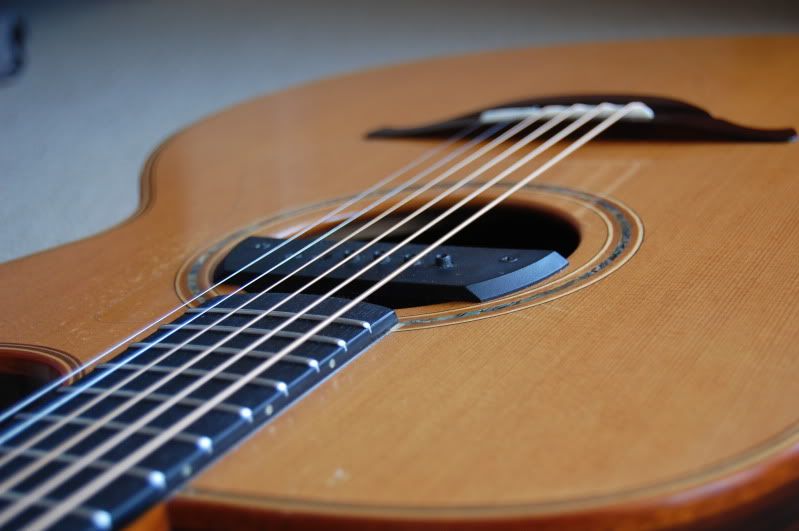
Since my late adolescence there has been this siren call that my music has had for me. During college, it was very strong and I was very close to making music my career. I majored in music and spent a lot of weekends traveling and performing in churches and coffeehouses. Still, it felt untenable as a way to actually live and I followed the other call and headed off to seminary. Then in seminary, the call re-asserted itself and I toyed with following a path as a "Christian" musician. After two years as an intern in a local church, I worked for one year with Come Alive Ministries, doing a syndicated radio show with Cheryl and traveling and performing in churches. I had some wonderful times and some that were anything but and it became clear that actually making a living doing music in churches was more difficult than I wanted to tackle. I decided to follow the call to the pastorate and, for the most part through the years, have felt that was the right decision.
I have continued to perform in a variety of settings through the years, playing in bar bands, as a solo singer/songwriter, in duos and trios and as a sideman. I also was on the board for the Eighth Step and now book a small concert series in Goleta. The tension has always been to find a way to make music that is meaningful and fits into the space allowed by the demands of family and job. At various times that has been easier and more rewarding than others.
I'm feeling a strong call again and trying to figure out how to make it all fit. I continue to play guitar for Jamie Green, although Jamie struggles with the same issues and is spending a significant part of her musical time with another project called Soul Aviv so we don't perform all that regularly. Alexis will be staying with us for a few months while her husband does a training program in New Jersey so we'll be performing once or twice, doing some of our material from the Alexis d days (one of the most satisfying musical times for me - you can hear it in the player on the right). Still, it feels like I need something more. I'm trying to take on a few more guitar students and to find a few more opportunities as a sideman on either guitar or bass but so far there hasn't been a lot of bites for either.
A couple of pieces have pushed me to think more about the solo singer/songwriter direction - a direction that is the most difficult, the most work, and perhaps has the most opportunity for reward. This past Sunday, my friend, Bob Terry played drums for us at church and we were talking afterward. Bob essentially said, "it's all about the music, making good music that feeds your soul." He was right. Then, I read a blog from an acquaintance, Fernando Gros, who seems at times to struggle with the same kinds of questions that I wrestle with... (although he answers them better). Fernando had two recent posts - here on the music biz, and here on putting together his new studio. Together with the discussion with Bob and my internal stuff, it has all been pushing me to get my butt in gear and start making more of my music and to do the work to get that happening.
So I'm writing this post as a way of making myself more accountable... and I'm hoping that every now and then some of you out there will say, "Hey Roy, have you written any music lately?" or "How is the plan for your little studio moving along?" or "Any solo gigs coming up?" I'm still looking for a few more students and I'd love to have a few gigs as a sideman on bass or guitar but... maybe with a little push, I'll answer the siren call in a way that both fits my life and makes some good music that is truly mine.
Saturday, March 26, 2011
dancing about architecture
Steve Martin reportedly once said that "talking about music is like dancing about architecture." I understand that. Music can be described and analyzed. There are rules and formulas that can be written down and passed on. There are techniques that can and must be learned in order to make music. Still, when it is all it should be, music becomes a spiritual experience that truly is beyond words... indeed, if what we say with music could be said with words, we'd do that. But we can't because there are things that must be communicated that are beyond words. So we make music. And music - vibration/harmony/melody/rhythm - is built into the very fabric of creation.
Zoe Keating is a cellist who makes sublime music using a cello and looping technology. This video is a short interview where she talks about her music and expands upon the ideas implicit in the Martin quote.
Zoe Keating is a cellist who makes sublime music using a cello and looping technology. This video is a short interview where she talks about her music and expands upon the ideas implicit in the Martin quote.
Thursday, March 24, 2011
Will the real....
_______ please stand up?
Back in my childhood, I remember watching the television show, To Tell the Truth. An individual with an unusual occupation or experience would be joined by two impostors and a panel of celebrities would question them and try to decide who was the real person. For some time I've struggled with the question, Would the real Baptists please stand up? or, Would the real Christians please stand up? And recently, Would the real Muslims please stand up? How do we decide who is the real thing? Who gets to define the term?
Let me give some examples. Early Baptists had four commitments that distinguished them from other Christian groups. They believed in soul liberty (an individual is responsible for his or her own faith), church freedom (no outside body can tell a church what its ministry must look like), freedom of the Bible (the scriptures speak for themselves and nobody can assign an official interpretation), and the separation of church and state(much more complicated than many people think, but that is another post). Those four commitments led to a wide variety of theological stances from fundamentalist to Unitarian but all stood within the tradition. Few Baptists today are willing to live with the implications of that freedom - think especially of the Southern Baptist Convention. Are they still Baptists?
How about Christianity in general? All Christians would presumably say they are trying to follow Jesus but their understanding of who Jesus is would differ to the point that, at least in some cases, they clearly are not talking about the same person. Let me give an example that is close to my heart and about which I'm willing to live with significant differences... but it is a real difference. The early Christians were pacifists. They followed the teachings of Jesus and understood the things he said about enemies as absolutely prohibiting participation in the military or acting in violence under any circumstances. Rather than take up arms against enemies, they chose to watch as loved ones were tortured and killed and to endure the same. Most in the Anabaptist traditions in the Church continue to understand the teachings of Jesus that way. Beginning with Constantine, Christianity began to identify more and more with the empire of the day and military service was seen as a appropriate way to express one's faith. There are movements in the US military today that absolutely identify themselves as followers of Jesus even as they launch missiles against Libya or attack enemies in Afghanistan. It is difficult to imagine a more different understanding of how to follow Jesus. Are they both Christian? Who decides and how? What does the term mean?
More recently there has been a great deal of discussions about the nature of Islam. We often hear statements like, "For Muhammad, religion and politics were one and the same so any Muslim is automatically against separation of religion and government and is out to impose Sharia law on the entire world. Convert or kill is the mandate." Whether or not that was Muhammad's original understanding is another discussion but it clearly is the understanding of some visible Muslims today. It also clearly is not the understanding of the overwhelming majority. Indeed, all of the Muslims I know are absolutely committed to freedom of religion and to a more peaceful expression of their faith. So, who gets to define the term?
I don't have any good answers. I find myself wanting to define the terms as I prefer they be used. Of course, that may or may not coincide with how you prefer they be defined or how the general population understands them. A good friend of mine was involved in a Black Muslim organization back in the 60's where they had a saying - "he who talks loudest gets over." Often these terms are defined by the most visible or most vocal groups... Do we allow the crazies (or at least the folk who don't think like us as they might define me as a crazy) to own the terms or do we keep trying to re-frame the discussions and redefine the terms? I have to admit that I'm growing tired of those battles... but they still feel worthwhile to me.
Tuesday, March 22, 2011
Libya
I feel deeply for the people of Libya. I respect the hunger they feel for freedom and self-determination and I think I understand both the optimism and the despair that led to their uprising. My heart breaks for the violence perpetrated by their own leader against them. I feel disgust at mercenaries willing to enter another country and kill the people there because the leader s afraid that using his own forces will alienate the military and turn them against him. Something in my gut resonates with the old Bruce Cockburn song, "If I Had a Rocket Launcher..." and the myth of redemptive violence calls me like a siren call.
All of that said, we should not be involved. There are at least three good reasons for that. The first is that we cannot afford to be involved in yet another war. I understand that on the first day, the US launched 112 cruise missiles into Libya. Those missiles cost $1 million each. Just for comparison sake, NPR receives about $5 million a year in government funding. Imagine how many teachers, college scholarships, meals for the poor, health care for the needy we could fund with $112 million dollars, and that was one day... there is no end in sight. Today, an F16E crashed. Evidently the pilots are safe but there are reports that US service people were injured in the rescue. I tried to find prices for an F16E and the ones I could discover ranged from $31.1 to 43 million in 1998 dollars. Add in the other costs and I can't imagine it is costing us less than $500 million a day. This is at a time when many are saying we're broke and those on the right are calling to slash programs for the poor, for children, for the elderly... We cannot afford to engage in yet another military adventure.
Second, we have seen that whether our intentions are good or not, we can't seem to get things right in the Middle East. No, I do not believe the lines we were fed by the Bush administration as we went into Iraq and Afghanistan, but at least some folk did... so even if I give them the benefit of a doubt, IT DIDN'T WORK. Why in the world would we think this would turn out any better?
The third is what war does to the participants, the human costs. Taking a human life destroys a piece of your soul even if the act is justified. For some folk, it is a small bit, for others, it is a huge piece and some never are the same again. I can't help but think the number of vets living on the streets has something to do with the condition of their souls when they got back... and healing a soul is not an easy thing. And there are the horrific examples of destroyed souls that we saw in the photos from Abu Ghraib and now from the "kill squad" in Afghanistan. I would never begin to imply that all soldiers turn into monsters... but some do. Were these evil kids before they went off to war? Perhaps some were, but what about those who were so damaged by their experiences that they became less than human. Again, I am not implying this is the norm or even common, but I do not believe these young men and women would have acted that way had they not been sent off to war. Yes, I know Obama has said we will not send in ground troops and at least to some degree that may mitigate some of the human costs to our side, but as today showed, even an "air war" sometimes requires boots on the ground and there are men and women firing the missiles and flying the planes who know their actions end in death and destruction. Plus, there are the traumatic brain injuries, the missing limbs, the deaths, collateral damage to civilians and infrastructure in foreign lands, and the destroyed families there and here.
I am a pacifist and do not believe war is justified, period, but for those who believe that at times war is a necessary evil, these human costs must be weighed seriously. This is not the time or place to send our young men and women.
Saturday, March 19, 2011
NFL lockout

You all know that I'm a football fan... well, not exactly a football fan, I'm a Steelers fan. Growing up in Pittsburgh, football is as present as the air you breathe and the Steelers are religion. Watching football on television, it is easy to forget just how violent the sport really is, how big, strong, and fast those players are. Imagine a 300 pound player with reflexes like a cat, wearing pads and a helmet, running at you at the speed of a high school sprinter with one thing in mind... and you're not at the happy end of that event.
My son, John, is built like an NFL defensive lineman and is stronger than a bull. His arms are significantly bigger than my thighs and as hard as rock. He is very athletic although not terribly aggressive. He started to play football in 9th grade and dislocated his knee in a scrimmage before the season even began. He decided not to play again.
There was some pressure on him through high school to join the team again and then even more when he attended City College where one of the coaches told him that with his size and strength and a bit of coaching, he'd have a good shot at getting a scholarship to a division one school when he was finished at City College. And they had a slot at nose tackle just waiting for him. He was very, very tempted but decided against it. I have to say that I was relieved. Even as I experienced a bit of a thrill, picturing him in my mind running out onto the field, pushing his way through the middle of the line and sacking the opposing quarterback, stopping a run up the middle to deny a touchdown, my imagination went back to the dislocated knee and imagined so much worse.
Those thoughts take me to the possible lockout of NFL players. Yes, many of them (not all) get paid huge salaries and it might be easy to see them as overpaid, spoiled brats. While some, no doubt, are, there is a lot more to the story. The average NFL career is only 3.6 years long and a very large percentage of those players leave the game with permanent injuries. Some will have permanent brain damage. Some will have leg injuries that will make walking painful or difficult for the rest of their lives. Many will struggle with weight issues and its attendant heart problems and diabetes. Depending on their length of play, they may or may not have significant health care benefits as they struggle with what are often lifelong problems.
During the lockout, the players will not be paid and they will lose whatever portion of that 3.6 year average career the lockout takes. In the meantime, the owners will continue to receive revenue from television contracts which pay whether or not the games take place. So, because of reduced costs and continued income, the owners will make a profit even if there is no season. The players, all of those who work in the stadiums, and the franchise cities will suffer.
So what do the owners want? They want an increased percentage of the total revenue. They now get approximately 50%. They say they are losing money but refuse to allow the players union to see the proof. They also want to increase the season 2 more games to 18. This would increase the likelihood of injuries to players and shorten their careers at the same time that their salaries would be cut. There are other details as well that would seriously impact the players.
What do the players want? A fair cut of the revenue, health care, basic rights, and to play the game they love. They are not asking for more of anything and indeed, had a collective bargaining agreement that the owners are choosing to back out of.
From what I can see, the players have tried to negotiate in good faith and the owners have done anything but. You can go to NFL Lockout to learn more and to sign a petition urging the owners to negotiate in good faith and allow the season to go ahead.
Tuesday, March 15, 2011
ahh springtime
Yes... I know it isn't spring time many places. And yes, I know that what passes for weather in Santa Barbra is pretty much perpetual spring. It took me a couple of years before I could figure out that there actually are seasons here, even though the differences are very, very subtle.

When spring comes, many flowering trees go into bloom and many of them are fragrant. The airs smells of flowers everywhere. We have a few pittosporum trees on the church campus that go into bloom in spring and are flat out amazing. They are bout 150 yards or so from my office but all I have to do is stick my head out the door to be intoxicated by them. Even cooler than that, as you would expect, they attract bees by the thousands. They are alive with them. Last year I discovered that if you stand under the trees in the morning and remain quiet, the trees actually buzz from the bees flitting from flower to flower, gathering pollen.
It is an amazing experience...
Thursday, March 10, 2011
Un-American
I'm a Baptist. One of the core commitments of all true Baptists is separation of church and state. Religion must be freely chosen and the government has no role in either curtailing or supporting religious practice. Essentially, religion must be invisible to government.
Today, Rep. King, a Republican from NY state is holding hearings to look into the "The Extent of Radicalization of Muslim Americans." While there is no doubt that there are radical Muslims in America and it might even be possible that the number is growing, to paint with such a broad brush is clearly a swipe against freedom of religion, a core principle upon which this nation was founded. When one faith group is singled out for attack, all are threatened.
Representative King, this is as un-american as it gets. You should be ashamed.
Tuesday, March 08, 2011
Time for Jubilee?
A few pieces fell together for me the other day and I have to admit, the constellation both horrified and frightened me.
Piece #1. There has been a concerted effort to mobilize the religious community in greater Santa Barbara to reach out to and care for our neighbors without homes.
Piece #2. I've read stats and seen charts about the economic division in the US... that the gap between the rich and the poor is growing wider, that the rich are getting richer at an alarming rate and everyone else is stagnant at best, that the wealthiest 400 Americans have about the same wealth as the poorest 155 MILLION people, that the percentage of children living in poverty is approaching 25% (here are a few graphs that point to some of this data)
Piece #3. Just when it is clear that more children are slipping into poverty, many of our political leaders call for cutting programs to help children. Just when it is clear that we are falling further behind much of the rest of the world in education (we're 9th in the percentage of YA's with college degrees), those same politicians are calling for cuts to education spending. Just as we're starting to crawl out of a terrible recession, they call for cuts in government jobs and spending which will put more people out of work. At a time of record deficits when a larger percentage of government receipts comes from regressive payroll taxes, they call for cuts in progressive taxes and for cutting the very programs that the regressive payroll taxes were put in place to fund.
Piece #4. The people seem to be rising up in response to the actions of the Wisconsin governor.
All of this got me thinking about the Year of Jubilee in the Bible. During the Year of Jubilee all debts were canceled, slaves were freed, and land returned to the families who had originally owned it. No family would permanently benefit from the hard work or luck of an ancestor nor would any family permanently suffer from the misfortune or laziness of an ancestor. There would be no trust fund babies and no permanent underclass. Every 50 years, wealth would be redistributed and everything would be equalized.
Now, as a person of European descent living in the US, I'd be more than a little leery of calling for a literal Year of Jubilee... that would put all of the property back in the hands of the Native Americans... Clearly though, it is God's plan that everything regularly be redistributed so everyone truly has a fair shake. I don't know what that might look like, but I think it begins with progressive taxes, includes programs for the poor, and values education and infrastructure above military might.
Tuesday, March 01, 2011
Love Wins
I've posted before about universalism... and I clearly believe it is the only reasonable option. I've been interested to see the topic being raised in evangelical circles lately. I think they struggle too hard against it, but more and more, especially younger evangelicals, seem to be embracing the idea.
Here's a video promo for a new book by Rob Bell
If you want to think a bit more theologcally about the subject, check out this excellent short post from Richard Beck on his blog. In a comment on that post, Tyler Priest remarks that at a conference he had attended, Jurgen Moltmann was asked if he was a universalist, Moltmann replied, "No no, there are some people I've met that I do not wish to meet again. But God, now God might be a universalist."
Here's a video promo for a new book by Rob Bell
LOVE WINS. from Rob Bell on Vimeo.
If you want to think a bit more theologcally about the subject, check out this excellent short post from Richard Beck on his blog. In a comment on that post, Tyler Priest remarks that at a conference he had attended, Jurgen Moltmann was asked if he was a universalist, Moltmann replied, "No no, there are some people I've met that I do not wish to meet again. But God, now God might be a universalist."
Subscribe to:
Posts (Atom)


