Hey I'm a Baptist. I believe in absolute freedom of religion. No government has any right sticking its nose in any matter having to do with religion. A few weeks ago I wrote a post about a movement of folk trying to get the LDS church in trouble for supporting prop 8 and that their tax exemption should be reneged.
I said "no" to this in spite of being staunchly opposed to their stand on the presenting issue.
I also made a statement in that post that puzzled a few people... Common wisdom is that non-profits don't pay taxes because of the benefit they provide to the community and the argument follows that when a non-profit breaks its covenant with the community, its tax exempt status is a benefit that can be removed. I said, "Religious groups are not taxed because the government has no say over them. The power to tax is the power to control and the state has no power when it comes to religion."
This power was demonstrated in the AIG mess when congress proposed a new tax law to tax the bonuses received by AIG workers at 90%. The power to tax was clearly the power to control. And that is why religious bodies are not taxed. If they could be taxed, then the government can control what they do and say. Indeed, that is precisely what those who wanted to remove the tax exempt status from the LDS were/are trying to do, control the actions of a religious organization through the power of the government.
Monday, March 30, 2009


Thursday, March 26, 2009
concrete
My friend Tom teases me about my cityboy background and celebrates that I have learned to appreciate places without concrete or traffic noise. Two weeks ago I had a meeting in one of the sections of LA where you can actually walk around, sort of like a northeast city. It reminded me why I like the city. Someday I hope I can live in a walking city again...
In the meantime I'm reminded of Ray Bakke's statement that the fall took place in a garden... and the kingdom of God comes in a city.
In the meantime I'm reminded of Ray Bakke's statement that the fall took place in a garden... and the kingdom of God comes in a city.
Monday, March 16, 2009
amplifying acoustics
guitars that is...
I love acoustic guitars. It is amazing what a good luthier can do with a few thin plates of wood, some metal strings, and a few other assorted parts. And it amazes me how much variation there can be in what is a pretty mature art. It is clear that dimensions can only vary so much or you either end up with an instrument that self destructs or one that sounds like a table. The materials chosen also make a significant difference in the end product. You can hear the difference between mahogany and Indian rosewood or even Indian rosewood and Madagascar rosewood. Scale length makes a difference. the size and shape of the body makes a difference. Every little detail is important. It is no wonder that the best guitars are not inexpensive.
Oh... but playing a good one... it is such an intimate experience to wrap the instrument with your arms and coax music from it.
Then comes the problem of playing live. Acoustic guitars are not very loud instruments. Sitting in the living room with friends, they're perfect. Playing on a stage in front of 100 or 1000, they just don't cut it. You need to amplify them. And amplifying an acoustic guitar is always a series of trade-offs between accuracy, feedback rejection, expense, the degree to which the source requires changes in technique, and complexity. You can't get cheap, accurate, with a low feedback threshold. So, the irony is that you spend thousands of dollars for a wonderful acoustic guitar and then have to spend a thousand more to get a good signal to send to an amplifier or PA system.
 Every player will come to his or her own conclusion regarding which trade-offs to make. For me, it is involves two different technologies of pickups. The first is a Sunrise. This pickup represents the same technology that is used in most electric guitar pickups - a magnet wound with wires that senses the movement of the string in a magnetic field. It is an old technology that is fraught with difficulties when used with acoustic guitars, not the least of which is that it tends to sound like an electric guitar rather than an acoustic. In my opinion, the Sunrise is the best magnetic pickup available for an acoustic guitar. It has a touch of the electric sound but only a touch. It also has a huge bass response and is the least likely pickup to feed back of anything out there. It is heavy, expensive, hard to get, and perhaps a bit ugly. By itself, I think it sounds OK. Paired with another source that makes up for its shortcomings, the Sunrise is amazing.
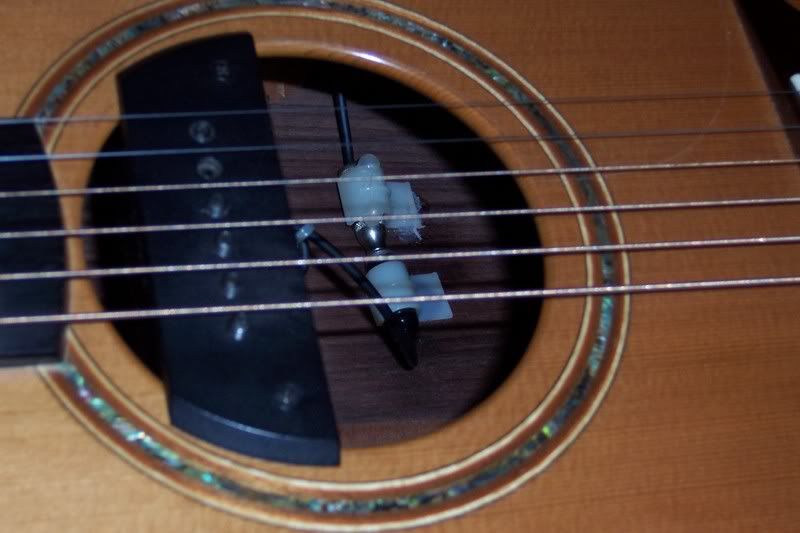
 Which brings us to the second source in my guitars, a piezo soundboard transducer affixed to the inside of the top of the guitar. This type of pickup can give a fairly accurate representation of the sound of an instrument. It works when a piezo crystal vibrates and generates an electrical current that is analogous to th vibrations. The downside is that they are extremely sensitive to placement (the photo is probably not the best placement), feedback relatively easily, and pick up every sound including your shirt sleeve sliding across the top of the guitar. My Lowden has a McIntyre in it and my Silver Creek will have a jjb like the photo in it.
Together the two pickups go to a pre-amplifier and a buffer that refines the sounds even more and I end up with a sound that isn't the same as the guitar acoustically but it is a HUGE sound that I find really pleasing. The irony is that it is a very expensive way to amplify an acoustic guitar and requires a huge amount of technology to sound... old fashioned. In the case of the Silver Creek, the pickups cost about the same as the guitar and when you add in the pre-amps and effects, the electronics are worth way more than the instrument where the sound begins.
I love acoustic guitars. It is amazing what a good luthier can do with a few thin plates of wood, some metal strings, and a few other assorted parts. And it amazes me how much variation there can be in what is a pretty mature art. It is clear that dimensions can only vary so much or you either end up with an instrument that self destructs or one that sounds like a table. The materials chosen also make a significant difference in the end product. You can hear the difference between mahogany and Indian rosewood or even Indian rosewood and Madagascar rosewood. Scale length makes a difference. the size and shape of the body makes a difference. Every little detail is important. It is no wonder that the best guitars are not inexpensive.
Oh... but playing a good one... it is such an intimate experience to wrap the instrument with your arms and coax music from it.
Then comes the problem of playing live. Acoustic guitars are not very loud instruments. Sitting in the living room with friends, they're perfect. Playing on a stage in front of 100 or 1000, they just don't cut it. You need to amplify them. And amplifying an acoustic guitar is always a series of trade-offs between accuracy, feedback rejection, expense, the degree to which the source requires changes in technique, and complexity. You can't get cheap, accurate, with a low feedback threshold. So, the irony is that you spend thousands of dollars for a wonderful acoustic guitar and then have to spend a thousand more to get a good signal to send to an amplifier or PA system.
 Every player will come to his or her own conclusion regarding which trade-offs to make. For me, it is involves two different technologies of pickups. The first is a Sunrise. This pickup represents the same technology that is used in most electric guitar pickups - a magnet wound with wires that senses the movement of the string in a magnetic field. It is an old technology that is fraught with difficulties when used with acoustic guitars, not the least of which is that it tends to sound like an electric guitar rather than an acoustic. In my opinion, the Sunrise is the best magnetic pickup available for an acoustic guitar. It has a touch of the electric sound but only a touch. It also has a huge bass response and is the least likely pickup to feed back of anything out there. It is heavy, expensive, hard to get, and perhaps a bit ugly. By itself, I think it sounds OK. Paired with another source that makes up for its shortcomings, the Sunrise is amazing.
 Which brings us to the second source in my guitars, a piezo soundboard transducer affixed to the inside of the top of the guitar. This type of pickup can give a fairly accurate representation of the sound of an instrument. It works when a piezo crystal vibrates and generates an electrical current that is analogous to th vibrations. The downside is that they are extremely sensitive to placement (the photo is probably not the best placement), feedback relatively easily, and pick up every sound including your shirt sleeve sliding across the top of the guitar. My Lowden has a McIntyre in it and my Silver Creek will have a jjb like the photo in it.
Together the two pickups go to a pre-amplifier and a buffer that refines the sounds even more and I end up with a sound that isn't the same as the guitar acoustically but it is a HUGE sound that I find really pleasing. The irony is that it is a very expensive way to amplify an acoustic guitar and requires a huge amount of technology to sound... old fashioned. In the case of the Silver Creek, the pickups cost about the same as the guitar and when you add in the pre-amps and effects, the electronics are worth way more than the instrument where the sound begins.
Thursday, March 12, 2009
more Andy McKee
this time playing a Lowden F model...
so which guitar do you like better? This one or the Greenfield in the post just before this one?
so which guitar do you like better? This one or the Greenfield in the post just before this one?
cool
growing up in the flower power days, materialism was a definite no no... except when you were talking about guitars. Then, you could own as many really cool guitars as, well, you could. More recently, materialism became trendy and owning huge numbers of guitars or a small number of very expensive guitars has even become an investment strategy. I try to avoid that temptation and my bank account impedes the reality... but I still find myself suffering from G.A.S. - guitar acquisition syndrome. My favorite guitars are build by George Lowden & company. I think George's design was a key to the movement of new fingerstyle guitar styles. Indeed, one of my fingerstyle playing friends Michael Millham, once remarked that Lowden was the guitar company owned by the largest number of his fingerstyle playing friends. I love my Lowden and can't imagine ever not owning & playing one.
Occassionally, though, I get GAS for someone else's guitars... and one builder who guitars inspire me from a distance - I've never played one - is Michael Greenfield, an individual builder who works in Canada. His guitars are gorgeous sounding... and really expensive.
Here is a video of Andy McKee playing his brand new Greenfield... I can only imagine how this guitar will sound as it opens up...
Occassionally, though, I get GAS for someone else's guitars... and one builder who guitars inspire me from a distance - I've never played one - is Michael Greenfield, an individual builder who works in Canada. His guitars are gorgeous sounding... and really expensive.
Here is a video of Andy McKee playing his brand new Greenfield... I can only imagine how this guitar will sound as it opens up...
Wednesday, March 11, 2009
a whale of a time
Santa Barbara is an inredible place to live for a lot of reasons. One is the closeness of the wild things of nature. A short hike into the mountains and you're in mountain lion country. A 22 mile ride in a boat and you can visit the least visited national pak - the Channel Islands National Park. A drive to Carpinteria and you can see the seals give birth. A drive up the coast and you can see elephant seals mating. Stand on the beach and watch the dolphins swim by...
The coastline runs east-west rather than north-south and there are a series of islands - the Channel Islands about 22 miles off the coast. Two currents, one from the north and one from the south meet in the channel. All of this adds up to wonderful feeding grounds for whales and because they migrate north-south, the curve in the coast here brings them very close to land.
This year, one or perhaps two adolescent whales found themselves very close to land... in the harbor as close as 30 feet from shore. They're feeding right at the mouth of the harbor and wandering in towards the marina. Here's a little video of one of them. Amazing!
The coastline runs east-west rather than north-south and there are a series of islands - the Channel Islands about 22 miles off the coast. Two currents, one from the north and one from the south meet in the channel. All of this adds up to wonderful feeding grounds for whales and because they migrate north-south, the curve in the coast here brings them very close to land.
This year, one or perhaps two adolescent whales found themselves very close to land... in the harbor as close as 30 feet from shore. They're feeding right at the mouth of the harbor and wandering in towards the marina. Here's a little video of one of them. Amazing!
Monday, March 09, 2009
beauty in small places
All too often I am too busy to pay attention to the small beauty all around me. Driving to Goleta, the hills are deep green now sprinkled with yellow mustard flowers and blue lupine. It is easy to drive past without being conscious of the beauty.
In our home, it is even more easy to miss the beauty. In December, I found a local artist named Kevin Loughran who makes the most wonderful, functional, pieces of art for a home. He is a gentle spirit who really does make the world a more beautiful place. In his words
We're slowly replacing switch plates in our home with his work... as reminder of the beauty that is all around us if we only look.
This one is by our entryway

Thanks Kevin for bringing a little more beauty into our daily lives!
In our home, it is even more easy to miss the beauty. In December, I found a local artist named Kevin Loughran who makes the most wonderful, functional, pieces of art for a home. He is a gentle spirit who really does make the world a more beautiful place. In his words
In nonferrous metals I build long term solutions for living graciously in a plastic world. I have been forming, etching and patinating metals into art for the past 25 years. I like to take the mundane in everyday objects and pay respect to their marvelous functions. That is why I presently work in switch plates, doorbells, and dimmers; to honor the beauty of the small things in our lives.
I feel very good about the quality and sensibility of my work as an expression of my obsession to create beauty.
We're slowly replacing switch plates in our home with his work... as reminder of the beauty that is all around us if we only look.
This one is by our entryway

Thanks Kevin for bringing a little more beauty into our daily lives!
Saturday, March 07, 2009
more on Iraq
My good friend Tom pointed me to an interview on NPR - Fresh Air - with Donovan Campbell. Campbell was a platoon leader in Iraq and put his experience there into a book called Joker One.
If Ricks' book talks about the big picture in Iraq, Campbell's talks about the personal. His memoir is at the top of my to read list. The little I heard in the interview when added to what I've learned from Fiasco has told me one thing. The cost of the mistakes made by both the civilian leadership and the military leadership in Iraq must never be allowed to be made again.
If Ricks' book talks about the big picture in Iraq, Campbell's talks about the personal. His memoir is at the top of my to read list. The little I heard in the interview when added to what I've learned from Fiasco has told me one thing. The cost of the mistakes made by both the civilian leadership and the military leadership in Iraq must never be allowed to be made again.
Thursday, March 05, 2009
Military
Anyone who has read much of my stuff knows that I am a pacifist. And I have that stand for religious reasons. There is more to it though. I grew up during the Viet Nam era and an anti-military stance was easy to come by. While family members of my father's generation all served - one uncle was in a German prisoner of war camp in WWII and my father served in Korea - we did not have a strong military tradition in the family. There is not a significant military presence in Pittsburgh, PA, where I grew up. I had few friends who served after Viet Nam and not a lot who served there. Those who did, never spoke of their experiences. Since moving to California, where the military has a significant presence, I have had more friends and church members with military backgrounds but even playing with guys stationed at Vandenberg Air force Base didn't give me much real information. All of that adds up to a serious ignorance about the way the military works. Any impressions I had were just that... and had various degrees of accuracy.
I heard Tom Ricks speak the other day at UCSB and was fascinated by what he had to say about Iraq. So I've started to work through his first book on Iraq Fiasco and when I'm finished with it, I will read The Gamble. I'm fascinated at his portrayal of the way the military works... even though I don't have any sense of how accurate it is. The philosophical and organizational principles really are significant to understand.
I was particularly taken by his discussion of "strategy," which he says is a technical term in the military, not to be confused with tactics. Strategy, he says, emerges from the answers to 4 straightforward questions and the clarity with which those questions are answered is foundational to everything that comes afterward.
1. Who are we in this situation?
2. What are we ultimately trying to do in this conflict?
3. How will we do it?
4. What resources will we use to accomplish these goals?
Good questions... that apply to just about any area of life but critical in situations where the decisions made can have lethal consequences.
I highly recommend the books. And I'd love to hear back from folk with a military background on the accuracy of his descriptions.
I heard Tom Ricks speak the other day at UCSB and was fascinated by what he had to say about Iraq. So I've started to work through his first book on Iraq Fiasco and when I'm finished with it, I will read The Gamble. I'm fascinated at his portrayal of the way the military works... even though I don't have any sense of how accurate it is. The philosophical and organizational principles really are significant to understand.
I was particularly taken by his discussion of "strategy," which he says is a technical term in the military, not to be confused with tactics. Strategy, he says, emerges from the answers to 4 straightforward questions and the clarity with which those questions are answered is foundational to everything that comes afterward.
1. Who are we in this situation?
2. What are we ultimately trying to do in this conflict?
3. How will we do it?
4. What resources will we use to accomplish these goals?
Good questions... that apply to just about any area of life but critical in situations where the decisions made can have lethal consequences.
I highly recommend the books. And I'd love to hear back from folk with a military background on the accuracy of his descriptions.
Tuesday, March 03, 2009
The Words
I have a good friend who is on a spiritual quest. She hungers for something... for faith... for connections. She has lots of friends from various faith traditions and she has shared her hunger with them all. Most have shared their stories in response. She especially struggles with dogma and with any top down kinds of directives.
We were talking one day and she told me that she was very attracted to Judaism but she just can't seem to leave out Jesus. I understand that feeling. Now, I know that I am a product of my culture and my background and all of that colors what I see and how I see it... but I just can't ignore Jesus either. His words, his actions, the movement he began, a view of God's kindom more inclusive and expansive than any other I'm aware of... I just can't ignore Jesus.
At the same time, there are lots of pieces that make me want to ignore those people who call themselves his followers. Since the very beginning we have overlayed Jesus with our interpretations, our dreams, our fears, and our theologies. Some, I think, have clearly represented him well. At other times, we have so skewed his message as to make it unrecognizable. Once, on a plane trip, a young woman with whom I was talking said, "we don't worship the same Jesus." She was correct, I think. Our presuppositions had so colored what we see, that we were not seeing the same thing at all.

Now, I know it is not possible to remove all of those lenses. But it is a good thing to work towards. One step is a new project by Lee Cantelon called The Words where he is publishing a collection of the words of Jesus. Again, I know there are translational issues and I know that scholars debate which statements Jesus actually made and which he didn't but the task is still a worthy and helpful one.
The book has already been translated into a variety of languages, has inspired a number of artists including Rickie Lee Jones and Abiodun Oyewole of the Last Poets, and is available as a free download in a bunch of languages both as text and as an audio book. You can purchase the printed copy at Amazon.
I'm really looking forward to it. I just can't ignore Jesus.
two quotes about the work... first from Rickie Lee Jones
and from Lee Cantelon
We were talking one day and she told me that she was very attracted to Judaism but she just can't seem to leave out Jesus. I understand that feeling. Now, I know that I am a product of my culture and my background and all of that colors what I see and how I see it... but I just can't ignore Jesus either. His words, his actions, the movement he began, a view of God's kindom more inclusive and expansive than any other I'm aware of... I just can't ignore Jesus.
At the same time, there are lots of pieces that make me want to ignore those people who call themselves his followers. Since the very beginning we have overlayed Jesus with our interpretations, our dreams, our fears, and our theologies. Some, I think, have clearly represented him well. At other times, we have so skewed his message as to make it unrecognizable. Once, on a plane trip, a young woman with whom I was talking said, "we don't worship the same Jesus." She was correct, I think. Our presuppositions had so colored what we see, that we were not seeing the same thing at all.

Now, I know it is not possible to remove all of those lenses. But it is a good thing to work towards. One step is a new project by Lee Cantelon called The Words where he is publishing a collection of the words of Jesus. Again, I know there are translational issues and I know that scholars debate which statements Jesus actually made and which he didn't but the task is still a worthy and helpful one.
The book has already been translated into a variety of languages, has inspired a number of artists including Rickie Lee Jones and Abiodun Oyewole of the Last Poets, and is available as a free download in a bunch of languages both as text and as an audio book. You can purchase the printed copy at Amazon.
I'm really looking forward to it. I just can't ignore Jesus.
two quotes about the work... first from Rickie Lee Jones
”The words of Jesus remain a ‘soft dream' that falls night by night, until the soul is ignited with courage. Our hearts, that did not sing until now, are filled with hope that did not yet dare to dream of freedom from poverty and oppression. With faith, what one feels is the Truth, and the truth, while difficult to teach, is immense. It is easy to learn. We have Christ among us, speaking through each of us, if we choose to listen. We have Christ and though there are few words, they are enough, they are enough to last two thousand years. In spite of so much distortion of His will and meaning, they reverberate clearly in the good work of so many Christians who may not even know they are ‘followers.'”
and from Lee Cantelon
The words of Jesus resound with a challenge to a world burdened by greed, self-righteous religion, and pride. The Jesus I discovered spoke a message of humility, one that did not emphasize a vengeful God, but one of love. His words were filled with mercy, compassion, and forgiveness. A new kind of kingdom was being introduced in his words, accessible to all; men, women, Jews, Gentiles, slaves, kings, free, lost, illuminated, and illiterate. All that was required was that we become “like children” and hold fast to this kind message that offers the stern command, “open your hearts!” How this has become so much dogma, who can understand? And understanding, to recognize his invitation to our right to become “children of God.” Is no great feat.
Friday, February 20, 2009
separation of church and state
I came across a group on Facebook today that is working to get the LDS Church stripped of its tax exempt status because of its support of Prop 8. The rumor is that over 50% of the money supporting Prop 8 came from the Mormons and letters were read in all of the churches in California encouraging members to work, volunteer, and give in support of the proposition.
I'm not fond of the idea that the Mormons may have pushed that terrible law onto the books in CA but I'm even less happy about the possibility of outside groups dictating the message or practice of any religious organization.
There are a number of arguments that should be addressed. Some say that tax exempt status is a privilege, gift, or benefit given to churches because they provide some benefit to the broader community and it comes with strings, including not being involved in politics in a substantial way. While that argument may fly for other 501 c3's, it doesn't fly for religious organizations. Religious groups are not taxed because the government has no say over them. The power to tax is the power to control and the state has no power when it comes to religion.
Others frame the tax exempt status as a subsidy to religious groups. While it is true that many religious organizations could not survive, at least in their current forms, if they had to pay taxes, again, this implies some gift that the government has the power to give or withhold from religious groups. It has no such power to give or to withhold.
A serious fallacy that is common in the US is the idea that religion is not supposed to be political. How can it not be if it is worth anything at all? If faith impacts an individual's values, is that not political? Doesn't that inform who we vote for and what ideas we support? If it impacts how they live their daily lives, is that not political? If religion speaks to what is important in life, is that not political? When we look at Jesus, the central metaphor for his ministry was a political one - the Kingdom of God. The history of social movements in the US is a history of religious groups acting politically whether it be the idea of religious freedom which found its strongest proponents in the Baptists and the Quakers, the elimination of slavery, women's rights, worker's rights, the civil rights movement, the anti-war movement... none of those political movements would have existed without people of faith acting politically from a standpoint of their religion.
Now one might argue that it is OK for people of faith to act poltically as individuals but not as groups. That betrays a misunderstanding of the diversity of faith groups. That certainly fits in the free church tradition, in many threads in Judaism, and in a number of other faith traditions which emphasize the role of the individual in shaping their own faith. In other groups, such as Catholicism and the LDS on a global level and even some fundamentalist churches on a more local level, the shape of faith is dictated by a hierarchy that literally defines what is and is not orthodox and who is in or out of the flock. In those settings, a political directive makes sense. A bishop might reasonably tell all of the members of his diocese that to vote for a certain pro-choice candidate is to risk excommunication. Likewise an LDS leader might tell all of the faithful that support for prop 8 is required to be a Mormon in good standing (I don't know how the encouragement was framed so this is just an example). Or a fundamentalist pastor may tell his congregation that they must believe a certain way which must be reflected in a vote for or against a certain candidate. Such prescriptions are built into the religion.
As a pastor, I think it is stupid to try to tell people how they should vote or what political stances they should take. In this age of baptistification (google the term, used by Martin Marty in the 80's), I think even the connectional churches risk serious problems when they try to dictate the beliefs of their constituents. Still, it solidly fits in their traditions and for the government or the people to try to curtail that practice seems clearly to be in violation of the 1st Amendment in that it impedes the free exercise of that religion.
I'm not fond of the idea that the Mormons may have pushed that terrible law onto the books in CA but I'm even less happy about the possibility of outside groups dictating the message or practice of any religious organization.
There are a number of arguments that should be addressed. Some say that tax exempt status is a privilege, gift, or benefit given to churches because they provide some benefit to the broader community and it comes with strings, including not being involved in politics in a substantial way. While that argument may fly for other 501 c3's, it doesn't fly for religious organizations. Religious groups are not taxed because the government has no say over them. The power to tax is the power to control and the state has no power when it comes to religion.
Others frame the tax exempt status as a subsidy to religious groups. While it is true that many religious organizations could not survive, at least in their current forms, if they had to pay taxes, again, this implies some gift that the government has the power to give or withhold from religious groups. It has no such power to give or to withhold.
A serious fallacy that is common in the US is the idea that religion is not supposed to be political. How can it not be if it is worth anything at all? If faith impacts an individual's values, is that not political? Doesn't that inform who we vote for and what ideas we support? If it impacts how they live their daily lives, is that not political? If religion speaks to what is important in life, is that not political? When we look at Jesus, the central metaphor for his ministry was a political one - the Kingdom of God. The history of social movements in the US is a history of religious groups acting politically whether it be the idea of religious freedom which found its strongest proponents in the Baptists and the Quakers, the elimination of slavery, women's rights, worker's rights, the civil rights movement, the anti-war movement... none of those political movements would have existed without people of faith acting politically from a standpoint of their religion.
Now one might argue that it is OK for people of faith to act poltically as individuals but not as groups. That betrays a misunderstanding of the diversity of faith groups. That certainly fits in the free church tradition, in many threads in Judaism, and in a number of other faith traditions which emphasize the role of the individual in shaping their own faith. In other groups, such as Catholicism and the LDS on a global level and even some fundamentalist churches on a more local level, the shape of faith is dictated by a hierarchy that literally defines what is and is not orthodox and who is in or out of the flock. In those settings, a political directive makes sense. A bishop might reasonably tell all of the members of his diocese that to vote for a certain pro-choice candidate is to risk excommunication. Likewise an LDS leader might tell all of the faithful that support for prop 8 is required to be a Mormon in good standing (I don't know how the encouragement was framed so this is just an example). Or a fundamentalist pastor may tell his congregation that they must believe a certain way which must be reflected in a vote for or against a certain candidate. Such prescriptions are built into the religion.
As a pastor, I think it is stupid to try to tell people how they should vote or what political stances they should take. In this age of baptistification (google the term, used by Martin Marty in the 80's), I think even the connectional churches risk serious problems when they try to dictate the beliefs of their constituents. Still, it solidly fits in their traditions and for the government or the people to try to curtail that practice seems clearly to be in violation of the 1st Amendment in that it impedes the free exercise of that religion.
Tuesday, February 10, 2009
Sunday, February 08, 2009
real people
A few months ago, prop 8 passed in California. Of the people with whom I spoke who voted for it, all did so on principles, on theology, or in some of the cases out of pure homophobia. The problem with all of them is that they forgot that prop 8 impacted the lives of real people. Here's a video that raises the next question... now what?
"Fidelity": Don't Divorce... from Courage Campaign on Vimeo.
"Fidelity": Don't Divorce... from Courage Campaign on Vimeo.
Tuesday, February 03, 2009
Gene Robinson's Prayer
Both before and after the inauguration, there was lots of discussion regarding Rick Warren's prayer. I knew that Gene Robinson, the openly gay Episcopalian bishop gave the prayer at the We Are One concert. I heard some controversy that HBO didn't include the prayer in their broadcast and I guess FOX didn't even mention it in the coverage, but I hadn't found the text of the prayer until today when I ran across it at Rabbi Rami's blog. Thank you Rami for making it easy for me to find.
I should say that I have real issues with prayers given at events like this. I'm not sure they are ever proper. They certainly are not if they just underscore nationalism and militarism as all too many do. All to many are either milquetoast or they just underscore the status quo... there is no place anywhere for prayers like that. Well, here is Bishop Robinson's prayer. It is a prayer that could be and should be prayed in places of power. It is a prayer that calls us all to be what we are called to be as God's children. It is a prayer that I join in praying with all my heart.
Amen.
I should say that I have real issues with prayers given at events like this. I'm not sure they are ever proper. They certainly are not if they just underscore nationalism and militarism as all too many do. All to many are either milquetoast or they just underscore the status quo... there is no place anywhere for prayers like that. Well, here is Bishop Robinson's prayer. It is a prayer that could be and should be prayed in places of power. It is a prayer that calls us all to be what we are called to be as God's children. It is a prayer that I join in praying with all my heart.
“O God of our many understandings, we pray that you will…
Bless us with tears — tears for a world in which over a billion people exist on less than a dollar a day, where young women in many lands are beaten and raped for wanting an education, and thousands die daily from malnutrition, malaria, and AIDS.
Bless this nation with anger — anger at discrimination, at home and abroad, against refugees and immigrants, women, people of color, gay, lesbian, bisexual and transgender people.
Bless us with discomfort — at the easy, simplistic answers we've preferred to hear from our politicians, instead of the truth, about ourselves and our world, which we need to face if we are going to rise to the challenges of the future.
Bless us with patience — and the knowledge that none of what ails us will be “fixed” anytime soon, and the understanding that our new president is a human being, not a messiah.
Bless us with humility — open to understanding that our own needs as a nation must always be balanced with those of the world.
Bless us with freedom from mere tolerance - replacing it with a genuine respect and warm embrace of our differences.
And bless us with compassion and generosity - remembering that every religion's God judges us by the way we care for the most vulnerable.
And God, we give you thanks for your child Barack, as he assumes the office of President of the United States.
Give him wisdom beyond his years, inspire him with President Lincoln's reconciling leadership style, President Kennedy's ability to enlist our best efforts, and Dr. King's dream of a nation for all people.
Give him a quiet heart, for our Ship of State needs a steady, calm captain.
Give him stirring words — we will need to be inspired and motivated to make the personal and common sacrifices necessary to facing the challenges ahead.
Make him color-blind, reminding him of his own words that under his leadership, there will be neither red nor blue states, but the United States.
Help him remember his own oppression as a minority, drawing on that experience of discrimination, that he might seek to change the lives of those who are still its victims.
Give him strength to find family time and privacy, and help him remember that even though he is president, a father only gets one shot at his daughters' childhoods.
And please, God, keep him safe. We know we ask too much of our presidents, and we're asking far too much of this one. We implore you, O good and great God, to keep him safe. Hold him in the palm of your hand - that he might do the work we have called him to do, that he might find joy in this impossible calling, and that in the end, he might lead us as a nation to a place of integrity, prosperity and peace.
Amen
Amen.
a hoot... or a hootenany
My friend Jon, blogged about a new software product from Microsoft called Songsmith. Evidently, it works like a reverse karaoke. You sing into it and it produces the chord structure and instrumntation for your melody in a style of your choice. There are scores (excuse the pun) of popular songs on Youtube, processed through the software. Some are hilarious. This one is my favorite.
or maybe this one...
And no, there is no way I'm going to get the software. It would be a black hole of wasted time for me. But it would be fun.
or maybe this one...
And no, there is no way I'm going to get the software. It would be a black hole of wasted time for me. But it would be fun.
Monday, February 02, 2009
talk radio
When I'm in the car I usually listen to either NPR or to talk radio. We have an Air America affiliate here but neither their coverage nor NPR's reaches all of my roaming area so sometimes I find myself listening to Sean Hannity or Rush Limbaugh or another talker of that stripe.
I understand that they need to keep an audience and that means pushing things a bit, but... but... but...
I have to say that I am more than a little miffed when they say they hope Obama fails. Now I am no fan of the W. I think and thought the first election was stolen and possibly the second one too. I think he was a disaster as a president. But I never once wished he would fail. I fully expected he would, but I never hoped for it. Why? Because his leadership impacted the entire world. If he failed. We failed. Jobs were lost. Unnecessary wars were fought. People died. I didn't want him to fail.
Now, of course, had he succeeded, it would have been very difficult for the dems to get power and for a dem to get elected as president, but that was a price I was willing to pay if it would have made the world more stable and people's lives fuller.
No, when they hope for Obama to fail, they are hoping for people to lose their homes and their jobs. They are hoping for my neighbors to lose their healthcare and to have to make choices between medicine and food. They are hoping for the world to erupt in violence and for innocent children to die as collateral damage. They are being absolutely unpatriotic. They are sinning against all of humanity.
The second piece that I've been hearing makes me laugh. I can't tell you how many times I've heard these apologists for the Bush administration attack Obama and say, as good Republicans, they are for fiscal restraint and a balanced budget. Did they sleep through the last 8 years? Did they forget that Bush came into office with a surplus (left to him by a Democrat) and left with the largest deficit ever? Or did they forget that in large degree the last administration, a Republican administration, virtually did exactly what it wanted to do for 8 years and in doing so, put our economy in the toilet, decimated our military, shredded the constitution, and destroyed our standing in the world? Or maybe they just think their audience is so stupid that they have forgotten who got us into the current mess.
Now they also spend a lot of time talking up the Bush administration's legacy. They remind us that during the final 7 years of Bush's administration no terrorist attacks took place on US soil. That is true. But no aliens from outer space attacked us either. Is either one due to the diligence of the Bushies? Got me, but given the way they ran the wars in Iraq & Afghanistan, the economy at home, and took care of the constitution, I have my doubts they were responsible for fending off either attack. At the same time, we do know who was president when 9/11 happened and we do know that reports were ignored that gave warnings about Osama Bin Laden. They seem to forget that as well.
Well, I guess they do succeed in accomplishing their primary objective though. I get upset. And I listen some more.
I understand that they need to keep an audience and that means pushing things a bit, but... but... but...
I have to say that I am more than a little miffed when they say they hope Obama fails. Now I am no fan of the W. I think and thought the first election was stolen and possibly the second one too. I think he was a disaster as a president. But I never once wished he would fail. I fully expected he would, but I never hoped for it. Why? Because his leadership impacted the entire world. If he failed. We failed. Jobs were lost. Unnecessary wars were fought. People died. I didn't want him to fail.
Now, of course, had he succeeded, it would have been very difficult for the dems to get power and for a dem to get elected as president, but that was a price I was willing to pay if it would have made the world more stable and people's lives fuller.
No, when they hope for Obama to fail, they are hoping for people to lose their homes and their jobs. They are hoping for my neighbors to lose their healthcare and to have to make choices between medicine and food. They are hoping for the world to erupt in violence and for innocent children to die as collateral damage. They are being absolutely unpatriotic. They are sinning against all of humanity.
The second piece that I've been hearing makes me laugh. I can't tell you how many times I've heard these apologists for the Bush administration attack Obama and say, as good Republicans, they are for fiscal restraint and a balanced budget. Did they sleep through the last 8 years? Did they forget that Bush came into office with a surplus (left to him by a Democrat) and left with the largest deficit ever? Or did they forget that in large degree the last administration, a Republican administration, virtually did exactly what it wanted to do for 8 years and in doing so, put our economy in the toilet, decimated our military, shredded the constitution, and destroyed our standing in the world? Or maybe they just think their audience is so stupid that they have forgotten who got us into the current mess.
Now they also spend a lot of time talking up the Bush administration's legacy. They remind us that during the final 7 years of Bush's administration no terrorist attacks took place on US soil. That is true. But no aliens from outer space attacked us either. Is either one due to the diligence of the Bushies? Got me, but given the way they ran the wars in Iraq & Afghanistan, the economy at home, and took care of the constitution, I have my doubts they were responsible for fending off either attack. At the same time, we do know who was president when 9/11 happened and we do know that reports were ignored that gave warnings about Osama Bin Laden. They seem to forget that as well.
Well, I guess they do succeed in accomplishing their primary objective though. I get upset. And I listen some more.
Saturday, January 31, 2009
Steelers!

I have wanted a Steelers jersey for years, the problem was, which one?
While the Steelers have always had great players, they have often been at positions that don't have a lot of sex appeal. For example, Pittsburgh has been known for its linebackers. Everybody knows quarterbacks and running backs and even receivers, but linebackers? James Harrison received the award for defensive player of the year, the best in the league right now, but a lot fewer people know his name than even the middle bunch of QB's. So, I thought about his number... 92. And the other three linebackers are even less well known but are all amazing players and equally important to the Steelers defense - Foote, 50, Farrior, 51, Woodley, 56. I actually found a Farrior jersey at a local store but it was the away color - white and I wanted a black one.
I thought about Hines Ward's number too, 86. Now as a receiver, his position has a bit more sex appeal and more people know his name. The piece that attracted me to his number is that he is a workhorse. He does whatever is necessary for the team to win. And he always comes up smiling. He just exudes joy when he is playing.
Lastly, I thought about Troy Polamolu, 43. He certainly is the most well known of the Steelers defense. Anyone who watches football recognizes his mane of black hair flowing as he charges across the field. He plays with the same intensity and abandon that I enjoy in guitar players (think Jeff Beck). He is not a big guy - 5'10" and 207 lbs - but he doesn't hesitate to tackle one of the 250 pound running backs coming at him at full speed. It doesn't hurt that he is a man of faith - Eastern Orthodox. His number was easy to find so here we are. Tomorrow, I'm wearing my #43 jersey to church.
Go Steelers
Friday, January 30, 2009
Subscribe to:
Posts (Atom)


