Showing posts with label Paris. Show all posts

Wednesday, November 25, 2015

A Good Guy with a Gun

Following the events in Paris, I have read multiple right wing commentators who speculated that if only Parisians had had guns, there would have been a very different outcome at the Bataclan.  Well, they're probably correct, but I don't know that the different outcome would have been a better one.

I won't argue whether or not a gun ever helps to deter crimes.  I understand there is good data that points that way but there is also good data that indicates that the very presence of a gun makes things more dangerous.  That is what I expect would have happened at the Bataclan.

Imagine the scene with me.  There is a large crowd of people gathered in a fairly chaotic place when all of a sudden one person pulls out a gun and begins firing.  Then a second pulls out a gun.  Then a third and a fourth.  How would you know who is a "terrorist" and who is not?  A fifth person, whom we know to be a "good guy," pulls a gun and begins to fire at one of the previous four, who then fires back.  If that fourth shooter was actually not a part of the terrorist group, he or she likely thinks the fifth is.  Multiply that by many people pulling guns and beginning to shoot at someone else who is shooting, all the while a number of innocent bystanders have been hit.  (After all, none of these shooters are trained to fire at real people in highly stressful situations while others are shooting back at them.) Then the police arrive on the scene only to see multiple shooters with weapons drawn, shooting at others in the panicked crowd.  How do they know who is a "good guy" and who is not?  So they begin firing as well.  Multiply all of that as the number of "good guys with guns" goes up.   What began as an horrific event has turned into the shootout at the OK corral. 

Recently in less crazy settings we have seen incidents that went horribly wrong.  There is the story of the car jacking victim in Houston a few weeks ago who was shot in the head, presumably by a "good guy with a gun" who was trying to help stave off the crime.  Instead, the victim was shot, the carjackers escaped, and the "good guy" picked up his shell casings and fled the scene, no doubt worried that he would be arrested.

I'm reminded of the meme that went around a few weeks ago... A small boy was throwing stones at other children in the school yard.  The teachers knew that something needed to be done or one of the children would likely be injured so, they handed out more stones to the other children.  That makes sense...

Adding more guns to a terrible situation does change things... but not necessarily in a positive way.

Wednesday, November 18, 2015

Fear and Religious Freedom

You have likely heard freedom of the press referred to as the "first freedom," because it is central to the functioning of a democracy but also because many folk think it is the first freedom listed in the Bill of Rights.  While it is part of the first amendment, it is not the first one listed.  The first freedom listed is freedom of religion.   One might argue that the order is irrelevant but I think it is not.  Freedom of religion tells us that the government has no say in the way that we order our values and shape our lives.  Freedom of speech and of the press is rendered impotent if the government first has the power to repress or support that most central of individual functions - the way we shape who we are, what we believe, what we value.  As with all of the freedoms in the Bill of Rights, religious freedom is aimed primarily at protecting those who fall outside of the centers of power - odd groups, minority groups, those who do not

Like all freedoms, freedom of religion comes with risk.  There are religious systems that by their nature are oppressive and destructive.  There are religious systems that by their very nature work against human progress.  There are even some that promote violence.  As a nation we have wrestled with the ways to deal with those issues and have decided - rightly I believe - that before the government can interfere with religious practice, it must show a compelling interest.  Fear is not a compelling interest.

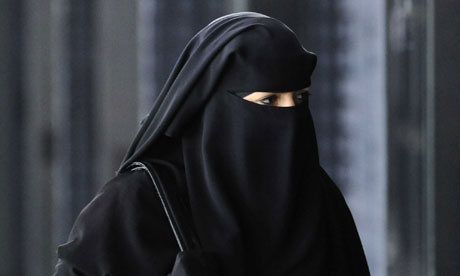
Recently, because of the actions of a very small group of jihadists, Muslims have been the object of
fear and of discrimination.  One piece that comes up regularly is the wearing of burqas or niqabs which cover everything except the eyes (and sometimes even the eyes) by Muslim women.  The arguments go two ways.  One says that such treatment of women is oppressive (that is another post).  The second is more prevalent now in these days following the terrorist attacks in Paris.  It says that these loose fitting garments allow someone to hide weapons which are then easily used to commit violence and prevent others from being able to identify the person wearing the garments.

The fact that the vast majority of terrorists are men and that loose garments that cover the majority of the body are often worn by folk for very practical reasons (spend any time in northern Minnesota in January without everything being covered?) and that in many states in the US, citizens are allowed to openly carry weapons down the center of the street tells us that this is more about fear of the other than about terrorism.

It is worth understanding Muslim discussions and thoughts regarding hijab - modesty of dress for both men and women - in various Muslim cultures and theological traditions but that is basically irrelevant at this point.  Many religious groups including orthodox Jews, the Amish, Sikhs,  some groups of evangelical Christians, and some Muslim traditions have proscribed ways of dress for both women and men.  The question is whether or not the government has the power to define religious expression in terms of dress.   Perhaps a more blunt way to phrase the question is whether or not the government has the power to tell you or me what we must wear?  If some Orthodox Jew finds it offensive that my wife's forearms are showing as she walks down the street or some Amish folk think my dress is too colorful should they be allowed to enforce their religious understandings?  Should a Sunni from Saudi Arabia be able to make my female readers wear a niqab?  We would be up on our hind legs in a second if any of those enforcements were to take place.   We should feel the same repulsion at the idea that the government can make a woman who believes that her religious commitment to hijab requires her to be covered to uncover herself.