Wednesday, July 29, 2009

health care again... until we all get it

In his periodic personal reflections, Roy Medley, the General Secretary of the American Baptist Churches, USA (my denomination) addresses the health care crisis. He begins with these words...

Health care needs to be affordable. For too many it is not.
Health care needs to be portable. For too many it is not.
Health care systems need to be more efficient. Too many are not.
Health care should not involve profiteering. For some it does.
Health care needs to be available. For too many it is not.


That is the key isn't it? The current system is broken. (I encourage you to read his entire article linked in the first sentence...) Anyone who argues against a single payer system comes back to those five simple facts and cannot adequately address them. There is no other way that I can see that addresses all of the concerns. To leave any of them unaddressed is unjust and poor stewardship of the resources of our nation. As a person of faith I would say that to leave any of these issues unaddressed is sin.

write you legislators and tell them to get on board with a strong public option, or better yet to remove the insurance companies altogether.

Thursday, July 23, 2009

wedding

Generally, I'm not crazy about doing weddings. They tend to be high pressure, low integrity events. Now, I have participated in some that were wonderful but that tends to be the exception in my experience.

This one looks like fun.


Just think... dancing into marriage rather than marching. Sounds good to me.

health care - 2 arguments

I am fascinated that there are two arguments circulating against a government sponsored health care plan... two arguments that conflict with each other. Let me address both of them.

The first is that the government can't do anything well so we can't allow them to do something as important as health care. A sub argument of this is that or system is already "the best in the world."

Let's get rid of the sub argument. According to the World Health Organization the US ranks37th in the world, just between 36- Costa Rico and 38, Slovenia. France is 1 and Italy is 2. We are still behind such countries as Singapore (6), Morocco (29), and Chile (33). We have huge number of folk uninsured who have no access to health care at all until they go into the emergency room and then are paid for by the rest of us. And very few of us have adequate health insurance. A few years ago my daughter needed surgery. Without it, she would have chronic pain in her jaw, eventually would lose her hearing, and would have her jaw lock occasionally which would have to be broken to unlock. Our incredibly expensive insurance didn't cover the procedure regardless of the prognosis without it. We were faced with the decision of paying out of pocket or watching that unfold. My daughter carries a new BMW in her mouth. In 2007, 62% of bankruptcies are related to health care costs.

I am always surprised that the same folk who argue against government sponsored health care are happy to rely on government sponsored police protection, fire protection, military, and roads. You can't have it both ways. Either the government is completely inept and shouldn't be doing those things either or you have to allow that government can do some things well. Indeed, there are some things that only government can do well.

Now some would say that they don't want a government bureaucrat making decisions regarding who gets what tests, etc. The problem is that under the current for profit insurance system, a bean counter makes those decisions. For the government employee, at least the primary concern is the public good. For the bean counter, the only concern is maximizing profits. At the bottom line, and it is about the bottom line, they are trying to cover as little as possible so as to spend as little as possible and keep as much as possible of your and my insurance premiums. We learned that with Alexis' surgery. Give me the government bureaucrat any day.

Will some decisions be made that we don't like? Yes. Will some procedures be denied? Yes. Is that different than now. No. The difference is the motivation for denial. Currently it is because of a profit margin. Then, it will be because of projected outcomes.

The second argument against a public option, is that the insurance companies won't be able to compete. Understand that. The government program will be cheaper and better so the insurance companies will not be able to provide the same service at as low a price. I love it. The government program will be too good. And that is an argument against government sponsored health care?

OK, the argument is a little more subtle than that. It goes like this. The government program will be so good and so cheap that the private companies will no longer be able to compete and will go out of business. Eventually there will be no competition and the government program will become sloppy and quality and price will suffer. This argument again ignores the current reality. Almost none of us shop for insurance. If you get it through your employer, they provide what they provide. Take it or leave it. And in large degree, they make contracts based on cost or availability. I get my health insurance through my church. It is ridiculously expensive. It s also the only option we have. If you don't get insurance through an employer, I'll bet you don't have any. Likewise regarding physicians, labs, etc. I get a list... a small list from my insurer and that is where I go. Sometimes there is one name. Sometimes, for some specialties, there are none. I know nothing about any of them and have no way of knowing anything about any of them. So much for choice or competition.

Another piece is the "bad word" - socialist. We can't have socialized medical care. First off, the only country I'm aware of with true socialized medicine - that is where the government owns the hospitals and clinics and the physicians and nurses are government employees - is Great Britain (number 18 on the list). Other countries have socialized insurance where the government provides a single payer insurance and the physicians/hospitals/etc. are private vendors. The difference is one insurance company with all of the economies of scale and the motivation of the public good vs. a system of multiple insurance providers with different rules, providers, and the primary motivation being profit rather than the public good.

There is another argument... and it is the saddest one of all. If we suddenly provide health care for everyone, there won't be enough doctors and facilities. This is always an argument from someone who has health insurance. The bottom line here is, "I have mine, so *%#* you if you don't have yours." It is a real concern but the answer is not to ignore the needs of so many, it is to change the system so we train more healthcare professionals. They do it in every other civilized nation in the world. Why not here?

Thursday, July 16, 2009

Whales

On Tuesday I visited Santa Cruz Island in the Channel Islands National Park for the first time. It was a wonderful trip with my friend, Rasul.

We hoped to see some whales in the Santa Barbara Channel but didn't have any luck. There are blues and humpbacks in the channel but none along our route. I really hope to see a humpback breach someday. We did see a few hundred common dolphins though...

so, whales have been on my mind lately. My friend Ashley Smith posted a link to this wonderful story in the NY Times on the
"friendlies" of Baja.

cool

Wednesday, July 08, 2009

evangelism

Back east, we called this kind of dancing "the Bennington Noodle" after the sort of hippie dancing we imagined students at Bennington College did and which we often saw at jam band concerts... It is less than rhythmic and certainly not graceful, but it is filled with joy.


A week or so ago, Len Sweet posted a link to Eugene Cho's blog with some discussion of the above video. Sweet tweeted that an entire theology of evangelism could be written from the video. (thank to both of you for sharing this fun video)

I think he's right. I think there is lots here to talk about. I think the video really points up the need in younger generations to be a part of something bigger than they are and to experience a sense of community. It points out the need to stand up for what is in our hearts even when it looks silly... and if we do, it might just become contagious. It underscores the need for a few early adopters. Most importantly for me though, it points to the deep down joy of just letting loose and experiencing the moment. That thought is underscored by the Old Testament reading in this week's lectionary readings - 2 Samuel 6:1-5, 12-19 where David dances before the Ark.

In my sermon prep I read that the word in Aramaic for dance is the same as the word for rejoice... So let us rejoice! or dance! or noodle! and not be concerned if it looks silly.

Tuesday, July 07, 2009

Michael Jackson

there's been way too much said already... but John Mayer's version of Human Nature at the memorial service is just wonderful. I love the tones he gets out of his guitar and the arrangement with only background vocals is just perfect for this setting.

Friday, July 03, 2009

It's Time


It is time... time for a public option national healthcare plan. Frankly, I don't care whether or not the option of private insurance continues but there must be a public option now.

Tuesday, June 23, 2009

Her Morning Elegance

a beautiful video and a great song...

translation

ever think about the way that one culture translates into another?

take a look at the opening sequence of The Cosby Show as it is seen in India.

Monday, June 22, 2009

Why I'm a Baptist

I write this to remind myself... because I'm not happy with the directions the tradition has taken nor with the choices that have been made by my own denomination - The American Baptist Churches, USA.

Walter Shurden in his book The Baptist Identity: Four Fragile Freedoms, says there are four distinctive commitments that define what it means to be a Baptist.

1. Freedom of the Bible - the idea that scripture speaks for itself and the individual believer is obligated to study it using the best possible tools. There is no "official" interpretation of the Bible. Nobody can definitely say, "this is what the Bible means" and therefore there are no creeds or doctrinal checklists.

2. Soul Freedom - Each individual is both able and required to work out his or her own faith and relationship to God with no interference by clergy, church, hierarchies, or state. Nobody can tell you what your relationship to God is supposed to look like. That is between you and God.

3. Freedom of the Church - It is the responsibility of each congregation to work out the shape of its faith and its ministry in its context. No outside body can tell a church what they must believe or how they must do ministry.

4. Freedom of Religion - The state has no power to impose religious tests on anyone or shape religion in any way. The idea of separation of church and state in the US came primarily from the Baptists and the Quakers.

Obviously, Shurden says more about these distinctives than I have shared in 4 short paragraphs but you get the picture and can sense the radicalness inherent in these four commitments. They leave the door open to incredible diversity from TULIP fundamentalists on the right to unitarianism on the left and everything in between. Indeed, the Baptist tradition in the US includes the whole of that diversity. It is that wild and wide tradition that caught my imagination and continues to insire me. It is that crazy mix that seems to me to be the most viable shape for Christianity to take in this post-modern world. It is also a tradition that is frightening to many and seems to me to be being abandoned by almost all Baptist groups.

Let me give one simple example. In the ABCUSA, they are talking about a "common table," i.e. when representatives gather, each of the participating bodies agrees not to send a representative that another body would exclude. Left out are GLBT folk because some of the more conservative folk in ABC will not sit at table with them. How can we claim to be Baptists and then tell a church or group of churches that they cannot send an entire class of people as representatives to our gatherings? What about the first three freedoms? It was in that rough and tumble mix of differing ideas and interpretations that I most clearly heard the voice of the Spirit. And now we move to the lowest common denominator?

I am still a Baptist. I want to remain a Baptist and I dream of a day when some Baptist body stands up and clearly says, "THIS IS WHO WE ARE!" I fear it will never come and the tradition will morph into something it is not, and then disappear completely.

Saturday, June 20, 2009

Father's Day

My father died on May 27, 2006. Below is the post I put up that day. I decided to copy it here rather than just link to it.

I still miss him and wish that things had been better. I'll think of him a lot tomorrow.

May 27, 2006
in memoriam George W. Donkin jr.


Some of you know that both of my parents were admitted into hospice in February. Both had severe emphysema and mom has an abdominal aneurysm as well. Dad died peacefully in his sleep this morning. I got to speak to him yesterday on the phone and assured him that we love him and it was OK to let go, we would see that mom was cared for.

Growing up we had the ambiguous relationship that children often have with their parents. Dad never showed his emotions very well and wasn't there a lot. He was a diesel mechanic and worked hard all of his life. He left for work before I got up, came home, often after a stop at a bar for a beer and talk with friends, took a hot bath, ate dinner, and went to sleep. Saturdays, he slept half the day. Sundays, we went to church and then to my grandmother's for Sunday dinner. Friday and Saturday nights were often cards with family or, for a few years, my parents went bowling. I never remember him missing a day of work for any reason. In his late 30's he had back problems... he wore a brace and went to work and when he came home he could barely stand, I would pull on his legs to relieve the pressure. The next day, he went back to work.

It was later that I began to realize that the hard work was his way of showing love. He understood his role as providing for his family and he did that the best he could as a blue collar worker for as long as he could. He probably should have died a few weeks ago but he hung on because he didn't want to leave mother alone.

When I turned 18 I learned that he was not my biological father. My mother married right out of high school, had my older sister, divorced, met my biological father & married, had me, and when I was 9 months old, he died. George Donkin, in his mid 20's, married Jean with a 6 year old daughter and 1 year old son. Three years later George and Jean had a daughter. My biological father was in many ways a fantasy - he was a first mate on an oil tanker and spent much of his time away at sea. When he was at home, it was all gifts and parties and the realities of living together never intruded. George competed with that image all of his life. I know it was difficult for him but he hung in there.

It wasn't until I was well into my adult years that I began to understand more of him and appreciate his love and the faithfulness with which he expressed it. I hope that I have learned that from him.

I love you, Dad. Peace be with you and may God hold you in the palm of his hands.

Saturday, May 30, 2009

Californication

no, not the CD by Red Hot Chili Peppers nor the show on Showtime...

I'm just really frustrated by this state... again...

Our state budget is in the toilet and essential services are being impacted in a serious way. Cuts to education are particularly troubling to me. And there is no need for it. California is a rich state. If it was a country, its economy would be something like the 9th largest in the world. We have everything from agriculture all over the state that feeds the world to Silicon Valley that shapes the way the world shares information. There is no reason our tax base should be unable to provide the basic services we need and pay for the government...

Well, no good reason. There is a reason. Propositions. I've written about this dysfunctional way of doing government before but it has hit the fan now. If you can get a relatively small number of people to sign a petition, you can get a proposition on the ballot. If you have enough money to do some serious advertising, you can get it passed. Once it is passed, the only way it can be changed is by another proposition. The legislature cannot touch any laws enacted by proposition. You've noticed that there are no requirements that the proposition be well written, aware of collateral consequences, or even helpful. You only have to sell it and then it is law.

So, what typically happens is that some special interest passes a law requiring funding for their cause. It may e a good cause. It may even be a great cause... but rarely does the proposition include provisions for a funding stream (that would look too much like a tax). It passes and codifies a program which takes away money from the general budget. Then another proposition is introduced to cut or cap taxes (prop 13 is the grand daddy of all of these). So the income shrinks but the outflow cannot. It is codified. And the legislature cannot address the issue without a proposition. As Bill Maher said in New Rules last week, you end up with a fantasy land where people vote for wonderful programs while also voting to get them essentially for free. And you can see the problem.

FWIW, Paul Krugman had a great column on the issue this week.

Prop 8 showed the other problem with propositions. After the court ruled that the prop 8 stands, there were lots of folk in the media commenting that the people had spoken and the role of government was to honor the wishes of the majority. Frankly, I'm glad that hasn't been the policy in the past. Segregation would not have ended in the south as the majority would clearly have voted to keep the races separate. The list of examples is long. Part of the role of government is to stand against the tyranny of the majority and to ensure the rights of those outside of the mainstream. Regardless of how one feels about this issue, this was not the way to address it.

I don't see any way to get rid of the proposition process... but I sure would like to see it happen.

Thursday, May 21, 2009

vocapeople

it's been a while since I posted a video so here is a vocal group that I think is pretty cool... would love to see them live some time.

Friday, May 15, 2009

Torture

There is an awful lot of discussion going on these days regarding the appropriateness or inappropriateness of waterboarding and whether those involved should be prosecuted.

Let me give my short answer and then I'll discuss the issue a bit...

Waterboarding is torture and as such it is never acceptable under any circumstances. All of those who were involved should be prosecuted and it should not be only at the lowest levels. If those higher in the Bush administration approved or ordered those "techniques," they should be prosecuted as well... all of the way up to the president if the trail leads that far.

Yesterday, I was listening to the Dennis Miller show on the radio and he had an exchange with a listener who said whaterboarding is wrong. Miller castigated the values of the listener saying something to the effect of, "you'd probably say that if it was a choice between 100's dying in a building that was attacked vs. waterboarding one known terrorist to get the information to stop the attack, that you'd have the innocent die. I don't want to live in that world. Do what you must do to get the information to save the innocent."

At the most simple level, I would say, "yes, let the attack happen if we must cease to be who we claim to be in order to stop it." But the simplest level is more than a little over simplified. It assumes that there is no other way to get the information and that torture works. Neither of these assumptions are accurate. All of the studies show that torture does not give accurate information. Those being tortured will say anything to stop the pain... and they do. Good police work and good intellegence efforts provide much more accurate and helpful information. But, let's allow thse two assumptions for a moment. Miller's argument begs us to follow his path to its logical conclusions as well... let me do that.

Let's assume we have chatter that an attack is imminent and we have in custody a terrorist who we are 100% positive has the information needed to stop the attack. (again, assumptions that are never accurate but for sake of argument...) So we waterboard the prisoner and he gives no helpful information. We know that waterboarding doesn't always give immediate information or those prisoners who were waterboarded would not have suffered the "technique" hundreds of times. So it becomes clear that the needed answers are not forthcoming. With Miller's argument, we would go the next step. After all, we are dealing with a clearly guilty person and trying to save the lives of 100's of innocents. So do we pull out fingernails? Or cut off fingers? Or electrocute? And then wat if the information still isn't forthcoming? We know the attack is coming and are sure he has the information we need to stop it. Do we bring the prisoner's wife in and rape her in front of him? Or do we begin to cut his 9 year old son's fingers off, one by one? After all, we are dealing with a known terrorist and we are trying to save the lives of 100's of innocents? What is the comparison between the family of one known terrorist killer and the lives of innocents? And so the argument goes to its logical conclusion... Do whatever it takes to get the information. The end justifes the means.

The question is where do we draw the line? The Bush administration tried to draw a line. Waterboarding is OK so many times. Slaming a head against a wall with X force in this way is OK but doing Y is not. Miller's arguent clearly leads to a conclusion that there is no line as long as the end can be construed as noble. I argue that there is a line that stands independent of the end and the line is clear in the law and in international treaties. No torture, ever, and waterboarding is torture.

There are those who argue that because the terrorists kill children, cut off heads, etc. that a little torture is not a problem. I refuse to allow terrorists to define for me what is right and wrong. I refuse to allow them to give me justification to break the clear laws of this country and the treaties we have signed in the past. I think America is and needs to be better than that. If we change who we are in response to their evil, then we have already lost the battle.

Thursday, May 14, 2009

Saving Faith

My daughter, Alexis, has recently begun a new video blog - Saving Faith - where she will be sharing some of her thoughts about the Church, where it is and where it needs to be. I think the issues are especially close to her heart since her move to Phoenix. She has had difficulty finding a faith community where she feels like she fits. There are lots of big conservative churches which don't work on a theological level and there are a few liberal churches that she has visited that don't work on a cultural level. So, she continues to struggle and search. I understand her difficulties.

She is passionate, thoughtful, has had a very interesting set of experiences in her life )including a mission experience in Central America and 6 months in India looking at the role of faith in building a civil society), and is very bright... sometimes oversimplifies things a bit perhaps (isn't that a prerogative of someone in their 20's?), but will certainly raise some good questions. I hope some of you will check out her thoughts and enter into genuine dialogue with her.

here is her second entry...

Tuesday, May 12, 2009

big government

With all of the folk complaining about "big government" these days, I'm thankful for big government. Resources came from all over the state of California and were organized and coordinated and paid for by... the government all to fight the Jesusita Fire. If we hadn't had "big government" at work in Santa Barbara literally thousands of homes would have been lost and who knows how many lives.

Yesterday I heard Dennis Miller say that single payer healthcare would be "like the post office only with wounds." Two observations... everybody gets mail from the post office and I don't remember the last time they lost something of mine. And... so, if you don't like the post office, why not look at the parts of government that you do like? Miller LOVES the military? Would he argue that we privatize the military? Would he have privatized the fire fighting effort in SB? Would he make all roads private so that with every change of ownership you had to stop and pay a toll?

So where should the government be involved? Anything that has to do with the commons... and that includes roads and firefighting and the military and... healthcare.

Saturday, May 09, 2009

beauty and fury


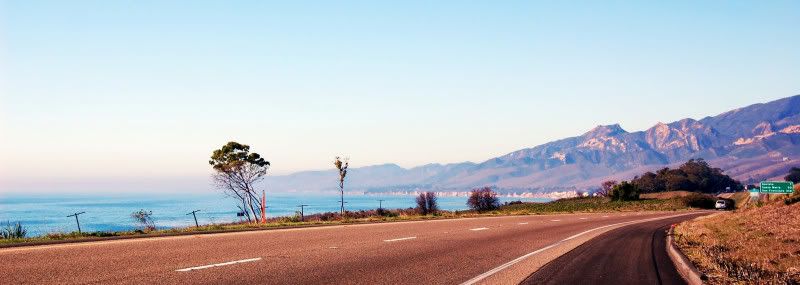
this photo is looking at the Gaviota Pass with the ocean to my back.

I tell people that I have the most beautiful commute in the world. I leave my house and drive south about 9 miles through the foothills of the Santa Ynez mountains and then through the Gaviota Pass. In some areas the mountains are covered with Live Oak trees, others with chaparral, others with golden grasses swaying in the winds, and still others with dramatic rock formations. I catch a few glimpses of some vineyards but most of them are to the north of my commute. I go through the pass and within about 1/4 of a mile I come to the ocean and make a left turn. For about the next 20 miles I drive with the ocean on my right and the mountains on my left. There are almost no buildings. The mountains continue their variety and occasionally are dotted with cattle or llamas grazing. I see the pelicans swooping along the shoreline and birds of prey watching for lunch or just enjoying the thermals. Every now and again, I glance out to the ocean and see a pod of dolphins swimming by. Traffic is generally pretty light. The final 5 miles are in the city of Goleta, traffic picks up and the view of the ocean is obscured. The mountains move a bit away from the coast but are still the dominant feature. It is easy to see why people refer to this area of the country as paradise.


heading west, about 7 miles east of the Gaviota Pass

But we can't forget the fury... The Jesusita fire is our third big fire in a very short time and this one was both dramatic and frightening. The flames have burned nearly 9000 acres as I write and at times the flames stretched over a five mile line along the mountains above the city of Santa Barbara and Goleta. The last I heard, 80 homes were confirmed destroyed. Many of my church members live in the mandatory evacuation zone and the church is located in the warning area. It is possible that one of our members lost a home and we know that some friends did. And then there was a small earthquake in nearby Ojai. At times the ash falls from the sky like snow and the ground looks like an old ash tray. Air quality is terrible down wind from the fire. When the rains come next fall, all of the areas burned will be subject to possible mud slides.


this is an AP photo by Keith Cullom

The beauty comes with a price and sometimes it is a high one.

Just as information, my home is far to the west of the fire. We can see the plume of smoke but haven't even had ash here.

Sunday, April 19, 2009

up in smoke

We had a fire in our newly remodeled education building yesterday. In the morning we had had a wonderful program called "Dad's Day" where fathers of our nursery school children come with them to the school and do a variety of fun activities. It was a great success. The last teacher left at 12:40. At 1:13, neighbors across the street saw flames through a window and dialed 911.

Damage was significant to the building. Tomorrow we'll meet with insurance people and our architect to get an idea just how significant everyone agrees the damage to be. The new church offices which are attached to the ed building received smoke damage. We'll see what needs to be done there. I'm particularly concerned about my books...

The biggest issue will be the impact upon our nursery school. We serve about 60 families with an excellent program and have, IMHO, the best staff any nursery school could hope to have. We're hoping that licensing will allow us to finish the academic year using outdoor space and the sanctuary but that remains to be seen.

here are a few photos of some of the results...

this is a view of the kitchen area where the fire started.


somehow the flames got inside the refrigerator and melted the insides of it...


this table was outside the wall where the fire was hottest. You can see that it melted. Look closely and you will see a melted plastic chair that was sitting on top of the table.


and this one would be cool if it wasn't what it is... another plastic chair outside of the building that melted in this interesting fashion


and a light fixture inside the building...


Please keep the nursery school in your thoughts and prayers. It has been a significant ministry for the church through the years and has touched the lives of thousands of children.

Thursday, April 16, 2009

Tea Parties?

I've been watching them and have a number of observations and puzzlements and fears.

My observations - reading comments of the participants, nobody seems quite clear what they're protesting. There are lots of concerns about taxes going up... but nobody has raised any taxes at this point. There are complaints about the government spending too much but no other suggestions for how to address the current situation other than tax cuts, which of course, got us where we are. And there is anger about helping out those who are poor or in trouble because it is obviously always their fault. And lots of poor logic... tax cuts do not cause investment in business. They cause profit taking. Higher taxes cause investment because by investing in infrastructure, you avoid the taxes.

As for redistribution of wealth... that is clearly a Biblical idea (see Acts 4 & Leviticus 25) and that is precisely was tax systems do - redistribute wealth. They only question is where and how. Sometimes it is direct and active, other times it is less direct but the result is always the same, capital moves. Under the Reagan philosophy which has held sway since 1980, wealth migrated upwards with the expectation that it would trickle down. Well, it did migrate up as wealth has become more concentrated and the gap between the wealthiest folk and the poorest folk in the US approaches that of any developing country, but it didn't trickle down.

puzzlement: Where were these folk when Bush was building record deficits? Many were saying that if you disagreed with Bush policies you were tantamount to a traitor. So why now are they marching? Do they really not understand the implications of doing nothing to help the economy? Do they not see the connection between tax cuts, a system that encouraged greed, and our struggling economy? And what in the world does any of this have to do with the Boston Tea Party? Or Thomas Paine?

It makes me afraid. In large degree the protests seem to be about fear. People are afraid of the future and feel insecure. Those are not unrealistic fears for many folk. The problem is that right wing media and politicians are feeding on that fear and deepening the polarization of our country. They are fanning the fears so that they move from rational concern to irrational terror. They are offering no solutions. They are not talking. They certainly are not listening to any other viewpoints. It is all about building up a political base who are blinded with rage and shaped by fear that is both rational and irrational and using them to gain power. That makes me worry about the future of my country.